15 June 2014

Swuzzlebubble wins at the 2014 RORC IRC Nationals

Peter Morton's revamped Farr Half-Tonner Swuzzlebubble won her debut event in the 2014 RORC IRC Nationals held on 13-15 June 2014. Swuzzlebubble, had scored two bullets on the opening day to lead her class (IRC Four), winning the first race by just seven seconds on corrected time. Morton explained the winning strategy - "There were a lot of bigger yachts from other classes in the race area, so finding clear air and holding a lane was always going to be difficult. In the first race, we actually planned to gybe-set at the top mark but we were forced to bear away and set the kite towards the shore. We got lucky and actually found lifting pressure, so it really worked out for us. Like they say - it's better to be lucky than talented!"

Swuzzlebubble sails upwind in the 2014 RORC IRC Nationals (photo pwpictures.com)
On the second day, Swuzzlebubble retained her lead, posting a first, second and third. Morton and his crew struggled on the final day in fresher breezes, but did enough to round out the winner of IRC Four overall, taking a fifth and third-equal. "This is the first big regatta for the boat since it was re-launched and we have learnt a lot about how to sail her," commented Morton. "We were joined this weekend by Tom Schnackenberg, who has won the America's Cup three times and knows a hell of a lot about these boats. I bought Swuzzlebubble for one euro, I have spent a lot of money on her, but about only half the cost of some of the boats racing this weekend. She definitely goes well in the light but against the displacement boats, we suffered in more breeze". 
Swuzzlebubble (KZ 3494) sails downwind behind IRC Two yacht Zephyr (photo pwpictures.com)
Whooper had a consistent series and won races six and seven to secure second overall. The Quarter Tonner Whiskers finished third.

Swuzzlebubble approaches a finish mark (photo pwpictures.com)
Swuzzlebubble also carries her original sail number KZ-3494 and koru-inspired hull graphics to retain something of a New Zealand presence in the regatta (not to mention Schnackenburg as an honorary Kiwi in her crew). Another ex-New Zealand yacht, the Quarter Tonner Blackfun (NZL-3391) made an appearance on the final two days to finish ninth overall, and included a second in the fifth race in her final tally. 


10 June 2014

Italian Half Ton Classics Cup 2014

Elena Celeste - Italian Half Ton champion 2014
The 6th Italian National Championship Half Ton Classic Cup was held in early June in Anzio, Italy. The fleet enjoyed four days of sailing, with five windward-leeward races in the first two days and the final two days dedicated to the longer Asteria Cup coastal race. Racing on the first day the wind was in a fresh 25 knots and large waves making for spectacular racing, and both races were won by Massimo Morasca's prototype Elena Celeste. Second on the day was a reborn Cicci VII. The 2013 winner, the Farr 31 Loucura, sailed by Fabrizio Gagliardi, ended the day in third.

The 11 boat fleet gets underway at the start of the first race
The breeze dropped for the second day to 10-12 knots, before increasing to 18 knots. The first of the three races was won by Domenico Rega's Purchipetola (who later had an OCS in the third race), while Loucura took out the second and the third race. Elena Celeste had a second and a third place and then slipped to fifth in the third race that was won by Loucura.
After the first two days of the provisional standings saw Loucura leading by just half a point from Elena Celeste, with Puchipetola third with 4.5 points behind. 

Loucura and sistership Pili Pili
The Asteria Cup race counted for 1.5 points and would decide the series. The fleet headed off on a windward beat in the first leg in a light south-easterly to Ponza. Loucura benefitted from a wind-shift to the west and arrived at the passage between Gavi and Zannone with a considerable advantage over rest of the fleet. The next leg saw a strong recovery by Helen Celeste, the all-female crew on Maria Letizia Grella on Eta Beta, and David Castile's Prydwen (a Ziggurat 916) in the passage between Ponza and Palmarola under spinnaker in an increasing breeze, which had turned back to the south-east.

Third placed Purchipetola
Loucura's advantage was reduced during the night while the first three boats were involved in a great battle that saw Prydwen prevail to take the Asteria Cup over Elena Celeste, while Loucura faltered to third. Elena Celeste won the ORC Asteria Challenge Trophy with seven of the Half Tonners finishing in the top ten. Loucura was awarded first place in the Half Ton division and the coveted challenge cup "Peppino Morasca".

Elena Celeste's second place in the final race gave her the series, just one point ahead of Loucura, with Purchipetola third. The female crew of Eta Beta was awarded the Half Ton "Spirit" trophy for their fighting spirit shown in the water, wihile the Trophy ASDEC, for the oldest boat in the top five, was presented to Paul Mirabile of Cicci VII.

Morasca acknowledged the good organisation of the series by the Sailing Club of Rome, and the competitive and well prepared fleet. "The strong winds of the first day we favored in those conditions Elena Celeste is strong, even on a jib and a spinnaker sail of Incarbona-Olympic Sails developed with extreme precision, skill and considering my experience on this boat. On the second day with light winds we still defended well. I'm really pleased, to honour Loucura and the rest of the fleet. The spirit that lives in this class is wonderful, and restore a Half Ton is a wonderful company, the costs are low, and the yield is very high in the race - I hope that other owners devote themselves with passion to these IOR era boats". Morasca also noted the efforts of his crew in the long races with the difficult tactics and frequent sail changes (tactician Roberto Sorge, tailer Orestano Andrea, trimmer Flavia De Luca, mastman Renato Costs, and bowman Pietro Bianchi).

Elena Celeste
Photographs are by Giancarlo Capobianco, and more can be seen at the Halfton Class Italia website here.

9 June 2014

Evergreen and the Canada's Cup 1978

The Canada’s Cup is the ‘other’ match racing event between two nations, commencing as a challenge by the Lincoln Park Yacht Club of Chicago to the Royal Canadian Yacht Club in 1896. Like the America’s Cup, it has employed a variety of boat design types, subject to a deed rule from 1897 that stipulated a waterline length between 25 and 40 feet. It has seen competition in 8-metres (under the International Rule) and then to offshore yachts under the CCA rule, which was replaced by the IOR in the 1970s and 1980s. Under IOR it was raced in Two Tonners (32ft IOR), and later in smaller One Tonners (30.5ft). Following the decline of IOR it was agreed to move to the smaller MORC designs, which brought unprecedented participation to the Canadian challenger’s selection trials. More recently the Canada’s Cup has been contested in the one design Farr 40 class.

This article focuses on the 1978 event, raced in Two Tonners, and which is most remembered for the epic battle between the challenger, Don Green’s radical Cuthbertson & Cassian (C&C) design Evergreen, and the defender, Terry Kohler's Holland design Agape for the US. Green had raced two previous C&C yachts before opting for something more adventurous, and deciding to mount a Canada’s Cup campaign. He commissioned C&C to build a flat-out racing machine, and gave the designers carte blanche to make it happen. The resulting yacht took advantage of every loophole under the IOR, and the stability rule in particular – Evergreen's lightweight carbon fibre and epoxy honeycomb hull weighed approximately 5,500 pounds, and allowed for some 10,000 pounds of ballast to achieve her measured displacement. A centreboard still retained some un-penalised advantages under the IOR, so this ballast was mostly internal, fitted in a ballast plate in the centre of the boat. The 500 pound centreboard was fitted in an angled case, so that it pierced the deck for’ard of the mast. 
Evergreen in the slings, with the tip of her centreboard just showing (photo from Doug Peterson Tribute Page)

Evergreen during the 1978 SORC
Evergreen's structure was augmented by longitudinal bulkheads, which in combination with the centreboard case, made the interior almost unliveable. Her interior was accessed by two flush hatches located close to her rails, and opened inward to aid with sail handling – a dubious proposition from a safety viewpoint. She had an open cockpit, and featured a central control panel for the myriad hydraulic switches to control her fragile, three-spreader five panel mast. The rig and hydraulic systems were designed and built by Tim Stearn, who was also to be the yacht’s helmsman. However, because of Canada’s Cup nationality rules, Green himself took over principal helming duties, with Stearn filling the tactician role.
Evergreen's complex deck layout and side deck hatches
Agape was a development of the highly successful Imp, and also of a high-tech construction, utilising carbon-reinforced fibreglass, with a Bergstrom/Kiwi load carrying aluminium spaceframe as pioneered by Holland with Imp, and the Half Tonner Business Machine. Agape's Bergstrom and Ridder mast featured swept spreaders, something of a departure from the norm for a masthead rig. Unlike Imp, she started life as a centreboarder, but was progressively modified during the summer and became a keeler, and Kohler described the boat that raced against Evergreen as Agape #5
Evergreen and Impetus during the trials series for the 1978 Canada's Cup (photo Facebook)
Evergreen had her racing debut in the 1978 SORC, the major US proving ground for offshore racers of the day. She faced an early protest by yachting writer Ted Jones, as her unusual dual hatch arrangement was considered to contravene IOR safety regulations. The protest was disallowed but, despite having both Tim Stearn and Lowell North on board, she had only an average series, finishing 5th in Class C with placings of 6/10/4/9/6/12, and was soundly beaten by the Peterson design Love Machine (1/3/1/4/3/2) and the Holland design Marionette (DNF/1/2/1/1/1). Agape fared far worse, finishing a woeful 22nd after breaking her mast in the first race and missing the next two. She then finished last in class in the Lipton Cup due to poor navigation. 
Evergreen powers upwind (photo Sharon Green | Facebook)
Some changes were made to Evergreen before the Canada’s Cup trials, with her full-ish bow sections being replaced by a longer and finer entry and her stern sections were narrowed. She was given a new centreboard, and her rig was increased in height by two feet, raising her rating from 31.5ft in the SORC to the Two Ton limit of 32.0ft for the Canada’s Cup. Notwithstanding that her existing hatch arrangement was already of questionable safety, she she was given two additional inward opening hatches in the bow to facilitate more efficient genoa and spinnaker handling. This gave the overall deck layout something of a ‘swiss cheese’ appearance. 
Agape chases Evergreen downwind during the 1978 Canada's Cup
The changes yielded some improvement, however, and Evergreen, representing the Royal Hamilton Yacht Club, saw off other would-be challengers Mia VI, a Kaufman-designed centreboarder, and an older Frers design Impetus to earn the right to challenge the US for the Cup, not held by Canada since losing it in the 1972 series. Agape had a tough fight for selection as the defender against another Kaufman-designed centreboarder Black Majic, and the two-year old Peterson design Sassy Lee.
Above and below, Evergreen goes into an uncontrolled gybe (photo Sharon Green | Facebook)


The two yachts would go on to engage in the stormiest, most bitterly contested match to date. There were more protests lodged in the 1978 series (seven) than in the entire history of the Canada’s Cup.  
Evergreen and Agape in close battle during the 1978 Canada's Cup (photo Sharon Green | Facebook)
Spinnakers and shooters flying, Evergreen pursues Agape
The first protest was made before racing even began, by the race committee and again over the legality of Evergreen’s deck hatch arrangement. This was again disallowed, and Evergreen went on to win both starts of the first two races, and increased her lead in each by small amounts at every mark of the 17-mile triangle courses on Lake St Claire. The third race, a 75-mile middle distance event, started in winds approaching 30 knots, and saw Agape over the line first and into the lead. An hour later, as the wind increased to 40 knots, both boats were still on the same tack when Evergreen ran out of water, breaking the 500 pound ballasted tip of her centreboard and damaging the rudder. Agape tacked immediately and took off on the long starboard reach to the mark. Evergreen held on for the next two legs before withdrawing, signalling a protest against the race committee regarding the placement of the weather mark and wind strength at the start of the race. The protest was not heard because it was filed outside the time limit. 
Evergreen leads Agape downwind
Evergreen leads Agape downwind with bloopers flying (photo Sharon Green | Facebook)
If the concept of a 75-mile match race seems odd today, then the next race was unbelievable - being a course of some 250-mile distance race on Lake Huron. This race started after a break of two days for repairs. Evergreen was the early leader as the boats ran up the lake in a moderate breeze. She had a substantial lead by the time they reached the first mark, some 40 miles away. However, the mark boat was out of position by five or six miles, and when it finally appeared out of the patchy fog and rain, it was Agape who had a better angle to the mark, and she rounded ahead. A midnight-to-dawn spinnaker duel later ensued, with poles on the headstays and both boats wiping out repeatedly, but Evergreen emerged the leader, sneaking around the third mark, off Port Huron, just 13 seconds ahead. However, her efforts were all to no avail after a chainplate on Evergreen broke several hours later in an increasing breeze and her mast went overboard. Evergreen's protest that the out-of-position mark had prejudiced her first position was disallowed, but she was granted another two days for repairs. 
Evergreen sporting her repaired mast (photo Sharon Green | Facebook)
By this stage, Agape led the series 3-2 as a result of Evergreen’s faults and defaults, and she needed just one win to retain the Cup for the US (the record is not clear but the history suggests that the long distance race may have counted for two points).
Evergreen sails over the top of Agape on a reaching leg during the 1978 Canada's Cup
With her new mast, Evergreen crossed the startline of the next race early, and it was Agape’s race until Evergreen rolled her on the second spinnaker reach and went on to win by 57 seconds. Protest flags were flying from both boats as they finished, and the resulting four protests meant that the jury had a marathon overnight sitting before dismissing all of them. The final race, on the 12th day of the series, was a repeat of the fifth race, with Agape winning the start, staying ahead on the beat and first reach, only to see Evergreen power over her on the second reach. Another protest, this time by Agape, was disallowed, but meant the victory celebrations for the Royal Hamilton Yacht Club – long awaited at the time – could not start until midnight. The story of Evergreen’s victory is covered in more detail in a book by Doug Hunter – "Against the Odds". 
From the cover of 'Against the Odds', the story of Evergreen's challenge for the 1978 Canada's Cup

The Evergreen crew celebrate victory as they cross the finish line in the last race of the 1978 Canada's Cup (photo Sharon Green | Facebook)
The next day, Stearn was asked how fast Evergreen really was. “I wish I could take her to the Two Ton Worlds in Rio”, he answered without hesitation. “She’s the fastest Two-Tonner in the world”. Canadian Admiral’s Cup team organisers thought so too, and Green and his Evergreen crew were invited to represent Canada in the 1979 Admiral’s Cup series in Cowes (by which time her centreboard had been changed to a keel). She joined another C&C design, Magistri, and Pachina, but Evergreen had a mediocre series, with placings of 37/46/36/53 in the four races before the Fastnet Race finale. 


Evergreen and her fellow competitors then found themselves in the middle of the deadliest ocean race in history, the 1979 Fastnet, where they were struck by an unpredicted and very fierce storm. In the end, 15 lives and 30 boats were lost, and it is remarkable that Evergreen survived relatively intact given her reputation for gear failures and her controversial deck hatch arrangement. Evergreen retired from the race safely, and Green later credited his crew’s preparedness for their fortunate survival, and he recounted that “it was a terrifying experience where every wave brought with it the fear that it was the one that would be your last”. 

The Hamilton Spectator newspaper revisited this event in its review of a book based on this event - "Beyond Endurance", written by Adam Mayers. In that article Green comments "(Evergreen) never should have gone to England". Green said he didn't want to do the Fastnet because he was worried about the boat's ability to withstand a North Atlantic storm. When he made the decision to withdraw, "it was a tough decision. I felt we would likely be embarrassed when we pulled into the dock".

Green had decided to call it quits just as the seas were growing ugly and confused. He threw the stern to the wind and made for the coast of England. The pitch black fury of the North Atlantic storm with Force 10 to 12 winds was upon them. "(The race) was the most traumatic experience of my life... It was earth-shaking. Every 60 seconds you'd get hit by those seas and you'd just wonder how much you can take".
 

The Evergreen crew for the 1979 Admiral's Cup - from left: Hans Fogh, Alan Jeyes, Jim Talmage, Brian Downey, Al Megarry, John Fitzpatrick, Steve Killing, Don Green, Rob Ball
Somehow, in the black sky, Evergreen spotted a flare shot off by stricken yacht Magic, which had lost its rudder. Green and his crew immediately went to attempt a rescue. The blackness of the night, the howling of the wind and the massive seas made the rescue impossible. "I felt really upset about it", said Green. "I thought they weren't going to make it. It felt very helpless. It was like no one knew what was happening". However, Evergreen's crew managed to tell Magic they would relay a mayday to another yacht, the maxi-yacht Condor of Bermuda, to the British Navy, and Magic eventually made it to safety.  

The Canadian team finished the Admiral's Cup in 18th place of 19 teams, and Evergreen finished a lowly 55th in the individual standings (in the 57 boat fleet).

Green passed away in 2019 and a tribute to him by the Royal Hamilton Yacht Club can be seen here


Article dated June 2014

31 May 2014

Howzat - nearing completion

Howzat, a Paul Whiting-designed Half Tonner from 1976, is nearing the end of a major restoration by her original owner. She recently emerged from her temporary shed at The Landings in Okahu Bay, Auckland, sporting a gleaming hull finish that reinstates her original red topsides and white stripes. 

Above and below - Howzat is picked up ready to be attached to her new keel (photos by Giles Grigg)

The original long sloping transom has been straightened up a little, providing more cockpit space, and a new bulb keel and deeper rudder have been fitted. A new rig is also expected to be fitted soon, and will be taller than her original.

Keel and rudder fitted - the transom has been straightened but the original IOR lines of this Whiting classic still remain evident, including the knuckle bow and pronounced 'chines' around the for'ard depth measurement points (photo RB Sailing)
The history of Howzat can be seen here.

23 May 2014

Half Ton Classics Cup 2014 - Press Release

The entry list is expanding rapidly for the Half Ton Classics Cup which will be held at Saint Quay Portreiux in Northern Brittany from 7 to 11 July 2014. More than 30 teams are expected to attend, and this 7th edition of the regatta is anticipating a bumper turnout including many of the best known boats and sailors in the class. 

Launched in 2003, the Half Ton Classics Cup led the way for the revival of the IOR Classes and its philosophy has helped to ensure that most boats remain as close to their original designs as possible. This gathering of veteran race boats and veteran sailors brings together a fascinating mix of people and vessels, and whilst the racing is always fiercely competitive the ultimate prize in the competition remains the "Half Ton True Spirit Trophy" which is awarded to the boat and team who best represent the ideals and camaraderie of the class.
Action from the 2011 Half Ton Classics Cup

This year the HTCC regatta will be a true European championship for the small IRC rated boats, with all the top French and UK half tonners on the starting line. Insiders confirm that at least a dozen of them are potential event winners. The event's top boat, France's Brittany Drizzle, is a good example of the modern half tonner: in the same ownership since the early 1980s, and constantly maintained and improved by her meticulous owner, who is not afraid of sharing his knowledge with fellow competitors. With her unrivalled series of class wins, Brittany Drizzle is the record boat at Spi Ouest France regatta, the annual Easter sailing event in Southern Brittany's La-Trinité sur-Mer. More, with Concorde, Superhero and Half Red, the last three half tonners ever built, will be present in St-Quay. Surprising detail: Bernard Fournier Le Ray, owner of Brittany Drizzle, built two of them.

Close racing in the 2013 event
With two weeks to go until the initial entry closing date of 31st May 2014, the Entry List already includes some 25 boats with additional entries being added regularly. Among the well known names competing this year are past HTCC winners General Tapioca, Chimp and Checkmate XV. There will also be several new faces at the event including Peter Morton, better known to many as the man behind the Quarter Ton Cup revival, who will be racing his IRC optimised Half Tonner Swuzzlebubble.

The 2013 champion, Checkmate XV
Alongside the excellent turnout for this event the Half Ton Class Europe is delighted to confirm two new class sponsors for the regatta, Euro Car Parks and Whitfield & Brown. Mr David Cullen, CEO of Euro Car Parks, comments as follows: "We are delighted to be able to support such a fantastic class which, like our own business, has a true spirit of camaraderie and friendship in this growing and vibrant fleet. We wish all competitors a fantastic season and look forward to seeing everyone in Saint Quay Portrieux in July, which promises to be the biggest fleet yet. We would also like to express our thanks to Bert Janssen and Philippe Pilate who behind the scenes put in huge efforts to make the class the success it is!"

Also confirmed as a sponsor for the Half Ton Classics Cup is Whitfield & Brown, a reputable forward thinking construction and development company established in 1972, which provides a reliable professional service to clients in both the public and private sectors.

Some of the fleet during the 2013 Half Ton Classics Cup
The regatta will be hosted by the Sport Nautique de Saint Quay Portrieux in collaboration with the Bruxelles Royal Yacht Club and the Half Ton Class Europe. Registration will open on Sunday 6 July, there will be practice racing on Monday 7 July and Championship racing will take place from Tuesday 8 to Friday 11 July.  The regatta will also feature a fun apres sailing programme to keep the competitors entertained from dawn to dusk and beyond.

Further information, the Notice of Race and Entry Form can all be found at the Half Ton Classics Class website. Members of the press wishing to accredit to attend the event or requiring additional information should contact Half Ton Classics Cup Press Officer Fiona Brown on fiona.brown@fionabrown.com, Tel +44 7711 718470 or Skype fpbrown.

- Ends -

22 May 2014

Terrorist - sailing again

Forty years on from her debut in the 1974 One Ton Cup, the radical Bruce King-designed twin centreboard One Tonner Terrorist is sailing again. Salvaged from a boatyard several years ago, Terrorist has been expertly rebuilt and refurbished by her new owner US yachtsman Paul Tullos. Her history and rebuild is documented in an earlier post here.  

When re-launched in 2013 she was fitted with twin rudders, and while these worked well when sailing, they proved to be of limited assistance when manouevring within the marina. Tullos has since reverted back to a single rudder. Although still reliant on internal ballast, Terrorist carries plenty of beam and Tullos reports that the boat loves sailing to windward in a good breeze, and this is leading to some good results in local racing. Tullos comments that it is hard to overpower the boat - "the boat's old mast was 2 feet longer than on the drawings - I now see why". The new carbon spars and stiff new sails are also helping with her upwind performance. 

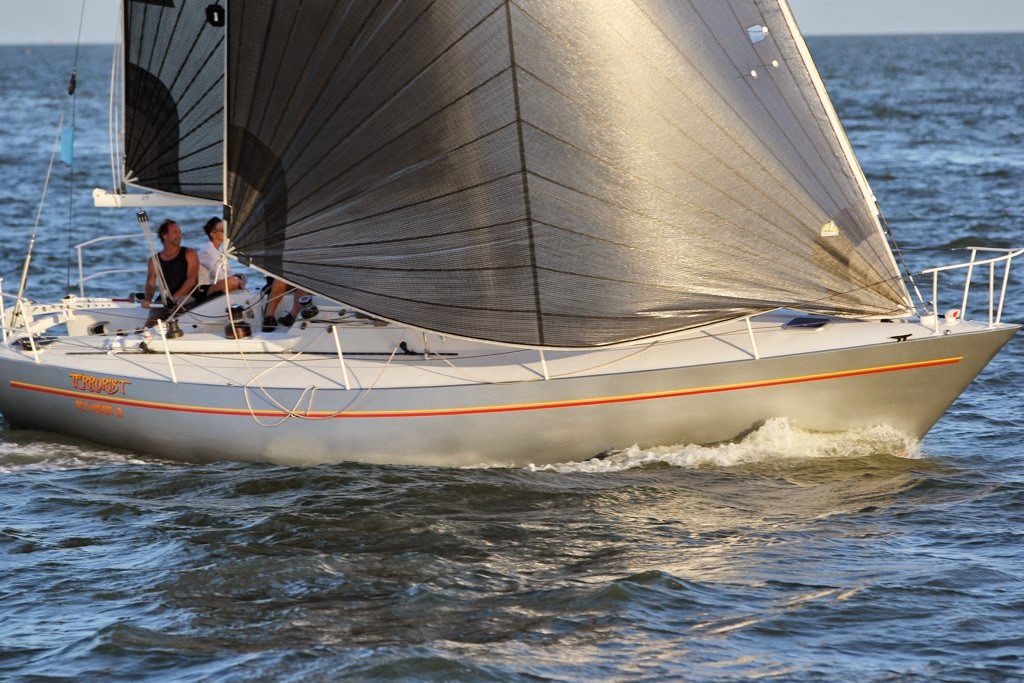
Terrorist sailing again recently (and still sporting her original sail number - US 7150)


20 May 2014

Rainbow II

Top New Zealand yachtsman, Chris Bouzaid, updates on the restoration of Rainbow II, currently underway at Silverdale, north of Auckland. Rainbow II was the iconic yacht of New Zealand sailing in the 1960's, leading the way for the many successful international campaigns that followed. She started the model of using international race competition to spearhead the products and expertise of the NZ marine industry.  Bouzaid writes:

"The restoration of Rainbow II is progressing well at Wayne Olsen’s Horizon Boats Ltd in Silverdale, just north of Auckland, but our fundraising is lagging. If you feel like helping to put Rainbow II back in the water in full racing trim, no contribution is too big, or too small, and your donation will be fully tax-deductable.


Chris Bouzaid with Rainbow II
The idea to resurrect Rainbow II was born in 2009. I was passing through Bermuda and took the time to visit the yacht that I sold to local sailor Charlie Berry immediately after she’d won the One Ton Cup in 1969 and done so well in England in the Channel Race and the Fastnet Classic. 

I found the old girl in bad shape and not all that far from the scrap heap. With a couple of friends, I took her for a sail and was amazed how well she still slid along, especially in the light air. Unfortunately, the breeze increased during the day, and so did the volume of water coming in through the garboard planks. We were pretty lucky to get back to the mooring without drowning the engine.

I made the decision there and then that this was not a fitting end for a yacht that had inspired so much and so many. She had to be brought home to Auckland. A few quick phone calls to friends in New Zealand and Monaco produced some very generous offers of both financial and physical help. So, I bought back Rainbow II from Jeremy Brasier and pretty soon, with the help of the Maersk Line, she was on her way home to the Waitemata Harbour. 


Rainbow II arrives in Auckland (above and below)
The original concept was to put Rainbow II back into presentable shape and donate her for public display in the Voyager National Maritime Museum. That idea was modified in June last year when it emerged that there was a lot of interest in Rainbow II having another romp around the harbour with as many of the original crew as could still come sailing, before she was retired to a museum. So, what was going to be a quick lick became a tad more complicated.
 

Last October this all changed again. Over a few beers at the Royal New Zealand Yacht Squadron, it was suggested by Alan Sefton that we should see if there is any interest in having a rerun of the old One Ton Cup's in Auckland around the time of the 2014/15 Volvo Ocean Race stopover in 2015.

An announcement was made seeking 'Expressions of Interest'. The international response – 28 from 9 different countries – was good enough for the Squadron to commit to formal planning, and a Notice of Race for a 'One Ton Revisited' regatta was published and disseminated the in March this year. Rainbow II’s 'quick lick' now became a full restoration to enable her to go racing again.

The goal is to raise enough money to complete the restoration and have a small endowment to cover on-going maintenance when Rainbow II goes on permanent public display, possibly as part of the marine heritage centre that is proposed for the iconic Percy Vos Boatshed in Auckland’s Wynyard Quarter.

Whangarei to Noumea race, 1967 (George Layton)
The target is to have all work completed by the end of August 2014, with Rainbow II re-launched at the Squadron’s Westhaven clubrooms in mid-September 2014.

The works team on the job are Wayne Olsen himself and the amazingly resourceful Mike Smith. The invaluable volunteer helpers include Max Carter, the man who built Rainbow II back in 1966, John 'Bulldog' Street, Tony 'Womble' Barclay, and Roy 'Rocket' Dickson. 


A growing list of equipment is being donated, to ensure that Rainbow II lacks for nothing when she goes to the race start line again in the One Ton Revisited regatta next year. I will include a full list of these suppliers in my next update, along with a similar list of all donors that allow us to publicly acknowledge their generosity.

Remember, all donations will be tax deductible and will only be applied to the restoration and maintenance of Rainbow II, and can be made to:

In the US:  The Presumpscot Foundation,
100 Middle Road, Cumberland, ME 04021, USA;
In NZ: The Classic Yacht Charitable Trust, PO Box 1951, Shortland Street, Auckland 1141. 

When we set out to build Rainbow II in 1966, for weight purposes we opted for a single skin of kauri with glued splines between the planks (instead of caulking). It is amazing how well she has stood the test of time, considering that the S&S 36-footer was raced very hard in the first three years of her life (she won the Whangarei-Noumea race in April 1967, the Sydney-Hobart classic in December 1967, finished second (1968) and then first (1969) in the One Ton Cup in Heligoland, and then, in August 1969, won the 245-mile Channel Race and finished first in her class in the 605-mile Fastnet Classic.

Once Horizon Boats had water blasted Rainbow’s exterior, they found a very small amount of rot in the marine ply deck but none at all in the hull – testimony to the qualities of the wonderful Kauri and to the boatbuilding skills of Max Carter.

The exterior of the hull has since been fibreglassed and will now be prepped, undercoated and brought up to finish-coat standard. All deck hardware has been removed, for refurbishment or if needs be, replacement, while the deck and cockpit are fibreglassed and repainted with anti-skid. The cabin top and teak toe rail are being reinstated and the coamings scraped right back and re-varnished. The interior, meanwhile, has been sand-blasted prior to prep and repaint. New floors are in, as is a new mast step. The original bunks will be restored while galley and navigatorium have been refurbished.

John Street, Wayne Olsen and Chris Bouzaid
Still to come is a new engine box (the engine itself has been fully reconditioned and repainted) and new toilet. All wiring will be renewed, as will the two batteries and engine start panel. There will also be new deck and navigation lights and a new performance electronics package.

When all the work is done, Rainbow II will be as close to original as we can make her with boatbuilder Olsen confident that she will stronger than she’s ever been.

It’s now approaching 50 years since Rainbow II’s ocean race win in the 1969 One Ton Cup shared equal front page billing in the Auckland Star evening newspaper with Neil Armstrong landing on the moon ('One Small Step For Man' on the left and 'Rainbow Wins Battle Of Jutland' on the right) so it is easy to forget the impact she made on the New Zealand public.

Heck – she even had her picture on the lid of the Arnotts Biscuits tin - a distinction usually reserved for racehorses in those days. 


I take a lot of pride in the fact that people in a position to judge these things claim that Rainbow II’s feats in the late 1960s, backing up Jim Davern’s 1966 line honours win, in Fidelis, in the Sydney-Hobart, are credited with launching the New Zealand invasion of ocean racing which, in the next 40 years, resulted in Kiwi designed boats and crews winning every major event in world offshore racing, most of them more than once. 


Rainbow II in action soon after the start of the fourth race during the 1969 One Ton Cup
That includes the Whitbread Round the World race, the Trophee Jules Verne and the America’s Cup, all three Ton Cups (Quarter, Half and One), plus the Admiral’s Cup, Southern Cross Cup and Kenwood (nee Clipper) Cups. That domination of the sport extended to yacht design, boatbuilding, and the design and construction of rigs and sails.

Quite astonishing when you consider: New Zealand’s population was only 2.8 million when Rainbow II won the One Ton Cup in 1969; 2.89 million when Pathfinder, Runaway and Wai-Aniwa finished first, second and third in the Sydney-Hobart classic to clinch the 1971 Southern Cross Cup; just 3.3 million when, in 1987, Propaganda, Kiwi and Goldcorp won the 1987 Admiral’s Cup; 3.36 million when Steinlager 2 won all six legs of the Whitbread Round the World race (on line and on handicap); and just 3.6 million when, in 1995, 'Black Magic' (NZL 32) won the America’s Cup.

Now – is that punching ‘way above your weight??

The Squadron and its members have been integral to most of that phenomenal success (and one should never forget either the important part played by the Royal Akarana Yacht Club).

Rainbow II’s 1968 challenge for the One Ton Cup in Heligoland was a first for the Squadron that, for the most part, in those days was content to organise racing for its magnificent fleet of harbour and gulf racers. The challenge in Germany was championed by Commodore Bruce Marler and senior club member Arnold Baldwin. What visionaries they proved to be. 


Rainbow II crosses the line of the fifth and final race to win the One Ton Cup, 1969
We managed to raise, mostly from club members, almost £20,000 – an awful lot of money in those days. From the acorn of those small beginnings, a very large oak tree sprouted, and - look where look where it has led the Squadron. There is no yacht club in the world that has as much recognition for its successful campaigns, and no other yacht club has won as many international regattas.

I want to thank all of you who have helped us get this far. It has been a journey with lots of memories and old friends coming out of the woodwork in all parts of the world. And, it would appear that the old Rainbow magic is still a factor. Even though we have kept fairly quiet about the Rainbow II restoration, a steady flow of interested parties find their way to Horizon Boats to check on progress - no easy task because the yard is well tucked away in a district north of Auckland that is only now beginning to make its way on to the GPS maps.


The original crew of Rainbow II
The modern era of the One Ton Cup started with yachts designed to the RORC Rule (1964 to 1969 - the Rainbow II era). Then the newly formulated International Offshore Rule (IOR) was introduced and, from 1970 to 1980, all competitors were designed and built to that rule. (the Wai-Aniwa era). During those two periods, the average Joe could afford to build, own and campaign a One Tonner. Then costs began to spiral and today you would not get much for the money you managed to scrape together for a whole campaign in days gone by, and this has had a serious impact on international competition. Maybe the old days weren’t so bad and maybe that’s why the idea for a One Ton Revisited regatta next year is proving so popular.

To all overseas yachties reading this – come join us for One Ton Revisited 2015 and enjoy the racing and hospitality of a country in which offshore racing looms so large in the national psyche.

Good and happy sailing,

Chris

GO RAINBOW GO"

Update - Rainbow II was re-launched on 2 February 2015