Showing posts with label Business Machine. Show all posts

15 December 2014

Kiwi 24 (Holland Quarter Tonner)

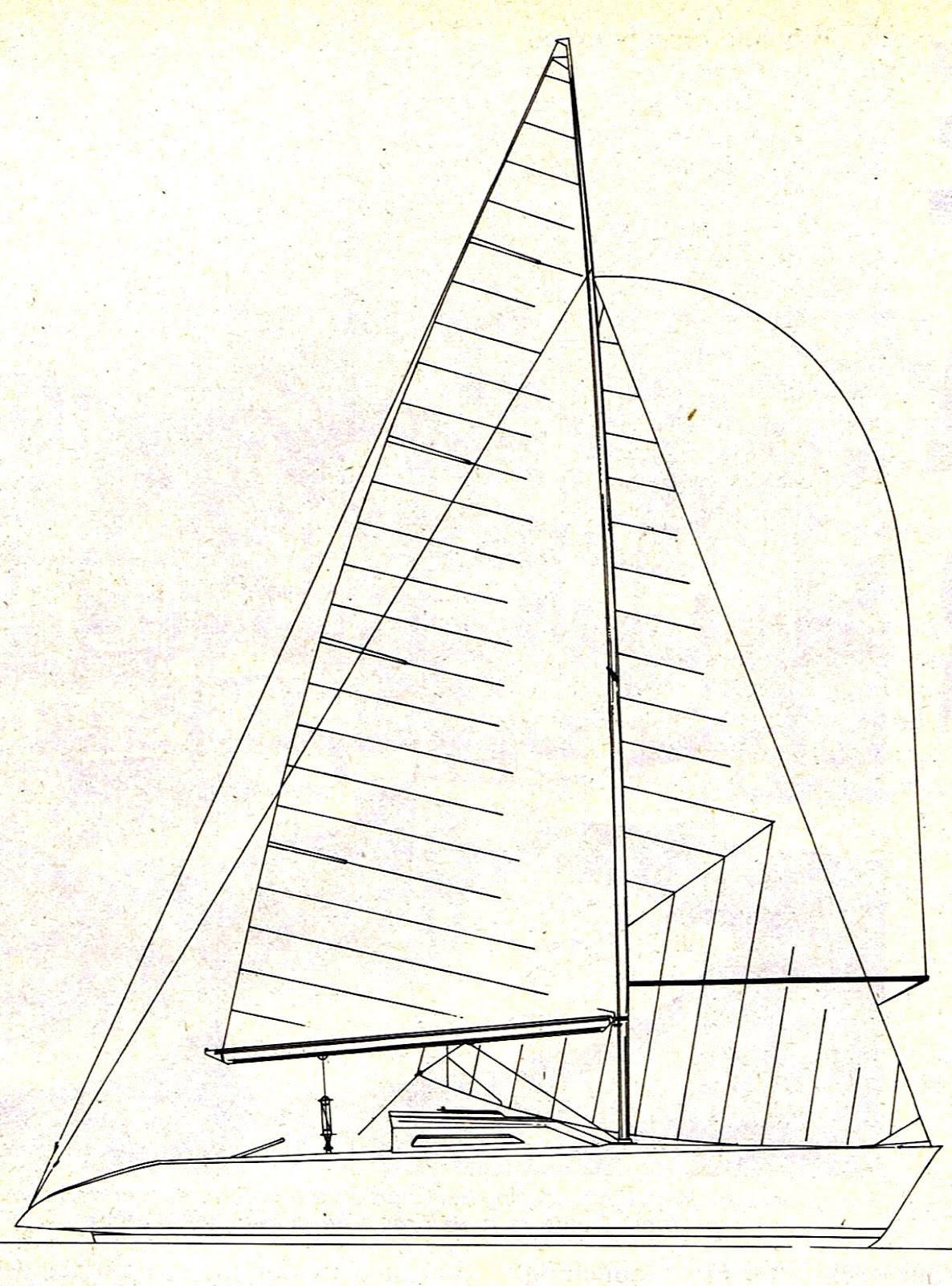
The following photographs are of the Holland designed "Kiwi 24" Fat Cat. The Kiwi 24 was a stock Quarter Ton design. This sequence of photos were taken by Tad Belknap during a local race on Lake Ray Hubbard (Dallas, Texas) while he and Gary Carlin were evaluating a stern extension on a near sistership Business Machine. Belknap and Carlin had started Kiwi Boats, and had developed the use of space-frame construction, firstly in Business Machine and later on the famous Holland 40 Imp.

Fat Cat begins a roll to windward (photo courtesy Tad Belknap)
Above and below, Fat Cat rolls further to windward and crash gybes (photos courtesy Tad Belknap)


The stern extension to Business Machine was judged to be a success (photo at right on the same day), and she went on to finish second in the 1976 Quarter Ton Cup, held in Corpus Christi (won by the Whiting design Magic Bus). The photos below show Business Machine under construction (and the fitting of the internal space frame), the new stern extension and while sailing in the 1976 Quarter Ton Cup.

Business Machine under construction (photo courtesy Tad Belknap)


27 September 2013

Imp (Holland 40)

The US yacht Imp was one of the most famous Admiral's Cup racing yachts of the late 1970s. Commissioned by David Allen, a San Francisco property developer, the boat was something of a breakthrough for her designer, Ron Holland. She was built by Kiwi Boats, a company headed by Gary Carlin, Holland's then brother-in-law, and based in Plant City, Florida. 
The framing of the mould for Imp (photo courtesy Tad Belknap)
The space frame prior to being added into the completed hull of Imp, at Kiwi Boats, Florida (photo courtesy Tad Belknap)
Imp as she was about to leave the Kiwi Boats yard (photo courtesy Tad Belknap)
Holland and Carlin had been involved in Allen's previous and bigger offshore yacht, Improbable, designed by Gary Mull. Improbable was a good boat, but too light, long and narrow to be a true all rounder under the IOR, and Imp incorporated some lessons learnt from experiences with Improbable. 
Imp being mated with her keel (photo Tad Belknap/Facebook)
Imp being launched at Snead Island Boat Works in Florida (photo courtesy Tad Belknap)
The concept of the design for Imp was not to worry greatly over the yacht's eventual IOR rating but to concentrate on a high-speed hull form with greater than usual stability and powerful stern sections, as a move away from the then-popular 'pintails' symmetrical hull forms which Holland and Doug Peterson had been producing at that time, to give the boat good performance when reaching in fresh winds. 
The lines of Imp
Notwithstanding the emphasis on a fast hull-shape, Imp still managed to measure in with a modest and competitive IOR rating of 30.9ft, and the performance of the boat was such that she could race alongside Two Tonners (32.0ft IOR), while rating more than a foot less.

One of the main features of Imp was her construction, which utilised a tubular aluminium geodesic structure that took all the loads and stresses of the keel and rig, with the hull itself being a lightweight layup of glass fibre with a balsa core and some carbon fibre reinforcement. This approach dispensed with the usual requirement for bulkheads and allowed plenty of space for sail stowage, pipe cots, the galley and the chart table, although in some ways it was an impractical set-up for anything other than an all-out racing boat. The space-frame was based on concepts tried on Holland and Carlin's earlier Quarter Tonner, Business Machine, which had finished second in the 1976 Quarter Ton Cup (behind New Zealand's Magic Bus). Imp carried a Stearn twin spreader masthead rig, adjusted with four hydraulic pumps (forestay, babystay, vang and backstay), and flew North sails, some of which incorporated experimental concepts, such as a tight leeched 'frisbee' shape for her mainsail. 
Imp demonstrating her downwind form during the 1977 Nassau Cup race with spinnaker and two staysails set (photo Eric Schweikardt)
Imp was launched just before the start of the 1977 SORC series - the optimisation of Imp for reaching and running meant that it was not a surprise to her designer to see her leading her class out of Tampa Bay at the start of the regatta. What was a surprise was seeing her still leading the fleet at the end of the race at the end of a 50-mile beat. The apparent compromises made to windward speed were not noticeable and so Imp went on to win five of the six races of the SORC, and the series overall, which ensured her selection for the US team for the 1977 Admiral's Cup, joining the larger Bay Bea and Scaramouche.
Imp during the 1977 Admiral's Cup
In Cowes Imp put on a dominant display, finishing third in the Channel Race (behind team-mate Scaramouche and Italy's Moby Dick), and going on to record a decisive win in the third inshore race - Imp was one of the smallest boats in the 57 boat fleet, but only three others crossed the finish line ahead of her that day, and the smallest of those rated a massive 4.6ft higher. Imp made another impressive showing in the final race, the Fastnet classic, keeping up with bigger yachts and even managing to finish ahead of Scaramouche, 6ft longer, to take a memorable victory from the English yacht Moonshine by six minutes, to complete the series as top scoring yacht overall (with results of 4/3/10/1/1). The US team finished second behind Britain.
Imp charges along on a broad reach (photo Tad Belknap/Facebook)
Imp powers upwind during the 1979 Admiral's Cup (photo courtesy Jonathan Eastland archives)
Imp went on to win the Big Boat Series in San Francisco later in 1977 and two years later she again qualified for the US team for the 1979 Admiral's Cup. Although she did not quite repeat her earlier standout performance from 1977 she still managed to finish as third placed yacht overall, including fifth in the storm-tossed Fastnet (series results of 11/13/3/17/5). 
Imp seen here just astern of the larger German yacht Duva during the 1977 Admiral's Cup (photo Facebook)

Imp rounding a weather mark (date unknown)
Imp at the end of the 1987 Fastnet race (photo Shockwave40 blogspot)
Imp is now owned by an Irish enthusiast, and is located in Kinsale. She participated in the 1987 Fastnet race. As of October 2021 she was undergoing a restoration, as seen in the photographs below (via Facebook), including a view of her internal spaceframe.


July 2022 update - the restoration of Imp has been completed, and she has been relaunched and is now sailing again (photos from Facebook):


Imp has also just competed in the 2023 Fastnet Race (finishing in 25th place in IRC 3 and 98th in IRC overall).
Imp seen here soon after the start of the 2023 Fastnet Race (photo John Green | Facebook)
A view of Imp out of the water, showing her redesigned keel and rudder (June 2025, Facebook)

The earlier history of Imp has also been immortalised in the Bill Barton's book The Legend of Imp (2010), above, which is available here, and a promotional image and film can be seen below. Ron Holland's new book All the Oceans also includes some of Ron's own recollections of this famous boat.


Article updated June 2025

6 October 2012

Fun (Davidson Quarter Tonner)

Laurie Davidson had made his mark in the early 1970s with his heavy displacement Half Tonners Blitzkreig and Tramp. However, after they had been beaten by Farr's Titus Canby, Davidson, as with Paul Whiting, began looking more closely at the light displacement concept, the validity of which had been further underscored by the success of the 727 design in the 1974 Quarter Ton Cup. He felt that the 727 and Titus Canby were too long in terms of rated length and disproportionately short on sail area. 

Davidson also sought to take advantage of the loophole in the IOR that had been exposed by the Britton Chance designed centreboarder Resolute Salmon in the 1976 One Ton Cup. With stability able to be achieved with internal ballast, the boat would gain a huge advantage over conventional fixed-keel Quarter Tonners, and so a centreboard was a designed as a central component of the yacht (the centreboard was just heavy enough to sink). The centreboard also allowed the yacht to be trailerable, so long as the beam was confined to the NZ trailering limit of 2.49m. A lifting rudder and skeg was contained in a cassette slot in the cockpit.
Fun soon after her launching in mid-1976
The boat was a beautifully proportioned design, with a graceful long sloping transom and a gentle slope to her stem, and featuring what would become the Davidson trademark curved forefoot. Two boats built in the US, but modified to meet more restrictive beam requirements and moded for lighter airs. The success of these boats convinced Davidson to proceed with his own version to challenge for the 1976 Quarter Ton Cup, named Fun.
Fun finishing second in the first race of the 1976 QTC

Fun wasn't launched in time for the 1976 NZ Quarter Ton nationals, but in the brief period before being shipped to Corpus Christi (Texas) she showed her competitiveness against the Whiting Magic Bus. Fun finished 5th overall in the Quarter Ton Cup, where a lack of time for tuning and crew training proved costly and meant that Fun was not able to reach her full potential, and a disqualification in the second race did not help her cause. Observers considered that Fun was the fastest yacht overall, however, especially on broad reaching legs.


Fun sails to weather of the Holland design Business Machine (photo Gary Baigent Collection)
Business Machine
Fun's campaign to the US proved to be another one way trip for a New Zealand yacht, with return shipping costs being too high for a campaign that had been run on a strict budget. Fun was sold to North American Clay Bernard, who went on to win the North American Quarter Ton championship in 1977.
Featuring new 1970s graphics (above and below), Fun went on to win the 1977 North American Quarter Ton championships with a come from behind win over the Peterson design Blitz

Fun later sailed in the 1977 Quarter Ton Cup held in Helsinki where she finished a creditable 5th in a fleet of 53 boats, with results of 1/13/9/13/1. She started and finished well, and was a pre-series favourite, but fell away in the middle part of the series. She finished 2nd in the North American Quarter Ton series, but in a reduced fleet of just nine yachts.
Fun undergoes a stability test in Helsinki (Quarter Ton Cup 1977)
Fun, circa 1997
The yacht has since been restored and sails today in San Francisco - she now has a new retractable keel, and a transom mounted rudder, and a new custom design has provided the correct balance for the yacht.
 Fun as she is today in San Francisco, US (photo courtesy of Craig aka CRM)

3 October 2012

Magic Bus (Whiting Quarter Tonner)

Today's featured yacht is Magic Bus, a Quarter Tonner by the late Paul Whiting. Having seen the success of the light displacement approach by Bruce Farr with his breakthrough Quarter Ton design the 727, an optimised version of which won the Quarter Ton Cup in 1975 (45 South), Murray Ross approached Paul Whiting for a boat that took a more aggressive approach to the IOR, taking advantage of the light displacement concept but pushing her light air performance through a more optimised hull form to provide greater sail area. 

Paul Whiting delivered a very fast Quarter Tonner, that was slightly longer than the 727, with a much more pronounced maximum beam, hollow waterline for'ard and a long flat transom. Murray Ross applied his dinghy sailing prowess to the design of the rig and sails, incorporating many small boat tricks into the overall set up. These included headsails flown from their own wire luffs and spinnaker launching tubes which allowed sail changes to be largely managed from the cockpit.  


Magic Bus was launched in early 1976 in time to contest the Balokovic Cup, and easily won her division and would have won the overall fleet title had one been declared. She went on to contest the 1976 South Pacific Quarter Ton Cup, hosted by Panmure Yachting and Boating Club. The new boat put in a commanding performance, winning all but one race and against a large number of 727s and other top boats of the day. Her single loss was in a race that exposed her small Archilles heel - tight reaching. This was a result of excessive bow down trim which was rectified before she went on a one way trip to compete in the 1976 Quarter Ton Cup in Corpus Christi, Texas.  


Magic Bus during the 1976 South Pacific Quarter Ton Cup

Magic Bus and Potent Star
Magic Bus on her way to winning the 1976 Quarter Ton Cup
Magic Bus held out the Holland design Business Machine in the final ocean race by just over a minute to secure the narrowest of victories (with Business Machine finishing second overall), and thus defended the Quarter Ton Cup title won by 45 South the previous year. Magic Bus, and her fellow NZ competitor, the Davidson designed centreboarder Fun, were easily the best of the non-North American entries, and their respective placings prevented a clean sweep by US and Canadian yachts. Magic Bus was the outstanding boat of the series, and there was little doubt that her crew was one of the best as well. She was the only light displacement boat able to stay with the masthead yachts in winds under 5 knots. At the same time she was able to foot it upwind with the best moderate to heavy displacement boats, but was able to stretch away easily on the offwind legs.
Magic Bus in a close tussle with Business Machine
Magic Bus and the Farr One Tonner Sweet Okole seen here in San Francisco circa 1979 (photo CRM)

Magic Bus was sold in the US and never returned to New Zealand. She is now reportedly in Alameda, San Francisco, and will hopefully be restored one day. She was a very innovative design and an important boat for her designer. 
Magic Bus, now located in Alameda, California (photo Patrick Kohlman/Half Ton History website)
Update June 2015 - Magic Bus has returned to New Zealand - follow her restoration here.