Showing posts with label Ganbare. Show all posts

21 April 2019

Regates Royales 2019

The 41st Regates Royales, organised by the Yacht Club de Cannes, will be held on 22nd to  28th September 2019 in Cannes, France.  This year, the organisers have included a division for "classic" One Tonners, being those "yachts designed or built from January 1965 of 22ft RORC minimum rating for yachts built before 1971, including One Tonner having participated in 1965/1966 editions having a design or construction prior to 1965, and 27.5ft rating minimum IOR for yachts built between 1971 and 1976 (yachts produced industrially from IOR plan are not allowed)". The regatta will use the ORC measurement system, and  more details can be seen on the event website here.


Doug Peterson's breakthrough One Tonner Ganbare, now owned and sailed by Don Woodhas competed in this regatta with some distinction over previous years.  The attached photographs were taken last year when she flew her new downwind sail wardrobe, including a modern take on the blooper.  The blooper was built by Peter Sanders, of Sanders Sails of Lymington UK - Classic Sails Division.  Sanders has been making sails since the 1970s and so his loft has a lot of experience in IOR sailplans, and made the remainder of Ganbare's sails which have helped Ganbare to victory in the Panerai Med Classic Challenge two years running.  

Wood notes that two of his crew used to race in the heydays of the IOR, so have had some fun recalling and using their skills in the optimal setting of a blooper sail, which involves trimming not just the sheet, but the halyard and tackline as well, while also trimming the spinnaker sheet and brace!

An earlier article noting a new allowance for bloopers under ORR can be seen here.

30 June 2017

Eight Bells - Doug Peterson

The sailing world lost one of its great talents, US yacht designer Doug Peterson, this week, on the 22nd anniversary of the day that one of his former America's Cup teams, Team New Zealand, won the Cup. Peterson was a major force in leading edge IOR design in the 1970s and 80s, starting off with his breakthrough One Tonner Ganbare.  
The 1973 One Tonner Ganbare, seen here in a 2016 regatta in the Mediterranean (photo Histoiredeshalfs)
Tribute articles can be found on Scuttlebutt here and here, and his contribution to New Zealand's winning effort in the America's Cup in 1995, is here. Some of his famous boats from the IOR era are presented in the gallery below.
The centreboard One Tonner B-195 sailing in the 1977 One Ton Cup (photo Jenny Green)

Eclipse - top individual yacht in the 1979 Admiral's Cup
Acadia (to windward of another Peterson design Forte) on her way to Class C and overall honours in the 1980 SORC
Louisiana Crude - the top performer in the 1981 SORC, but later sold and her place in the US Admiral's Cup team was taken up by 4th placed Intuition (below)


 Container 79 and Almagores thunder downwind during the 1983 Admiral's Cup

Scarlett O'Hara - top individual yacht in the 1983 SORC, and top inshore yacht in that year's Admiral's Cup

The maxi yacht Midnight Sun performed strongly in the 1983 SORC

Secret Love, a Peterson 45 during the 1984 SORC - winner of Class C (photo Larry Moran)
Legende - One Ton design, competing in the 1985 SORC
A tribute Facebook page has been set up for Doug by his family here. The family are keen to receive any photos and other records about Doug's designs, which will be sent to a major university museum with all his drawings and papers.

23 February 2015

One Ton Cup 1973

The 1973 One Ton Cup was held in early September out of Porto Cervo on the northern coast of Sardinia, an impressive venue that provided a variety of conditions for the 24 boat fleet that contested the series. The Olympic courses were set in the eastern waters of the Straits of Bonnaficcio, while the offshore races were through the Straits and out to the north-western tip of Sardinia. 
The two dominant yachts of the 1973 One Ton Cup, Ydra (to leeward) and Ganbare
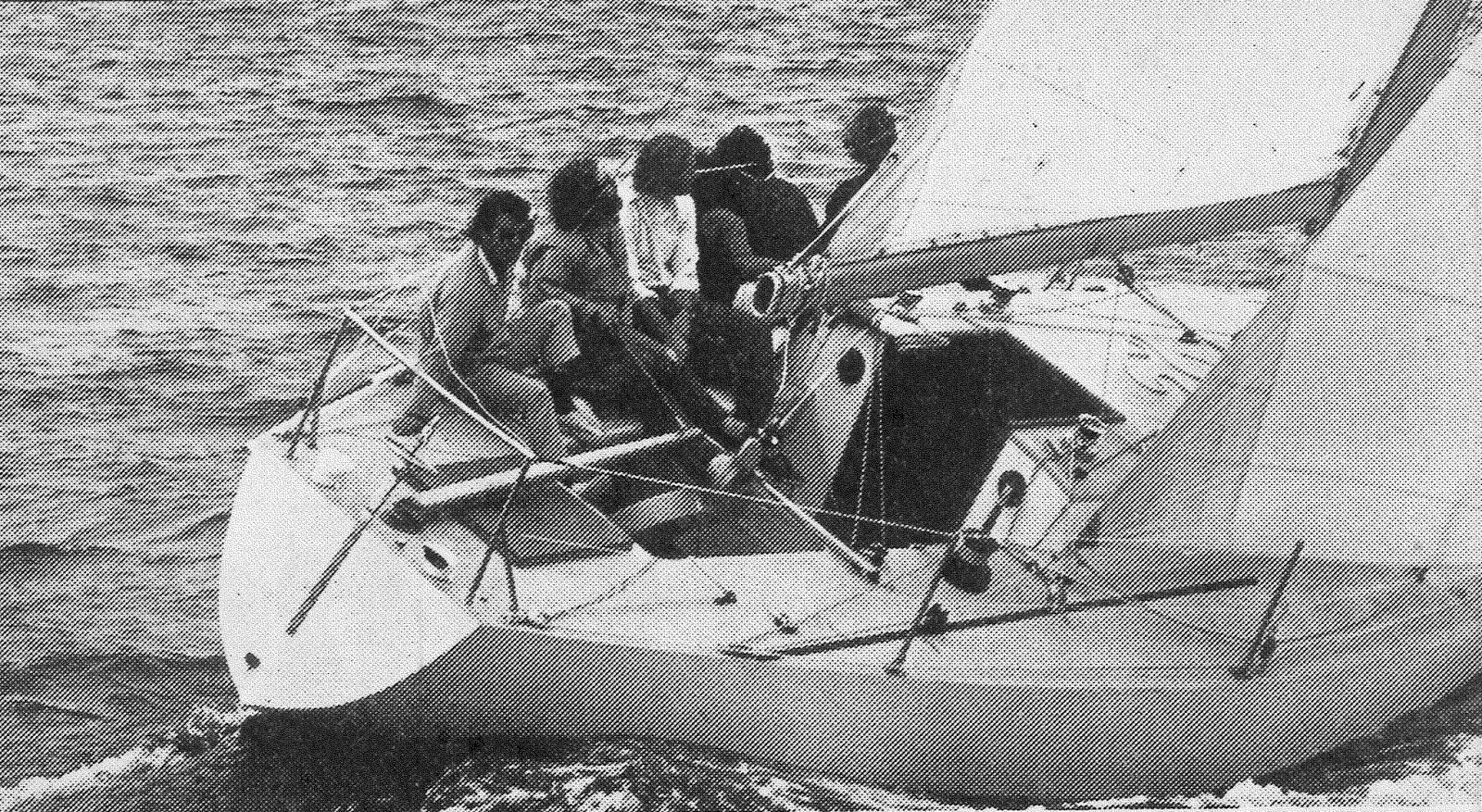
The standout yacht of the 1972 series (but which had finished fourth), the Carter designed Ydra, and the new Peterson breakthrough Ganbare, were dominant in a fleet made up of largely older yachts, or simply outdated designs. Ganbare was clearly the fastest yacht, and only Ydra was able to offer any threat. Ganbare represented a new style of One Tonner, a smaller and lighter custom design, that was faster than her competitors on all points of sail, except reaching in fresher conditions.
Ganbare during the US trials
The only race in which Ganbare and Ydra did not have an untouchable lead on the rest of the fleet was during the second Olympic course, where it blew 20 to 30 knots, and Winsome V gained the lead after a 20 degree windshift on the first beat. She was fast enough in the fresh conditions to hang on for second place behind Ydra, with Ganbare taking third. The crew of Ganbare were happily surprised at the ability of their yacht in the medium to fresh conditions as she had been designed to excel in the light airs typical of her home port of San Diego, and the expected light airs of the Mediterranean. As it turned out, she didn't get to test her light air speed until the final long ocean race, but she performed as expected and soon opened up a substantial lead to win the series finale by over half an hour in a dying breeze from Ydra, with the Ted Hood centreboarder Robin finishing third.

Ydra in light airs during the 1973 One Ton Cup
But although Ganbare was clearly the fastest yacht, a navigation error in the middle distance race cost her dearly - she rounded the final mark incorrectly and had to accept a 5% penalty, which dropped her from first to 13th in the bonus points race.  This gave Ydra the One Ton Cup, a prize that had eluded her in the 1972 event in Sydney when her forestay broke in the middle distance race. 
Ganbare in fresh reaching conditions during the 1973 One Ton Cup
Australia's Bonita working upwind in fresh conditions in the second Olympic race (Bonita finished 17th overall)
The Carter 37 Hann sailed by Chris Bouzaid for NZ
Without Ganbare's presence, Ydra would have been the outstanding yacht for the second year. Ydra was an aluminium prototype of Carter's production 37 design. In winds of over 12 knots and in flat water Ydra was close to Ganbare in performance, but the latter's narrower beam allowed her to slip away in any kind of chop. Ydra only held an upper hand in fresh reaching conditions. The Carter 37 aluminium prototype was also superior in speed in all conditions to the GRP versions of the same design, one of which was chartered by Chris Bouzaid (Hann), then of Rainbow II and Wai Aniwa fame, and defender of the One Ton Cup; a second was chartered by Australian Syd Fischer, the One Ton Cup winner in 1971 (Chloe). 

Both campaigns from downunder were hampered by problems common to charter-efforts - a lack of time. Bouzaid had tried, unsuccessfully, to raise the funds to send Wai Aniwa to Sardinia to defend the Cup, and so the charter was the best that could be done in the circumstances. So although both Bouzaid and Fischer had formidable backgrounds in One Ton Cup campaigns, neither could get their boats going to their full potential. In the end Bouzaid and his crew came out top over Fischer, with a creditable third place, just 1.5 points behind Ydra, mostly due to good placings in the longer races, with Fischer finishing in fifth place.

The appeal for funds for Wai Aniwa's defence of the One Ton Cup was unsuccessful. She is seen here testing sails on Auckland Harbour in preparation for Sardinia.
Ted Hood's Robin, seen here during the US trials series
The next best performing designs were Ted Hood's Robin's, his own one racing for the US, and his earlier design sailing for Canada. Both yachts represented a heavier-than-normal approach to the Mk III version of the IOR, and although both were well sailed, they could not match the speed of Ganbare or Ydra, except in light air. The new Robin featured a stiff hull design capable of carrying a lot sail, but which would be described as full-bodied with her beam carried both well forward and aft. Unusually for the time, and indeed even now, Robin sported a gybing centreboard, which was made of steel and weighed 600lbs, and a retractable spade rudder, without a skeg. 
Robin during the 1973 One Ton Cup
Cockpit view (above) and foredeck (below) of Robin, as photographed by Steve Kelley in Newport, Rhode Island, in 1974
The performance of the S&S yachts in the fleet was remarkable, but for all the wrong reasons. Under all the conditions experienced in Sardina, none of the S&S boats showed any speed to match the top five (other than Winsome V's effort in the second Olympic race). Ted Turner's Lightnin' made the US team after winning the Miami leg of the US trials, but had tended to make a great deal of leeway in the SORC series and modifications had been made to her keel. Olin Stephens acknowledged that he was designing his yachts too big - but even though his latest design, Ojala II, was a step down in size from Ted Turner's Lightnin' (6th), Thunder, and Winsome V, she finished behind all three of her bigger sisters in 14th place (who finished 6th, 7th and 9th respectively). 
Ydra heads downwind ahead of Italy's Sumbra and France's Drac
Certainly for the 1974 event the pendulum had swung from the earlier dominance of Carter and S&S and to Peterson's favour, and that's for a future article.


Footnote: Ydra is current understood to be located in northern Germany - if anyone knows of her actual whereabouts one of the followers of this blog would be very grateful! Leave a comment or send an email to rb_sailing@outlook.com.


22 January 2015

One Ton Cup 1975

The 1975 One Ton Cup was sailed off Newport, Rhode Island, under the sponsorship of Ida Lewis Yacht Club, in early September of that year, and contested by 20 yachts from eight countries.
Pied Piper - North American and World One Ton Champion 1975 (photo histoiredeshalfs)
The series was taken convincingly by Lowell North and Dick Jennings sailing a new Doug Peterson design, Pied Piper. The pair had sailed a near flawless series in the North American championship two weeks prior, which had also been attended by nine of the One Ton Cup fleet, and went on to post a 1/5/1/1/2 series in the Cup to beat second placed Peterson design Gumboots (Germany), the defending champion, by just under 8 points, with another US yacht America Jane III (Scott Kaufman design) third.


Gumboots - 1974 One Ton Cup winner (photo Robert Foley/Yacht Racing)
Although there were several other contenders, including the new Holland design Silver Apple (Ireland), the real battle lines were among the top three as the series wore on. There was almost always a first division and then the rest of the fleet - the difference was small but difficult to break, with ten yachts rounding a mark in the offshore races after 50 miles just three minutes apart. Racing was also a complete test for the fleet, with light to moderate airs predominating, but a real New England blow featuring in the final race to expose those less prepared.

Gumboots and America Jane III in light air conditions during the 1975 One Ton Cup
The 1974 One Ton Cup held in Tourquay had been won by Gumboots, a development of his previous breakthrough design Ganbare that had finished second in 1973. The success of Ganbare paved the way for One Ton design to settle on a smaller and lighter type of yacht (but still of relatively heavy displacement in today's terms), with reasonably pronounced forefoots, flat-ish garboards and narrow sterns. America Jane III was perhaps the most different of the new boats, as it was heavier, very broad aft and deeper, and seemed able to carry more sail as the breeze increased. It was evident at this stage that the future of S&S types such as Mach II, and the earlier America Jane II, were really in doubt, given their lack of speed in the series. Masthead rigs remained universal, with many sporting hydraulic backstays and forestays, as well as vangs and other items of gear.

The new Kaufman America Jane III (right) alongside the smaller S&S America Jane II (photo histoiredeshalfs)
Earlier in the summer, East Coast One Tonners had also competed in both the Block Island and Larchmont Race Weeks. This provided time for changes in sails, tuning, ballast arrangements and rating in the pursuit for improved performance. Later, and between the North American championships and the Cup, America Jane III, Silver Apple and another Peterson design Kindred Spirit (US) all put chainsaws to their keels to remove lead. America Jane III, which had removed about 460lbs of lead, and Kindred Spirit increased their sail area, and Silver Apple removed their solid propeller in favour of a folding one.
 
America Jane III in power reaching conditions (photo histoiredeshalfs)
America Jane III
became more tender and reduced her rating by about .35ft - she raised it back to the One Ton limit of 27.5ft by adding length to her spinnaker pole and girth to her spinnaker, and about 2 feet to her LP (genoa overlap). Before she made these changes she had performed so poorly in the North American championship that she was almost dropped from the invitation list for the Cup. Her subsequent results in the Cup series, at least after her disastrous first race where she placed 15th, proved that the changes were successful.


The US yacht Artemis, designed by Ron Holland, finished fifth overall (placings 5/6/5/9/9) (photo histoiredeshalfs)
Silver Apple also benefited from changes to her keel and ballast, but not by as much. Kindred Spirit ran out of time to add sail in response to her lightened keel, but did not suffer significantly as a result, even though she sailed with a sub-optimal rating of 27.4ft.
The first race was an Olympic course sailed in light to moderate airs, and the shift off the Point Judith shore determined the preferred side of the course. However, tactics played second fiddle to boat speed, and in this regard Pied Piper asserted herself early. The second race was a little windier and sailed on a windward-leeward track. There were no real surprises, other than Pied Piper finishing fifth and the race being won by Kindred Spirit, which after a second in the first race was leading the series at this stage. America Jane III bounced back from her poor result in the first race with a second placing.


US yacht Kindred Spirit challenged early but finished fourth overall (photo Robert Foley/Yacht Racing magazine)
The middle distance offshore event started in light airs and conditions remained shifty throughout. Fog closed in on the second day's dawn and rounding marks became a real test for the navigators. The fleet assumed their normal order, with Pied Piper winning, ahead of America Jane III and Gumboots.

Pied Piper (left) and America Jane III 'bloop' their way downwind (photo Robert Foley/Yacht Racing)
The third inshore race, race four, started in a dying breeze, which eventually gave out as the entire fleet reached the 'windward' mark with spinnakers up. A new breeze then arrived with force, building to 30 knots by the finish. America Jane III managed a second, behind Pied Piper, despite a port-starboard incident with Silver Apple - the force of the collision was such that Silver Apple's stem fitting was damaged beyond repair, and she was unable to start in the final race. America Jane III was holed, but she was able to be repaired.

Ted Turner's Vamp, chasing Mach II (middle) and Pied Piper (yellow, to the right) (photo histoiredeshalfs)
The final long offshore was held in strong winds, with seas up to 8 feet and 35 knot winds and fronts crossing the fleet on three occasions. Damage was relatively light, however, with Natael II (Italy) breaking a forestay fitting and Fortune Hunter (Australia) losing part of her rudder. America Jane III powered through for the win (for series places of 15/2/2/2/1), with Pied Piper second, and Gumboots finishing in her customary third place (with series placings of five thirds).

Pied Piper was the most consistent boat in the fleet, benefiting from excellent helmsmen and an experienced crew which included Tim Stern and Rod Davis, and she was quickly bought after the series by Ted Turner (who owned and sailed the Peterson designed Vamp to sixth place in the series). She featured a very effective rig, designed by Lowell North who worked closely with Stern on its development. Her genoas appeared to marry well with her forestay curve, and could bend her mast with great control. This allowed her to carry a mainsail with more shape for lighter air and reaching, while still permitting her to flatten the sail for stronger winds. The control over her mast bend was such that the crew rarely needed more than a flattening reef to depower the rig in heavier air. Turner planned to contest the SORC with Pied Piper the following year, but in the meantime took the boat to Australia for the 1975 Southern Cross Cup where she lined up for a close contest with the new Farr design Prospect of Ponsonby.  She later competed in the 1979 One Ton Cup, which was again raced in Rhode Island, but by which time she was well off the pace.

The crew of America Jane III sheet on after rounding a leeward mark (designer Kaufman grinding) (photo Robert Foley/Yacht Racing magazine)
The early threat posed by Kindred Spirit faded after the second race, and although leading the series at this stage she faded to fourth after posting 6/8/7 in the final three races. Ganbare (Italy) contested the series with a largely Italian crew. She was competitive in the light going but otherwise outclassed and finished 16th overall (from a 16/16/8/15/DNF series), which indicated the level of progress that the One Ton fleet had made in the previous two years.

The fleet start one of the races in light airs during the 1975 One Ton Cup

 Dockside photos of some of the 1975 One Ton Cup fleet can be seen here.

19 December 2014

One Ton Cup 1972

The 1972 One Ton Cup was held in Sydney, and was contested by 15 yachts representing nine countries. Designs from the Sparkman & Stephens were well represented, with no less than ten yachts from this famous design office, two from US designer Dick Carter, and one each from Joubert, Rodgers and Gary Mull. 

Wai Aniwa training in blustery conditions on Auckland Harbour, 1972
With the contest being held just across the Tasman, and with a number of yachts still available following the 1971 series hosted in Auckland, three yachts were selected to represent New Zealand. No new yachts were launched, but Chris Bouzaid skippered his 1971 'Mk II IOR' Carter design, Wai Aniwa to win the trials, finishing with a 6/2/1/1/1 series. After her disappointing fifth place in the 1971 One Ton Cup, Bouzaid had set out to modify and improve Wai Aniwa under the new Mk III rule - her mast was increased in height by 0.6 metres, her genoas limited to 150% LP and 680 kg of ballast was added. The changes had earlier been proven when she led New Zealand to victory in the 1971 Southern Cross Cup, where she finished as top individual yacht, ably supported by team-mates Pathfinder and Runaway. In fact, the team finished with an unprecedented, and unrepeated, 1st, 2nd and 3rd in the Sydney-Hobart classic to secure the series. 

Pathfinder sailing in the New Zealand trials
Wai Aniwa's original pivoting keel had caused some issues, turning 90 degrees in one practice race and bringing the yacht to a shuddering halt, and was fixed in place before the New Zealand One Ton Cup trials, and a larger mainsail was fitted (requiring a longer boom). 
Wai Aniwa during New Zealand trials
The One Ton Cup team was completed by Pathfinder (Roy Dickson), runner up in the trials (4/1/2/2/3), and Young Nick, skippered by Peter Mulgrew, was third (1/3/4/3/5). Mulgrew's previous yacht, the diminutive Townson 32 Moonlight, finished sixth. The fourth placed yacht, Gil Hedges' Escapade, was chartered by an English team, skippered by Rodney Hill.
Ydra in winning form during Cowes Week 1972 (photo One Ton Class Facebook page)
Ydra (pronounced "Ee-dra", and named after a Greek Island) was the pre-series favourite. She was the latest design from Dick Carter, based on the Mk III version of the IOR that had been formulated to reduce the emphasis on beam and encourage more depth amidships. She was constructed in aluminium and built in Germany by Abeking & Rasmussen. Her clean flush decks gave her an appearance well in advance of all her rivals.Carter commented at the time that particular emphasis was placed on combining upwind capabilities with downwind performance. In order to achieve strong light air performance across all points of sail, Carter specified a large sail plan, with maximum emphasis on a large foretriangle, with a number one genoa programmed for 160% LP.

Profile and general arrangement plan of Dick Carter's Ydra
  A most notable feature of Ydra was the emphasis on operation efficiency. This included the provision for spinnaker poles to be stowed in tubes below deck, with opening ports on the for'ard side of the cabin trunk, to enable faster handling of the pole. The foreguy was permanently attached to further maximise handling speed. Carter noted that there was also great satisfaction in eliminating poles from the deck, both from an operational and aesthetic viewpoint. Another interesting development was the use of a solid vang, which allowed micrometer adjustment allowing very accurate control of the mainsail leech.


In her first series, the 1972 Cowes Week, and skippered by 1968 Cup winner Hans Bielken, she was completely dominant, taking six firsts and a third. She also had to carry a DSQ for being over the line early in one race, and a DNF after a collision with a larger yacht). She trained for one more month in Germany, before being shipped to Australia. Yachting journalist Jack Knights proclaimed Ydra to be the fastest One Tonner in the world and all those that saw her perform in that regatta fully expected a great performance in the Cup. 

The 1972 One Ton Cup consisted of five races, as was normal for these level rating events, including a medium offshore (1.5 points) and a long offshore (2x points), and a winning campaign could not afford a poor result in the longer races. What was not typical was that the offshore races were aligned along the coastline south of Sydney. As a result, navigation was not a major factor as nearly all the racing took place within sight of land, and visual bearings were the order the day. The main tactical consideration was to determine what the Southerly Set was doing (speed and direction).

The 1972 One Ton Cup fleet assembled in Sydney, Australia
In the first race Ydra sailed away at the start, demonstrating superior windward ability to such an extent that after five miles in light winds she was over two minutes ahead which she extended to 12 minutes by the finish.  However, in the long offshore she stripped her forestay turnbuckle and this put her out of contention for Cup honours, and she finished with results of 1/2/2/DNF/1. Wai Aniwa sailed a conservative series, and the result came down to the final ocean race. Wai Aniwa and Australian yacht Pilgrim (the ex-Italian yacht and S&S design Kerkyra IV) raced neck and neck throughout the race, Bouzaid and his crew finally leading Pilgrim into Sydney Harbour by seven minutes to reclaim the One Ton Cup for New Zealand.
Wai Aniwa finishes one of the ocean races in tight reaching conditions
So Wai Aniwa won the series with placings of 3/4/3/1/4, Pilgrim was second (2/1/7/2/7) and Pathfinder was third (8/3/1/4/10).

Second placed Pilgrim (Australia)
Wai Aniwa was a two year old design, to the Mk II version of the rule, but such was Chris Bouzaid's proficiency as a sailmaker, tuner and skipper of an offshore yacht, that it was difficult to draw a conclusion that Wai Aniwa's win marked a victory of Mk II designs over the first attempts of Carter and S&S at Mk III designs. Although Wai Aniwa won the series, Ydra was considered the faster boat, and also benefited from having a sail-maker at the helm, Hans Beilken. 

Ydra with spinnaker and big staysail set
However, it was apparent that Carter and S&S were designing quite different boats for Mk III than their earlier efforts under Mk II. This could be seen in the design contrast between Wai Aniwa and Ydra. Wai Aniwa was rounded for'ard with dish-like midship sections and slack bilges. A long flat run hull finished in a deep bustle and skeg with the rudder faired in. Ydra was slab sided in her for'ard sections, and was noticeably beamy, 0.3 metres wider than Wai Aniwa

The extreme beam of Ydra is evident in this photo
The Mk III version of the IOR had come about as a result of criticism, particularly in the US, of Mk II, the original version of the rule issued in 1970. The most publicised change inherent in Mk III was in the depth formula (D), and it was claimed that the extra depth measurements and loading of the inboard depth measurement in particular (MDI) would curb the tendency to extreme beam which was becoming evident. 

The differences between Wai Aniwa (solid line) and Ydra (dashed line)
It was therefore interesting to find that the two newest designs in the fleet, and the only ones designed to Mk III (Ydra and the S&S Columbine) were about a foot wider than the beamiest yacht in the 1971 contest, the S&S Kerkyra IV

Ydra sail plan
The trend to extreme beam was even more startling, given that the designers of these new boats were both involved in the original drafting of the IOR. It was apparent that the new depth measurements were not sufficiently attractive to encourage the design of narrower, deeper yachts, and this was considered disappointing at the time, as beamier yachts were viewed as being difficult to handle, especially downwind. One positive development was that, based on Ydra and Columbine, the stern buttock lines could be made lower and wider under Mk III without undue penalty. 

In terms of sail plans, there was no apparent move towards larger mainsails, and only Wai Aniwa had taken extra mainsail area under Mk III. Most other mainsails were very close to the minimum permissible area, but the aspect ratios of foretriangles were slightly higher than in 1971. 

The next competition for the One Ton Cup would be held in 1973 in Sardinia, where Ydra would herself be surpassed, but once again the series would prove that having the fastest yacht was only one part of a winning campaign...


Footnote: Ydra is current understood to be located in northern Germany - if anyone knows of her actual whereabouts one of the followers of this blog would be very grateful! Leave a comment or send an email to rb_sailing@outlook.com.