Showing posts with label Southern Cross Cup. Show all posts

4 February 2016

Dr Feelgood (Farr 40)

Dr Feelgood was a US semi-production and masthead-rigged version (Design #143) of the Farr 40 Design #136 that had dominated the 1983 Southern Cross Cup and had finished first, second and ninth in the 40-boat fleet (Pacific Sundance, Geronimo and Exador), winning the Cup for New Zealand. Dr Feelgood was built by Garrett Marine, the first of what was to be a fleet of yachts known as the Garrett 40. Dr Feelgood was launched in Florida in early 1984 in quest of SORC glory.

Geoff Stagg, skipper of Pacific Sundance in the Southern Cross Cup and marketing director for Farr International, said at the time that his "light years" victory with Sundance was particularly gratifying because the original design had proved fast in a wide variety of conditions, and on all points of sail.

Sail Magazine described Dr Feelgood and the Garrett 40 as a "production boat" in the sense that "one could be ordered tomorrow. However, she goes toe-to-toe with custom-built boats in many important areas. Vacuum bagging and Kevlar laminates are part of her construction". The Garrett 40 was slightly shorter and heavier than her Design 136 grand prix sisterships. Particular attention was nevertheless still paid to keeping weight out of the ends of the boat, even down to the tapered faceting of her transom. 

Dr Feelgood during the 1984 SORC (Sail magazine)
Freeboard was also kept low compared to her IOR contemporaries. Sail magazine noted that Farr's distinctive, deep lozenge-shaped rudder, deep blade of a keel and practised handling of the IOR hull shape (with a touch of emphasis on downwind power) all helped explain why their Southern Cross competition was far from happy with the Dr Feelgood sisterships. 

Garrett 40 internal arrangement plan
Dr Feelgood, and the Farr 40's generally, carried their maximum beam relatively far aft. This maximised the effectiveness of crew weight, but also afforded a wide, workable cockpit. The masthead rig chosen for Dr Feelgood and the Garrett 40's had three sets of spreaders, rod rigging and running backstays. Stagg commented "the secret of this design is in its simplicity. Not only does that save cost, it means that because you don't need a pack of experts aboard to make everything work, the average guy can race and really enjoy it". 
Dr Feelgood puts her bow down during the Ft Lauderdale race in the 1984 SORC (photo Larry Moran)
Dr Feelgood lined up against similar-sized One Tonners (30.5ft IOR) at the 1984 SORC, including the 1981 Admiral's Cup champion Diva, the J/41 Dazzler and Mark Soverel-design S-39 and Finot/Berret/Fauroux designed Evolution First One Ton, and sat very much in the middle of that company in terms of her key IOR measurements. Unfortunately Dr Feelgood was still being built on her way out to the SORC racecourse, and completed only the first two races (9/7 in class, and 41/24 in fleet) and so not much could be gleaned as to her overall potential.
Dr Feelgood sails upwind in light conditions (photo Farr Yacht Design)
Compared to the dinghy-like Diva, Dr Feelgood was beamier and fuller aft, with a proportionately finer forebody. A review by designer Bruce Kelley, for Yacht Racing & Cruising magazine and which was focused on the 1984 SORC One Ton fleet, suggested that the boat would have been happier with a fractional rig in deference to her relatively more trim-sensitive hull shape. Kelley also considered that the boat was slightly heavier than intended, with a SHR (sail/hull ratio) of 15.62, lower than expected for a Farr design, and a DLF (displacement/length factor) of 1.0022 that was also lower than typical.
Dr Feelgood during the 1984 SORC (photo Larry Moran)
Dr Feelgood later competed in the North American One Ton Championships hosted by the Annapolis Yacht Club in April 1984, but failed to fire, finishing 11th of 13 boats (with placings of 9/10/6/DNS).

It is unclear how many of the Garrett 40's were built, but on the racecourse Design #143 was certainly eclipsed by her fractionally-rigged sisters, and later developments of that design that were consistent top performers in the One Ton class throughout the 1980s.


Article dated February 2016

25 May 2013

Exador (Farr One Tonner)

Exador 1983 (Farr Yacht Design)
Exador is another of the Bruce Farr-designed trio of 40 foot One Tonners that burst onto the New Zealand and international ocean racing scene in 1983. Exador was commissioned by yachtsman Tom McCall, and his commitment to building the first of Farr's new Design 136 convinced Owen Chantaloup and Del Hogg to proceed with sisterships Geronimo and Pacific Sundance with which to campaign in the 1983 Southern Cross Cup trials.  

The three New Zealand yachts all benefited from the one-design nature of their tuning programme, and all secured places in the New Zealand Southern Cross Cup team. The team put on a devastating and all-conquering performance in the Southern Cross Cup, taking wins in three out of five races to take the Cup with a big lead over the second placed New South Wales team. Exador finished fourth overall, behind Pacific Sundance (first) and Geronimo (second), with Exador also finishing ninth in the 160 boat fleet that contested the Sydney-Hobart race that was also the final race in the series. 
Exador on a downwind leg during the 1983 Southern Cross Cup (photo Diana Littler/Sea Spray)

Exador approaching a windward mark during the 1983 Southern Cross Cup (photo Phil Uhl)

Exador in the 1983 Sydney-Hobart race (photo Farr Yacht Design)
1984 Clipper Cup
The next year Exador, Pacific Sundance, and Shockwave were selected for the New Zealand 'A' team to contest the 1984 Clipper Cup. This was a powerful line up, and the team lead the series from the first race, with Exador finding the conditions much to her liking and taking four wins in the first four races. 

Both Exador and Pacific Sundance were going so fast in the final Round the State race that they were running first and second on corrected time and the Clipper Gold Cup looked to be New Zealand's. On elapsed time Exador was even ahead of the eventual winner of the race Sidewinder, which rated some 3 feet higher, and so she was looking good to claim the 300 points for the winning yacht, and the Cup itself. However, disaster struck when Exador was engulfed by a rogue wave off South Point (on Hawaii's Big Island) that tore out her rig. The loss of Exador from the running dropped the team to second overall (just 12 points behind the US White team of Camouflage, Checkmate and Tomahawk). 

Exador during the 1984 Clipper Cup

Exador in hard running conditions off the Molokai North Shore during the 1984 Clipper Cup (photo Phil Uhl)
Exador on a reaching leg alongside the Farr 38 Expectation during the 1984 Clipper Cup
McCall nearly sold Exador, for business reasons, to the US (via an offer through Geoff Stagg of the Farr office) on the eve of the 1985 New Zealand Admiral's Cup challenge evaluation series. Fortunately, quick footwork by Auckland businessman Mike Clark kept the champion yacht in New Zealand. Skippered by Graeme Woodroffe she was the form yacht of the trials, and in lighter trim and with new sails she was an easy selection for the team, alongside Epic, another Farr 40, and Canterbury, a Davidson One Tonner. 
Exador beats upwind in the Rangitoto Channel during the 1985 Admiral's Cup trials (photo Peter Montgomery/SailWorld)

Exador leading the fleet during the 1985 Admiral;s Cup trials, with (right to left) Barnstorm, Epic Lass, Canterbury Export, and Swuzzlebubble V (photo Peter Montgomery/Sail World)
Exador in close company with Swuzzlebubble V during the 1985 Admiral's Cup trials

Exador beats upwind in the Rangitoto Channel during the 1985 Admiral's Cup trials

Exador begins another windward leg during the 1985 Admiral's Cup trials (photo NZ Yachting)
In her new team livery before heading overseas for the 1985 One Ton Cup and Admiral's Cup

Exador approaches a windward mark in the 1985 One Ton Cup, behind Alliance (right) and just ahead of Panda (left)
Exador during the 1985 One Ton Cup
All three New Zealand yachts competed in the 1985 One Ton Cup curtainraiser, held in Poole before the Admiral's Cup. With so many Admiral's Cup teams fielding One Tonners, the series was well attended and closely fought. Exador had a solid series, but after incurring a significant penalty in one race slipped from a possible third place overall to fourth behind Jade, Highland Fling and Panda. Exador then went on to lead the New Zealand Admiral's Cup team from the front, finishing as fifth yacht overall to help secure the team's third place amongst 18 teams, its best result in the regatta up to that time.

Exador during a pre-start at the 1985 One Ton Cup, with Australia's Hitchhiker II to leeward (photo Facebook)
The evergreen yacht went on to earn a place in the 1985 team that was selected to defend the Southern Cross Cup, joining Ian Gibb's Swuzzlebubble V, and Tom McCall's Farr 43 Switchblade. Unfortunately, New Zealand split its strongest performers between two teams, and Swuzzlebubble V proved to be off the pace, while in the second team the Peterson 43 Barnstorm undermined the top individual yacht of the series, the Davidson One Tonner Mad Max (later Goldcorp). Nevertheless, Exador sailed strongly, and was the only boat in the New Zealand A team to match pre-regatta expectations, finishing as third yacht overall (with placings of 4/5/9/4/6).
Exador finishing one of the inshore races off Cowes during the 1985 Admiral's Cup (photo Margherita Bottini/SailWorld)

Exador seen here to leeward of Portugese entry Algharbe, a Castro 40 (photo Histoiredeshalfs website)
Exador again showed her pedigree and incredible longevity by forming part of another champion New Zealand offshore team, alongside two Farr 43's Thunderbird and Equity, which won the 1986 Kenwood Cup. Exador had sailed well in the New Zealand trials, sporting some new sponsorship and renamed Paxus Exador. This injection of funds allowed a refit and new sails. A weight-saving exercise, including lighter floorboards and a new boom, and some re-trimming for Hawaiian conditions, gave the yacht a new lease of life and she went on to win Class D. Paxus Exador was also looking good for overall fleet honours, but large holes in the Round the State race caught many of the smaller boats, Paxus Exador included.
Exador sporting new livery for the 1986 Kenwood Cup trials
Exador blazes upwind in the conditions she was designed for, circa 1986
By the time of the 1986 Kenwood Cup, Exador had been sold to Japan's 'Harry' Takeda, a move that was met with some sadness in New Zealand sailing circles. An editorial in New Zealand Yachting magazine at the time lamented that it was hard to imagine any other yacht matching Exador's record across such a large number of regattas, an ever-present campaigner in the New Zealand's 1983-85 Champagne Mumm World Cup victory.
Exador seen here (Offshore magazine) racing in Japan in the 1989 Big Boat Series in Gamgori, Japan (finishing 19th overall). The red dot in the middle of the boom was the logo of the Bengal Bay Yacht Club America's Cup Challenge and the event was held at the Nippon Ocean Racing Club America's Cup Challenge headquarters

Exador is understood to be currently based in Vladivostok, Russia, where she sails at the '7 Feet' Yacht Club (see photo above). In 2012 she finished second in the 500 mile Sea of Japan race, and finished fifth in 2013. The owner's are proud of Exador's rich and distinguished history, and are doing everything possible to maintain her in top condition. More recent photographs can be seen below.


Article updated February 2025


18 April 2013

Pacific Sundance (Farr One Tonner)

Pacific Sundance was one of an initial trio of new boats to Bruce Farr's Design #136, a 12.2m (40ft) development of Farr's fast 37 footers (Migizi and Freefall, Design 124) that had shown great speed at the SORC in 1983 and were the first of a new generation of Farr IOR designs. The design was finalised in April 1983 and was the first response to the change in the ORC rules that increased the IOR limit for the One Ton class from 27.5ft to 30.5ft. 

Design 136 was pitched to excel in the lumpy and windy Australian and New Zealand conditions, with less sail area and more length than boats intended for Northern Hemisphere racing, but it went on to do well everywhere. The boat was considered to be extremely stiff, with small straightforward trapezoidal keels. The design proved a phenomenal performer upwind, and in their day were fast reaching and OK running.  

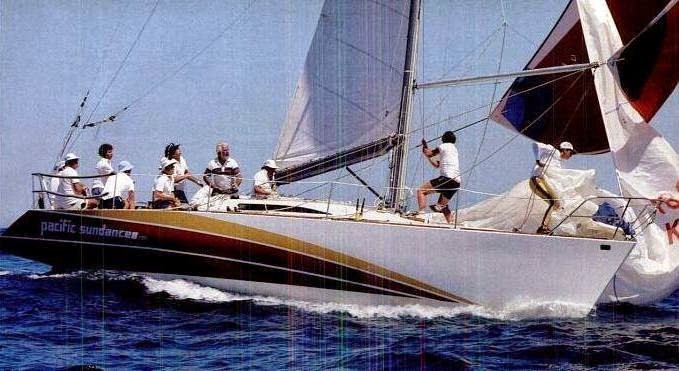
Pacific Sundance during the 1983 Southern Cross Cup trials (photo Diana Littler/Sea Spray)
Pacific Sundance was commissioned by Del Hogg for the New Zealand Southern Cross Cup trials held in late 1983, following Tom McCall's decision to press ahead with the first of the new design, Exador. These two yachts were joined by sistership Geronimo (Owen Chantaloup), and all three were built from the same mould at Cookson Boatbuilders, utilising a PVC core and some kevlar. It is understood that her original name, Pacific Sundancer, based on sponsorship from a skin-care company, ran foul of IYRU Rule 26 - the 'r' was covered up with tape to give the yacht her better-known name.
Pacific Sundance in close-quarters action in an upwind leg during the 1983 Southern Cross Cup (photo Phil Uhl | Uhl Studios)
Pacific Sundance leads team-mate Geronimo during the 1983 Southern Cross Cup (photo Diana Littler/Sea Spray)
Pacific Sundance during the 1983 Southern Cross Cup (photo Facebook)
As noted in an earlier post on Geronimo, the three yachts all benefited from the one-design nature of their tuning programme, and were able to edge out the only other real threat in the Hitachi-sponsored trials, from Neville Crichton's Frers 43 Shockwave. Pacific Sundance was the top performer, and Geronimo and Exador finished second equal, and thus the New Zealand team for the Southern Cross Cup in 1983 was comprised of three Farr One Tonners. 
Spinnaker hoist at a top mark during the 1983 Southern Cross Cup series (above and below)

Pacific Sundance heads off on a reaching leg, team-mate Geronimo behind and approaching the top mark
The 1983 team made up for disappointing New Zealand efforts in 1979 and 1981, with a devastating and all-conquering performance, taking wins in three out of five races. Pacific Sundance finished as first yacht overall in convincing fashion - skippered by Geoff Stagg and Peter Walker, Pacific Sundance posted a first, third and fourth among 27 yachts in the three inshore races. They also won the 180-miler, and the Sydney-Hobart race finale - in fact she nearly won the Sydney-Hobart overall, but ran out of wind just 40 miles from the finish.  
Geronimo and Exador finished the series in second and fourth place overall, cementing a solid win by the New Zealand team, by a massive 100 points over second-placed New South Wales. This was an even more dominant performance than 1977, and on a par with New Zealand's first win in 1971. 
Pacific Sundance sails on a flat run during the 1983 Southern Cross Cup series
The next year Pacific Sundance, Exador and Shockwave were selected for the New Zealand 'A' team to contest the 1984 Clipper Cup. This was a powerful line up, and the team lead the series from the first race. Pacific Sundance and Exador were going so fast in the final Round the State race that they were running first and second on corrected time and the Clipper Gold Cup looked to be New Zealand's. However, disaster struck when Exador was engulfed by a rogue wave off South Point (on Hawaii's Big Island) that tore out her rig. The loss of Exador from the running dropped the team to second overall (just 12 points behind the US White team of Camouflage, Checkmate and Tomahawk).
Pacific Sundance behind the Ross 44 Blast Furnace and ahead of Exador being unloaded in Hawaii for the 1984 Clipper Cup, with Shockwave just visible to the right (photo Phil Uhl | Uhl Studios)

Pacific Sundance during the 1984 Clipper Cup (photo John Mallitte/Sea Spray)
Pacific Sundance on a reaching leg during the 1984 Clipper Cup (photo NZ Yachting)
Pacific Sundance works her way upwind during the 1984 Clipper Cup
Pacific Sundance was sailed in San Francisco in the mid-1980s (as Sundance), including the 1986 Big Boat Series, and she raced in the 1988 One Ton Cup in San Francisco, where she was sailed by Chris Dickson and finished in a creditable eighth place, given her vintage by that time, and was one of seven Farr designs to finish in the top ten.
Sundance (as she was known for a while) during the 1986 San Francisco Big Boat Series
Pacific Sundance in a broach during the windy conditions of the 1988 One Ton Cup in San Francisco
Pacific Sundance now races actively in Auckland, and featured in the 2013 Three Kings offshore classic and competed in the 2015 One Ton Revisited regatta in Auckland.
Pacific Sundance during a RNZYS winter series race in May 2014 (photo Ginger Photography)
Pacific Sundance finishing the 25 November 2016 White Island Race (photo Suellen Hurling)

Pacific Sundance during a windy Squadron winter series race in 2018

Pacific Sundance gets a new coat of paint at Pier 21, Westhaven, Auckland (photo Facebook)

This piece of famous New Zealand yachting history is currently (as at March 2024) for sale.


Article updated August 2026