16 May 2013

Resolute Salmon (Chance One Tonner)

An earlier post on Jiminy Cricket and 45 South II covered the 1976 One Ton Cup series, held in Marseilles, France. The winner that year was the Britton Chance design Resolute Salmon, a big hefty One Tonner which was able to offset a poor showing in the ocean race finale by amassing a strong points advantage from her convincing results in the previous four races. Resolute Salmon flew the US flag for her One Ton Cup campaign, although she was Italian owned, had been built in France and was rigged and worked up in Cowes, England.

Although Jiminy Cricket and 45 South II raised some interest in Marseilles with their light hull forms and small fractional rigs, it was Resolute Salmon that was perhaps the most radical of the 43 boats that comprised the 1976 One Ton Cup fleet. She represented the polar opposite to the Farr boats in every way. Firstly she was a centreboarder, to take advantage of a previously unexposed loophole in the IOR, with stability obtained through internal ballast in a deep hull, and combined with a large engine. The centreboard approach was popular in the shallow cruising grounds of the east coast of the US, and gained a benefit under the IOR (through a negative DC measurement) to recognise their usually slower shallow keel/centreboard configuration used in such waters. However, when designed as an efficient dinghy-style daggerboard (that weighed just 250lbs), the foil provided a more effective lifting surface, and one that could be retracted on downwind legs for less wetted surface. 


Resolute Salmon on a broad reach during the 1976 One Ton Cup
Resolute Salmon works her way to windward during the 1976 One Ton Cup (photo Sail magazine)
Secondly the midship depth of Resolute Salmon was carried well forward into a very deep forefoot. The full forebody moved the bow wave forward and the corresponding stern wave further aft. By filling in the stern overhang, the lee quarter wave was delayed and, combined with a beamy powerful hull shape, the yacht became quite stiff to windward which allowed her to carry her lofty masthead rig.  
Resolute Salmon sailing downwind in moderate conditions and showing her large quarter wave
Resolute Salmon in light two sail reaching conditions (photo Jonathan Eastland)
While Resolute Salmon was a heavy displacement yacht (some 14,000lbs compared to the 8,400lbs of the Farr yachts), she was very lightly built in Western Red cedar, with carbon fibre reinforcing. This meant that a large amount of internal ballast had to be carried to achieve her flotation marks, which provided a very high ballast ratio. This ballast took the form of two giant paving slabs sitting on the floor of the cabin just behind the mast. The combination of these various design characteristics, helped by a highly professional crew led by Dick Deaver, who first saw the yacht just three days before the series, meant that the yacht was particularly fast in the light winds and sloppy sea conditions that prevailed off Marseilles.

While quick in light airs, however, Resolute Salmon was an absolute handful downwind in any kind of breeze and big following sea. In such conditions, Resolute Salmon had a very nasty habit of trying to turn herself inside out in violent broaches. While she had a high ballast ratio, and as described by Farr at the time, the power of that ballast was just below the centre of buoyancy. This meant that she had to heel ten degrees or more before the ballast stiffened the boat up. Resolute Salmon would therefore start a rhythmic roll very easily and it got to the point where the boat was out of control before the hull became stiff enough to support it. 

Nevertheless, Resolute Salmon was able to post some solid placings in the windier races of the series, with fourth in the first and fourth races, and winning both the abandoned and re-sailed second race and the middle distance race. Although she had established a solid points buffer going into the long ocean race, Resolute Salmon was one of several yachts that failed to properly navigate their way around the Borha meterological platform, some 100 miles out into the Mediterranean Sea. Resolute Salmon and others were too far from Borha to see it in the hazy conditions and sailed past it and carried out out to sea. They salvaged a 20th place which was enough to win the Cup with a 4/1/1/4/20 scorecard. The defending champion, the Peterson design Pied Piper finished second, while another US yacht, the Kaufman designed America Jane III completed the US podium sweep in third.
Resolute Salmon with Jiminy Cricket on her windward hip (photo Bateaux magazine)
The Scott Kaufman designed America Jane III (third overall)
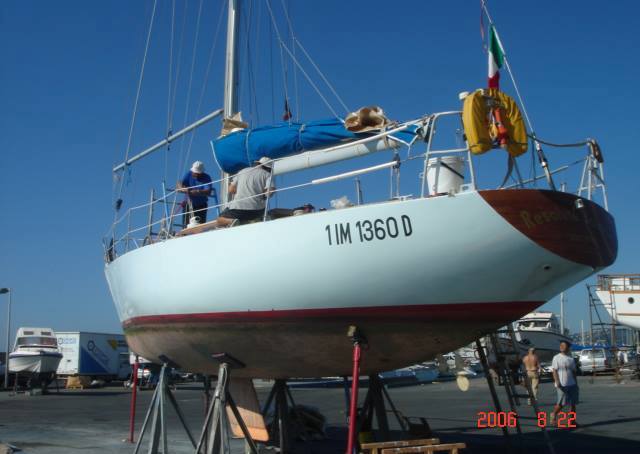
Resolute Salmon does not appear to feature in any subsequent regattas - she did not travel to Auckland to defend her title in 1977, nor to Flensburg, Germany, for the 1978 regatta. Later changes to the IOR meant that centreboards were no longer a viable proposition, and this heavy style of yacht also became outdated by the time of the 1979 series. Recent photographs indicate that she is still maintained in sailing condition, and still sports her original centreboard, and is understood to be lying in Italy.
Resolute Salmon as seen in 2006
Resolute Salmon has been refurbished and is sailing again, seen here in November 2016 (photo One Ton Class Facebook/Raffete Barbera Photographer)
Resolute Salmon competing in the Regates Royales de Cannes, 2021


12 May 2013

Val Maubuee (Ribadeau-Dumas Two Tonner)

Val Maubuee was a less famous Admiral's Cup contender from the 1987 series, and notable only really for the extreme lengths that her designer, Guy Ribadeau-Dumas, went to in order to try to cheat some of the parameters of the IOR rule, resulting in something of an ungainly looking yacht and one that was ultimately unsuccessful.

Designed as a Two Tonner (34.5ft IOR), Ribadeau-Dumas is reported to have commented on characteristics of the 44 foot Val Maubuee as being a yacht with a narrower underwater shape than her competition, and over a foot longer on the waterline. This was meant to increase performance in lighter winds and downwind in fresh conditions.  

The yacht had a very narrow stern and was very flat at the BMAX station, with an angular deck plan that allowed crew weight leverage to be maximised within the constraints of the Crew Stability Factor component of the IOR, and enabled the spinnaker clew sheeting points to be located further outboard.  A curved sheerline was designed to reduce windage, but Ribadeau-Dumas acknowedged the debatable aesthetics of the end result. Another unusual feature was the rudder, hung directly under the skeg, supposedly to give better leverage in normal conditions. The skeg then ran all the way to the transom, while a small step provided support for the backstay.


 The cockpit was deep and exceedingly wide, with two hatches behind the helm position and located above the navigation station, with a short mainsheet traveller further aft.

The tortured deck lines of the curious Val Maubuee (photo Ian Watson)
While she was reported to be fast in certain conditions, her radical concept prevented her from being a good all-rounder. She was skippered by French ace Yves Pajot, however, the French selection trials in 1987 ran into some difficulties, with a protest between two of the One Ton contenders, and the initial selection of Val Maubuee over Corum for the Two Tonner spot was reconsidered by the selection committee. 

Under sail in her favoured light airs, but Val Maubuee failed to impress in any conditions. Note the unusual extension of the skeg to the transom
In the end Val Maubuee was dropped for the team in favour of Corum, and Val Maubuee sailed for the last placed Belgium team, the yacht herself finishing last (42nd) in the individual standings, collecting just 28 points - so off the pace was she that the crew, along with that of Belgium team-mate CGI, didn't even bother to start the Fastnet race.


A view of the aft sections of Val Maubuee (photo Ian Watson)
The yacht is understood to have been maintained in good condition and is used for charter sailing off the French Atlantic coast. 

8 May 2013

Jiminy Cricket and 45 South II (Farr One Tonners)

This post follows on from an earlier article on the Farr 1104 with two custom race versions of the famous 36 foot design - Jiminy Cricket which was built for Stu Brentnall, and 45 South II, built for Graeme Woodroffe and a follow up to his successful Quarter Tonner 45 South.

Jiminy Cricket under construction at Alexander Boats
Jiminy Cricket was built by Alexander Boats and launched in time for the 1975 Dunhill Cup series - an international regatta that followed the Southern Cross Cup and the Hobart to Auckland race and which, it was hoped, would become a new fixture on the international ocean racing scene. Against an international line up Jiminy Cricket reinforced the impressive credentials of the Farr One Tonner (Design 51) that had been displayed by Prospect of Ponsonby in Australia, and won the regatta with some ease.
Jiminy Cricket racing in the Hauraki Gulf in the 1976 One Ton Cup trials (photo Farr Yacht Design)
Jiminy Cricket in light airs on Auckland Harbour
45 South II (originally launched as The Number) was built in fibreglass and was slightly lighter than her sistership. She achieved the same sail area as other versions built in Europe by placement of the engine being located further for'ard, just behind the mast. 45 South II featured a special deck and cockpit layout, with an open stern and an unusual raised deck area behind the companionway. 
The Number during the 1976 One Ton Cup trials (photo Maritime Museum)
45 South II (as The Number) during the gale lashed long offshore race in the 1976 One Ton Cup trials
By the time of the 1976 New Zealand One Ton Nationals (doubling as trials for the One Ton Cup) the Farr 1104s were prolific and filled the top four places. 45 South II with her lighter displacement and larger sail area was by far the best light air performer in the fleet, and won the three inshore races and the series overall, while Jiminy Cricket finished a close second by winning the two offshore races. So impressive were the performances of the two boats that a decision was made to send both yachts to the 1976 One Ton Cup, to be held in Marseilles, France.

Following her selection, rapid changes were made to the trim of Jiminy Cricket, including shifting the engine forward and installing a taller rig, although her rated sail area remained less than that of 45 South II.

As with 45 South at the Quarter Ton Cup the year before, the New Zealand yachts were something of an anomaly amongst the 43 yachts that arrived in Marseilles, being lighter, shorter and with smaller sail plans than most of their competitors. The first race, held in a good breeze, suited the two Farr boats perfectly, with 45 South II taking the gun and Jiminy Cricket finishing second.

Close up view of the stern sections and cockpit layout of 45 South II in Marseilles
45 South II tacks around the windward mark in the first race after a port tack approach, Jiminy Cricket comes in on starboard to the far left
45 South II (left) to leeward and ahead of Jiminy Cricket 
Lighter winds for following races put a stop to the Kiwi onslaught, however, and the abandonment of the second race, when the New Zealand duo finished with solid results, proved to be a disaster. Jiminy Cricket sailed poorly to finish well down the fleet to effectively scuttle any chances she had to win the regatta. By this stage the US yacht Resolute Salmon, a big heavy centreboarder designed by Britton Chance, had gone on to win the second race (both the abandoned version and the re-sail) and the third, the middle distance offshore race, to look unassailable.  
45 South II on a tight reach during the 1976 One Ton Cup
45 South II in light airs during the 1976 One Ton Cup, with the German yacht Sabina to windward (photo Jonathan Eastland)
45 South II and Jiminy Cricket finished together in the third race (eighth and ninth), and then took out first and second in the fourth. Jiminy Cricket then showed what might have been, by winning the long offshore race finale through a combination of great speed when the wind picked up, and excellent navigation.  
Jiminy Cricket sails downwind during the 1976 One Ton Cup (photo Facebook)

45 South II broad reaching with spinnaker and staysail set, 1976 One Ton Cup
Jiminy Cricket in fresh conditions during the 1976 One Ton Cup
45 South II (Farr Yacht Design)
In the end, 45 South II finished fourth overall, just ahead of Jiminy Cricket in fifth, and Resolute Salmon, although 20th in the last race, won the Cup to lead a clean sweep of the podium places by the US, with Ted Turner's Peterson design Pied Piper second and the Scott Kaufman design America Jane III third. Two other Farr One Tonners, Solent Saracen from Britain and Puma IV from Sweden, were less successful than their Kiwi counterparts, finishing 17th and 27th overall, both having their best result in the fourth race (finishing sixth and seventh).

It is not known what happened to Jiminy Cricket as she did not return to New Zealand. 45 South II did not return either, but I have recently heard from her current German owner who bought 45 South II in 1998 and maintains her in excellent condition. He has recently fitted her with a carbon mast, this provided a weight saving of about 23kg, with further savings through replacement of the nitronic rod stays with carbon.

Above and below - 45 South II sailing in Germany (the pink stripe is now blue)

The 1104 design further evolved with Country Boy which was commissioned by Clyde Colson and went on to win the New Zealand One Ton Nationals in early 1977. The speed of the Farr One Tonners in a breeze was further underscored however with an emphatic win by Piccolo (Australia) and second placing by Rockie (New Zealand) in the storm tossed 1976 Sydney-Hobart race. 
Country Boy, winner of the 1977 New Zealand One Ton Nationals

Country Boy in close company with Magic Pudding (ex-B195) during the 1978 Clipper Cup (photo Phil Uhl/Facebook)
While the design was outclassed later that year by the new centreboarders in the One Ton Cup series, the US yacht Sweet Okole won her class in the 1977 SORC. The design was particularly hard hit by changes to the IOR aimed at light displacement and wide sterns, but Sweet Okole was able to overcome her increased rating in mostly downwind conditions to win the 1981 Transpac race.
Sweet Okole sweeps to victory during the 1981 Transpac


4 May 2013

Admiral's Cup 1991

These photos are from the 1991 Admiral's Cup series, which suffered somewhat from a drop in entries with just eight teams competing. It was notable however for the win by the well-organised French team, their first victory after many attempts, and was achieved by excellent sailing during the Fastnet race finale where the Corum-sponsored team came back from fourth after the preceding five races to win the series.
Action soon after one of the starts in the 1991 Admiral's Cup (left to right: Container, Will, Corum Diamante, Rubin, Mandrake and Bravura
Unibank and Larouge in close company at a gybe mark in the 1991 Admiral's Cup (photo Guy Gurney)

Corum Saphir, the French 50 footer which was the top 50 footer in the series and spearheaded France's first Admiral's Cup victory
Wings of Oracle, the Farr designed Two Tonner, sixth overall and sailing for the fourth placed British team
Irving Loube's Farr designed Bravura - top Two Tonner in the series and part of the third placed US team (photo shockwave40blogspot)

Corum Rubis, third overall in the Two Tonner division
Bimblegumbie (ex-Juno IV- part of the last-placed Australian team and seventh overall in the Two Tonner division
Cyclone - the last-placed Australian 50 footer
Bravura seen here to windward of Wings of Oracle and Unibank from Denmark

Japan's 50 footer Will (2nd overall) chases the British yacht Juno V (5th) downwind
The Australian One Tonner Shardana II rounds a windward mark (seventh overall)
Cyclone gybes ahead of Denmark's Tuborg and Germany's Container
Bravura chasing Wings of Oracle downwind
Shardana II
Bimblegumbie follows Bravura and Corum Diamante
Wings of Oracle to leeward of Italy's Mandrake and Britain's Juno V

The Dubois-designed One Tonner Port Pendennis, second of the One Tonners behind Italy's Brava

A further set of images can be seen here, and a video of the 1991 Admiral's Cup is below:

Article updated March 2024