Showing posts with label Ceramco. Show all posts

18 November 2023

Big Boat Series - 1978-84


This back-lit photo of yachts (with Geronimo leading and Medicine Man visible to the far left, and Insatiable to the right) during the 1984 Big Boat Series highlights the colourful spectacle of yacht racing in the 1980s (photo Sharon Green | Ultimate Sailing)
The St Francis Perpetual Trophies Regatta, which became known as the Big Boat Series, was an annual regatta hosted in San Francisco Harbour by the St Francis Yacht Club, first run in 1964. After the unprecedented cancellation of the 2001 edition of the series, Latitude 38 magazine published a retrospective on the regatta, which itself was an update of its September 1993 article titled '30 Years of the Big Boat Series - Thanks for the Memories'. I have combined this overview of the results for the 1978-1984 period and have included a 'Yacht Racing and Cruising' article covering the 1984 regatta and some spectacular photos from Sharon Green and Phil Uhl. A future article will cover the 1985-1988 period.
Wings follows Free Enterprise and others during the 1980 Big Boat Series (photo Phil Uhl)
Mistress Quickly follows Christine and Windward Passage (right) in the 1980 Big Boat Series (photo Phil Uhl)
The 1978 regatta was the biggest series to date with 46 boats and necessitating a fifth class for the first time - hence the Atlantic Perpetual Trophy, won by Bill Sullivan's Peterson 43 Blue Norther. Other trends included the largest entry to date (Fred Priess' 84-footer Christine); a record number of spectators (thanks in part to the superb new clubhouse) and more women crewing on boats than ever before. Maxi division - Windward Passage; IOR II - Swiftsure; IOR III - Leading Lady; IOR IV - Lois Lane.
Action aboard Windward Passage - winner of the Maxi division in 1978 and 1980 (photo Phil Uhl)
1979 was a 'little' boat series again with 37 boats competing. Swiftsure, High Roler, Wings and Brown Sugar were supposed to win, but none of them did. Brown Sugar, in fact, never finished the series: they had the dubious distinction of being the only boat ever removed from the series by the Race Committee for conduct unbecoming of gentlemen, or words to that effect. Other highlights/lowlights: the last day's dockside swim party/water fight between the crews of Swiftsure and the bilgeboarder Hawkeye; and the straight-bullet performance of John Reynold's new Peterson 46 Ghost in IOR II. IOR I - Hawkeye; IOR III - Leading Lady; IOR IV - Inca
High Noon completes a gybe with Tomahawk (67377) and Wings (right) close behind during the 1980 Big Boat Series (photo Phil Uhl)
The Peterson design Cadenza running downwind during the 1981 Big Boat Series (photo Phil Uhl)
1980 saw 59 yachts racing and was considered to be a great year for spectators, featuring memorable death rolls, crash-and-burns, and assorted carnage. Five maxis and two ULDBs (Drifter and Merlin) sailed in two divisions of the St. Francis Perpetual Trophy for the first time. Bob Cole's squeaky new Farr 52 Zamazaan turned heads, as did Neville Crichton's controversial Davidson 45 Shockwave until she was dismasted in the last race. Maxi - Windward Passage; ULDB 70 - Merlin; IOR I - Zamazaan; IOR II - Jetstream; IOR III - Leading Lady; IOR IV - Big Wig.
Great Fun (Davidson 50), winner of Division 1 in the 1981 Big Boat Series, seen here rounding a leeward mark while trying to avoid the trailing spinnaker of the yacht in front (photo Phil Uhl)
The Britton Chance designed Glory during the 1981 Big Boat Series (photo Phil Uhl)
In 1981 eight SoCal 50s were the 'big boats' in the biggest fleet seen yet (61 entries). Bob Brockhoff and Jim DeWitt chartered Silver Streak and won, a rare thing as rented boats seldom win the BBS. Two new grand prix boats straight-bulleted their classes: Clay Bernard's Davidson 50 Great Fun and Bill Power's Holland 43 High Roler. Bill Clute's new Peterson 48 Annabelle Lee had four bullets and a deuce. Irving Loube's Frers 46 Bravura discovered the rock at the end of the harbour breakwater, known ever since as 'Irv's Rock' - and boats still hit it. The regatta attracted some big name sailors too: Dennis Conner aboard Swiftsure, Rod Davis on High Roler, Tom Whidden on Love Machine V and many more. IOR I - Great Fun; IOR III - Annabelle Lee; IOR III - High Roler; IOR IV - Big Wig
A colourful downwind spinnaker run, with Sioc and Wings (both Peterson 43s) ahead of Leading Lady (18900) and Love Machine (30333), Monique (3325) and Illusion (67666) during the 1981 Big Boat Series (photo Phil Uhl)

A photo taken just after the one above, with Leading Lady ahead of Love Machine, Monique and Illusion (67666) during the 1981 Big Boat Series (photo Phil Uhl)

Spinnakers and bloopers provided colour and lots of work for the crews, as evident here during the 1981 Big Boat Series (photo Phil Uhl)

The original Checkmate (Peterson 50) during the 1981 Big Boat Series - finishing 7th in the City of San Francisco trophy division (photo Phil Uhl)

Confrontation (ex-Shockwave) leads Bravura and Jetstream during the 1981 Big Boat Series - Jetstream finished the series in 4th, Confrontation 6th and Bravura 7th in the Atlantic Perpetual division (photo Phil Uhl)

Zamazaan, a Farr 52-footer and winner of the IOR 1 division in 1980, seen here in the 1982 Big Boat Series (photo Phil Uhl)
The Farr 36-footer Sweet Okole running downwind during the 1981 SORC (photo Phil Uhl)
52 boats competed in the 1982 series the two-boat maxi division was a bust when Jim Kilroy's new Holland 81 Kialoa IV thrashed the Jeff Madrigali-driven Condor of Bermuda. The wind was mostly light and fluky. In one race, the entire fleet 'parked' together at one of the marks (YRA #8) for hours! Talent in the four IOR classes was abundant; Dave Fenix's new Peterson 55 Bullfrog, with Steve Taft driving, was the stand-out performer of the week. Maxi - Kialoa IV; IOR I - Bullfrog; IOR II - Bravura; IOR III - Clockwork; IOR IV - Shenandoah
Scarlett O'Hara leads Monique and Aleta during the 1982 Big Boat Series (photo Phil Uhl)

New Zealand yacht Bad Habits (Mull 45) struggles with an errant spinnaker during the 1982 BBS (photo Phil Uhl) 

The Davidson-designed Pendragon follows Celerity around a leeward mark during the 1982 Big Boat Series (photo Phil Uhl)
The Farr 48 Sangvind on a tight reach during the 1982 Big Boat Series (photo Phil Uhl)
Kialoa IV in power reaching conditions during the 1982 Big Boat Series (photo Phil Uhl)
Zamazaan seen here with some spinnaker problems but showing her distinctive Farr hull shape (photo Phil Uhl)
The Peterson 45-footer Secret Love skippered by Lowell North rounds a leeward mark during the 1982 Big Boat Series - she went on to finish second overall to Bravura in the Atlantic Perpetual Division (photo Phil Uhl)
1983 was the heyday of local IOR racing, with 33 of the 52 boats hailing from the Bay Area. Al Schultz and Vicki Lawrence sailed their two-week-old Camouflage to a near-perfect record in her debut; Larry Harvey and Bill Twist won their respective classes in their 'small boats'; Secret Love 'fouled' a tanker in one of the most celebrated instances of interfering with commercial traffic. IOR I - Bullfrog (1st), The Shadow (2nd), Tomahawk (3rd); IOR II - Camouflage (1st), Secret Love (2nd), Annabelle Lee (3rd); IOR III - Brooke Ann (1st), Secret Love (2nd), Wings (3rd); IOR IV - Salute (1st), Quintessence (2nd), High Risk (3rd). 
A group of Class D yachts led by Geronimo in power reaching conditions during the 1984 Big Boat Series, with It's Ok (87477) visible to the right (photo Sharon Green | Ultimate Sailing)
The Big Boat Series celebrated its 20th anniversary in 1984 with its biggest fleet ever (68 boats) and the return of the maxis, which put in an appearance on the Bay on alternate years following the biennial Clipper Cup regatta. Five maxis, and one 'mini-maxi', Winterhawk (ex-Ceramco New Zealand) were on the line in Class A. In the four smaller classes, competition was tight during the five-race series, which was held two weeks later to attract Clipper Cup yachts and other new boats that had not been ready for that earlier regatta. This did not affect the reliable 20-knot north-westerly that funneled through the Golden Gate Bridge. Jim Kilroy, with Dennis Conner beside him at the wheel of Kialoa IV took the first start of the maxi division, but didn't hold it for long as George Coumantaros' Frers 81 Boomerang quickly overhauled Kialoa to lead the way around the 34-mile course and eventually capture the St Francis Perpetual Trophy.
Medicine Man (foreground) and It's Ok (left) during the 1984 Big Boat Series (photo Sharon Green | Ultimate Sailing

The Peterson-designed Wings during the 1984 Big Boat Series (photo Phil Uhl)
The second race of the maxis provided the high point for spectators, after Boomerang started early and had to play catch-up on the first long beat. Two legs later she was overlapped with Sorcery as they ran down the city waterfront and hardened up for a tight reach out into the Bay. The sailed the entire leg overlapped with their spinnakers on the verge of collapse, their mainsails flogging. They rounded the next mark with Sorcery still holding a marginal lead and squared away for the run. A poor headsail choice on the last upwind leg saw them underpowered and she was quickly overtaken by Boomerang and Kialoa.
Sorcery and Boomerang in a close battle in the second race of the 1984 Big Boat Series (photo Sharon Green | Ultimate Sailing)
Class B was made up of 15 boats, separated by a whopping 14.6ft of rating, competing for the City of San Francisco Trophy. The Frers 50 Tomahawk (ex-Margaret Rintoul III) won the first race over the Soverel 55 The Shadow and Brooke Ann, and this was the same order in the final results. Basil Twist's new Reichel/Pugh 48 Blade Runner was the early favourite in Class C (for the Atlantic Perpetual Trophy). She was not completed in time for the Clipper Cup but blasted off the line from the first race to dominate the class with three firsts and two second places, with Bravura in second overall, Sidewinder third and Shockwave fourth.
The Shadow leads Checkmate (ex-Bullfrog) and Jubilation during the 1984 Big Boat Series (photo Sharon Green | Ultimate Sailing)
The tightest racing was in the 19-boat Class D (with a narrow rating range of just 1.3ft). Lee Otterson's Clockwork (Nelson/Marek 41) taking the overall win from Scarlett O'Hara. In Class E, Denis O'Neil's Bondi Tram consolidated her legend status from a perfect Clipper Cup performance (winner of Class D and third overall) by taking four firsts and a second.
Jubilation leads Checkmate in power reaching conditions during the 1984 Big Boat Series (photo Sharon Green | Ultimate Sailing)

Revenge crosses behind Scalawag (Holland 43) - the latter went on to finish fourth in Class D (photo Sharon Green | Ultimate Sailing)
A close up of the action aboard Swiftsure, a Frers 59-footer, with Blade Runner just visible to windward (photo Sharon Green | Ultimate Sailing)

Confrontation (ex-Shockwave) during the Big Boat Series circa 1984 (photo Sharon Green | Ultimate Sailing)

Spinnaker and blooper action in the 'Keefe-Kilborn division of the 1984 Big Boat Series, with (left to right) Clockwork, Revenge and Insatiable (photo Phil Uhl)


Article updated August 2025

17 April 2022

Kenwood Cup 1988

The Maxis on the charge in reaching conditions off Hawaii - Sorcery leads Il Moro di Venezia, Ondine VII and Matador

This post features a selection of great photographs by Sharon Green (Ultimate Sailing) that capture some of the action during the 1988 Kenwood Cup held in Hawaii. A total of 45 yachts entered the regatta, which was the sixth biennial sailing of the Hawaii International Ocean Racing Series. Competitors came from Australia, Brazil, France, Italy, Japan, New Zealand, the United Kingdom and the United States. The series was a combination of the Maxi World Championship, the Champagne Mumm World Cup and the Kenwood Cup, all rolled into a single event. Given its status, the regatta featured the biggest fleet of Maxis ever assembled in the Pacific, and included Congere, Emeraude, Il Moro di Venezia, Kialoa, Matador, Ondine VII, Ragamuffin, SovereignWindward Passage II and Winterhawk (ex-Ceramco New Zealand). It was also the first series in which a team from the United Kingdom would compete in the Cup, consisting of the yachts Indulgence VI, Juno and Yeoman XXVII.

Action aboard Maxi yacht Ondine VII

The Olympic triangle races again proved to be the most exciting part of the series as the steady tradewinds in the 20-knot range assured excellent racing conditions. Unfortunately Kialoa was dismasted during practice and was unable to compete agains the stellar fleet assembled in Hawaii. The two new fractionally-rigged Maxis, Il Moro di Venezia and Windward Passage II were clearly faster than their older masthead rigged rivals. It was, however, the smaller yachts that lead the fleet on handicap as Irv Loube's One Tonner Bravura (US) sailed to three first places in the Olympic triangle races to win the Hawaii Silver Jubilee Trophy. The Australian One Tonner Sagacious V was hot on his heels with two second paces, but fell off the pace in the third triangle race.

Bravura leads her One Ton rivals around a wing mark during one of the Olympic triangle races

No records were set in the Molokai Race due to the prevalence of light winds resulting from a tropical disturbance south of Hawaii. The race started in moderate trade winds of 10-12 knots which would drop to five knots by the morning. Windward Passage II was leading the fleet by 15 minutes at the turning mark and although she then sailed into a hole just before the finish line, she managed to protect their line honours position by just two minutes from Sorcery. The smaller yachts were left becalmed off Molokai's North Shore and the overall winner on corrected time was Jubilation, from Santa Barbara, while Bravura faltered with an 11th place to fall behind Sagacious V by five points in the top individual yacht standings. 

A close start amongst the One Tonners, with (amongst others obscured) Once a Jolly Swagman leading Sagacious V, Seikaiha, Kaitaro IV, Ultimate Challenge, General Hospital, Bravura and Black Jack

The Around the State Race was also sailed in lighter than normal winds which again meant that no records would be set. Windward Passage II continued to show her impressive form as she lead the fleet around the course finishing over six hours ahead of the Australian Maxi Sovereign. Sagacious V relinquished her hold on the overall honours after retiring with rigging problems. Bravura put in an excellent performance by finishing second behind Chicago yacht Insatiable, and secured overall individual honours and the King Kamehameha Trophy.

Insatiable (fifth overall and first overall in Class D)

In the team competition for the Kenwood Cup, the Australia Red Team of Great News, Sagacious V and The Esanda Way, and the USA Red Team of Bravura, Champosa V and Insatiable established their early dominance for the coveted trophy. However it was the Australia Red Team that were finally able to narrowly win the Cup by just five points.

Sagacious V (ninth overall and second overall in Class E)

Matador (13th overall and second in Class A) to leeward of Ondine VII

Yeoman XXVII (29th overall and fourth in Class C) rounds a leeward mark

Jubilation (second yacht overall and first in Class C)

Champosa V (17th overall and third in Class C)

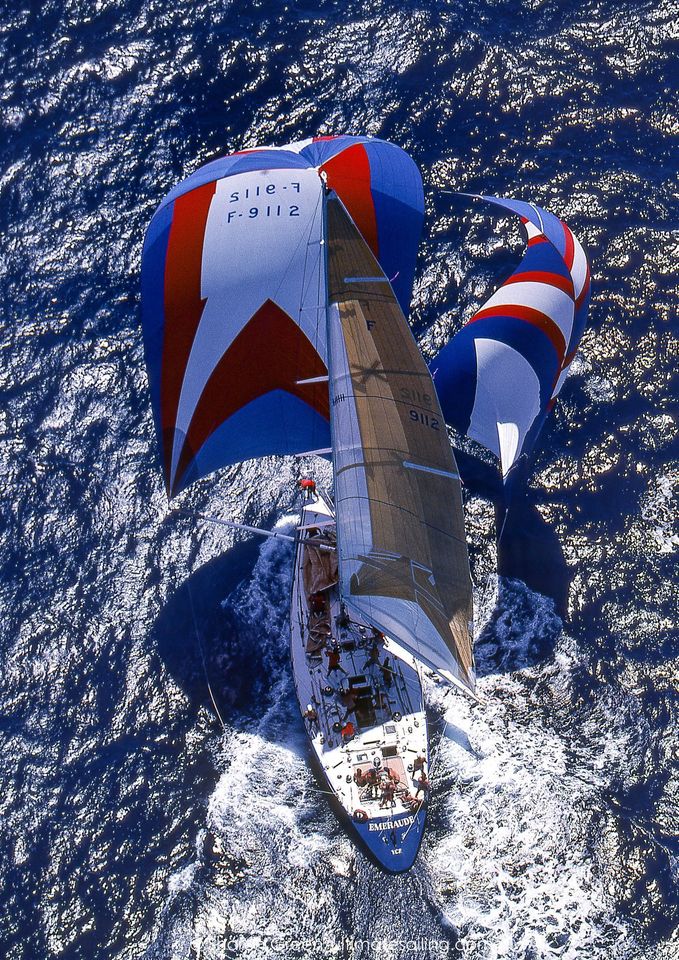
French 'mini' Maxi Emeraude (30th overall and eighth in Class A)

The Japanese Farr 43 Mimi (ex-Equity) (13th in Class E and 27th overall)

Sorcery (18th overall and fourth in Class A) to leeward of Matador

Japanese One Tonner Victoria (seventh in Class E and 14th overall)

A happy looking crew aboard Insatiable

Brazilian One Tonner Black Jack (ninth in Class E and 20th overall)

Ondine VII

More photos from this series can be seen here.


Article dated April 2022

10 September 2021

Steinlager 2

This article is a tribute to the mighty Steinlager 2 (or Big Red as she became known), Sir Peter Blake's all-conquering Maxi ketch that won the 1989/90 Whitbread Round the World Yacht Race.
Blake had been involved in all previous Whitbread races, including as skipper of Ceramco New Zealand (1981-82) and Lion New Zealand (1985-86). Due to race course changes for the 1989/90 edition of the Whitbread, a different kind of yacht was called for due to the expected increase in downwind and reaching conditions. Farr Yacht Design was commissioned to design Steinlager 2 - and she would be initially modelled on the base design developed by the Farr office for the 1989-90 class of Maxis, which were to be an evolution of Farr's earlier yachts such as UBS Switzerland and NZI Enterprise. Development of the base design followed tank testing of hull concepts at the Wolfson Unit, the costs of which were shared between four Maxi syndicates (the process embarked upon by the Farr office is detailed here).
Those four designs were then developed to suit the different needs of each syndicate to create Steinlager 2 (Farr design no.190), Fisher & Paykel (another New Zealand entry, skippered by Grant Dalton, design no.191), Roger Nilson's The Card (no.195) and Pierre Felmann's Merit (no.183).
Steinlager 2 in profile (Course au Large, Histoiredeshalfs website)

It was initially intended that they would all be sloop rigged but, as this race would include more downwind sailing than the previous races, three syndicate heads, Blake, Dalton and Nilson, asked Farr to investigate the relative speed potential of a ketch. Farr’s research, using 'Fast Yacht' software and a Velocity Prediction Programme, revealed that a ketch had potential to get around the Whitbread course more quickly. The ketch rig also yielded rating benefits on two fronts. Firstly, the IOR treated a ketch rig as old-fashioned and inefficient, with the mizzen being rated less than the mainsail, a benefit that increased with greater distance between the two masts. It also only measured the mizzen, and not the mizzen staysail. Secondly, these benefits were further enhanced when calculated under the Mk IIIA version of the IOR, a rule amendment that was developed to penalise lighter displacement yachts (and where Farr yachts were particularly targeted) in the late 1970s. The reduction in measured or rated sail area could then be transferred to hull length.

Although designed for downwind conditions, Steinlager 2 was a very capable yacht upwind too. Note the fore-and-aft spreader on the mizzen to provide support for the narrowly angled outer mizzen forestay (photo Histoiredeshalfs website)
The Farr office delivered a design to the Blake campaign that looked very similar to Dalton's Fisher & Paykel (F&P), a mast-head ketch. Blake went one stage further by suggesting that a fractional ketch could be even faster, based on his experience of his father's ketch yacht, and so he persuaded a reluctant Farr to run his models again based on this new concept. The VPP result was encouraging, but even more gains were made on the rating side of things. The fractional rig provided an even lower rated sail area, but the Mk IIIA equation provided additional benefits through increased length and displacement, and so in the end Steinlager 2 became longer and heavier than her sisters, for the same 70.0ft rating (the maximum allowable for the Whitbread and IOR races generally). She also sported a bulb keel - such a feature would normally be a rating disadvantage as the IOR tended to penalise stability (to a minimum point), but perhaps such a penalty was deemed worth it given the length and sail area gains made elsewhere under the rule.

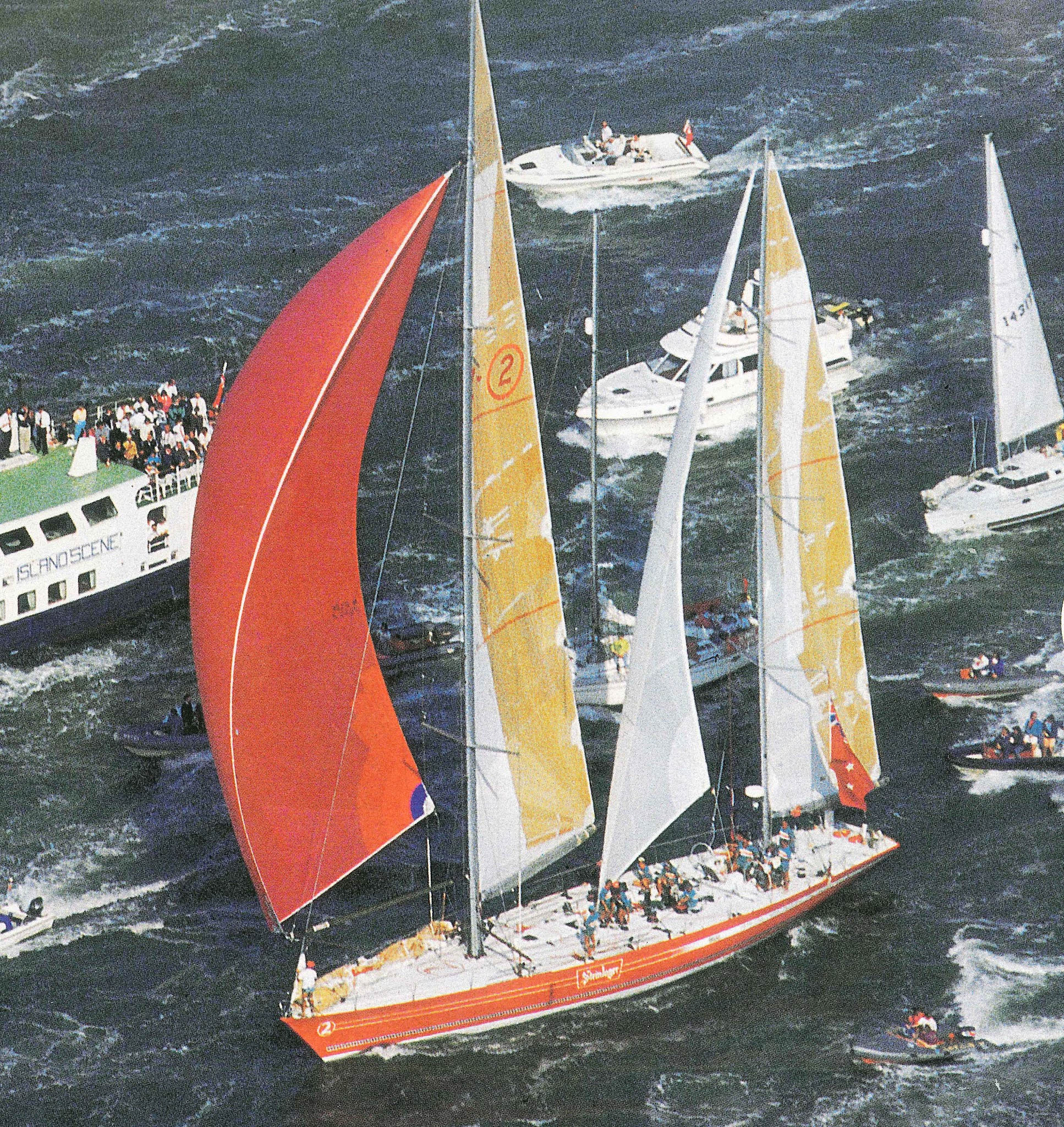
Steinlager 2 slips along in reaching mode flying a huge mizzen staysail that was effectively 'free' sail area under the IOR
So Steinlager 2 was a big Maxi, at 25.5m long (nearly 84ft) and 35,177kg displacement, half a metre longer and more than 3,200kg heavier than F&P. However, it's worth noting that she was not as big as the fastest inshore Maxi at the time, Bill Koch's 26m-long Matador 2, which was 25% heavier at 45,350kg, and Steinlager 2's offshore-orientation meant that she was also significantly lighter than Farr's inshore Maxi of the same era, Longobarda (39,450kg). In addition, and despite the cloud of sail she was able to carry when reaching and downwind, and thanks to the quirks of the Mk IIIA formula, she also had a much lower rated sail area, at 288m2, compared to Matador 2's 325m2.

Steinlager 2 under construction
Blake's earlier boat, Steinlager 1, a trimaran designed and built to win the 2-handed Round Australia race, established the materials and techniques that would be used by Southern Pacific Boatyard to construct Steinlager 2, with the general construction approach for all four Farr Maxi's being "carbon/Kevlar composite with Nomex and PVC foam core used selectively for various effects in weight (relative to cost), stiffness, strength and overload failure mode". However, despite the success of that earlier project, the first version of Steinlager 2's pre-preg composite hull was found to have serious delamination due to a resin problem which meant the entire hull had to be disposed of. Fortunately the sponsors continued to back Blake's ambitions and a new hull was built with all materials verified by SP Systems. 

Steinlager 2 and Fisher & Paykel work up in Auckland (above and below)


Steinlager 2 follows F&P in early trials (photo Shane Kelly | Auckland Maritime Museum)
After launching, Steinlager 2 and F&P began an informal two-boat testing programme in New Zealand, with F&P edging out Steinlager 2 narrowly in the 100-mile Noel Angus Memorial Race, before they were both shipped to England.
Steinlager 2 is loaded aboard a ship in Auckland bound for the Tilbury docks in England
Steinlager 2 beating out of the Solent after the start of the 1989 Fastnet race (photo Derek Stroud)
Both New Zealand yachts contested the 1989 Fastnet Race in England, with this classic offshore race providing a useful 'warm-up' for the big race. Steinlager 2 proved to be very fast downwind and she took line honours, just over three minutes ahead of F&P, providing an important confirmation of her design concept. 
Steinlager 2 five-sail reaching after the Whitbread start

Steinlager 2 five-sail reaching out of the Solent and past the Needles (photo Seahorse/Histoiredeshalfs website)
As readers will know, Steinlager 2 went on to take victory in all six legs of the Whitbread against a fleet of 14 maxis, with a total elapsed time of 128 days 9 hours, well ahead of second-placed F&P's 129 days 21 hours.
Steinlager 2 finishing the 1989-90 Whitbread
After the race finished Steinlager 2 remained in the northern hemisphere for 20 years, under three different owners. She was variously known as Safilo and Barracuda before Swiss sailor Stefan Detjen bought her in 2003. He restored her original name and distinctive original livery, sailing her in six Atlantic crossings (including a Huelva to La Gomera race record), three Middle Sea Races and various Mediterranean regattas. She also took part in some Whitbread reunion races, including the Volvo Legends regatta in Alicante in 2011.
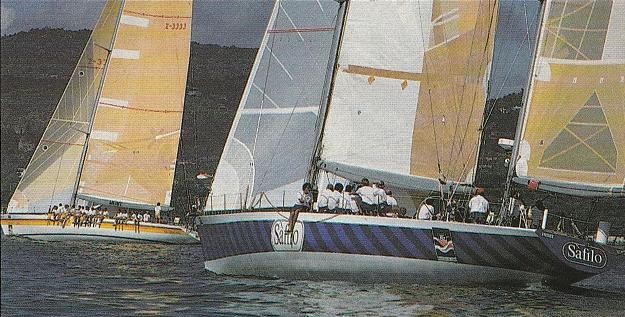
Sailing as Safilo (ITA-12222) (photos Histoiredeshalfs website)

Safilo sailing in St Tropez (photo Phil Uhl | Uhl Studios)

Steinlager 2 back to her original livery
The New Zealand Sailing Trust had been established in 2008 to purchase Lion New Zealand – Blake's Ron Holland -designed yacht which he had taken to second place in elapsed time in the 1985/86 Whitbread – so as to provide sail training experiences for young New Zealanders. There was a growing feeling that Steinlager 2 should also be returned to New Zealand and the following year the opportunity to purchase her arose, so the Trust immediately did so. She was then sailed back to Auckland via the Panama Canal. After an extensive refit, Steinlager 2 was relaunched in November 2013 to take up her new role. Since then, she has participated in various races such as the Coastal Classic and Auckland to Suva, but with a focus on taking New Zealand schoolchildren on voyages all over the Hauraki Gulf.

Steinlager 2 during the 2014 Coastal Classic race (photo Histoiredeshalfs website)

Steinlager 2 in her current berth at the Auckland Viaduct (photo RB Sailing)

The half-hull version of Steinlager 2 now adorns the eastern side of Auckland's Maritime Museum (photo RB Sailing)
A half-hull version of Steinlager 2 was created for the Auckland Maritime Museum (photo above). It is understood that this was built from the original hull mould in 1992, which was cut in half to which five precise bulkheads were added to allow it to be fitted to the exterior Museum wall. 

The fractional ketch concept was subsequently adopted through three new Farr Maxi's for the 1993-94 race, and taken to the extreme. Dalton's yacht, New Zealand Endeavour, which went on to win that race, is covered in this article.
Steinlager 2 in action during a Royal New Zealand Yacht Squadron race on the Waitemata Harbour (photo Instagram November 2023)

Steinlager 2 at Orams Marine in June 2025 for maintenance


Sources:
Sources for the content of this article include the Farr Yacht Design websiteThe Shape of Speed (John Bevan-Smith, 1999), Maxi - The Ultimate Sailing Experience (Preben Nyeland, 1990), Sea Spray and Seahorse magazine (1990), On Board Sir Peter Blake's Refitted Whitbread Champion (Yachting World, August 2019, view here), The New Zealand Sailing Trust (view here) and the Histoiredeshalfs website.


Article updated June 2025