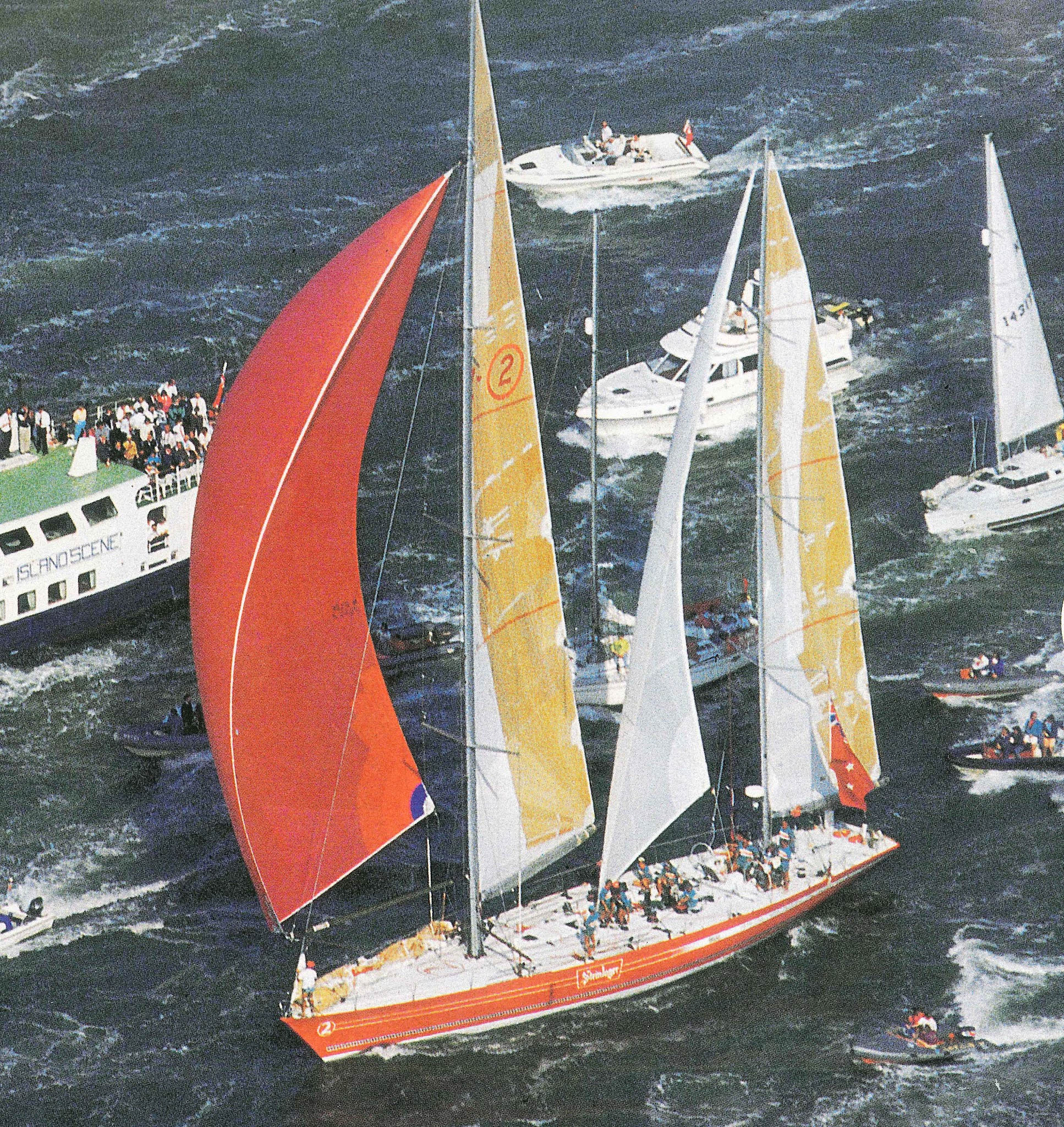
This article is a tribute to the mighty Steinlager 2 (or Big Red as she became known), Sir Peter Blake's all-conquering Maxi ketch that won the 1989/90 Whitbread Round the World Yacht Race.
Blake had been involved in all previous Whitbread races, including as skipper of Ceramco New Zealand (1981-82) and Lion New Zealand (1985-86). Due to race course changes for the 1989/90 edition of the Whitbread, a different kind of yacht was called for due to the expected increase in downwind and reaching conditions. Farr Yacht Design was commissioned to design Steinlager 2 - and she would be initially modelled on the base design developed by the Farr office for the 1989-90 class of Maxis, which were to be an evolution of Farr's earlier yachts such as UBS Switzerland and NZI Enterprise. Development of the base design followed tank testing of hull concepts at the Wolfson Unit, the costs of which were shared between four Maxi syndicates (the process embarked upon by the Farr office is detailed here).
Those four designs were then developed to suit the different needs of each syndicate to create Steinlager 2 (Farr design no.190), Fisher & Paykel (another New Zealand entry, skippered by Grant Dalton, design no.191), Roger Nilson's The Card (no.195) and Pierre Felmann's Merit (no.183).
Steinlager 2 in profile (Course au Large, Histoiredeshalfs website)
It was initially intended that they would all be sloop rigged but, as this race would include more downwind sailing than the previous races, three syndicate heads, Blake, Dalton and Nilson, asked Farr to investigate the relative speed potential of a ketch. Farr’s research, using 'Fast Yacht' software and a Velocity Prediction Programme, revealed that a ketch had potential to get around the Whitbread course more quickly. The ketch rig also yielded rating benefits on two fronts. Firstly, the IOR treated a ketch rig as old-fashioned and inefficient, with the mizzen being rated less than the mainsail, a benefit that increased with greater distance between the two masts. It also only measured the mizzen, and not the mizzen staysail. Secondly, these benefits were further enhanced when calculated under the Mk IIIA version of the IOR, a rule amendment that was developed to penalise lighter displacement yachts (and where Farr yachts were particularly targeted) in the late 1970s. The reduction in measured or rated sail area could then be transferred to hull length.
Although designed for downwind conditions, Steinlager 2 was a very capable yacht upwind too. Note the fore-and-aft spreader on the mizzen to provide support for the narrowly angled outer mizzen forestay (photo Histoiredeshalfs website)
The Farr office delivered a design to the Blake campaign that looked very similar to Dalton's Fisher & Paykel (F&P), a mast-head ketch. Blake went one stage further by suggesting that a fractional ketch could be even faster, based on his experience of his father's ketch yacht, and so he persuaded a reluctant Farr to run his models again based on this new concept. The VPP result was encouraging, but even more gains were made on the rating side of things. The fractional rig provided an even lower rated sail area, but the Mk IIIA equation provided additional benefits through increased length and displacement, and so in the end Steinlager 2 became longer and heavier than her sisters, for the same 70.0ft rating (the maximum allowable for the Whitbread and IOR races generally). She also sported a bulb keel - such a feature would normally be a rating disadvantage as the IOR tended to penalise stability (to a minimum point), but perhaps such a penalty was deemed worth it given the length and sail area gains made elsewhere under the rule.
Steinlager 2 slips along in reaching mode flying a huge mizzen staysail that was effectively 'free' sail area under the IOR
So Steinlager 2 was a big Maxi, at 25.5m long (nearly 84ft) and 35,177kg displacement, half a metre longer and more than 3,200kg heavier than F&P. However, it's worth noting that she was not as big as the fastest inshore Maxi at the time, Bill Koch's 26m-long Matador 2, which was 25% heavier at 45,350kg, and Steinlager 2's offshore-orientation meant that she was also significantly lighter than Farr's inshore Maxi of the same era, Longobarda (39,450kg). In addition, and despite the cloud of sail she was able to carry when reaching and downwind, and thanks to the quirks of the Mk IIIA formula, she also had a much lower rated sail area, at 288m2, compared to Matador 2's 325m2.
Steinlager 2 under construction
Blake's earlier boat, Steinlager 1, a trimaran designed and built to win the 2-handed Round Australia race, established the materials and techniques that would be used by Southern Pacific Boatyard to construct Steinlager 2, with the general construction approach for all four Farr Maxi's being "carbon/Kevlar composite with Nomex and PVC foam core used selectively for various effects in weight (relative to cost), stiffness, strength and overload failure mode". However, despite the success of that earlier project, the first version of Steinlager 2's pre-preg composite hull was found to have serious delamination due to a resin problem which meant the entire hull had to be disposed of. Fortunately the sponsors continued to back Blake's ambitions and a new hull was built with all materials verified by SP Systems.
Steinlager 2 and Fisher & Paykel work up in Auckland (above and below)
Steinlager 2 follows F&P in early trials (photo Shane Kelly | Auckland Maritime Museum)
After launching, Steinlager 2 and F&P began an informal two-boat testing programme in New Zealand, with F&P edging out Steinlager 2 narrowly in the 100-mile Noel Angus Memorial Race, before they were both shipped to England.
Steinlager 2 is loaded aboard a ship in Auckland bound for the Tilbury docks in England
Steinlager 2 beating out of the Solent after the start of the 1989 Fastnet race (photo Derek Stroud)
Both New Zealand yachts contested the 1989 Fastnet Race in England, with this classic offshore race providing a useful 'warm-up' for the big race. Steinlager 2 proved to be very fast downwind and she took line honours, just over three minutes ahead of F&P, providing an important confirmation of her design concept.
Steinlager 2 five-sail reaching after the Whitbread start
Steinlager 2 five-sail reaching out of the Solent and past the Needles (photo Seahorse/Histoiredeshalfs website)
As readers will know, Steinlager 2 went on to take victory in all six legs of the Whitbread against a fleet of 14 maxis, with a total elapsed time of 128 days 9 hours, well ahead of second-placed F&P's 129 days 21 hours.
Steinlager 2 finishing the 1989-90 Whitbread
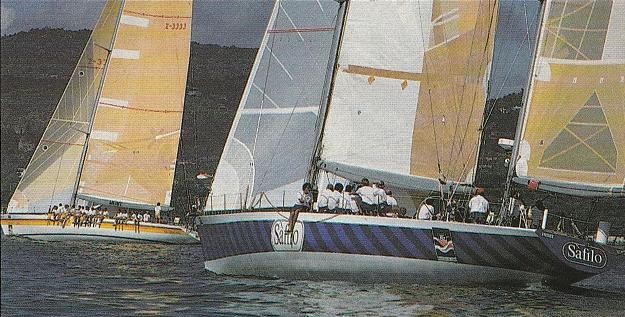
After the race finished Steinlager 2 remained in the northern hemisphere for 20 years, under three different owners. She was variously known as Safilo and Barracuda before Swiss sailor Stefan Detjen bought her in 2003. He restored her original name and distinctive original livery, sailing her in six Atlantic crossings (including a Huelva to La Gomera race record), three Middle Sea Races and various Mediterranean regattas. She also took part in some Whitbread reunion races, including the Volvo Legends regatta in Alicante in 2011.
Sailing as Safilo (ITA-12222) (photos Histoiredeshalfs website)
Safilo sailing in St Tropez (photo Phil Uhl | Uhl Studios)
Steinlager 2 back to her original livery
The New Zealand Sailing Trust had been established in 2008 to purchase Lion New Zealand – Blake's Ron Holland -designed yacht which he had taken to second place in elapsed time in the 1985/86 Whitbread – so as to provide sail training experiences for young New Zealanders. There was a growing feeling that Steinlager 2 should also be returned to New Zealand and the following year the opportunity to purchase her arose, so the Trust immediately did so. She was then sailed back to Auckland via the Panama Canal. After an extensive refit, Steinlager 2 was relaunched in November 2013 to take up her new role. Since then, she has participated in various races such as the Coastal Classic and Auckland to Suva, but with a focus on taking New Zealand schoolchildren on voyages all over the Hauraki Gulf.
Steinlager 2 during the 2014 Coastal Classic race (photo Histoiredeshalfs website)
Steinlager 2 in her current berth at the Auckland Viaduct (photo RB Sailing)
The half-hull version of Steinlager 2 now adorns the eastern side of Auckland's Maritime Museum (photo RB Sailing)
A half-hull version of Steinlager 2 was created for the Auckland Maritime Museum (photo above). It is understood that this was built from the original hull mould in 1992, which was cut in half to which five precise bulkheads were added to allow it to be fitted to the exterior Museum wall.
The fractional ketch concept was subsequently adopted through three new Farr Maxi's for the 1993-94 race, and taken to the extreme. Dalton's yacht, New Zealand Endeavour, which went on to win that race, is covered in this article.
Steinlager 2 in action during a Royal New Zealand Yacht Squadron race on the Waitemata Harbour (photo Instagram November 2023)
Steinlager 2 at Orams Marine in June 2025 for maintenance
Sources:
Sources for the content of this article include the Farr Yacht Design website, The Shape of Speed (John Bevan-Smith, 1999), Maxi - The Ultimate Sailing Experience (Preben Nyeland, 1990), Sea Spray and Seahorse magazine(1990), On Board Sir Peter Blake's Refitted Whitbread Champion (Yachting World, August 2019, view here), The New Zealand Sailing Trust (view here) and the Histoiredeshalfs website.
New Zealand Endeavour (Farr design no.274) was Grant Dalton's entry in the 1993/94 Whitbread Round the World Yacht Race, a successor to Dalton's previous maxi, Fisher & Paykel. New Zealand Endeavour and her near sisterships Merit and La Poste (design no. 278) were born of an extensive research and development exercise by the Farr office. When planning for the boats began in early 1991 it was expected that the costs of that research would be spread over five programmes. However, as global economic conditions declined at that time, research was scaled back, although it remained very thorough, covering weather analysis, tank testing of 14 hull variants, velocity prediction development, appendage development, rig analysis and construction optimisation.
This Maxi class of 1993 took their lead from Steinlager 2, Peter Blake's all conquering ketch from the 1989-90 edition of the race (design no. 190). The new boats were 25.9m long, only slightly longer than Steinlager 2, but with a shorter waterline and much lighter in displacement (27,660kg compared to 35,150kg), with less rated sail area and similar rated beam (it is interesting to compare these displacement figures with the less constrained design of the 1995 ILC maxi Sayonara, of 24,400kg). Rated sail area was traded away to achieve a long light hull, while the rigs were developed to produce more power for their rated area. Appendage drag was drastically reduced through the use of smaller keel foils married to large bulbs, and more slippery hull sections ensured less drag for an equivalent stability and IOR rating.
Profile and deck plan for New Zealand Endeavour (Farr Yacht Design)
The bow profile was a modern interpretation of the clipper bow, having the function of a bowsprit but without the rule complications that use of a bowsprit might entail, a conservative position adopted as one of the lessons from the failed New Zealand America's Cup campaign in 1992.
New Zealand Endeavour is turned over at the Marten Marine yard - the square shape in the keel is the location of the internal ballast slab
The yacht was constructed by Marten Marine and was state-of-the-art - the hull being a complex layup of carbon fibre laminate of five outside and three inside skins, laid on top of three Kevlar skins, which in turn were sandwiched around a 25mm core of Nomex honeycomb and then cured at 80 degrees. More weight gains were achieved in her deck gear - for example the winches were moulded from carbon fibre and milled from titanium and aluminium. The total weight of the winch package was 300kg, compared to 500kg on Fisher & Paykel.
Early trials in the Hauraki Gulf, with main gennaker and mizzen staysail set
Despite carrying less sail, Farr's new 1993 designs were faster in light airs and significantly faster in moderate and strong downwind conditions due to the lower displacement and high effective length. Although New Zealand Endeavour was oriented towards heavier air than her two sisterships (less sail and slightly less displacement), Dalton was keen to ensure that the boat would still be competitive in the light, as a result of losses in these conditions incurred against Steinlager 2 during the 1989 race aboard his previous Fisher & Paykel. The design approach for New Zealand Endeavour also traded off some upwind performance in preference to reaching and downwind speed, but notwithstanding the crew were impressed with her upwind pace in early trials.
This aerial view shows the large separation between the main and mizzen rigs
New Zealand Endeavour slices upwind in light-moderate conditions in early trials - the clipper bow is a notable feature in this photo. The local Lidgard loft provided Endeavour's working sail wardrobe.
The development of the rig was an interesting area, with analysis of different options of rig separation and sail area distribution leading to a high aspect ratio arrangement for both the mizzen and the main, with taller mizzen masts than the 1989 generation, and substantially larger separation between the rigs. This increased separation resulted in smaller mizzen staysails, but greater efficiency was achieved due to the increased space in which they could be set.
The mizzen boom extended well past the transom
The use of a ketch rig was a result of the predominance of reaching conditions typically experienced on the Whitbread course, but also because the sail area of the mizzen was treated 'cheaply' under the IOR. Indeed, the official book of the Endeavour campaign records that an even larger mizzen was contemplated, with a mizzen mast of similar height to the main mast, but engineering challenges saw the height of this rig 'moderated' to just 2 metres shorter.
New Zealand Endeavour powers upwind in fresh conditions during her New Zealand trials
The overall impression was that of a more extreme version of Steinlager 2, with a more pronounced and elongated overhang, married to her unusual clipper bow, and a main mast set for'ard and her mizzen boom extending well past her transom. Her sail plan presented an unusual arrangement of small foresails and spinnakers, offset by large gennaker staysails. She was, to all intents and purposes, the ultimate expression of the offshore Maxi at the very end of the IOR era.
The official launch of New Zealand Endeavour in Wellington Harbour, November 1992
New Zealand Endeavour was officially launched amongst much fanfare in Wellington Harbour in November 1992, reflecting the corporate location of her principal sponsors, in front of a crowd of more than 30,000 - a thunderous fireworks display lit up the harbour in a ceremony broadcast on prime time TV.
New Zealand Endeavour power reaching and flying one of her Banks' gennakers
Any early passage to Wellington for the launching revealed the big advantage in the design of her rig, achieving high average speeds over long periods in five-sail reaching conditions. Dalton commented at the time that the performance gain was largely due to the use of assymetric spinnakers, by then permitted under the IOR rules, as amended for the Whitbread maxis, and which were more stable and could be carried closer to the wind.
New Zealand Endeavour (photo Rick Tomlinson | Facebook)
Her first big test was the 1992 Sydney-Hobart race, which she passed with flying colours, taking line honours in convincing fashion (see video above). She was then shipped to Europe to take part in the UAP Round Europe race and the 1993 Fastnet race. New Zealand Endeavour came up against her maxi competition in the Round Europe (photo right) - Merit Cup and La Poste - where she rounded out the winner, despite finding some chinks in her light air speed due to some sails being off the pace and the boat being optimised for heavier winds. Just before the
Round Europe race, some delamination was discovered in the bow sections
and these were required to be repaired before the Fastnet race, resulting in
some major surgery. During this refit new rigs, designed and built by Southern Spars, were stepped, some 25kg lighter than the originals. A new lighter keel was also fitted (500kg) - being smaller in size it also reduced underwater drag. The changes proved successful, and New Zealand Endeavour was the best of the maxis in the Fastnet race, but they lost out to the smaller Whitbread 60s that were better suited to the fresh upwind conditions in the first half of the race.
New Zealand Endeavour at the start of the third leg from Fremantle to Auckland (8 January 1994)
The performance of New Zealand Endeavour in the Whitbread race is well documented - she won the first leg to Punta del Este, lost the top half of her mizzen mast on the leg to Perth, but bounced back to win the third leg to Auckland and the fourth leg to Punta del Este. She finished with the fastest elapsed time of 120 days and five hours, to give Dalton and his crew the coveted Whitbread trophy. Her time was nine hours faster than Yamaha, the first to finish of the new Whitbread 60 class, and some eight days faster than Steinlager 2's record breaking performance four years prior. Merit Cup finished third, 21 hours behind New Zealand Endeavour.
New Zealand Endeavour sails out of the inner Hauraki Gulf at the boisterous start of the fourth leg (19 February 1994)
At full power with spinnaker and her big mizzen gennaker set
New Zealand Endeavour was later purchased by Australian sailing interests and renamed Tasmania, which went on to take line honours in the 1994 Sydney-Hobart race. The video of that race can be seen here:
New Zealand Endeavour (as she has since been renamed) was listed for sale in 2014 (in Portoferraio, Elba Island in Italy) after having been largely unused in the prior six years, apart from an Atlantic crossing in 2008 (although she received some extensive refit work before undertaking that crossing).
Recent photographs (April 2022, Sailing Anarchy), below, show that New Zealand Endeavour is being maintained in much better condition, and is now located in Marina Santelena, Venice, Italy, under the ownership of Scuola Navale Militare.
New Zealand Endeavour, as seen in January 2023 (photo Facebook)
New Zealand Endeavour, sporting some additional sponsor decals, as seen in Dubrovnik in October 2025 (photo Facebook)
New Zealand Endeavour also competed in the Barcolana regatta, held in Trieste, Italy, in October 2025.