Showing posts with label One Ton Cup 1978. Show all posts

2 January 2014

Stress (Norlin One Tonner)

Following a recent article on the Peter Norlin designed One Tonner Agnes I have been contacted by the current owner of the last of Norlin's 'A-series' of yachts, the One Tonner Stress, which has prompted this post  regarding her origins and racing history based on some excellent insights and photographs from Markus Norlin and her current owner, Polish yachtsman Zbyszek Kania.

Stress was built with GRP over an Airex core by Sailing Progress for the 1977 season, commissioned by Goran Winberg and Borje Blumenthal. She was essentially a development of the Agnes lines, but with slightly less drawn out displacement in the bow and slightly larger. 

Stress achieved immediate success in her first season - the overall winner of the Round Gotland race (against 200-300 boats) and a host of other local regattas in Sweden and Finland. She was winner of her class in Cowes Week that year, performing strongly in the light winds that prevailed, and she then went on to finish second overall in the Channel Race. Her result in the light airs Fastnet Race was not as impressive, as stronger winds came in for the smaller yachts after Stress and other top boats had finished.
Stress during the 1978 One Ton Cup (photo courtesy Markus Norlin)
Stress had measured in at just 27.2ft IOR, just below the One Ton limit of 27.5ft, and so for the 1978 season, and the One Ton Cup of that year, her bow section was replaced with one with a finer entry, extending her waterline and increasing her rating by 0.3ft. 
The original lines drawing of Peter Norlin's Stress
Peter Norlin at the helm of Stress
At the 1978 One Ton Cup, held in Flensburg, Germany, Stress opened her campaign strongly, with a first place in the opening race, and followed this with a fourth in the second race. But after this she stood no chance against the lighter fractional rigged yachts as the breeze arrived. Stress finished the series in seventh place overall, but won the Bummerlunder Cup for the best yacht in the inshore races, and was the top scoring masthead rigged yacht. 

Startline action in the 1978 One Ton Cup - Stress leads off towards the pin end of the line - Danish yacht Heatwave is visible two boats back with second placegetter Bremen just to windward (photo courtesy Markus Norlin)
Stress in her preferred light air conditions during the 1978 One Ton Cup (photo courtesy Markus Norlin)

Stress (left) in close company during the 1978 One Ton Cup, with Heatwave (D2892) and Export Lion (KZ-3398) to leeward and ahead.
After that Stress was sold by her original owners to a Swedish doctor Stephan Brandstedt, who raced her in the 1979 Fastnet Race. In the severe conditions that prevailed the mast was lost and the crew sought shelter in Cork, Ireland. She was then sold in 1984 to Johan Listrup and she was renamed Sylvia 2 (after his wife and mother), and the yacht went on to scored further victories in the Round Gotland race in 1984 and 1986, and in other years, up to 1991, she dominated Class 3 in this famous Swedish race. 
Sylvia 2 during a long offshore race off Sweden during the 1980s
Her present elliptical rudder was built in 1985 by Listrup's son, Jens Listrup, and based on rudder drawings from the Norlin One Tonner Big Foot. The previous owner had already modified the original rudder but this was very heavy, while Jens utilised the original aluminium shaft and corrected the previous asymetric shape to a more efficient (and symmetrical) design, saving 100kg in the process.
The Listrup family also built these impressive 1:10 scale models of Stress
Sylvia 2 was sold to a Polish sailor Bruno Salcewicz in 1996. She is now raced by another Polish sailor, Kazimierz Kuba Jaworski, who had also won the monohull division in the 1980 OSTAR. Kania has renamed the yacht as Mist and she now sails on the Baltic Sea, and is looking in good condition after a recent refurbishment in Poland. 
Stress in her more recent configuration, seen here in Poland in 2013 (photo Zbyszek Kania)
 

10 September 2013

Heatwave (Jim Young One Tonner)

Original profile drawing for Checkmate
Heatwave, a Jim Young designed One Tonner, started life as Checkmate, making her racing debut in the New Zealand One Ton Nationals held in early 1977. Checkmate was a fairly radical looking yacht, with a very upright bow profile and waterline sections based on Youngs' earlier NZ37 design, plus flared topsides to maximum crew leverage and some hull distortion for a favourable IOR rating. Contrary to the strong wind orientation of his earlier Half Tonner Mama Cass, Checkmate tended to be overpowered in a breeze and performed better in the light. While she showed some potential, she was never an all-round threat and finished a disappointing 11th in the Nationals (with placings of 8/13/6/9/11/DNS).

Following that performance, Young carried out some major surgery to Checkmate, to the extent that the fiberglass yacht was cut in half, retaining the bow sections while long hours were spent fitting a new after section. Also discarded was the keel which was substituted by a 800lb weighted centreboard that, originally, was able to automatically gybe three degrees to weather and gave a definite advantage when beating, particularly in a breeze. The old name was also discarded, and the yacht emerged as Heatwave.

Checkmate during the 1977 New Zealand One Ton Nationals (above and below)

The bow sections were not left completely untouched, however, with the introduction of a new sharp upward curve in sheerline, combined with a 'stepped' concave stem profile (similar to Stephen Jones’ English Quarter Tonner Odd Job) – an approach that appeared to allow the forward girth station to be moved aft while retaining maximum waterline length for’ard. Her rig utilised a swept-back spreader concept, with a small set of spreaders for the lower inboard stay, and did not appear to be as sophisticated the in-line set up used on her Farr competitors, nor, in the end, as robust.  

Heatwave featured the longest rated length and widest beam aft of all the top boats that entered the 1977 One Ton Cup trials, which suggested high theoretical speed. However, in a fixed rating class length had to be paid for, and was offset in Heatwave's case through a more voluminous underbody and significantly greater displacement, and a relatively modest sail plan. 
Heatwave during the 1977 One Ton Cup trials (photo Maritime Museum)

Heatwave did go on to be the surprise performer of the New Zealand trials for the team to contest the 1977 One Ton Cup. While she was generally considered to be the fastest boat on a tight reach, she suffered a broken mast in the first race, and had to scramble to put a new rig in the boat in time for the second race, in which she finished a lowly tenth. However, Heatwave recovered to finish in third place In the medium offshore race - she was the only boat to head Smackwater Jack in the outer Gulf, leading from Groper Rock to Channel Island, but she was headed by the superior capabilities of Smackwater Jack and Jenny H to windward, and suffered from damage to her cockpit instrumentation. She then backed that up with a second in the fourth race and a modest sixth in the final race.
Heatwave during the first race of the 1977 One Ton Cup, behind Result (KC2998) and Rockie (US2900)
Heatwave opened her One Ton Cup scorecard with an eighth place, last of the centreboarders and edged out for sixth and seventh by the Farr keelboats Country Boy and Rockie. However, Heatwave bounced back strongly in the second race to lead at the first mark, after working the favoured left hand side of the course, but gear problems caused her to fall back. A mainsail slide jammed as the crew went to reef the sail for the second beat while closing on the bottom mark. The crew ended up late getting the spinnaker down and by the time everything was sorted out they had dropped to third place.  


Heatwave
then had a disappointing 11th in the medium distance offshore race, which got underway in light airs, but recovered in the stronger conditions in the fourth race with another third.

Heatwave leads Mr Jumpa and The Red Lion around the first mark in the second race of the One Ton Cup
Heatwave on a downwind leg during the 1977 One Ton Cup

Heatwave powers along upwind during the 1977 One Ton Cup (photo Facebook)
With near gale conditions for the start of the long offshore finale, there were hopes that Heatwave may be able to put in a strong performance to lift her up in the overall standings.  However, trouble started before the race even got underway when Heatwave suffered a collapsed spreader. She ended up starting half an hour behind the fleet after tying up to Orakei Wharf to effect repairs. Heatwave finished the long race in fifth place, and she finished the series in sixth place overall.
Heatwave sails up the Rangitoto Channel during the 1977 One Ton Cup (photo Maritime Museum)
Heatwave arrives back at Westhaven after a race in the 1977 One Ton Cup
Heatwave leads Export Lion around a gybe mark during one of the inshore races during the 1978 One Ton Cup
Heatwave during the 1978 One Ton Cup
Heatwave was bought by a Danish sailor in time to compete in the 1978 One Ton Cup, which was sailed in Flensburg, Germany. With her long length, heavier displacement and moderate sail area, was in her element upwind in a breeze, which was in good supply for the series, and she benefited from some new sails from the Fogh loft. While Heatwave was sailed at least 8 to 10 degrees lower than anyone else, her boatspeed was so good she more than made up for this lack of height. But she was not endowed with particularly good speed downwind, mainly managing to live off whatever buffer she had earned on the upwind legs. 

Heatwave may well have won the series had she not met such light airs in the first race. In that race, and although she was faster in light airs than she had been a year earlier, she finished a calamitous 16th. But Heatwave followed this with a second, sixth and a first, for fourth overall, and in three of the four races, including both offshore races, she led around the first weather mark.  

Heatwave has since been based in Europe, and more recent photos from circa-2003 are shown above and below.

4 September 2013

The Red Lion (Farr 37)

The Red Lion, the Bruce Farr centreboarder that won the 1977 One Ton Cup, is still going strong! I recently heard from the current owner of The Red Lion, an Italian yachtsman (Marco) who bought the champion yacht in 1980 from her previous owner in Punta Ala. This was a couple of years after the 1978 One Ton Cup series in Flensburg, Germany, where she finished in ninth place.

The Red Lion has been maintained by Marco in excellent condition in her current home port of Salerno, Italy. She undergoes a complete refit every ten years to ensure her wooden hull remains sound. After experiencing some problems with the centreboard, The Red Lion was fitted with a Farr-designed fixed keel in 1984. The new keel and added stability has also allowed for a new and taller mast. For her most recent upgrade the owners made use of the photos attached on an earlier article on the history of The Red Lion, and the name and lettering is now faithful to her original appearance. 


I am grateful to the Marco and his family for providing these more recent photographs of The Red Lion, showing her competing in many regattas in the Mediterranean seas of Italy over the years, including the Italian Championship off Capri in 1986 (where the stunning Bert Richner photograph at the top of this article was taken). Photos like this shows that the fears of yachting officialdom in the late 1970s that boats like The Red Lion would fly to pieces were unfounded.

The Red Lion racing in Capri, 2000 (above and below)


The Red Lion racing in Gaeta, 2002 (above and below)

The Red Lion following her most recent 19-month long refit


13 July 2013

Export Lion (Farr One Tonner)

The 1978 One Ton Cup was held in Flensburg, Germany. Stu Brentnall and his crew had won the 1977 series in Auckland aboard their Farr centreboarder The Red Lion, but after the Cup Brentnall sold the champion yacht to an Italian yachtsman.  With the sale of other top local One Tonners to overseas owners, including Jenny H, Mr Jumpa and Smir-noff-Agen, it was apparent that New Zealand would struggle to mount a defence of the trophy.  

Brentnall approached the RNZYS with a proposal to build a new boat for the 1978 series, based largely on the design that was so successful in 1977 but optimised to meet the changes to the IOR. This included several hull and rig alterations aimed to improve performance in the light to moderate conditions expected in the Baltic, being slightly shorter, beamier and lighter and with a bigger rig.  A centreboard configuration was opted for rather than a fixed keel, because at the time the design was drawn this still appeared to be a viable proposition.

Final preparations for the launching of Export Lion, June 1978 (photo Jenny Green/Sea Spray)
Export Lion was built in double quick time by Alexander Boats, who had also built The Red Lion, and Brentnall's earlier One Tonner, Jiminy Cricket. 
Export Lion on launching day at Westhaven, Auckland (photo courtesy of Lion Archives)
Export Lion on launching day (photograph by Jenny Green/Sea Spray)
Export Lion sails downwind along the central Auckland waterfront (photo courtesy Lion Nathan)

Export Lion during sailing trials on the Waitemata Harbour
With the return of the One Ton Cup to Europe, there was a boost in fleet numbers, with 36 yachts representing 13 countries. The Red Lion and Jenny H (renamed Scalawag) remained competitive, despite the changes needed to their centreboards under new IOR regulations. But a series threat also emerged in the shape of two Ron Holland designed yachts, Tilsalg and Bremen, who had engaged in extensive two boat tuning before the series. 
Germany's Tilsalg sails upwind during the 1978 One Ton Cup (photo Peter Montgomery/Sea Spray)
Germany's Bremen sails downwind alongside Britain's Solent Saracen, another Farr design, in the 1978 One Ton Cup (photo Peter Montgomery/Sea Spray)
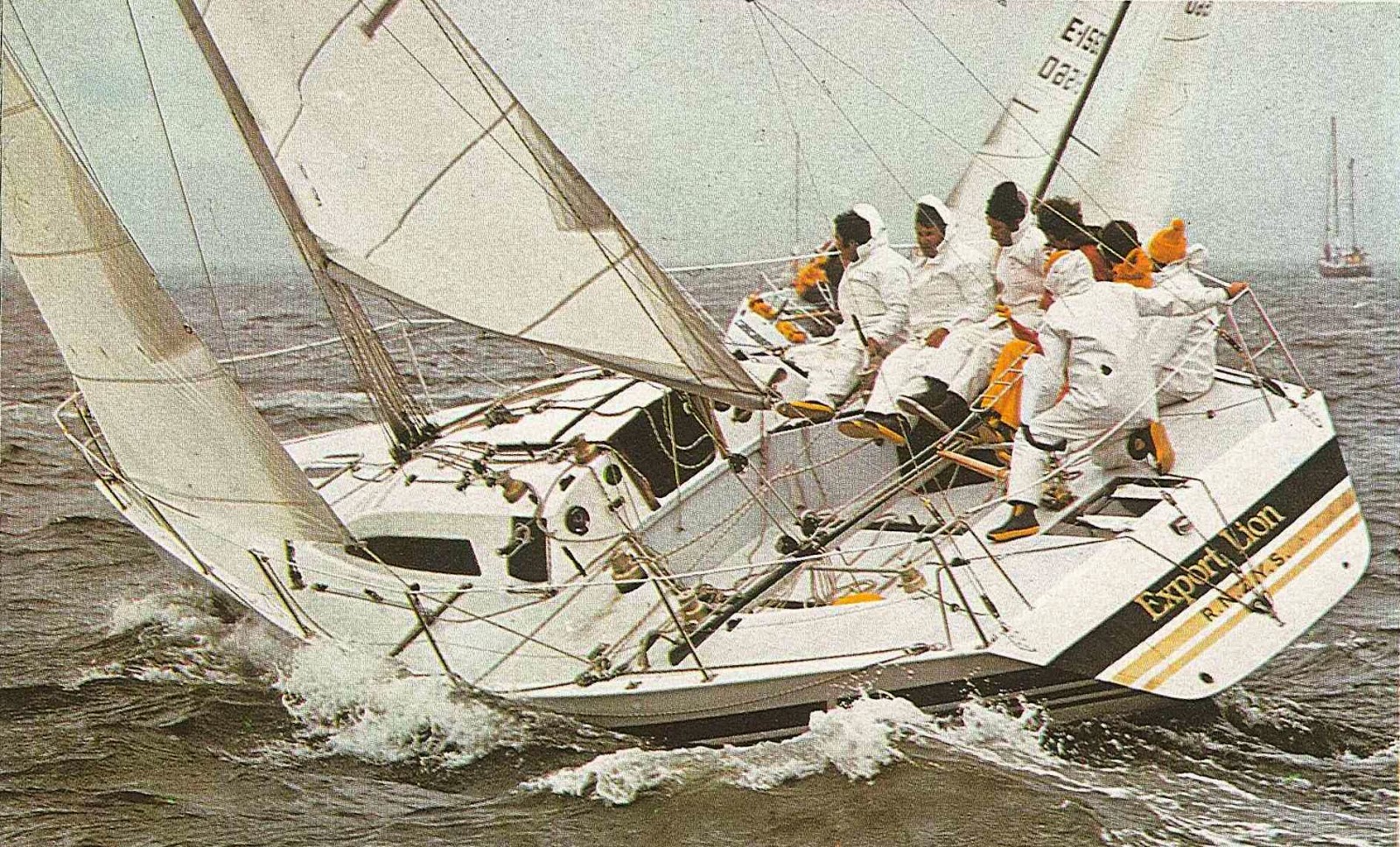
However, it was Export Lion that held a slender lead after three races of just 0.625 points over Bremen, with Tilsalg a further 2.25 points behind. Scalawag was not far off the pace, and any of these four boats could have gone on to take the series. Export Lion had proved to be more tender than her predecessor, but proved fast in all conditions and points of sailing, and performed best when the breeze was above 5 to 8 knots. She was equipped very lightly, but had minimal problems with gear breakages.
Export Lion in fresh conditions in Flensburg (photo Facebook)

Export Lion 
Export Lion alongside a German competitor in light airs and amongst an enthusiastic spectator fleet (photo Peter Montgomery)
With such a narrow lead, Export Lion took a cautious approach to the start of the last race, the long offshore. But despite hanging back from a biased start line on starboard tack, with sheets eased and waiting for the line to clear, the also-ran Cascabel collided with Export Lion with such force that Export Lion was spun around and was pointing backwards when the gun went. It took some time for the two yachts to disengage, and both were at the back of the fleet at the first mark. Although in a 300 mile race this would not have seemed insurmountable, the mark had heralded the start of the 150 miles of fast downwind sailing, and gave the front runners, sailing at 9 knots, a big advantage over those still trying to get to the first mark at 6 knots.


Export Lion powers along upwind in the 1978 One Ton Cup (photo Peter Montgomery)

Tilsalg prepares for a spinnaker set during the 1978 One Ton Cup
Tilsalg also had some ground to make up as she was in the middle of the fleet at the top mark, but she was able to summon some good downwind speed to work her way up to tenth at the next turning mark. Both Tilsalg and Bremen were able to secure more than a sufficient margin over Export Lion to take the first two places overall. Both were beneficiaries of Export Lion's misfortune - but Export Lion had been sailed as well as any in the series. Even though Farr had - unnecessarily as it turned out - remodelled his 1977 design in anticipation of lighter airs in Germany, Export Lion was still considered the fastest boat there. But in the end Scalawag finished as the best placed Farr boat in third place, while Export Lion finished fifth.
 Tilsalg - winner of the 1978 One Ton Cup (photo Peter Montgomery/Sea Spray)
Export Lion trails Heatwave during one of the inshore races during the 1978 One Ton Cup