Showing posts with label Quarter Ton Cup 1981. Show all posts

8 March 2016

Quarter Ton rebuild news

A couple of Quarter Ton rebuilds have appeared on the "1/4 ton zeilers" page recently - the upgrade to Innuendo (GBR-7557), the ex-Senator Incitatus, looks particularly impressive - this boat is a James McIlraith design, that was bought by Peter Morton in 2015 and is receiving the kind of attention previously applied to the likes of Anchor Challenge and Bullit, and the Half Tonner Swuzzlebubble.

Another impressive upgrade to an old Quarter Tonner - the original bustle in the stern quarters remains evident, but a new IRC-optimised keel has been added
Innuendo now features a simple and highly refined deck layout


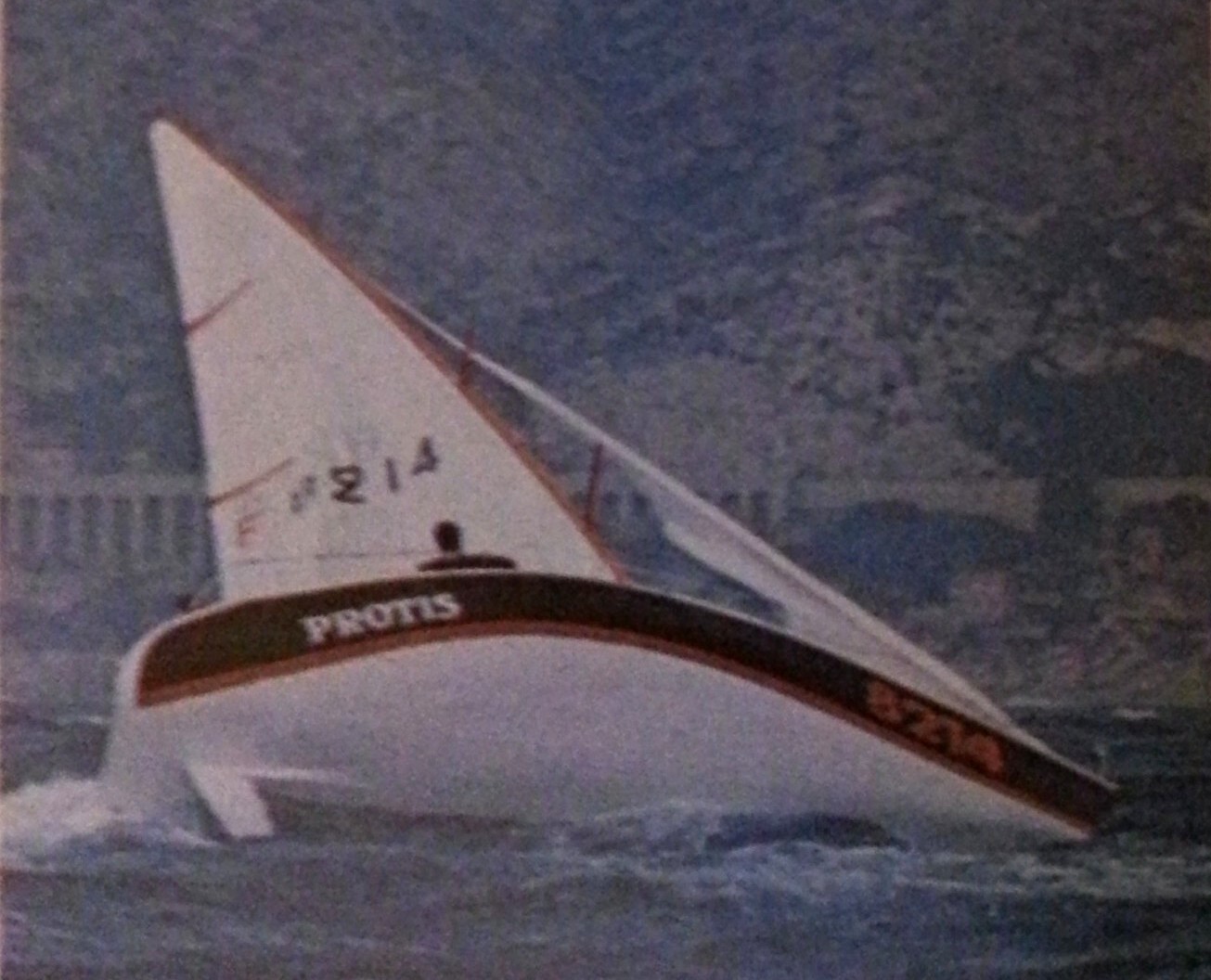
Also receiving some love and IRC optimisation is the 1981 Quarter Ton champion, the Jacques Fauroux-designed Lacydon Protis, which is being prepared for the 2016 UK season.

Lacydon Protis in the wild conditions of the 1981 Quarter Ton Cup


22 February 2016

Hellaby (Davidson Quarter Tonner)

Hellaby was designed by Laurie Davidson, for the 1980 Quarter Ton Cup, held in Auckland, New Zealand. She was owned by John Lasher and skippered by Tony Bouzaid, of Waverider fame, and was one of the fastest of the new Quarter Tonners launched for the 1980 series, that included new Bruce Farr designs Anchor Challenge (which won the New Zealand Quarter Ton trials) and Hot Number. Compared to the Farr designs, Hellaby, as a development of Davidson's earlier Quarter Tonners such as Fun, was slightly longer than the Farr boats overall, but with a shorter 'length between girths', and a slightly narrower beam.
Hellaby working upwind during the 1980 Quarter Ton Cup
The new boats were joined by a number of revamped yachts from the local fleet, including earlier Davidson yachts such as Bashful, Blackfun, Continental Fun and Hi-Flyer, and the Whiting Quarter Tonners Strawberry Letter, Smokey Joe and Hatchway Hummer.
Hellaby undergoes some early modifications to optimise her rating under IOR, including bumping of her midship depth
But the local fleet were comprehensively beaten by the Jacques Faroux-designed Bullit, which at the time demonstrated that European design thinking had overtaken the New Zealand style of boat, with more of a dish shape, with less depth and more beam, a longer stern overhang and an ability to surf downwind much more easily than her rivals. 
Hellaby follows Bullit around a windward mark during the 1980 Quarter Ton Cup
The moment of truth arrived after the top mark in the first race. Bullit rounded second, behind Australian entry Bashful, but by the wing mark was 38 seconds ahead, and went on to finish a full six minutes ahead of the second placed Hellaby. After a repeat performance in the early stages of the second race, sailed in fresh conditions, one of Bullit's spreaders failed and the crew were forced to reduce sail, letting Hellaby in to win after she overtook Anchor Challenge on the second reach.
Hellaby and Bullit before a race - note Hellaby's name covered to address Rule 26 (sponsorship) issues (photo Peter Montgomery Collection)
Bullit was able to reinforce her superiority in devastating fashion in the 140 mile intermediate race, where she beat the second placed Hi Flyer (another Davidson design, and sailed by Helmer Pederson) by almost 47 minutes in the 24 hour long race. Hi-Flyer managed to beat Hellaby by just 12 seconds. The race was sailed in 15-20 knot winds which suited Bullit perfectly. She repeated the performance in the fourth race, steaming away on the reaches and runs after rounding the first mark in fourth place. Hellaby took second in the fourth race, with Bullit again taking the gun.
Hellaby during the 1980 Quarter Ton Cup

The 220 mile long ocean race was sailed in very fresh conditions, with 40 knot gusts at the start and a forecast that did not provide much hope for an improvement for a fleet faced with two roundings of Channel Island. Again, Bullit set a blistering pace in the initial downwind work, but many of these small boats suffered knockdowns and a nervous, if not scary, time while out in the vicinity of Channel Island. Bouzaid considered the race dangerous, and said they were lucky not to strike wind against tide at Channel Island. Hellaby at one stage submerged completely after gaining high speeds from a number of waves - the boat was white from bow to stern and Bouzaid, standing as far aft as he could get, had water around his knees while gear on the boat began snapping and popping.

Hellaby in Marseilles, 1981
Hellaby during the 1981 Quarter Ton Cup
Hellaby during the first race of the 1981 Quarter Ton Cup
The race was again won by Bullit, despite rig damage, while Anchor Challenge finished second. Hellaby came in third. With the victory in the final race Bullit secured the Quarter Ton Cup for France, with 116.5 points, well clear of Hellaby in second place on 106.25 points, just 0.75 points ahead of Anchor Challenge, while Hot Number finished fourth.
Mädchen at the 1984 Quarter Ton Cup - the winner of the series Comte de Flandre (F-9083) visible to the upper left
Hellaby went on to contest the 1981 Quarter Ton Cup in Marseille, where she finished fifth in a fleet of 31 boats - she was lying second with placings of 1/6/5/3 before the final Mistral-affected final race from which she retired. After that series she was bought by German yachtsman Horst Dietrich who renamed the boat Mädchen. Dietrich contest the 1984 Quarter Ton Cup in Nieuwpoort, where she finished sixth (of 26 boats). Dietrich sold Mädchen after the 1984 Quarter Ton Cup to Danish sailer Bent Folke Larsen, where she finished seventh in the 1985 Cup with a number of wins and a broken mast after a regatta with winds above 25m/s and a fun couple of legs as the only one carrying a spinnaker. Mädchen was replaced by Whopper for 1986 (3rd), and McDonalds which won in 1987. She had a poor regatta in 1990 (finishing 37th, as SCO) and the boat was later bought for a sailing school in Hamburg and renamed Quatro. Dietrich sailed a Judel & Vrolijk design the following years - also called Mädchen, coming in 5th in Cork in 1987.
Mädchen at the 1984 Quarter Ton Cup (photo 1/4 zeilers Facebook page)
Hellaby, prior to her 2016 refit by Robbie Stewart (photo Facebook)
Hellaby was subsequently found in a somewhat worse for wear state and underwent a refit in 2016 by Robbie Stewart and optimised for racing under IRC and in the Quarter Ton Cup revival series.
Hellaby's refit included an updated keel and rudder (photo courtesy of Jon Sturmer)

Hellaby after her refit, with the stern transom filled in - and still sporting her original sponsor's name, a prominent New Zealand meat producer, as well as her original New Zealand registration number (photo courtesy Jon Sturmer)

A revamped Hellaby competing in the 2018 Quarter Ton Cup

Hellaby with a revised paint scheme (more aligned with the original) seen here competing at the 2022 Cowes Week (photo Facebook)

Hellaby (now 'Puffin Hellaby') seen here in the 2026 Bangor Regatta (hosted by the Royal Ulster Yacht Club), where she finished second in IRC 2 (photo Con Murphy | Afloat | Facebook)


Article updated July 2026

27 October 2015

Quarter Ton Cup 1981

The 35-boat fleet that assembled for the 1981 Quarter Ton Cup in Marseilles, France, included qualifiers from the well-attended French and Italian selection trials (a total of 70 boats competed in these two events), and several boats from other countries. The winds ranged from Force 2 to Force 11 (4 to 60 knots), and in the last race of the series, only three boats were able to reach the finish line.
Protis, winner of the 1981 Quarter Ton Cup
The pre-regatta favourites were the many custom and semi-production boats designed by Frenchman Jacques Fauroux, whose Bullit had won the previous two editions of the Cup. Fauroux sailed one of his designs, La Concorde, which, like many other of his boats in 1981, had less extreme stern sections than Bullit, in response to changes in the IOR. The best competition for the Fauroux boats promised to come from the Italian Willy Willy, designed by the Fontana/Maletto/Navone team, and from New Zealand, the Davidson-designed Hellaby that had finished second to Bullit the previous year. 
Cifraline in trouble on a downwind leg during the 1981 Quarter Ton Cup
The opening race was an Olympic triangle sailed in Marseilles’ South Bay in a 17-33 knot easterly. Hellaby took the start and kept the lead throughout the race, with a careful cover over a new custom Fauroux design, Protis which was co-skippered by Bruno Trouble (interestingly, Protis was the only boat in the fleet to carry an inboard engine, which allowed her to be a little bigger and to carry a little more sail area). As the wind freshened, Hellaby extended her lead and won by more than two minutes, with Protis second, and Petite celte, another Fauroux design third, and Willy Willy fourth. 
Adelaide - her ability to carry her spinnaker during the fourth race gave her a big advantage over the rest of the fleet
The second inshore race, sailed in similar conditions to the first, was won by Adelaide, yet another Fauroux design, owned and skippered by Dominique Caparros, who had co-skippered Bullit in 1979 and 1980 and had Adelaide built from the same mould. She led the race convincingly from Protis, while Willy Willy finished fourth and Hellaby sixth. 

The photo to the left is of Lorraine, another new Fauroux design owned by Hong Kong sailor Gilbert Ng and skippered by Helmer Pederson. The photo was taken by Beken of Cowes, on the first day of racing - another reef was needed on the second day and was too fresh for the photographers.

Due to the hard going in the first two races, only 29 entries began the 80-mile middle distance race, which started in much lighter conditions, with La Concorde taking the early lead. Protis moved up to second on the next downwind leg before passing La Concorde to move into first, a position that she would not relinquish. La Concorde was subsequently disqualified for rounding a mark incorrectly. 


Protis during typically fresh downwind conditions during the 1981 One Ton Cup
In the next race, another Olympic triangle held in West Bay, the seas were less rough but the wind was much stronger than the previous inshore races. Adelaide again showed excellent speed in these conditions, gaining the lead early and setting her spinnaker on the reaching legs and opening up a huge lead in dramatic planning conditions. Several other boats tried setting spinnakers and suffered broken masts as a result. While Protis held second place at the start of the run, she too broke her mast after setting her spinnaker. 
Protis - possibly during the first race, and before the more wild conditions of the second and fourth inshore races
The start of the third triangle race (photo Frederic Allain/Seahorse)
Only 21 boats started the 180-mile final race, and four more dropped out in the early stage. The fleet beat their way east in a moderate breeze towards St Raphael, the only mark of the course save for the requirement to stay seaward of the islands along the shore. Protis, which had been allowed to install a new and stronger mast after her fourth race mishap, took over the lead on the first leg and turned the St Raphael mark early the next morning. La Concorde, the early leader, reclaimed her position at the head of the fleet as they worked their way southwest to the islands again. 
Willy Willy
As the fleet entered the last stage of the race in the late afternoon, a mistral wind began blowing from the west at 35-60 knots. Willy Willy, built of plywood, broke some frames and retired as did a number of others, including La Concorde and the New Zealand crew on Hellaby, who professed to never having encountered winds of mistral force before. 
Protis above and below caught in the mistral wind in the fifth race

Greg Dagge from Lorraine recalls that by evening they were just holding station off the Isle de Hyeres against huge waves that were coming off the land. They were in a good position when the compression strut between the chainplates gave way and they were forced to retire, but sailed back to Hyeres under bare poles and incredibly recorded speeds of up to 18 knots.

New Zealand's Hellaby, sailed by John Lasher and which finished in fifth place overall
Another photo of Cifraline in trouble on a downwind leg
By early evening, there were only three boats left in the race. Gyptis, a Jezequel design, was anchored far to the east and would not finish for two more days. Cifraline, a steadily improving Daniel Andrieu design, was battling with Protis which, unbeknownst to the crew, now only needed to finish the race to win the series. Both boats managed to beat past the dangerous Cape Sicie, but then found it so rough that they ran back into the lee of the Cape and anchored for most of the night. They began racing again in the morning, but since Cifraline weighed anchor half an hour earlier, she made it home against the still heavy mistral ten minutes ahead of Protis.
Gyptis
Her second place in the final race gave Protis the Cup, and Fauroux his third consecutive Quarter Ton title. Cifraline finished second and Gyptis third. Willy Willy was fourth, while Hellaby finished the regatta in fifth place. 
Protis during the 1981 Quarter Ton Cup (photo Seahorse magazine)
Protis as seen in 2015
 
Protis has continued her winning ways in Cowes during the running of the modern Quarter Ton Cup series (photo Facebook)


Article updated February 2024