The second
edition of the Pan Am Clipper Cup attracted 64 yachts from Australia, Bermuda, Canada,
Japan, New Zealand, Hong Kong, the United States and the United Kingdom. Fortunately renowned marine photographer Phil Uhl was there to capture the action, and this article features a number of his photos from the series.
 |
| Winner of the 1980 Clipper Cup, Australian yacht Ragamuffin (photo Phil Uhl) |
The fleet
included three Maxis, Siska (Australia) and Windward Passage (US) and the smaller Mistress Quickly (UK). Condor of Bermuda had also planned to compete, but struck a coral atoll north of Tahiti enroute to Hawaii.
 |
| The 73-foot Maxi, Windward Passage in her new configuration as a sloop, put in a dominant performance through the first four races of the series (photo Phil Uhl) |
It was the Australian yacht Ragamuffin, a Peterson 45-footer owned by Syd Fischer (rating 35.2ft IOR), won the Clipper Gold Cup for the top individual yacht of the series, also winning on corrected time the final 775-mile Around the State Race, the Class B point score for the series and for the three inshore races. Ragamuffin was part of the Australia No.1 team, with Challenge and Sweet Caroline, that convincingly won the international teams prize, the King Kamehameha Trophy, with a runaway margin over the US Red team. Sweet Caroline, a Davidson Two-Tonner (31.9ft), also won the Class C point score for the series. .jpg) |
Ragamuffin rounds a mark during the 1980 Clipper Cup (photo Phil Uhl)
|
This result meant that Australia, in less than a year, had won the Admiral's Cup, the Southern Cross Cup and the Clipper Cup, and was their second successive victory in the Clipper Cup teams series, having won the inaugural event in 1978 (with Fischer's earlier yacht, the Frers-designed Ragamuffin, being part of that victorious team).
The US Red team was comprised of two Holland designs, Tomahawk and Shenandoah who performed consistently, but the 1976 Farr One Tonner, Carrie Ann V, turned in five average results.
 |
| The Australian 77-foot Maxi, Siska (67.2ft IOR) (photo Phil Uhl) |
The first race, the Around Oahu Race, was a line honours battle between the Maxis with Siska setting a new record and beating Windward Passage by 3½ minutes and Mistress Quickly by 6 minutes, although the placings were reversed on corrected time. |
| The Bob Miller designed Maxi, Mistress Quickly (63.2ft IOR) sporting her unique and recognisable spinnaker (photo Phil Uhl) |
 |
| Soon after a start in Class D, with yachts Sweet Caroline (3557), Brother Dominic (KZ-4264) and Unchu (J-2611) visible, amongst others (photo Phil Uhl) |
The Olympic Triangle courses again provided a showcase for racing skills among the offshore yachts, although winds were unusually light. Windward Passage showed her style and versatility by winning the Maxi class in all three of these races, while New Zealand’s Anticipation (a Bob Miller 50-footer) and Gold Coast Express each did the same in Classes A and D.
 |
| The New Zealand Davidson 46-footer Shockwave (photo Phil Uhl) |
The 775-mile
Around the State Race would prove to be a race for the navigators and
tacticians trying to avoid the windless holes in the lee of Kauai and the Big
Island. Windward Passage again took line honours finishing in four days, 11 hours
and 32 minutes, but this was not enough to set a new record. Mistress Quickly
was 11½ hours behind while Siska withdrew after she hit a coral head on the
windward side of Oahu shortly after the start.  |
| Kiwi Klipper (35.5ft IOR), a production Farr 38, from the US (photo Phil Uhl) |
Ragamuffin, Fischer's fourth boat of the same name, was a member of the Australian team in the 1979 Admiral's Cup and finished the series with results of 7/3/1/3/1, with her win of the quadruple points Round the State Race being enough to displace Windward Passage from the point score lead.  |
| Windward Passage leads Siska and Mistress Quickly off Oahu (photo Phil Uhl) |
 |
| US yacht Shenandoah (30.9ft IOR) leads Shockwave and Challenge during the Laihana Sauza Cup, a warm-up event before the Clipper Cup - Challenge would suffer a collision during this race but was repaired in time for the start of the series (photo Phil Uhl) |
It was noted at the time that Fischer's new Ragamuffin had been the least successful member of the winning Australian team in the previous year’s Admiral’s Cup. It was considered a good boat, but not outstanding at that level of competition. She seemed to be inferior to another member of the Australian No.1 team, the S&S 46-footer Challenge (34.5ft), owned by Lou Abrahams. Challenge had been the outstanding boat of the 1979 Southern Cross Cup series, and beat Ragamuffin in three out of the five races in the Clipper Cup, including winning the Around Oahu Race. She would have made it four if the ball joint at the top of her forestay had not failed on the final beat of the third race. A quick bear-away saved the mast, and with halyards rigged as a jury forestay she managed to finish the race at 17th on corrected time, after earlier looking likely to be third. |
| The US yacht Saudade, a S&S design (35.1ft IOR) (photo Phil Uhl) |
 |
| Shockwave trails closely behind another Davidson design Snow White II (NZ, 37.4ft IOR) (photo Phil Uhl) |
Ragamuffin's other team-mate Sweet Caroline was sailed consistently well throughout the series and was one of several Davidson designs which performed strongly in the Hawaiian trade-wind conditions. Shockwave, a Davidson 46-footer (33.6ft IOR) owned by New Zealander Neville Crichton, gave Ragamuffin and Challenge strong competition in Class B and finished second overall in the Round the State Race to finish second in the Clipper Cup overall point score, just two points behind Ragamuffin.  |
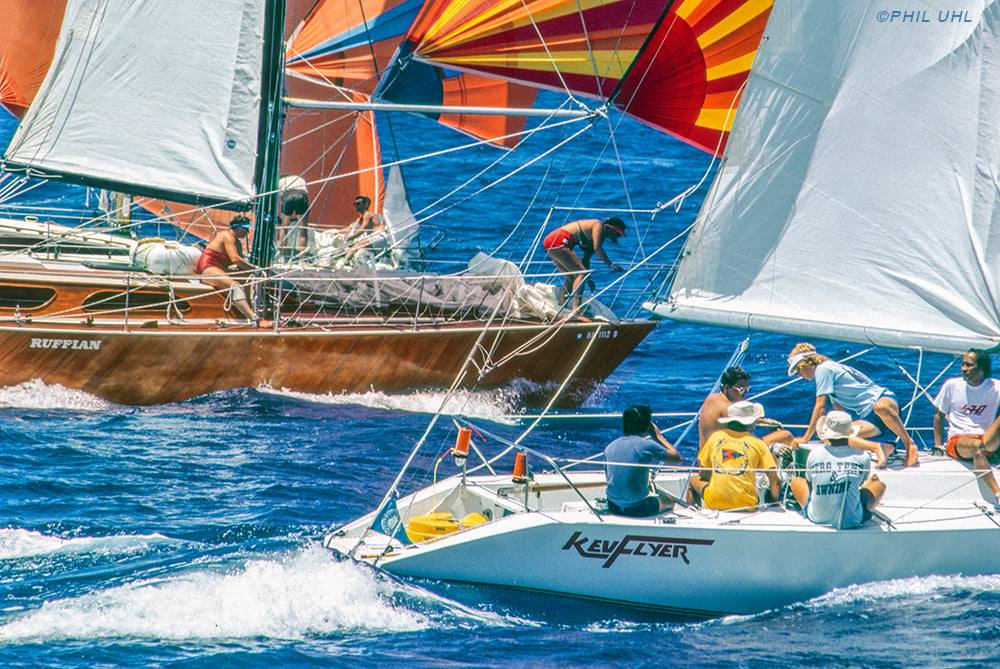
| The smallest yacht in the series, the Farr-designed Kev Flyer (20.0ft IOR), seen here alongside the Wilson-designed Ruffian (30.7ft) (photo Phil Uhl) |
Other yachts which topped Ragamuffin, Shockwave and Challenge at times included Anticipation, a Lexcen 50-footer that benefitted from an age allowance (39.2ft IOR) that had been the leading yacht after three races (and was third going into the final race), and the new Farr designed 52-footer Zamazaan (41.7ft) which won Class A overall (and finished sixth overall).  |
| Shockwave leads ex-New Zealand yacht Inca (both trailing Gerontius) during the 1980 Clipper Cup (photo Phil Uhl) |
 |
| Shenandoah with Unchu to leeward and New Zealand's Brother Dominic (another Davidson design) passing Koko Head (photo Phil Uhl) |
The time-on-distance system used for calculating the handicap results appeared to favour the big yachts in the regatta. Apart from taking line honours in four of the races, Windward Passage (67.7ft IOR) also posted corrected time scores of 3/1/1/2, before falling to 13th in the Round the State finale and finishing third overall, behind Shockwave.  |
| Gold Coast Express, convincing winner of Class D (photos Phil Uhl) |
The performance of Gold Coast Express, another Davidson design, was also notable as
she won every race in Class D on both line and corrected time. She was unique in that she had 60 owners, all members of the small Southport Yacht Club on the Gold Coast of Queensland. She was a development of Davidson's famous Half Ton champion Waverider, and rated only 27.1ft with the centreboard fixed. But despite outclassing her competition in Class D, she could not figure higher than 15th in the overall fleet in a series dominated by higher rating boats.  |
| Foredeck action aboard Windward Passage (photo Phil Uhl) |
 |
| Japanese yacht Unchu - this photo seems to be from the fourth race (third inshore) which she won, as she looks to be ahead of many larger yachts (photo Phil Uhl) |
One exception to the big boat hegemony was the result of the the 40-foot Japanese yacht Unchu (30.3ft) which won the fourth race, the final Olympic triangle after picking a favourable windshift. Unchu was designed by Ichiro Yokoyama, who had designed Magician V, the winner of the 1978 Quarter Ton Cup held in Japan. This was the first win for a Japanese yacht in a major offshore series outside Japan.
 |
| Japanese yacht Unchu, winner of the final inshore race (photo Phil Uhl) |
The increase from 1978 in the number of competing yachts in 1980 was considered a good sign that the regatta was popular with offshore sailors, and attracted another quality fleet in 1982.
 |
| The 45-foot S&S design Inca (which sailed for NZ in 1978 but was US-owned by 1980) rounds a leeward mark followed by Timber Wolf (Farr, USA), Darth Vader (Tarrabochia, NZ) and Uin na Mara III (Farr, USA) |
 |
| The Farr Half Tonner Don Quixote (rating 22.7 ft), not much bigger than Kev Flyer, rounds a leeward mark (photo Phil Uhl) |
 |
| Mile High, a 50-foot fractional Peterson design (rating 39.0ft) from Hong Kong, seen here off Koko Head - she went on to finish third in Class A (photo Phil Uhl) |
 |
| Another Davidson design, Brother Dominic, seen here rounding a windward mark (NZ, 32.1ft IOR) (photo Phil Uhl) |
 |
| The Britton Chance-designed Glory (US, 43.7ft IOR) leads Snow White II (photo Phil Uhl) |
 |
| The Tarrabochia-designed Darth Vader (33.4ft IOR) from New Zealand at a gybe mark during one of the inshore races (photo Phil Uhl) |
 |
Another view of Siska on one of the downwind legs (photo Phil Uhl)
|
 |
| Australia's Impetuous (Holland 42) leads Canada's Kanata (photo Phil Uhl) |
 |
Ragamuffin completing a gybe while rounding a wing mark (photo Phil Uhl)
|
 |
| The Australian yacht Mary Muffin, a Frers 47-footer (photo Phil Uhl) |
 |
| Mile High, a Peterson designed 50-footer sailing for Hong Kong (39.0ft IOR), finished third in Class A, behind Zamazaan and Anticipation (photo Phil Uhl) |
 |
| An aerial view of Snow White II on a downwind run (photo Phil Uhl) |
 |
| Snow White II seen here alongside Ruffian, with the Farr 36 Country Boy (29.0ft) and Gold Coast Express in the background, during a pre-regatta race (photo Phil Uhl) |
Article updated May 2026


.jpg)