Showing posts with label Pendragon. Show all posts

31 March 2023

International Offshore Rule - Part 4: Level Rating and Handicapping

Earlier articles about the International Offshore Rule ('IOR') have looked at some of the key components of measuring a yacht under the rule, and deriving a handicap with the aim of allowing different size yachts to compete against each other at any venue around the world (Part 1 is here). Level rating was the non-handicap form of racing under the IOR, where each boat was designed to the same handicap rating, or ‘Ton’ class. 
Part of the big 43-boat fleet that contested the 1976 One Ton Cup in Marseille, France (photo Bateaux magazine)
Looking at the level rating classes first, the glamour fleet were the One Tonners, which had the ‘Coupe Internationale du Cercle de la Voile de Paris’, or the One Ton Cup, as their holy grail. The Cup was so named because it was presented in 1899 by the Cercle de la Voile de Paris ('CVP') for competition by boats with fixed keels, rated at one ton or less under the French tonnage rule of 1892. These small boats, approximately 5m on the waterline, raced in Cowes or on the Siene until 6-metre class yachts were used for the trophy following the advent of the IYRU International Rule. The impressive trophy was just under a metre high and was carved out of a 10kg block of solid silver by a Parisian goldsmith.
The One Ton Cup
The last One Ton Cup in 6-metres was held in 1962. In 1965 the CVP declared that it should be used for yachts racing boat for boat at a maximum specified RORC rating (22ft). The clubs at La Rochelle soon after gave the Half Ton Cup for boats with an 18ft rating, and the Quarter Ton Cup for boats with a 15ft rating. The additional international racing that occurred under this arrangement became a major influence on the whole process for a change towards an international rating rule. With the arrival of IOR, it was agreed to use the same level rating concept. Thus in 1971 the One Ton class was defined at 27.5ft IOR, Half Ton at 21.7ft, and Quarter Ton at 18ft. There was also a Two Ton class which was not well supported at a 33ft rating and was changed to 32ft in 1974 (and later to 34.5ft). In 1974 the US delegates to the ORC presented a Three-Quarter Ton Cup for racing at 24.5ft, and the Mini Ton class was introduced in 1978 for racing at 16.0ft. In 1983 the rating limit for One Tonners was raised to 30.5ft, after a drop in support for the One Ton Cup at the old limit, and giving the class a dual purpose as they would now meet the lower rating limit for the Admiral's Cup.
The popularity of the Half Ton Class was evident from this photograph of a start during the 1976 Half Ton Cup in Trieste (photo Bateaux magazine)
These limits were further adjusted to two decimal figures as measurement techniques became more precise (e.g., the One Ton limit became 30.54ft). The 50-Foot Class, followed a similar model using a limit of 40ft (increased slightly to 40.54ft in 1991), but used individual and variable ratings within this limit for some regattas, and no ‘Ton’ classification was applied to this fleet. 
The 50-Footers enjoyed close racing on a level-rating basis for many years (photo Guy Gurney)
In the same vein, Maxi yachts were those that raced under the IOR's rating limit of 70.0ft (which was subsequently eased in the late 1980s), but given the sometimes large variance in actual ratings for these large yachts their racing was usually based on handicap results, although line honours remained a keen focus. 
Part of the Maxi fleet competing in the 1988 Kenwood Cup in Hawaii, with Sorcery (70.82ft IOR) leading Il Moro di Venezia (70.05ft), Ondine VII (70.04ft) and Matador (69.99ft)
Associated with the Quarter, Half and One Ton Cups were race-specific trophies. For the One Ton Cup, these included the Trophee de la Societe Nautique de Marseilles, for the winner of the short offshore race, and the White Horse Trophy, for the winner of the long offshore race.
One challenge in changing Pendragon from her original configuration as a Three-Quarter Tonner to a One Tonner in 1979 was meeting the increased accommodation requirements for One Tonners stipulated by the ORC 'Green Book' regulations (photo Paul Mello)
Each level rating class was subject to specific ORC regulations that governed the world championships (the ‘Ton Cups’) for each of the level rating classes (the ‘Green Book’). This set out the rating limits for each class, the rules under which each championship would be raced (such as the length and type of courses to be raced) and the maximum number of entries for any given championship. The Green Book also specified certain design parameters not otherwise covered by the IOR rule itself, such as the minimum height and area of headroom, freshwater capacity, the minimum number of berths, and even the minimum thickness of squabs to be carried.
A closely packed fleet of One Tonners during the 1984 One Ton Cup, the first held under the new rating limit of 30.5ft
Level-rating yachts were also campaigned in mixed fleet regattas (where they might further optimise performance and fall in or out of the class limit), which necessitated the use of handicapping and the application of time correction factors.
Close racing between a group of One Tonners during the 1987 Admiral's Cup (photo Bateaux magazine)
A yacht’s IOR rating was a length measurement, expressed in feet. For a yacht designed with an eye to the rule, its rating might typically be around 8-10ft less than its LOA. In a handicapped race, the IOR rating was used to compute either a Time Correction Factor ('TCF') expressed as a decimal figure, and which for 'Time-on-Time' handicapping was computed against elapsed time to provide a corrected time; or as a Time-on-Distance allowance, expressed in seconds per nautical mile. Time-on-Time is similar to a general handicap or PHRF system. Time-on-Distance was used by multiplying the distance of the race by a time factor, and subtracting from the boat's actual time, to compute the boat's corrected time (the current IRC rule dispenses with the conversion between rating and handicap, by simply expressing a yacht’s rating by way of a TCF).
A crowded start line at the 1985 Admiral's Cup, with 57 yachts (representing 19 national teams) rating between 30 - 40ft IOR in a single fleet (photo Guy Gurney)
This was a further complication in the level of acceptance achieved by the IOR, at least in mixed-fleet racing. This is because no matter how accurate the measurement system, if the time correction formula was seen to unduly favour one size of yacht over another, the system would lose support.
Startline action during the 1978 Quarter Ton Cup in 1978, held in Japan (photo Guy Gurney)
Under IOR, and as with the former CCA and RORC, the USA continued to use Time-on-Distance while others used a single figure TCF, and this also resulted in different perceptions of the rule. A committee of ORC sat for several years attempting to reach a single compromise on time allowances, and duly dissolved itself without finding a solution. However, both approaches were based on the same principle, in that a higher rating gave a smaller time allowance, and vice versa.
The diminutive Farr-designed KevFlyer, rating just 20.0ft, racing in the 1980 Clipper Cup (photo Phil Uhl)
The generally adopted formula for the TCF adopted by the RORC for IOR racing was, at least initially, a relatively simple calculation: TCF = (R1/2 + 2.6) / 10. For example, a One Tonner, with a rating of 27.5ft, had a TCF of 0.774, while a Half Tonner, with a rating of 21.7ft, had a TCF of 0.716.
International mixed fleet racing under IOR, with Half Tonners (eg Swuzzlebubble, KZ3494) racing alongside the Maxi Kialoa III (background) during the 1977 Southern Cross Cup (photo Phil Uhl)
As with the IOR rule itself, the TCF formula underwent further evolution, with yacht clubs able to adjust the formula to suit their preferences. For example, in 1975 the RORC produced the following amendment: TCF = 0.2424(R)1/2/1 + 0.567(R)1/2. The only significance of this was to create a ‘hard point’ in the time correction factor graph at the place of a ‘base’ yacht of 29ft rating (TCF of 1.000). This formula withstood pressure for further change until the mid-1980s, where bigger yachts were given some easement following the dominance of One Tonners in the 1985 and 1987 editions of the Admiral’s Cup, but the swing of the pendulum lead to something of a rout by the fastest 50-footers in 1989. Such problems with finding the 'perfect' formula were, at least for the Admiral's Cup, subsequently avoided by changes to the regatta format from 1991 with boats racing in level rating divisions. 
Changes to the RORC's TCF in 1989 saw the ascendancy of the 50-footers in that year's Admiral's Cup, with Jamarella taking individual honours overall, followed by Will (second) and Stockbrokers Container in fourth (photo Peter Ludlow)
The Farr-designed Shockwave on her way to winning the 1992 Two Ton Cup (held in conjunction with the 1992 Kenwood Cup in Hawaii)


Part of the text used for this article is adapted from the book A Lighter Ton - The Champion NZ Yachts of the 1970s2012

6 October 2021

Laurie Davidson (1926 - 2021)

New Zealand and the wider sailing world lost one of its great yacht designing talents, Laurie Davidson, this week (4 October 2021). Davidson was a major force in leading edge IOR design in the 1970s and 80s, starting off with his breakthrough Quarter Tonner Fun before going on to find further international success with winning designs in Half Ton, Three-Quarter Ton and One Ton world championships in the 1970s and was a key part of New Zealand's success in international yacht design through into the 1980s and 1990s. He will of course be best remembered for his breakthrough designs for Team New Zealand in their successful 1995 America's Cup challenge and 2000 defence, but created fast and beautiful looking yachts across the whole design spectrum.

Fun - fifth at the 1976 Quarter Ton Cup in Corpus Christi (and fifth again in Helsinki in 1977)

A tribute article can be found on the Yachting New Zealand website here, and some of his famous designs from the IOR era are presented in the gallery below.

Waverider - fourth in the Half Ton Cup in 1977 but went on to win in 1978 and 1979

Laurie inspecting the hull of Pendragon at the 1978 Three-Quarter Ton Cup in 1978 (photo Doug Wardrop)
Pendragon on her way to winning the 1978 Three Quarter Ton Cup

Laurie seen here checking in with the crew of Pendragon following her conversion to a One Tonner and winning the 1979 One Ton Cup (photo Paul Mello)

Pendragon winning the 1979 One Ton Cup (photo Paul Mello)

Stu Brentnall's 46-footer Shockwave at the 1980 Clipper Cup
Quarter Tonner Hellaby, racing at the 1980 Quarter Ton Cup in Auckland

The 38-foot Southern Raider at the 1982 Clipper Cup (photo John Malitte)

Graeme Woodroffe's 50-footer Jumpin' Jack Flash - although not designed to the IOR (and carrying a high 48.3ft rating), she was New Zealand's top yacht in the 1982 Clipper Cup
Digby Taylor's 51-foot Whitbread yacht Outward Bound during the 1981 New Zealand Admiral's Cup selection trials

Bernard Clay's 50-foot Great Fun during the 1982 Clipper Cup (photo Phil Uhl/Facebook)
Australian 39-footer Szechwan 

The One Tonner Canterbury Export formed part of the New Zealand team for the 1985 Admiral's Cup

The 44-footer Pendragon II (1981)
Mad Max (also known as Goldcorp) seen here during the 1985 Southern Cross Cup
One Tonner Swuzzlebubble VIII (ex-Beyond Thunderdome) at the start of the ill-fated 1994 Sydney to Hobart yacht race


3 February 2013

1979 One Ton Cup

My recent post on Pendragon features a number of photographs taken by US photographer Paul Mello who was active in the Newport area in the late 1970s and early 1980s. He has recently released more of his great black and white prints from the One Ton Cup held in September 1979. I have created a gallery from his photographs and I am grateful for his permission to use them here. 

Mello has noted these photographs on the Sailing Anarchy website as being from the North American One Ton series (held shortly before the One Ton Cup proper). Some of these shots feature various European yachts, however, and so could also be from the One Ton Cup itself, unless some of the European boats had decided to contest the North American series as a warm up regatta. 

Startline action, Indulgence leads away to leeward
Hot Flash, a Gary Mull design, built by Goetz Boats, looks good here during the North Americans
Pendragon to leeward of Indulgence
The tortured stern treatment of the defending champion, the Ron Holland design Tilsalg-Flensburg from Germany (finished 10th overall)
The classic Peterson pintail stern shape of the 1975 One Ton Cup winner Pied Piper (finished 12th overall)
 Tilsalg-Flensburg approaches the weather mark in the lead with Indulgence to the right and Pendragon to the left
The fleet heads off on one of the reaching legs, Pied Piper bringing up the rear
 The Farr design Downtown during the North Americans
US yacht the Bill Cook designed Celebration works up in Narragansett Bay in the prestart of the second race in the One Ton Cup that was waived off due to 40 knot plus winds and a forecast for more. Celebration finished sixth overall.

28 January 2013

Pendragon (Davidson 34)

Pendragon sailing during the 1978 Three-Quarter Ton Cup and sporting her experimental mylar headsail
Pendragon was another legendary Laurie Davidson IOR yacht, that made a name for herself by winning the Three-Quarter Ton cup in 1978, and then went on to win the One Ton Cup in 1979, a feat not achieved by any other yacht in level rating competition.

After the success of Waverider, and despite penalties being introduced to the IOR rule to slow the light displacement type of yacht, Davidson remained in demand. US dinghy sailor John MacLaurin wanted a flat hulled New Zealand-style centreboard yacht and asked Davidson for a Three-Quarter Tonner. The result was Pendragon, a development of and big sister to Waverider, and also built lightly in wood by Tim Gurr of Ocean Racing Yachts in Auckland. 
Pendragon being lifted for inspection ahead of the 1978 Three Quarter Ton Cup (photo courtesy of Doug Wardrop)

Builders plaque (photo Craig CRM)
Pendragon achieved the designers brief and the distinctive purple yacht put in a dominant performance in the 1978 North American One Ton championship held in San Diego, but lost the title to the Graham & Schlageter designed Chocolate Chips after a poor final race that counted for 150% points (with a final regatta result of 2/1/1/1/9). She went on however to win the 1978 Three-Quarter Ton Cup held in light airs in Victoria, British Columbia, and in so doing beat new designs from Britton Chance, Ron Holland and others in conditions in which the light yacht was not expected to excel. A notable addition to her sail wardrobe was an early and experimental mylar genoa, and because of the dark green colour of this early prototype, it was dubbed the "garbage bag."
Pendragon undergoing inspection (including by her famous designer, second on right) before the 1978 Three-Quarter Ton Cup (photo D Wardrop)
Pendragon sailing during the 1978 Three-Quarter Ton Cup (above and below) and sporting her experimental mylar headsail
The changes to the IOR in 1979 had a serious effect on Pendragon, with her rating moving up a full two feet (from 24.5ft to 26.5ft). It became apparent at a very early stage that Pendragon could not remain competitive in a Three-Quarter Ton configuration. Davidson resolved however that his champion yacht could still be competitive, by audaciously turning the formerly full-size 34ft Three-Quarter Tonner into a small One Tonner, a yacht that would normally be at least 36ft long. Davidson advised owner MacLaurin that the next One Ton Cup was to be held in Newport, Rhode Island, a venue noted for generally light winds, and so a small, light yacht with a large sail plan could be a potent combination.
The specific changes for Pendragon's rig to move her up to One Ton class

The alterations required to bring the yacht up to a One Ton rating (27.5ft) were, however, extensive. Further displacement was required to achieve the increased minimum centre of gravity factor, and for this Gurr travelled to the US to oversee the addition of 15mm of lead around the midships area, which was then glassed over and faired in. The sail plan was increased by approximately 20%, through the addition of a longer boom and a small bowsprit for larger headsails (see diagram above). A bigger centreboard was also fitted, although this proved to be slightly too thin in section. The yacht sailed with the centreboard pinned down to avoid the new moveable appendage factor penalty, and Pendragon was the only centreboard boat in Newport in 1979.

Other changes were also needed to meet the different regulations for the normally bigger One Tonners, with more headroom needed and accommodation for an extra crewmember. During the North American One Ton series, held a month before the Cup, Pendragon showed that she had the pace against the top boats, but was making too much leeway upwind and finished in fifth place, with results of 2/5/4/8 in the fifteen boat fleet (won by the Cook design Firewater). Additional width was added to the centreboard before the One Ton Cup series.
Pendragon during the 1979 One Ton Cup (photo Sail magazine)
Continuing changes to the IOR possibly accounted for the fact that only 12 yachts from four countries attended the 1979 One Ton Cup, although a non-European venue was probably also to blame. The regatta was also affected by the influence of nearby Hurricane David, with one race waved off in high winds, and another was scrubbed after the hurricane had caused one of the marks to come adrift causing some navigational issues for many boats. 
Pendragon during racing (above) and afterwards (below) - photos by Paul Mello
Pendragon proved to be fast in the light air of the first race, and throughout the series she proved to be untouchable downwind, while able to hold her own on the upwind legs. The result of the regatta remained close, however, with the Holland design Indulgence, which had proved to be very fast in the preceding North American championship, challenging strongly for the title by winning the final 245 mile ocean race and taking the coveted White Horse Trophy. Pendragon stayed close and finished a close second, which was enough to win the Cup (with a series result of 1/3/2), an unprecedented and un-repeated result for a yacht designed for a different, and lower, level rating class.
Pendragon's increased sail plan is clearly evident in this photograph taken during the 1979 One Ton Cup
Some great photographs from the 1979 One Ton Cup, and the preceding North American One Ton series, taken by photographer Paul Mello, and I am grateful for his permission to reproduce some of these here.
Pre-regatta preparation by crewmember Kimo Worthington on Pendragon's centreboard
Startline action in the 1979 North American One Ton series, Indulgence to weather of Pendragon

Pendragon rounds a windward mark during the 1979 One Ton Cup
Pendragon designer Laurie Davidson is interviewed after the One Ton Cup victory by David Phillips of the Providence Journal 
 Meanwhile the crew celebrate, skipper Rod Davis on the left, John MacLaurin holding the now-empty bottle. Other crew are Dave McCulley, Bryon Pratt, Curt Oetking, Kimo Worthington and Paul Murphy.
A delighted John MacLaurin (centre) receives the One Ton Cup, September 1979
Pendragon seen here racing off Marina Del Rey in 1981 (photo Phil Uhl)
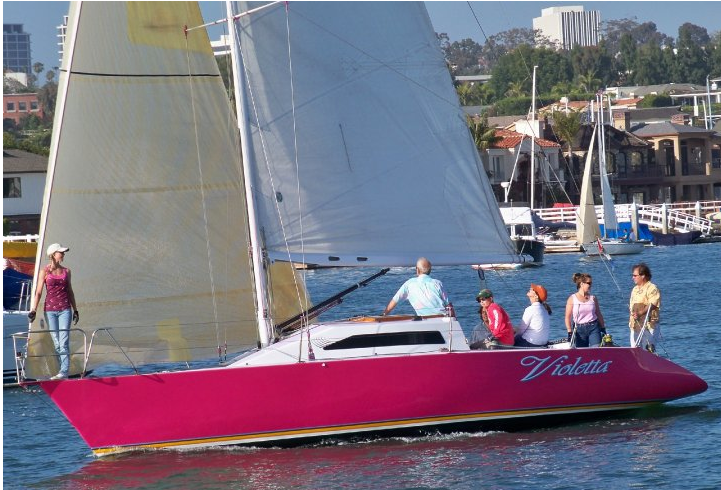
The yacht continues to sail and race in Newport on the US West Coast under her new name Violetta. Her original purple colour scheme has now given way to vivid pink, but she retains the distinctive bowsprit. 
Pendragon as she was seen in 2017 (photos Craig CRM)

Recent photographs of Violetta (Yachtworld)

Violetta (Facebook)


Article updated May 2025