Showing posts with label Export Lion. Show all posts

3 February 2013

1979 One Ton Cup

My recent post on Pendragon features a number of photographs taken by US photographer Paul Mello who was active in the Newport area in the late 1970s and early 1980s. He has recently released more of his great black and white prints from the One Ton Cup held in September 1979. I have created a gallery from his photographs and I am grateful for his permission to use them here. 

Mello has noted these photographs on the Sailing Anarchy website as being from the North American One Ton series (held shortly before the One Ton Cup proper). Some of these shots feature various European yachts, however, and so could also be from the One Ton Cup itself, unless some of the European boats had decided to contest the North American series as a warm up regatta. 

Startline action, Indulgence leads away to leeward
Hot Flash, a Gary Mull design, built by Goetz Boats, looks good here during the North Americans
Pendragon to leeward of Indulgence
The tortured stern treatment of the defending champion, the Ron Holland design Tilsalg-Flensburg from Germany (finished 10th overall)
The classic Peterson pintail stern shape of the 1975 One Ton Cup winner Pied Piper (finished 12th overall)
 Tilsalg-Flensburg approaches the weather mark in the lead with Indulgence to the right and Pendragon to the left
The fleet heads off on one of the reaching legs, Pied Piper bringing up the rear
 The Farr design Downtown during the North Americans
US yacht the Bill Cook designed Celebration works up in Narragansett Bay in the prestart of the second race in the One Ton Cup that was waived off due to 40 knot plus winds and a forecast for more. Celebration finished sixth overall.

3 December 2012

Shockwave (Davidson 46)

The first of Neville Crichton's famous Shockwave series of offshore racing yachts was a Davidson 46, designed and built for the 1980 Clipper Cup series. However, she missed the first set of trials for the New Zealand team and was only launched in time for the second evaluation series. While the number of new yachts being built during 1979/80 for regattas such as the Clipper Cup was low, the fractional-rigged Shockwave joined two other new Davidson yachts, the masthead rigged Snow White 2 (47ft) and the fractional Brother Dominic (41ft).

Like her near sisters, Shockwave sported fairly radical stern sections, with a very square and straight aft run behind the trademark Davidson bustle, this area being so flat that it formed a chine where it met the aft topside area. The transom was reasonably upright in around the centreline, but the transom/sheerline intersection was moved aggressively forward by a triangular-shaped cutout at the point where that intersection met the after girth station measurement as defined by the IOR rule. Most IOR boats tended to achieve the same result by more angled transoms, but this arrangement allowed a longer deck area, and an aftward and central position for the running backstays. It also yielded a low 33.8ft rating.
Shockwave sails to windward in the 1980 Clipper Cup - her chiselled aft sections clearly visible

Another view of the stern sections of Shockwave, with Ragamuffin ahead and to leeward (photo Adrian Herbert/Seahorse)
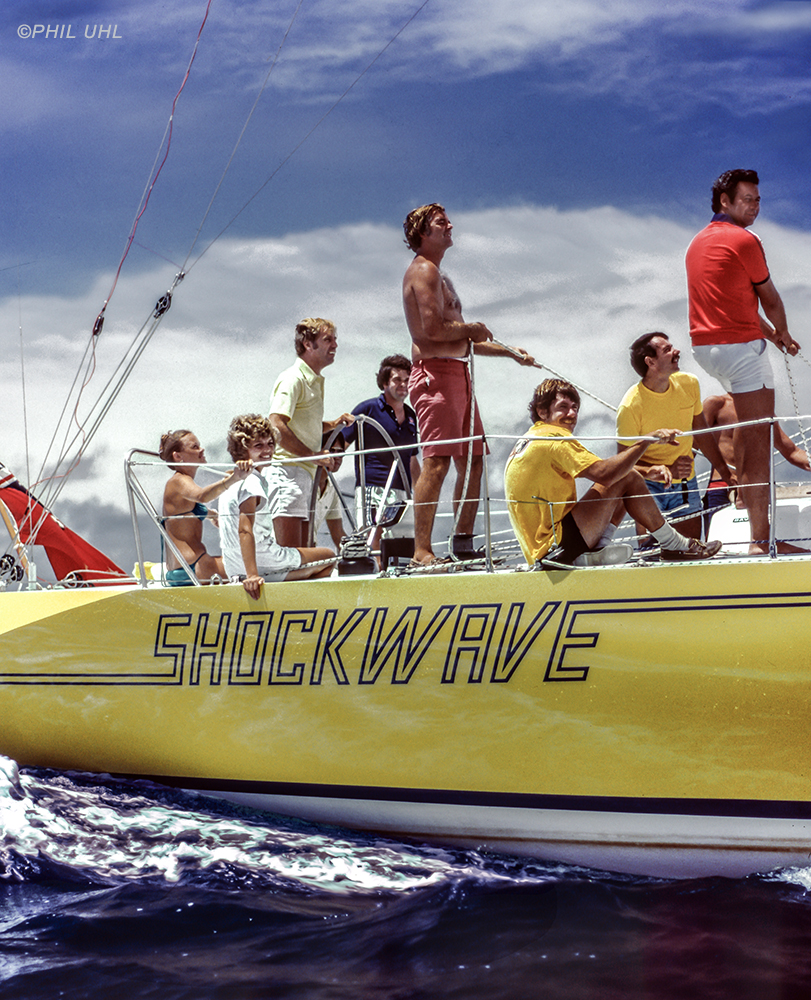
Close up view of a happy crew aboard Shockwave as she slides downwind during the 1980 Clipper Cup (photo Phil Uhl)
Shockwave was sailed in the 1980 Clipper Cup by Stu Brentnall and his crew from his earlier Red Lion and Export Lion campaigns. She didn't make it into the New Zealand team, but went on to finish second overall, behind the Peterson-designed 45-footer Ragamuffin, with the same placings being achieved in Class B. Ragamuffin's overall win also spearheaded an Australian team win, joined by the Davidson Two-Tonner Sweet Caroline and the S&S-design Challenge II. The New Zealand team of Anticipation (Lexcen 50), Brother Dominic and Country Boy (Farr 36) finished fourth.
Shockwave in close company with former New Zealand yachts Inca and Gerontius (photo Phil Uhl)


Shockwave (middle on starboard) between Shenandoah (left) and Challenge II during the Lahaina Sauza Cup in 1980 that was held prior to the Clipper Cup (photo Phil Uhl | Facebook)
The stern shape of Shockwave is visible in this recent (2024) photo of a near sistership (photo Facebook)
Shockwave went on to sail in the 1980 Big Boat Series, but was dismasted in the last race. She was later bought by a San Francisco yachtsman David Fladien and became Confrontation. She finished 11th in the 'Atlantic Perpetual' division in the 1982 Big Boat Series (with results of 8/13/7/8/8) and also raced in the 1982 Clipper Cup.
Confrontation sailing in San Francisco during the 1981 Big Boat Series, leading Jetstream (ex-High Roler) and Bravura (photo Phil Uhl)

Confrontation sailing in San Francisco during the 1982 Big Boat Series regatta(photo Sharon Green | Ultimate Sailing)

Article updated June 2025

4 November 2012

The Red Lion (Farr One Tonner)

The Red Lion was commissioned by NZ sailor Stu Brentnall who was keen to have another crack at the One Ton Cup after his efforts with Jiminy Cricket in the 1976 series held in Marseilles. The yacht was one of a number of new centreboarders to emerge from the board of Bruce Farr in 1977, and she joined sisterships Jenny H, Smir-Noff-Agen and Mr Jumpa for the New Zealand One Ton Cup trials, for the regatta held in Auckland later that year. 

These new generation One Tonners were a significant development of Farr's earlier keelboats from 1975/76 - after the rulemakers failed to close the centreboard loophole exposed to great effect by the Britton Chance design Resolute Salmon in 1976, a centreboard was used for the new boats, although the fins on the Farr yachts weighed about 360kg, despite the fact that this was discouraged by the IOR.  The need for a large amount of internal ballast meant that a higher displacement was necessary to achieve a higher ballast ratio, but this in turn allowed for more sail area, and better light air performance. 
The Red Lion on launching day, sporting her original Lion Breweries-influenced signwriting which was removed before long after a protest under Rule 26 from the Royal Akarana Yacht Club sailing committee
Although narrower in the stern than their 1976 counterparts, clever design of the after girth stations allowed for undistorted stern sections and a more upright transom. The design was able to reach high speeds very easily, and they were particularly fast in reaching conditions.
The Red Lion shows the clean and narrower stern shape of the 1977 generation of Farr One Tonners
The sharp end of The Red Lion
Joining the Farr boats for the One Ton Cup trials was another centreboard design by Paul Whiting, Smackwater Jack and the redesigned Jim Young yacht Heatwave. The Red Lion faced an early challenge over sponsorship advertising, and changes were made to the yacht's signwriting before the trials began (including the removal of a Lion emblem from the bow).

The centreboarders took out the top places and thus filled all the places for the New Zealand team, with Smackwater Jack taking out overall honours (some of the out-moded keelboats went on to compete in the Cup proper as overseas charter entries). The Red Lion failed to fire in the trials, but nevertheless qualified for the team with a fifth placing. She also competed soon afterwards in the Southern Cross Cup trials, but missed out, finishing behind the Half Tonner Swuzzelebubble, Smir-Noff-Agen and Jenny H. 

The Red Lion during the 1977 One Ton Cup and sporting her new Ross&Jones mainsail
Efforts were made to find another gear in the yacht's performance for the One Ton Cup. A new mainsail and no.2 genoa from Murray Ross' sail loft yielded significant improvements. Roy Dickson joined the crew from his failed Half Ton campaign, and this gave added depth in the afterguard. The Red Lion went on to put in a much improved and consistent performance (with places of 2/1/1/4/3) to hold out challenges from Mr Jumpa, Smir-Noff-Agen, and the Australian Peterson centreboarder B195, to win the coveted trophy.

The Red Lion in light airs during the start of the middle distance race of the 1977 One Ton Cup
Spinnaker and shooter set on a downwind leg in the 1977 One Ton Cup
The Red Lion powers upwind during the 1977 One Ton Cup series
The Red Lion was soon sold to an Italian sailor, and she went on to compete in the 1978 One Ton Cup in Flensburg, Germany. 
The Red Lion under her new Italian ownership at the 1978 One Ton Cup
Brentnall commissioned a new One Tonner from Farr, Export Lion, for this series which was designed with lighter conditions in mind.  The regatta proved to be windier than expected, and although this should have suited The Red Lion, she finished a disappointing ninth overall.  She was later fitted with a fixed keel following changes to the IOR that had removed the rating benefits of centreboards. More difficult to overcome were the rule changes that dictated much greater displacement and The Red Lion and her light displacement sisters were effectively ruled out of the game, at least in level rating terms. 

The Red Lion was bought in 1980 by her current owner, where she is maintained to an impeccable standard, and regularly updated. She is kept in Salerno, Italy, and is still racing.  Photos here.