Showing posts with label Indulgence. Show all posts

26 April 2025

Admiral's Cup 1993

A stampede of 50-footers during the fourth race of the 1993 Admiral's Cup, with Champosa VII leading Pro-motion VII, Indulgence and Corum Saphir (photo Sharon Green | Ultimate Sailing)
Just as they did in similarly boisterous conditions in 1985, Germany outlasted their opponents to win the 1993 Champagne Mumm Admiral’s Cup for the fourth time. In a series that became a battle of attrition by the end of the Fastnet race, the Germans finished with all three boats – Container, Rubin XII and Pinta - intact, while the early front-runners, Australia and Italy, paid dearly for collisions and gear failure. Germany won by just a quarter of a point, an even narrower margin than the French in 1991. It was a fittingly close result for what was to be the swansong for the IOR in the Admiral's Cup.

Starline action during the 1993 Admiral's Cup, with Nippon to windward (mid-tack), Swing (JPN3553), Indulgence (GBR) and Jameson 3, with the bow of Mandrake to the right (photo Sharon Green | Ultimate Sailing)
The win nevertheless came as a surprise to the German team. Despite having the current One Ton champion Pinta, their team was not considered to be as strong as Australia or Italy.
Pro-motion VII powers along in fresh reaching conditions during the 1993 Admiral's Cup (photo Sharon Green | Ultimate Sailing)
As with the 1991 event, teams were made up of a 50-footer, Two Tonner and a One Tonner. However, the three-class level-rating scoring that had proved so successful in 1991 was dropped. Elapsed times had to be corrected not just into class order, but fleet order too. An age allowance factor was also introduced. However, only two scores from three boats were counted for each race (after it was feared that the series might fail and so two-boat teams were permitted for the first time). Only the Dutch team failed to field a three-boat team. It was therefore impossible to tell the results while racing was underway, and as a windy series, it favoured the larger yachts. This meant that some crews may have sailed well, but were rewarded with no points. A good 50-footer seemed essential for success, since their ability to obtain clear air early in any of the races guaranteed them a better chance than the boats which had to struggle through the disturbed air of one or two bigger classes – indeed, five of the seven races were won by the 50-footers and the other two went to Two Tonners. The One Tonners hardly got a look in, but Germany’s One Tonner, Pinta, that year's World One Ton champion, was essential to the team’s success even though she only recorded a score in two races.
Mandrake leads Jameson 3, with Champosa VII setting her spinnaker and followed by Corum Saphir and Container (photo Sharon Green | Ultimate Sailing)
Australia showed early form – Syd Fisher’s Ragamuffin (ex-Will) in the hands of Peter Gilmour, had looked the best 50-footer on the track. Gilmour constantly proved that, and only the combined attack of his opponents, and hitting a windward mark in the third race, stopped Ragamuffin from winning every race easily. The team’s One Tonner, Ninja, was a touch off the pace but this was made up for by John Calbert Jones’ Great News II (ex-Wings of Oracle), which became a force in the hands of Colin Beashel and it was only when her mast broke off at the deck early in the Fastnet, 20 miles north of the Scillies Islands, that the Australian challenge was lost.
Corum Saphir creates a bit of white water as she rounds a leeward mark (photo Sharon Green | Ultimate Sailing)
The German success was due to the efficiency of the team with back-up support that was ready for almost every eventuality, with New Zealand’s Peter Lester playing a key coaching role.
Jameson 2 rounds a gybe mark ahead of Rubin XII and Swing (photographer unknown)
France had probably had more practice than the rest of the team, but the combined talent never materialised into a winning force until the Fastnet, where once again, the French were the highest point scorers. But by then it was too late. Mistakes were common and Corum Saphir, the team's 50-footer (ex-Springbok), failed to score for her country in three of the inshore races when the big boats were dominant. Corum Rubis, the Two Tonner (ex-Bravura), recorded a solid score in every race and only Ragamuffin and Container were able to do as well. But Corum Diamant, the One Tonner (ex-Okyalos VI) failed to shine.
The aftermath of the Mandrake / Pro-motion VII collision in the fifth race (photo Sharon Green | Ultimate Sailing)
Italy lead into the final race, but were impacted by the loss of Mandrake, the 50-footer, in the fifth race after she had won two consecutive inshore races. Mandrake and the Dutch yacht Pro-motion VII crashed as they approached the windward mark for the second time. After losing her lead at the first mark Pro-motion was caught by other 50-footers, and then slightly over-stood the windward mark on the second time. She was slightly high on Indulgence’s weather hip as Mandrake came across on port. Skipper Francesco di Angelis dipped Indulgence’s stern but when the rudder stalled while attempting to dip Pro-motion and her bow entered the middle of Pro-motion’s hull, slicing to just below the waterline, at the same time breaking off the front four feet of the Italian yacht. For a time it seemed that both would sink, and it was a full minute before they could be prised apart. The crew of Pro-motion immediately put her on port tack to keep the gaping hole clear of the water and headed for Chichester Harbour with pumps going flat out. Mandrake’s crew, meanwhile, covered the hole in the bow with a storm jib, massed their weight and all sails in the stern and settled in for a long slow tow home to Cowes.
The extent of damage to Pro-motion is clearly visible from this photo by Gilles Martin-Raget (Facebook)
The video footage of this incident, including the lead-up and aftermath, can be seen in a Reuters film here, and in the video below (at 33 minutes).

Mandrake’s loss was crucial for the team which had looked so strong on paper. Larouge, the Two Tonner, had just won the Two Ton Cup and was top scorer in the class going into the Fastnet, but on the way back from Fastnet Rock, and 40 miles from Bishop Rock, her runner parted and their rig tumbled with 130 miles to go. The One Tonner, Brava Q8 (One Ton Cup winner in 1992) was seen as a potent performer, but she only produced a good score on one occasion. She was initially lucky in race 3 when after hooking the mooring of the outer distance mark, the race committee delayed the start, but later lost her mast not long after rounding the final leeward mark.

Japan finished fifth. Champosa VII, the team's 50-footer, showed flashes of brilliance but her overall score was not as hoped for. Swing was a regular scorer for her team, but Nippon, the One Tonner, was not as strong, and things were not helped when a crew-member went over the side during the Fastnet, and the yacht subsequently retired.

Britain was a lowly sixth. Indulgence (ex-Juno V) finishing as top yacht in the Fastnet, but other than a second in the opening race, she failed to score in the next four. Provezza Sauce, the Two Tonner, had good speed but this was often wasted. The young team aboard 
GBE International (ex-Port Pendennis), might have done better but lacked experience of mixed-fleet sailing in a small boat.
"Jameson on the rocks" (photo Sharon Green | Ultimate Sailing) 
The Irish team’s performance were impacted from the first race after the team’s One Tonner, Jameson 1 (ex-Fram XI), hit the rocks off Gurnard Ledge (to the west of Cowes) and lost her keel. Four other One Tonner’s hit as well but Jameson 1 was the only serious casualty. Down to two boats, there was further disappointment when Jameson 3 (ex-Heaven Can Wait) broke her boom at the mainsheet attachment during the Fastnet race. Jameson 2 (ex-Shockwave) was the team’s bright note, finishing as the top Two Tonner overall.

The 35th Fastnet race, the seventh race of the regatta, provided the 20 remaining boats left in the Cup with a proper test of the fleet. Good strong winds, on the wind all the way to the Fastnet Rock, and a fast run and reach back, found weaknesses and, as usual, was the final arbiter of the Cup. At the front of the fleet, it was a battle between Ragamuffin and Indulgence, with Corum Saphir coming into the equation on the way home. Corum Rubis led the Two Tonners at the Rock, 16-minutes ahead of Larouge. Pinta led the One Tonners, ahead of Brava Q8 by 11 minutes, and Ninja another seven minutes back.

Experience aboard Indulgence was a key factor at the Lizard, when in a foul tide navigator Peter Morton took the boat inshore into a countercurrent and this enabled Chris Law to steer her ahead of Gilmour and the Ragamuffin team. She then led Ragamuffin into Plymouth Sound by just 11 seconds, with Corum Saphir a further 12 seconds astern. 

However, Ragamuffin lost a place to Corum Saphir on corrected time, which was crucial for the overall results. After Larouge’s dismasting, the Cup result became a battle between Australia and Germany, and much depended on the One Tonners. Pinta was the difference, finishing seven minutes ahead of Brava Q8 and, more importantly, one place ahead of Jamieson 2 on corrected time. 

A subsequent protest against Jameson 2 by Prevezza Sauce under the Collision Regulations about an alleged luffing incident during the hours of darkness, which would have raised Ninja by one point and given the Cup to Australia, was dismissed by the International Jury and the final result, and Germany’s victory, was confirmed. 

It is noted that without the discard scoring system, Germany's points margin would have been even higher, so at least the 'right' country won under the 1993 system. Ragamuffin was the highest individual points scorer.

An excellent video of the close racing experienced during the series can be seen below.


This article (April 2025) is adapted from the accounts within Bob Fisher's article in 'Admiral's Cup Blow by Blow', September 1993 (as printed in Boating NZ magazine) and Timothy Jefferey in The Official History of the Champagne Mumm Admiral's Cup (1994). 

24 June 2022

Juno IV (Castro 44)

Juno IV prior to the 1989 Admiral's Cup (photo Seahorse)
Juno IV is a 44-footer designed by Tony Castro for Mike Peacock to seek selection for the British team in the 1989 Admiral’s Cup. It was one of the earliest all-carbon race yachts, with the structural design developed by the Castro design team, and was built by Killian Bushe in England.
Juno IV sails upwind in light airs (Riggarna Rigging advertisement)
Peacock had commissioned the earlier One-Tonner Juno for the 1987 Admiral’s Cup, and as part of the second-placed British team and had finished 9th in the individual standings. He was drawn to a mid-size yacht for 1989 because it was a vacant slot for the British team, with Alan Gray’s 50-footer Jamarella looking likely to gain the big-boat position, and because Graham Walker already had a well-advanced plan to try to win the 1989 One Ton Cup, and the One Ton position on the team, with his new Indulgence. Changes to the Time Modification Factor (TMF) for 1989 would benefit bigger boats, but they would still need to perform well.
Juno IV - note curved genoa tracks (photo Facebook)
After a late launch, early racing indicated that Juno IV was too stiff, although this yielded good results in a breeze. This lead to a series of keel changes, reducing the boat’s stability and rating, but also affecting her speed. In the pre-Admiral’s Cup analysis, Seahorse magazine noted that Juno IV had trialed different sails from three lofts but was still performing below expectations.
A view of Juno IV's underwater shape, at Lymington Marina (photo Shockwave40 blog)
The selection of the British team proved to be controversial. The team selectors, headed by Harold Cudmore, decided to send boats to Kiel Week, the last part of the German and Dutch trials, to measure them against the opposition. Jamarella generally proved her case, but Hitchhiker II, the ex-Jamarella (One Ton) was making a claim for either of Juno IV or Indulgence’s berth. Despite a poor result in Kiel Week, where Juno IV finished last of the serious contenders for a team place and appeared off the pace against the German 34-raters, the selectors decided there was sufficient time to re-adjust all of Juno IV’s parameters to give her more speed. Indulgence was selected because of her results in Naples, but as only a single One Tonner was sought, the nod went against Hitchhiker II in preference to Juno IV.
Juno IV in light air downwind conditions 
Said Cudmore at the time, “the third boat was a difficult choice and the selectors were in a quandary, as the bigger boats were proving to be more success with the new TMFs. Within the mid-size category, Juno’s performance had been disappointing. Hitchhiker was a proven boat with a proven owner…Juno was in extreme rating mode, more similar to the Kiwi boats, which was wrong for Kiel and wrong for the Admiral’s Cup. Whether in correct rating mode she would be more competitive was unknown. Size was the deciding factor, and Juno was selected”.
Juno IV (photo Peter Ludlow)
With only a month left to tune the British boats, Castro planned a longer, lower boom for Juno IV to increase her sail area by 5 percent, which was combined with the removal of 200kg of internal ballast (to reduce stability and the CGF measurement of the IOR) and further bow-down trim to offset the consequent rating increase of sail area changes. This lead to a final rating of 35.17ft for the Admiral's Cup, while the team also settled on a North Sails wardrobe, with the boat skippered by Mike McIntyre, a 1988 Star class gold medallist.
Juno IV (photo Facebook)
Observers remained sceptical that Juno IV was the best choice and Seahorse opined before the series that “something special needs to happen if Juno is to find the speed of the German team, and unless she does, this boat will be the weak link in the British team”.
Juno IV seen here leaving Lymington Marina (photo Shockwave40 blog)
The results of the initial stages of the 1989 Admiral's Cup suggested these concerns were well placed, with Jamarella’s first and Indulgence’s third in the first race being let down somewhat by Juno IV’s lowly 26th, after she was boxed in at the start and was never able to properly recover.
Juno IV
Juno IV was 24th in the Channel Race, although fortunately this was enough when combined with Jamarella’s third and Indulgence’s seventh, for the British team to move into the series lead.
Juno IV in the midst of (possibly) Admiral's Cup trials action, with Jamarella (K-180) visible to windward (photo Bateaux magazine, Histoiredeshalfs website)
Juno IV during the 1989 Admiral's Cup (photo Auckland Maritime Museum)
The team then put in a dominant display in the third race, the second inshore, with Juno IV improving strongly to finish 11th. This was a good result considering the time lost on the last run, where she had tried to shake off Librah with a gybe set but managed to tangle the boom in a running backstay. The resulting broach led to a torn spinnaker which had to be replaced.
Juno IV sails downwind during the 1989 Admiral's Cup (although is sailing with an inshore mainsail without reefing patches) (photo Facebook)
The third inshore was less impressive, with Juno IV finishing 21st, although this was better than Indulgence’s uncharacteristic 27th. Jamarella’s third, however, kept the team in first position in the overall standings.
Juno IV powers along upwind (photo Bateaux magazine, Histoiredeshalfs website)
Juno IV went on to finish 11th in the fourth inshore and 12th in the Fastnet Race, to finish the series in 13th place overall, and this was enough to help Britain to overall Admiral's Cup victory after their second place in 1987 (Jamarella was the top individual yacht and Indulgence was 11th). 

Juno IV went on to race in the 1989 Southern Cross Cup as part of the British team, with owner Peacock leading the UK challenge for the Cup which they won. She then competed in the 1990 Sardinia Cup, finishing second (either individually or as part of the British team) and was winner of the 1990 Setimana Del Boque, also in Sardinia.
Juno IV arriving at Lymington Marina (photo Shockwave40 blog)
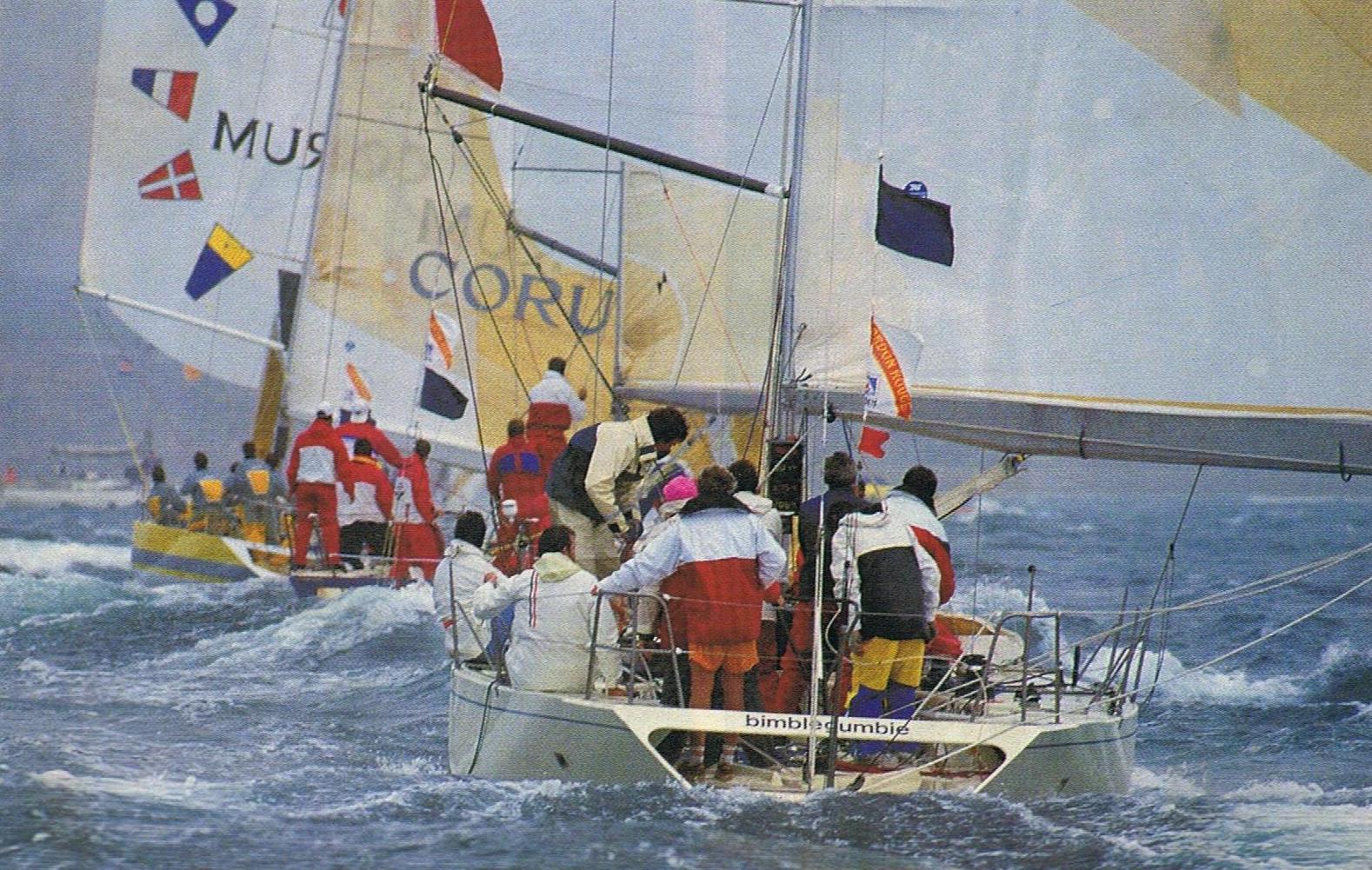
Juno IV as Australian entry in the 1991 Admiral's Cup Bimblegumbie (and photo below)
In 1991 Juno IV filled the Two-Tonner slot in the Australian team for that year's Admiral's Cup as Bimblegumbie, but finished seventh of the eight Two Tonners, although she collected more points than her team-mates Cyclone, the team's 50-footer, and Shardana II, the One Tonner. The Australian team finished last overall.
Juno IV was converted in the early 1990’s in private ownership to a cruiser/racer specification with easier deck gear to allow her to be easily sailed two-handed. In 2013 she was sold to another private owner who put her back into the racing circuit after 14 years and entered in the Round the Island 2014. Despite the lack of wind around the Needles, she was able to keep moving and won two trophies, the Field Barnacle (line honours) and the Renaissance Trophy.
Juno IV in more recent times (photo Challenge Yachting)
Juno IV was then re-established as a true racer. Further investment and improvements followed and she was entered in the Round the Island Race in 2015. Conditions were perfect for this classic racer and again the Juno IV team won the Field Barnacle trophy. The original aluminium mast was replaced with a carbon-fibre version in 2019, but it is understood that the boat is now being used purely as a cruising yacht and is based in Scotland.

Article updated May 2023

14 November 2014

Indulgence V (Andrieu Three-Quarter Tonner)

The Daniel Andrieu designed Three-Quarter Tonner Indulgence V was another in a long line of yachts to the same name owned by British yachtsman Graham Walker. Andrieu designs were typically very attractive yachts, and Indulgence was no exception, featuring a slightly curved sheer, rounded transom line and a distinctive cabin window. Her French design origins were complemented by her construction, carried out to a very high standard by B&B, located in Trinite-sur-Mer.

Indulgence was designed and built for 1986 Three-Quarter Ton Cup (24.5ft IOR), which was organised by the RORC and raced in Torbay, and which she rounded out as winner, albeit by a close margin. She was skippered by Eddy Warden Owen, one of the British 12-metre helmsmen of the time, and carried sails by the British Banks loft. 
Perspective view of the lines of Indulgence
Deck plan of Indulgence

At the time, the IOR was facing increasing criticism for being over-complicated in its concept, over-expensive in its application and for producing ratings that were sometimes unable to be repeated in subsequent measurements. But for the 1986 Three-Quarter Ton Cup, the inherent strength of the rule became evident on the basis of the number of entries (26 yachts from ten nations), with the top five boats coming from the boards of different designers, and the racing being as close as in a one design series.
Indulgence under construction at B&B, Trinite-sur-Mer (above and below)

So despite Indulgence's high powered crew and 'no expense' spared construction, she didn't have it all her own way, being pushed to the very end by the Niels Jeppesen designed production X-3/4 Ton Frontrunner, steered by sailmaker Ib Anderson, who's firm Diamond Sails also provided her sail wardrobe. This all Danish team, who also formed the backbone of Andelstanken's win in the One Ton Cup that year, were no strangers to the event having won in 1985 in Green Piece and twice before that in the X-3/4 Ton predecessor, the X-102.

Indulgence on her way to winning the 1986 Three-Quarter Ton Cup
Indulgence chases Frontrunner around a wing mark
Whilst Indulgence and Frontrunner were the most consistent fleet leaders, often by an enviable amount, there were three others who were not far off the pace. One of them, the new Humphrey's Decasol, skippered by David Howlett, at times looked like a possible candidate for second place overall. Decasol won the short offshore race but otherwise she took third place too often and that was where she finished overall, followed in fourth by German yacht Flurshaden, which had placed second in 1984 and third in 1985.

The Humphreys designed Decasol - third overall

Indulgence went on to race in the 1987 edition of the series, held in Nieuwpoort, Belgium (contested by 15 yachts from seven nations). She had been sold to an Italian yachtsman (skippered by Vittorio Codesca), but still showed plenty of speed one year on and her crew had high hopes of retaining the Cup. The regatta was held in a wide range of conditions, from mirror-like seas which saw yachts kedging in  the tide to a full gale in the short offshore race which ended in retirement for five yachts and damage on three others. 

Indulgence during the 1986 Three-Quarter Ton Cup

The first race was in light airs, and had to be shortened, and Indulgence V finished 7th, which would prove to be her best placing. The long offshore race was also shortened, prior to the start, simply by deleting the first and last marks from the course to reduce the distance from 240 miles to 190. This caught out a few navigators because they failed to cancel the last buoy's waypoint from their Decca sets. After a long and trying race in light airs, they sent their yachts off on a needless 24-mile leg only to come into the finish line from the wrong direction. One of the yachts was Indulgence, which had led at every mark, so the subsequent disqualification from the race was a huge disappointment, and essentially put her out of the running for overall honours.
Indulgence during the 1986 Three-Quarter Ton Cup
The Indulgence crew bounced back from their error by sailing a faultless third race, the second Olympic triangle. As before, she led the whole way round, ahead of second placed Ramasjang from Denmark. A consistent series thus far by Ramasjang saw them into the lead overall.
The winner of the 1987 Three-Quarter Ton Cup, Jelfi-X, passes behind team-mate Escapade (6th overall)
A lack of wind delayed the start of the short offshore race, and when it got underway it still took an hour to sail the mile to the first mark, where the fleet kedged to avoid being taken back to the start in the strong tide. But when the wind arrived it did so strongly, a Force 6-7 north-westerly which built into a Force 8 gale. Series leader Ramasjang was soon dismasted when her backstay failed. Race leader Prudential Bache was under pressure from Indulgence V who was threatening as night fell. But her series came to an end when her mast collapsed without warning. The latest X-3/4 Jelfi-X (representing the Netherlands) took up the running to stake her claim to the series, and a third in the final race secured the Cup. Indulgence V, forced to retire from the short offshore and unable to start the last race, finished 13th overall.

Sources for this article are based on articles held on the Histoire des Halfs website (where you can read more articles in French) and Sailing Year (1987-88)


26 March 2014

One Ton Cup 1989

1989 One Ton Cup winner Brava
The 1989 One Ton Cup was held in Naples, Italy, three months ahead of that year's Admiral's Cup series, and although the number of IOR yachts worldwide was continuing to thin out, the intensity of competition in the Cup definitely wasn't. Some 28 yachts lined up for the event, of which 19 were less than a year old - commissioned, built and worked up very much with the One Ton Cup and Admiral's Cup double in mind. Of the 28 yachts, Farr could claim 12, with four to Denmark's Neils Jeppesen, although only one, Stockbroker, was a serious contender, while the German duo of Judel/Vrolijk could count three.

The one major aspect of the regatta that detracted from the calibre of the event was the weather. Naples Bay has a regular afternoon gradient wind but it blew for only two of the three inshore races, but never more than 12 knots, and generally only about 6-8 knots. The wind was at its most capricious in the first race, which descended into farce such that the race committee was on the brink of calling it off twice during the first beat, but the international jury urged that the race be able to run its course. The first leg took over an hour, and only four legs were completed. The race was won by the Daniel Andrieu designed Indulgence, skippered by Eddie Warden-Owen, with Germany's Farr design ABAP/4 second and Aria third. 

Indulgence during some of the windier conditions of the 1989 One Ton Cup
The offshore races also suffered from light winds, and light as they were during the day, at night they died to nothing, resulting in long 'park ups', with positions changing dramatically as the breeze arrived each morning. Even with the offshore races reduced to just 145 and 95 miles, they took 27 and 24 hours to complete. "It was the Hare Krishna school of sailing", joked Graham Walker, who's crew aboard Indulgence burnt joss sticks at night to try to detect the direction of the wind. The overnight races utterly exhausted the crews, for the level of concentration required to coax their boats along was enormous. Their cause was not helped by the race committee setting the weather mark in the short offshore race in the windless lee of Capri Island.
Above and below - startline action during the 1989 One Ton Cup
It was Indulgence which looked like a possible winner half way through the series. She won the first two races and was points leader until the fourth, the short offshore race. She was leading that too in the early morning when the dawn breeze brought a group of six, including the Farr designed Brava, owned by Italian yachtsman Pasquale Landolfi, to the front. In the chase, Indulgence cut too close to the island of Ischia and struck a rock. The crew had to extricate themselves by using the spinnaker pole as a punt to push the boat off backwards. She managed to salvage an 11th placing. 
Indulgence approaches a windward mark
In the end it was all Brava, which was sailed well throughout the Cup, and her 9/5/4/2/4 record showing the consistency that Indulgence lacked with a 1/1/13/11/13 which dropped her to second place. 
Brava
In design terms, the Farr boats were considered a gentle progression a proven all-round design. Brava and seventh-placed Bellatrix were more light air oriented than the previous year's design, and near sisterships ABAP/4 (fifth) and Bravura (ninth) all seemed to have a slight edge downwind, while their upwind penetration was as good as ever. Brava had a Sail Hull Ratio (SHR) of 15.70 and a Righting Moment Corrected (RMC) of 133.4, coupled with a relatively short rated Length (L) of 10.09m. 
Australia's Joint Venture, sailing upwind above, and leading the pack below (possibly in the fourth race where she finished in fifth place)
In contrast, the Australian Farr design Joint Venture, which was similar to the New Zealand yacht Propaganda (which did not attend as she was being optimised for the Admiral's Cup), had a longer L of 10.19m, with a lower SHR of 15.4 and an RMC of 140, which was considered stiff. She tended to lose out badly in the light airs during the offshore races, dropping hard-won places to slower boats and finished 16th overall. 
The Andrieu design CGI, sistership to Indulgence
In Indulgence, and her erratically sailed French sistership CGI (20th), Daniel Andrieu had attempted to get some windward bite without giving up his design's well known reaching and running speed. Indulgence was finer for'ard than previous Andrieu boats, and she was fast upwind in light ghosting conditions, and in more than 12 knots of wind. But in a slight chop and 6-10 knots she appeared to labour in both height and speed.  Indulgence was optimised for Naples, with a relatively large sailplan, resulting in a high SHR of 15.92, and was considered short relative to the Farr boats, with an L of 10.085. The Andrieu boats also had 2cm less freeboard than the others, to lower total weight and the centre of pitch.
Norway's Fram XI, finished 13th overall
Indulgence was due to undergo substantial modifications before the British Admiral's Cup team was to be announced, and to be reconfigured for more wind than had been expected in Naples, including a new keel and rig.
Stockbroker crosses ahead of Indulgence
Leeward mark action aboard Japan's Are Can Bay
Italy's Shardana 2 finished sixth overall (photo Facebook)
In designing Stockbroker, Jeppeson had noted that rated lengths in the 1988 fleet were around 10.05-10.15m, and that waterline beams varied less than 5cm. Noting the success of Propaganda and Container (renamed Aria for 1989), he chose a high stability boat with a RMC of 150, much higher than the Naples average of some 138-140. To pitch the boat more to light airs, the engine was moved aft, a strut drive installed and the keel's lead shoe removed to get the RMC down to 147. Like Indulgence, Stockbroker was good in flat water, and she finished the series in third place, after a 8/4/20/5/6 series.
Key rating statistics for a range of boats from the 1989 One Ton Cup
Full results for the 1989 One Ton Cup
CGI