Showing posts with label Admirals Cup 1993. Show all posts

26 April 2025

Admiral's Cup 1993

A stampede of 50-footers during the fourth race of the 1993 Admiral's Cup, with Champosa VII leading Pro-motion VII, Indulgence and Corum Saphir (photo Sharon Green | Ultimate Sailing)
Just as they did in similarly boisterous conditions in 1985, Germany outlasted their opponents to win the 1993 Champagne Mumm Admiral’s Cup for the fourth time. In a series that became a battle of attrition by the end of the Fastnet race, the Germans finished with all three boats – Container, Rubin XII and Pinta - intact, while the early front-runners, Australia and Italy, paid dearly for collisions and gear failure. Germany won by just a quarter of a point, an even narrower margin than the French in 1991. It was a fittingly close result for what was to be the swansong for the IOR in the Admiral's Cup.

Starline action during the 1993 Admiral's Cup, with Nippon to windward (mid-tack), Swing (JPN3553), Indulgence (GBR) and Jameson 3, with the bow of Mandrake to the right (photo Sharon Green | Ultimate Sailing)
The win nevertheless came as a surprise to the German team. Despite having the current One Ton champion Pinta, their team was not considered to be as strong as Australia or Italy.
Pro-motion VII powers along in fresh reaching conditions during the 1993 Admiral's Cup (photo Sharon Green | Ultimate Sailing)
As with the 1991 event, teams were made up of a 50-footer, Two Tonner and a One Tonner. However, the three-class level-rating scoring that had proved so successful in 1991 was dropped. Elapsed times had to be corrected not just into class order, but fleet order too. An age allowance factor was also introduced. However, only two scores from three boats were counted for each race (after it was feared that the series might fail and so two-boat teams were permitted for the first time). Only the Dutch team failed to field a three-boat team. It was therefore impossible to tell the results while racing was underway, and as a windy series, it favoured the larger yachts. This meant that some crews may have sailed well, but were rewarded with no points. A good 50-footer seemed essential for success, since their ability to obtain clear air early in any of the races guaranteed them a better chance than the boats which had to struggle through the disturbed air of one or two bigger classes – indeed, five of the seven races were won by the 50-footers and the other two went to Two Tonners. The One Tonners hardly got a look in, but Germany’s One Tonner, Pinta, that year's World One Ton champion, was essential to the team’s success even though she only recorded a score in two races.
Mandrake leads Jameson 3, with Champosa VII setting her spinnaker and followed by Corum Saphir and Container (photo Sharon Green | Ultimate Sailing)
Australia showed early form – Syd Fisher’s Ragamuffin (ex-Will) in the hands of Peter Gilmour, had looked the best 50-footer on the track. Gilmour constantly proved that, and only the combined attack of his opponents, and hitting a windward mark in the third race, stopped Ragamuffin from winning every race easily. The team’s One Tonner, Ninja, was a touch off the pace but this was made up for by John Calbert Jones’ Great News II (ex-Wings of Oracle), which became a force in the hands of Colin Beashel and it was only when her mast broke off at the deck early in the Fastnet, 20 miles north of the Scillies Islands, that the Australian challenge was lost.
Corum Saphir creates a bit of white water as she rounds a leeward mark (photo Sharon Green | Ultimate Sailing)
The German success was due to the efficiency of the team with back-up support that was ready for almost every eventuality, with New Zealand’s Peter Lester playing a key coaching role.
Jameson 2 rounds a gybe mark ahead of Rubin XII and Swing (photographer unknown)
France had probably had more practice than the rest of the team, but the combined talent never materialised into a winning force until the Fastnet, where once again, the French were the highest point scorers. But by then it was too late. Mistakes were common and Corum Saphir, the team's 50-footer (ex-Springbok), failed to score for her country in three of the inshore races when the big boats were dominant. Corum Rubis, the Two Tonner (ex-Bravura), recorded a solid score in every race and only Ragamuffin and Container were able to do as well. But Corum Diamant, the One Tonner (ex-Okyalos VI) failed to shine.
The aftermath of the Mandrake / Pro-motion VII collision in the fifth race (photo Sharon Green | Ultimate Sailing)
Italy lead into the final race, but were impacted by the loss of Mandrake, the 50-footer, in the fifth race after she had won two consecutive inshore races. Mandrake and the Dutch yacht Pro-motion VII crashed as they approached the windward mark for the second time. After losing her lead at the first mark Pro-motion was caught by other 50-footers, and then slightly over-stood the windward mark on the second time. She was slightly high on Indulgence’s weather hip as Mandrake came across on port. Skipper Francesco di Angelis dipped Indulgence’s stern but when the rudder stalled while attempting to dip Pro-motion and her bow entered the middle of Pro-motion’s hull, slicing to just below the waterline, at the same time breaking off the front four feet of the Italian yacht. For a time it seemed that both would sink, and it was a full minute before they could be prised apart. The crew of Pro-motion immediately put her on port tack to keep the gaping hole clear of the water and headed for Chichester Harbour with pumps going flat out. Mandrake’s crew, meanwhile, covered the hole in the bow with a storm jib, massed their weight and all sails in the stern and settled in for a long slow tow home to Cowes.
The extent of damage to Pro-motion is clearly visible from this photo by Gilles Martin-Raget (Facebook)
The video footage of this incident, including the lead-up and aftermath, can be seen in a Reuters film here, and in the video below (at 33 minutes).

Mandrake’s loss was crucial for the team which had looked so strong on paper. Larouge, the Two Tonner, had just won the Two Ton Cup and was top scorer in the class going into the Fastnet, but on the way back from Fastnet Rock, and 40 miles from Bishop Rock, her runner parted and their rig tumbled with 130 miles to go. The One Tonner, Brava Q8 (One Ton Cup winner in 1992) was seen as a potent performer, but she only produced a good score on one occasion. She was initially lucky in race 3 when after hooking the mooring of the outer distance mark, the race committee delayed the start, but later lost her mast not long after rounding the final leeward mark.

Japan finished fifth. Champosa VII, the team's 50-footer, showed flashes of brilliance but her overall score was not as hoped for. Swing was a regular scorer for her team, but Nippon, the One Tonner, was not as strong, and things were not helped when a crew-member went over the side during the Fastnet, and the yacht subsequently retired.

Britain was a lowly sixth. Indulgence (ex-Juno V) finishing as top yacht in the Fastnet, but other than a second in the opening race, she failed to score in the next four. Provezza Sauce, the Two Tonner, had good speed but this was often wasted. The young team aboard 
GBE International (ex-Port Pendennis), might have done better but lacked experience of mixed-fleet sailing in a small boat.
"Jameson on the rocks" (photo Sharon Green | Ultimate Sailing) 
The Irish team’s performance were impacted from the first race after the team’s One Tonner, Jameson 1 (ex-Fram XI), hit the rocks off Gurnard Ledge (to the west of Cowes) and lost her keel. Four other One Tonner’s hit as well but Jameson 1 was the only serious casualty. Down to two boats, there was further disappointment when Jameson 3 (ex-Heaven Can Wait) broke her boom at the mainsheet attachment during the Fastnet race. Jameson 2 (ex-Shockwave) was the team’s bright note, finishing as the top Two Tonner overall.

The 35th Fastnet race, the seventh race of the regatta, provided the 20 remaining boats left in the Cup with a proper test of the fleet. Good strong winds, on the wind all the way to the Fastnet Rock, and a fast run and reach back, found weaknesses and, as usual, was the final arbiter of the Cup. At the front of the fleet, it was a battle between Ragamuffin and Indulgence, with Corum Saphir coming into the equation on the way home. Corum Rubis led the Two Tonners at the Rock, 16-minutes ahead of Larouge. Pinta led the One Tonners, ahead of Brava Q8 by 11 minutes, and Ninja another seven minutes back.

Experience aboard Indulgence was a key factor at the Lizard, when in a foul tide navigator Peter Morton took the boat inshore into a countercurrent and this enabled Chris Law to steer her ahead of Gilmour and the Ragamuffin team. She then led Ragamuffin into Plymouth Sound by just 11 seconds, with Corum Saphir a further 12 seconds astern. 

However, Ragamuffin lost a place to Corum Saphir on corrected time, which was crucial for the overall results. After Larouge’s dismasting, the Cup result became a battle between Australia and Germany, and much depended on the One Tonners. Pinta was the difference, finishing seven minutes ahead of Brava Q8 and, more importantly, one place ahead of Jamieson 2 on corrected time. 

A subsequent protest against Jameson 2 by Prevezza Sauce under the Collision Regulations about an alleged luffing incident during the hours of darkness, which would have raised Ninja by one point and given the Cup to Australia, was dismissed by the International Jury and the final result, and Germany’s victory, was confirmed. 

It is noted that without the discard scoring system, Germany's points margin would have been even higher, so at least the 'right' country won under the 1993 system. Ragamuffin was the highest individual points scorer.

An excellent video of the close racing experienced during the series can be seen below.


This article (April 2025) is adapted from the accounts within Bob Fisher's article in 'Admiral's Cup Blow by Blow', September 1993 (as printed in Boating NZ magazine) and Timothy Jefferey in The Official History of the Champagne Mumm Admiral's Cup (1994). 

26 November 2022

Juno V (Farr 50)

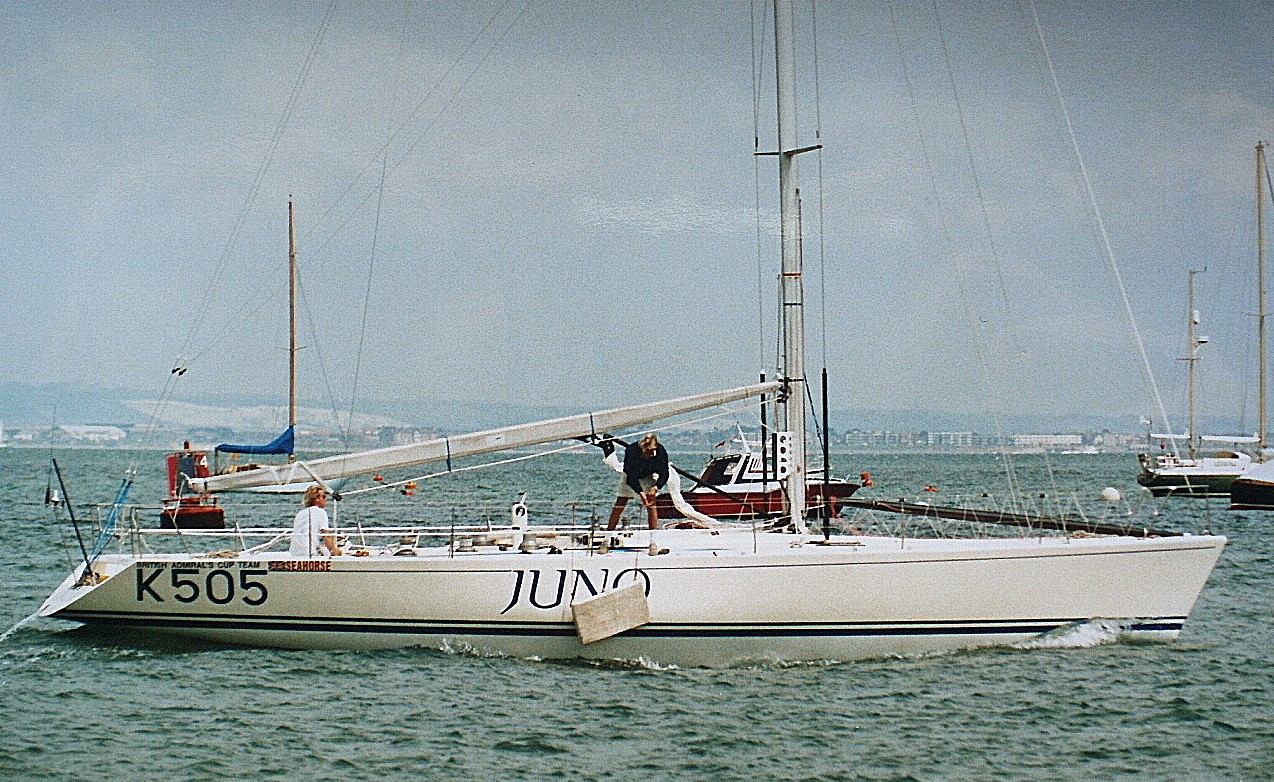
Juno V racing in the first 1991 50-Foot World Cup race at Key West (photo North Sails | Sailing World)
Juno V was English sailor Mike Peacock’s follow on yacht from his 1987 One Tonner Juno III, and 1989 Two Tonner Juno IV.  She was designed by Bruce Farr to compete in the highly competitive 50-foot circuit and the 1991 World Cup, and with a view towards filling the big-boat slot for Britain in the 1991 Admiral's Cup. Juno V was Farr design #224m, being a derivative of near sistership designs #224 Mandrake and Springbok. While her dimensions are not published, a comparison of design #224 to the earlier generation #203 Carat shows slightly less overall length (49.6ft) and more beam and a little more displacement. 
Juno V in Cowes
Juno V was built by Green Marine, all in carbon fibre with foam and honeycomb core in the hull and an all honeycomb core in the deck. Because she was built to race in the Admiral’s Cup, and would have to cope with the conditions that might be encountered in the Channel Race and Fastnet Race, she was built a little more heavily than the circuit-only Fifties, including carrying a stronger (and heavier) mast.
Juno V working up in early trials in Cowes (photo shockwave40 blog)
Juno V was sailed for the first time in the Solent in November 1990 (flying North working sails and Sobstad spinnakers) so that builder Bill Green could take care of any last-minute modifications before the boat was shipped to Miami for the World Cup Florida regattas in early 1991, including Key West, which featured a very competitive fleet of 15 boats.
Juno V in the thick of the action during the Key West regatta, 1991 (photo Yachting magazine)

Juno V on her way to winning Key West, January 1991 (photo Seahorse)
Juno V approaching Cowes Marina, possibly just prior to or during the 1991 Admiral's Cup (photo shockwave40 blog)
After a poor first race (10th) at Key West, Juno V put her mark on the series from Day 3, winning the first two races of the day. Although she finished the regatta with two ninths, the series was notable for the lack of dominance by any one boat, and she took out the event, just 2.25 points ahead of Heaven Can Wait and Champosa VII. She was lucky in the last race to just avoid a pile up at the first windward mark between Carat, Capricorno and Windquest, dipping just to leeward of the wreckage and then shoot the weather mark and continue racing. Juno V also benefited from improved reliability against the likes of Fujimo and Champosa VII who had encountered difficulties in the windier and warm-up races.
Juno V during the 1991 Admiral's Cup, above and below (photo shockwave40 blog)

For the 1991 Admiral’s Cup, Juno V was joined by the Farr Two Tonner Wings of Oracle and the Dubois One Tonner Port Pendennis. The Official History of the Admiral’s Cup notes that “Britain’s team served as an indication of how fast the pool of Admiral’s Cup boats was slipping away. Only Mike Peacock’s new Farr 50, Juno V, was the old style of yacht: owned by a private individual and sailed by pretty much a Corinthian amateur crew, headed in this instance by Mike McIntyre".
Juno V (right) ahead of Will during the 1991 Admiral's Cup
Unable to repeat her 50-Foot circuit form, Juno V finished fifth of the eight 50-Footers, with placings of 2/6/3/4/2/7, and while Port Pendinnis sailed strongly in the One Tonner division, Wings of Oracle was less impressive and the team finished fourth overall.
Juno V during the 1991 Admiral's Cup (photo Derek Stroud)
The 1991 World Cup concluded with a regatta in Miura, Japan, in early November 1991. Juno V didn’t make the podium in this series, but did enough to finish second in the overall World Cup standings, just 4.5 points behind Abracadabra.
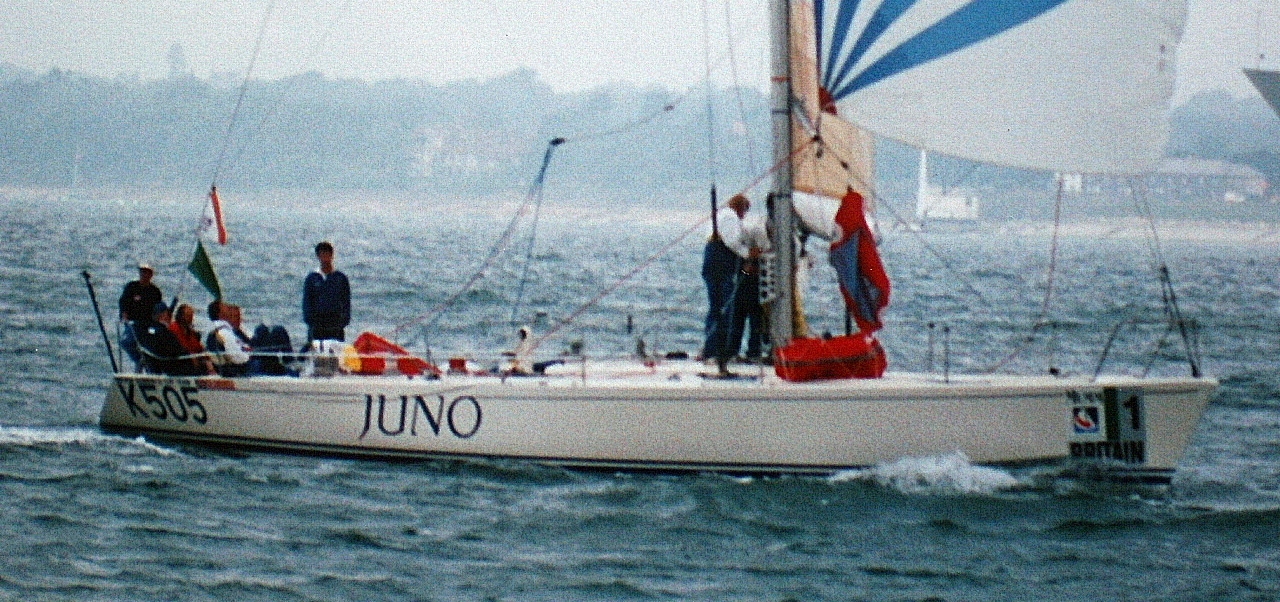
Indulgence (dark blue hull), ex-Juno V, during a Lymington Regatta ahead of the 1993 Admiral's Cup (photo Sharon Green | Ultimate Sailing)
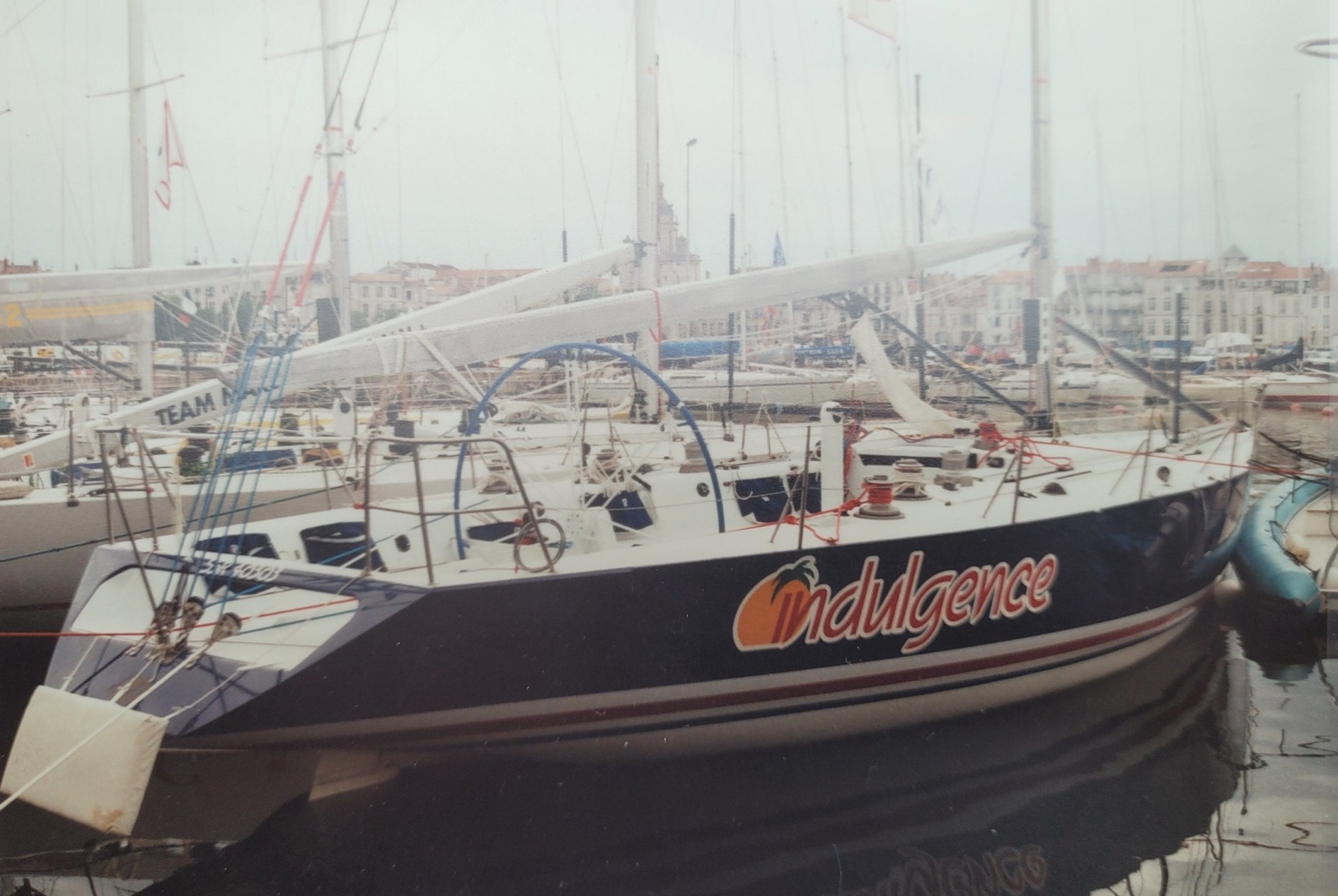
Indulgence circa-1993 (photo Facebook)
Juno V was later bought by Graham Walker and became the latest (and eighth) Indulgence, and Walker then took it upon himself to line up two team-mates for the 1993 Admiral’s Cup – no small task as by this time IOR racing was all but dead save for a few pockets of interest: the One Ton circuit and 50-Foot World Cup. Walker’s ‘chef d’equipe’ Peter Morton secured GBE International (ex-Port Pendennis) and Provezza Source (ex-Unibank) from Turkey. The problem was, however, that the British took control of these two boats only days before the Admiral’s Cup started. Indulgence did not get into her stride until half way through the series, her original skipper Eddie Warden Owen being replaced by Chris Law, who had flown in from Australia just three days before the first race. Indeed she saved her best for the last race, leading the 50-Foot fleet home in the Fastnet, crossing the line just two lengths ahead of Syd Fischer’s Ragamuffin (Australia), with France’s Corum Saphir a further few lengths behind. But the perils of bringing together a last-minute team to race at Admiral's Cup level were clearly apparent, with the team finishing a lowly sixth overall.

The history of Indulgence through the 1992 and final 1993 year of the 50-Foot World Cup and the following years are not known, but she later became Manado, racing as a charter vessel in Sweden (photos above). She is now looking a bit worse for wear, at least below the waterline, and has recently been surveyed by Lars Klingstrom, of Flirt of Paget fame, and some of his photographs are shown below. 
The topsides still retain a high gloss finish (above and below) (photos Lars Klingstrom)

View aft, though the companionway towards the navigation station and aft pipe berths (photo Lars Klingstrom)

The navigation station above the engine, with the primary winch couplings close above (photo Lars Klingstrom)


2 May 2017

Wings of Oracle (Farr Two Tonner)

With the next edition of the America's Cup about to get underway soon (2017), where the Oracle name is now synonymous with the event, not least of all as the present defender of the Cup, it is interesting to look back at where Oracle's involvement in sailing began. The Oracle corporation had its first foray into top level international sailing in the 1991 Admiral's Cup. Oracle had sponsored the Royal Air Force Sailing Association's (RAFSA) Sigma 38 one design cruiser-racer, which had acquitted herself well in club-level racing in British waters during the 1990 season. 
Wings of Oracle - Admiral's Cup 1991 (photo Farr Yacht Design Facebook page)
For the 1991 Admiral's Cup, the RORC had decided that the event would be better served by requiring teams to field one boat in each of the One Ton, Two Ton and 50ft rating bands, introducing level rating into an event traditionally built around teams of mixed handicaps. Oracle put RAFSA in charge of a new Farr-designed Two Tonner to form part of the British team, to join the One Tonner Port Pendennis and the 50 Footer Juno V. Getting Oracle involved in the British campaign was no small feat in itself, and saw the British effort being fully funded, a first for the local team.
Wings of Oracle (photo Bateaux magazine)
Wings of Oracle in fresh conditions during the 1991 Admiral's Cup
The new Wings of Oracle was based on Design #268, a 1990 development of #242 (Larouge) and which had yielded Shockwave and Japan's Donky 6. Like her US sistership Bravura, Wings of Oracle was an improvement on Larouge, the 1991 Two Ton Champion. Design #268 indicated gains in all-round performance, with developments that included subtle changes in hull shape to improve speed in waves, and a more efficient keel and rudder. It is understood that her ballast was comprised of a single lead piece of 7,000lbs.
Wings of Oracle leads Bravura (left) and Unibank (right) during the 1991 Admiral's Cup
So the boat itself came with evident pedigree from a design perspective, and was well built by Green Marine, under the close supervision of Farr International. The boat carried a North UK wardrobe, flown from a Southern Spars NZ rig (with the successful Steinlager 2 campaign having given Southern Spars a significant jump in international profile). While the boat was being built, the Castro designed Turkish Delight (renamed Oracle Arrow) was chartered as part of an intensive training campaign based in Hamble.  
The ex-Turkish Delight being used for training for the Oracle sailing team
Oracle were, however, told that the lack of experience within RAFSA would let the campaign down, and the saga around the boat's performance preoccupied the British press for many months. When she under-performed in the Two Ton Cup, with questionable tactics on the race course, there was a call for significant changes to the afterguard. Eventually, and just three weeks before the Admiral's Cup, the original skipper (a Flight Lieutenant) was replaced by Stuart Childerley, then a 24-year old Finn sailor.
Wings of Oracle in an upwind groove during the 1991 Admiral's Cup (photo D Stroud)

Wings of Oracle during one of the Christchurch Bay inshore races, sitting to leeward of two 50-footers - Italy's  Mandrake (I-11933) and team-mate Juno V (K-505)
Although she struggled throughout the 1991 series, the British effort started strongly, with both Juno V and Wings of Oracle second in their respective divisions to see Britain in second place overall. Wings of Oracle led the Two Ton pack early in the Channel Race, before being affected by seaweed on the keel that had been a particular problem throughout the season and in the Cup itself, and finished fourth.
Wings of Oracle (photo Farr Yacht Design Facebook page)
Wings of Oracle (photo D Stroud)
Wings of Oracle (photo Bateaux magazine)
Wings of Oracle had a terrible start in the second inshore race, electing to re-cross the startline even though she had not been recalled. She clawed back two places, only to be hit with a 20 percent penalty when her spinnaker touched the second weather mark during a set. Wings of Oracle finished poorly in the third inshore and was a lowly seventh in the Fastnet Race. Overall she finished the series as the sixth Two Tonner, and Britain was fourth in the team standings.
Wings of Oracle (photo D Stroud)

Wings of Oracle sails back to Cowes Marina following one of the inshore races during the 1991 Admiral's Cup (photo Shockwave40 blog)
Great News II (ex-Wings of Oracle) rounds a wing mark during the 1991 Admiral's Cup
Wings of Oracle sailed for the Australian team in the 1993 Admiral's Cup, as Great News II, but lost her rig in the Fastnet race finale.
Great News II (ex-Wings of Oracle) in action during the 1993 Admiral's Cup

It is understood that Wings of Oracle ended up in Boston in the mid-1990s and then went to the Great Lakes in 1997, and had a second place in the Port Huron Mac in the late 1990s. She was then sold and went to the Gulf Coast of Florida in 2000 or 2001, but sadly was destroyed by a hurricane shortly afterwards. 
Wings of Oracle (Offshore magazine Aug/Sept 1991 | Facebook)


Article updated October 2025