Showing posts with label Juno IV. Show all posts

26 November 2022

Juno V (Farr 50)

Juno V racing in the first 1991 50-Foot World Cup race at Key West (photo North Sails | Sailing World)
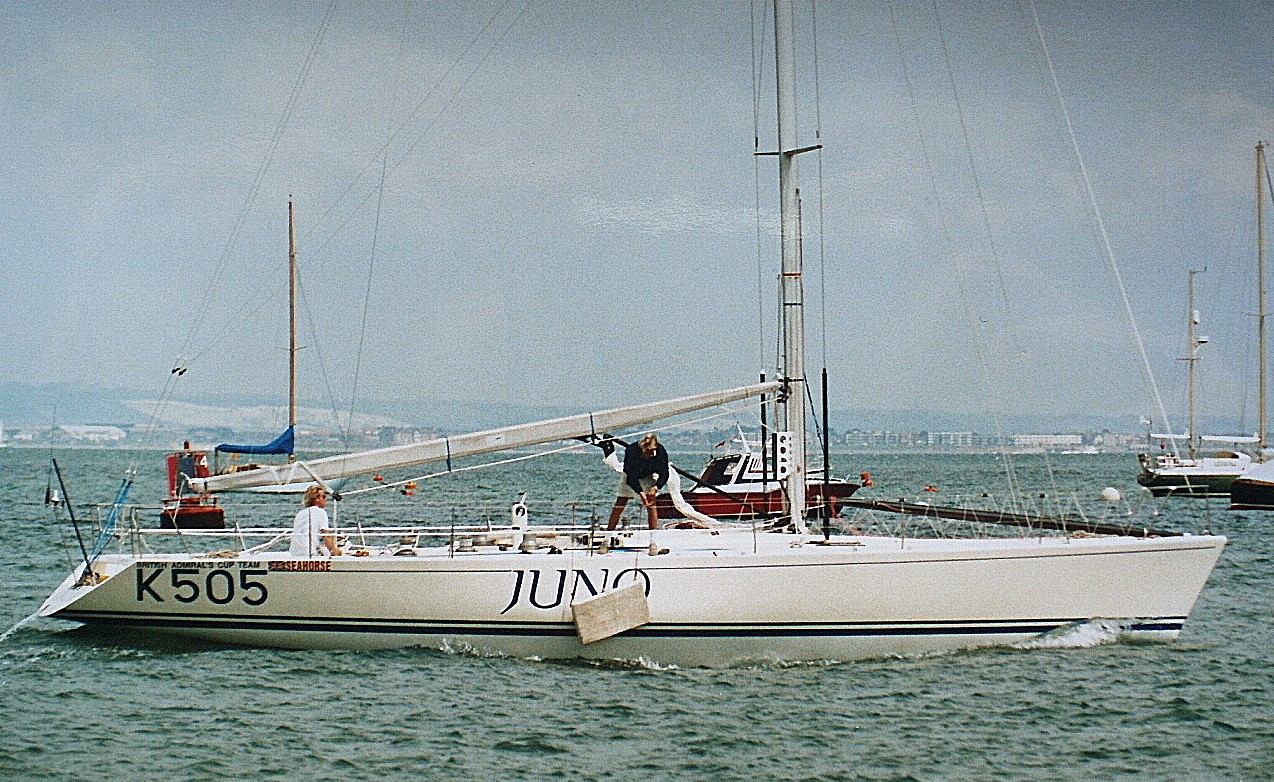
Juno V was English sailor Mike Peacock’s follow on yacht from his 1987 One Tonner Juno III, and 1989 Two Tonner Juno IV.  She was designed by Bruce Farr to compete in the highly competitive 50-foot circuit and the 1991 World Cup, and with a view towards filling the big-boat slot for Britain in the 1991 Admiral's Cup. Juno V was Farr design #224m, being a derivative of near sistership designs #224 Mandrake and Springbok. While her dimensions are not published, a comparison of design #224 to the earlier generation #203 Carat shows slightly less overall length (49.6ft) and more beam and a little more displacement. 
Juno V in Cowes
Juno V was built by Green Marine, all in carbon fibre with foam and honeycomb core in the hull and an all honeycomb core in the deck. Because she was built to race in the Admiral’s Cup, and would have to cope with the conditions that might be encountered in the Channel Race and Fastnet Race, she was built a little more heavily than the circuit-only Fifties, including carrying a stronger (and heavier) mast.
Juno V working up in early trials in Cowes (photo shockwave40 blog)
Juno V was sailed for the first time in the Solent in November 1990 (flying North working sails and Sobstad spinnakers) so that builder Bill Green could take care of any last-minute modifications before the boat was shipped to Miami for the World Cup Florida regattas in early 1991, including Key West, which featured a very competitive fleet of 15 boats.
Juno V in the thick of the action during the Key West regatta, 1991 (photo Yachting magazine)

Juno V on her way to winning Key West, January 1991 (photo Seahorse)
Juno V approaching Cowes Marina, possibly just prior to or during the 1991 Admiral's Cup (photo shockwave40 blog)
After a poor first race (10th) at Key West, Juno V put her mark on the series from Day 3, winning the first two races of the day. Although she finished the regatta with two ninths, the series was notable for the lack of dominance by any one boat, and she took out the event, just 2.25 points ahead of Heaven Can Wait and Champosa VII. She was lucky in the last race to just avoid a pile up at the first windward mark between Carat, Capricorno and Windquest, dipping just to leeward of the wreckage and then shoot the weather mark and continue racing. Juno V also benefited from improved reliability against the likes of Fujimo and Champosa VII who had encountered difficulties in the windier and warm-up races.
Juno V during the 1991 Admiral's Cup, above and below (photo shockwave40 blog)

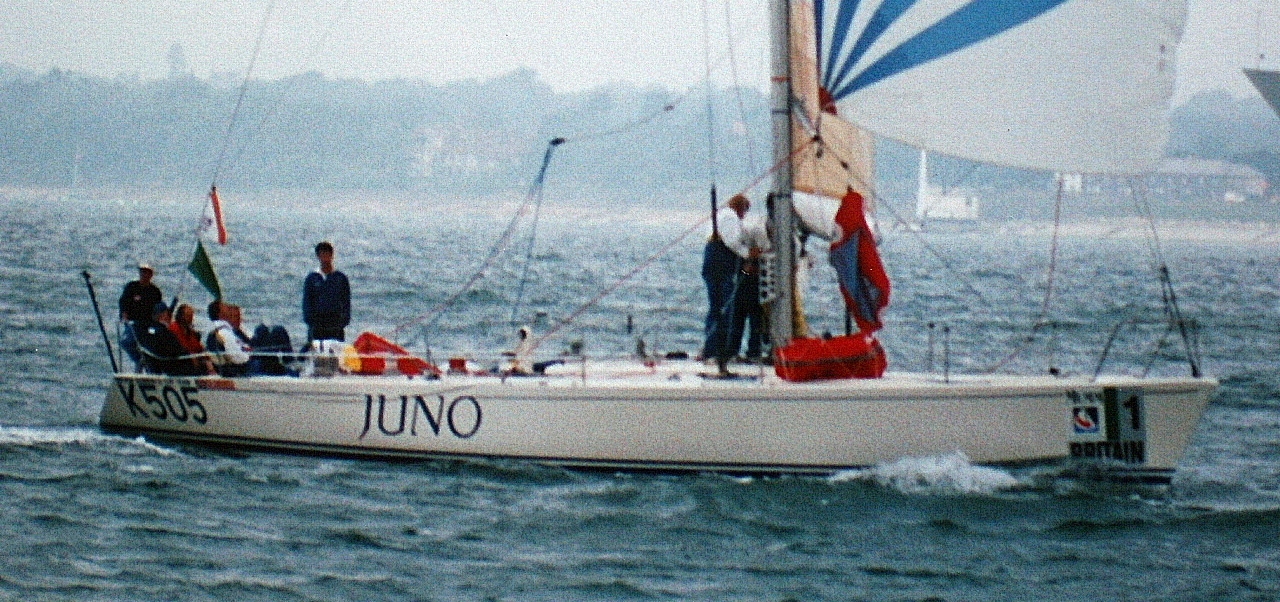
For the 1991 Admiral’s Cup, Juno V was joined by the Farr Two Tonner Wings of Oracle and the Dubois One Tonner Port Pendennis. The Official History of the Admiral’s Cup notes that “Britain’s team served as an indication of how fast the pool of Admiral’s Cup boats was slipping away. Only Mike Peacock’s new Farr 50, Juno V, was the old style of yacht: owned by a private individual and sailed by pretty much a Corinthian amateur crew, headed in this instance by Mike McIntyre".
Juno V (right) ahead of Will during the 1991 Admiral's Cup
Unable to repeat her 50-Foot circuit form, Juno V finished fifth of the eight 50-Footers, with placings of 2/6/3/4/2/7, and while Port Pendinnis sailed strongly in the One Tonner division, Wings of Oracle was less impressive and the team finished fourth overall.
Juno V during the 1991 Admiral's Cup (photo Derek Stroud)
The 1991 World Cup concluded with a regatta in Miura, Japan, in early November 1991. Juno V didn’t make the podium in this series, but did enough to finish second in the overall World Cup standings, just 4.5 points behind Abracadabra.
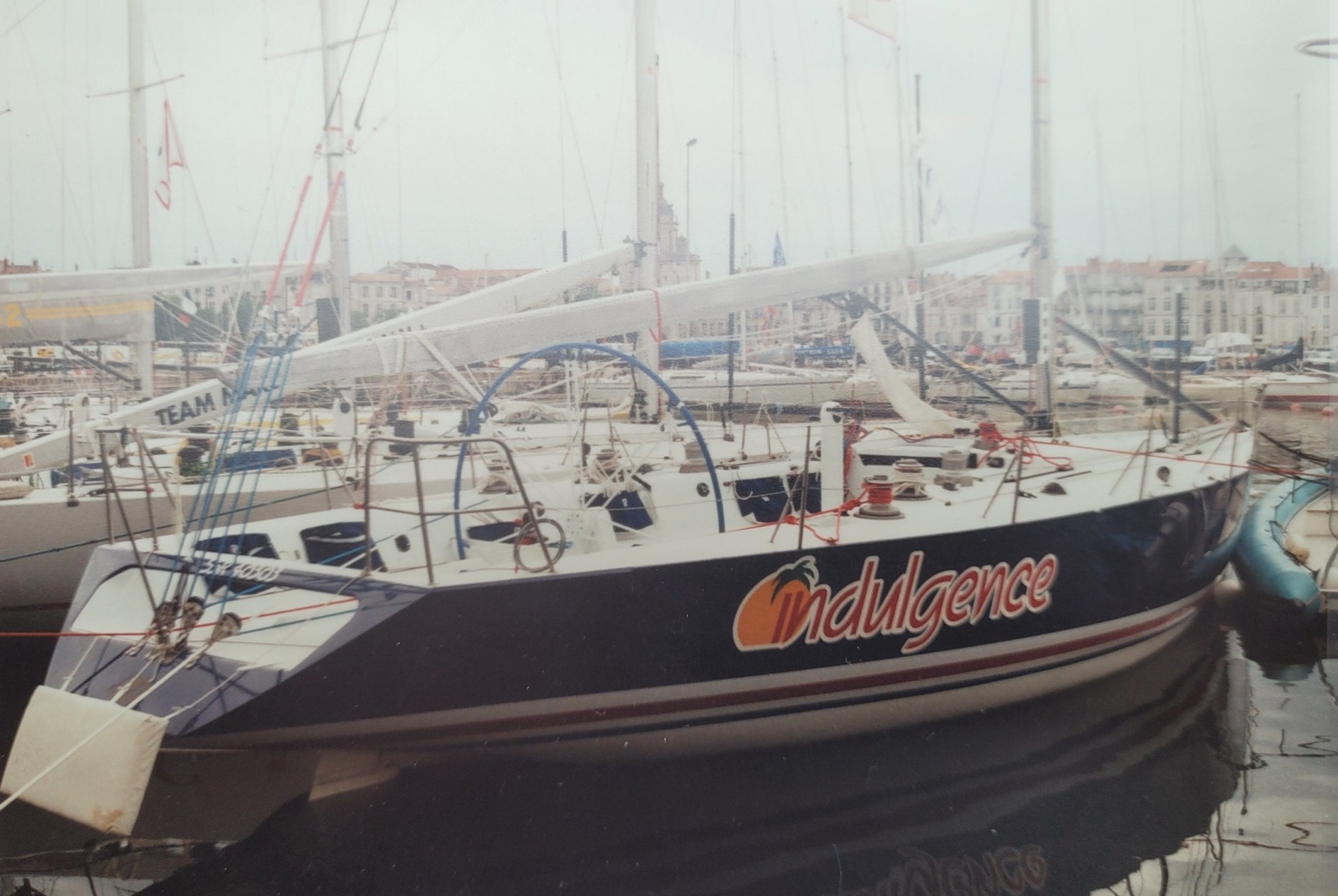
Indulgence (dark blue hull), ex-Juno V, during a Lymington Regatta ahead of the 1993 Admiral's Cup (photo Sharon Green | Ultimate Sailing)
Indulgence circa-1993 (photo Facebook)
Juno V was later bought by Graham Walker and became the latest (and eighth) Indulgence, and Walker then took it upon himself to line up two team-mates for the 1993 Admiral’s Cup – no small task as by this time IOR racing was all but dead save for a few pockets of interest: the One Ton circuit and 50-Foot World Cup. Walker’s ‘chef d’equipe’ Peter Morton secured GBE International (ex-Port Pendennis) and Provezza Source (ex-Unibank) from Turkey. The problem was, however, that the British took control of these two boats only days before the Admiral’s Cup started. Indulgence did not get into her stride until half way through the series, her original skipper Eddie Warden Owen being replaced by Chris Law, who had flown in from Australia just three days before the first race. Indeed she saved her best for the last race, leading the 50-Foot fleet home in the Fastnet, crossing the line just two lengths ahead of Syd Fischer’s Ragamuffin (Australia), with France’s Corum Saphir a further few lengths behind. But the perils of bringing together a last-minute team to race at Admiral's Cup level were clearly apparent, with the team finishing a lowly sixth overall.

The history of Indulgence through the 1992 and final 1993 year of the 50-Foot World Cup and the following years are not known, but she later became Manado, racing as a charter vessel in Sweden (photos above). She is now looking a bit worse for wear, at least below the waterline, and has recently been surveyed by Lars Klingstrom, of Flirt of Paget fame, and some of his photographs are shown below. 
The topsides still retain a high gloss finish (above and below) (photos Lars Klingstrom)

View aft, though the companionway towards the navigation station and aft pipe berths (photo Lars Klingstrom)

The navigation station above the engine, with the primary winch couplings close above (photo Lars Klingstrom)


7 July 2014

Juno (Humphreys One Tonner)

Juno was a One Tonner designed for the 1987 Admiral's Cup for English yachtsman Mike Peacock, who had previously campaigned Cifraline 3. She was a development of the 1985 trend-setting Jade, the One Ton Cup winner of that year and member of the second-placed English team in the 1985 Admiral's Cup. 

Humphreys had sought to retain Jade's impressive two-sail reaching speed in the new design, while adding some upwind emphasis. Juno was considered very light for a One Tonner (displacement of 5,404kg), with a lower centre of gravity than Jade. Although most IOR designers were pushing up freeboards a little at the time, Humphreys pursued the low-freeboard style that marked Jade out from the crowd. However, with Juno he was also able to streamline the cabin slightly - the design required builder Adrian Thompson to do away with the keel H-frame, and instead sling the keel off the solid central area of the hull. The resulting saving in construction depth allowed the freeboard to remain similar to Jade but with a lower cabin-top.

The aft shape of Juno, with the characteristic IOR 'crease' at the aft measurement station
Juno on launching day - notice the elliptical 'MME' keel
Juno working up in Mallorca, Palma Bay, prior to the English Admiral's Cup trials in 1987
The yacht was built from a one-piece male mould, using a divinycell foam core with unidirectional and woven carbon-fibre and Kevlar laminates (the mould had to be broken up inside the boat and removed through her small companion way opening shown below). Her spartan interior featured a navigation console above the centrally-located engine box, while ring frames around the mast were spaced to accommodate battery stowage and twin anchorages for the shrouds.  As was standard with One Tonners by this stage, she sported a tall triple-speader fractional rig, although it was placed slightly further forward than many of her contemporaries. Unlike her contemporaries, she was fitted with a carbon tiller, rather than a 'typical' titanium version.

Juno sailing upwind during her buildup to the 1987 Admiral's Cup (photo Rick Tomlinson/Seahorse)
Early trials, with designer Humphreys checking the B&G Hercules navigation and performance data computer
Juno, skippered by Andrew Hurst, went on to qualify for the English team for the 1987 Admiral's Cup, alongside Jamarella (Farr One Tonner) and Indulgence (Andrieu 44). She finished as ninth yacht overall, with placings of 31/7/16/43/2. Her seventh in the second race (the Channel Race) was particularly commendable, as she had been hampered during the surfing spinnaker run back from EC2 buoy by ankle-deep water in the cabin, as a result of a failed gasket around the engine strut drive. She had a poor first race and a middling third race where, along with Jamarella, she had been part of the pursuing pack and was forced to sail outside the bunch at the gybe mark between reaches.


Juno amongst the One Ton pack during the 1987 Admiral's Cup (photo One Ton Class Facebook page)
She had a disastrous race in the Third Inshore, where she collided with Centurion (ex-Jade) at a windward mark and had to take a 20 percent penalty. This was on top of a poor team decision to all sail for the right hand side of the course on the first leg. Juno bounced back in the Fastnet race finale, however, reveling in the two-sail reaching conditions to take second place. 

Juno in the Queen Ann Battery marina after the 1987 Fastnet race (photo shockwave40 blog)
Juno went on to compete in the 1987 One Ton Cup, where she finished tenth (after placings of 18/10/30/6/6). She also raced in the 1988 Kenwood Cup as part of the British team (alongside Indulgence VI and Yeoman XXVII), with a new higher aspect 'MME' keel and a reduction in her 'E' measurement showing much improved upwind speed. Downwind she retained most of her speed, benefiting from a much thinner keel profile than 1987. Her series was unfortunately brought to a premature end when she was damaged in the fourth race during a windward mark incident when General Hospital, a local Farr 40, sailed into her on port tack. Juno was kept afloat and despite this mishap finished fourth in Class E and seventh overall. She was shipped straight to San Francisco to be repaired in time to compete in the 1988 One Ton Cup in San Francisco where she finished 18th. 
Juno during the 1988 One Ton Cup, just ahead of Australia's Sagacious V
Juno performs a spectacular wipe-out during the 1988 One Ton Cup

Juno as Citroen in the 1989 Spi Quest regatta (Bateaux magazine)
Juno was renamed Citroen after she was bought by French interests. Although she performed with great distinction during the 1989 season, including being awarded the RORC Yacht of the Year, she had a disastrous 1989 Admiral's Cup series where she sailed for the Irish team, finishing near last in 41st place, following results of 24/32/41/38/39/35.


Citroen approaching Lymington Marina after a race during the 1989 Admiral's Cup (photo shockwave blog)
Sometime in the 1990s Juno was converted to an IMS racer at Vision Yachts (and named Tango), which involved a new coachroof, removal of her IOR rating bumps and bustle, with a new Judel/Vrolijk keel and rudder. She was later named Freelance (photos below from the Historiedeshalfs site).


The yacht is now located in Portavadie Marina in Scotland (photos below from the One Ton Class Facebook page). Small windows have been added to the cabin top, and the original Juno name has been reinstated.


Further update (2022, Facebook)

Juno, as seen in May 2024 in Peel, Isle of Mann (photo Facebook)


Article updated June 2024