Showing posts with label IOR 50. Show all posts

4 May 2024

Big Boat Series - 1985-1990

The IOR 50-footer Abracadabra powers across a startline during the 1987 Big Boat Series (photo Phil Uhl)
The St Francis Perpetual Trophies Regatta, which became known as the Big Boat Series, was an annual regatta hosted in San Francisco Harbour by the St Francis Yacht Club, first run in 1964. After the unprecedented cancellation of the 2001 edition of the series, Latitude 38 magazine published a retrospective on the regatta, which itself was an update of its September 1993 article titled '30 Years of the Big Boat Series - Thanks for the Memories'. I have combined this overview of the results for the 1985-1990 period and have included a 'Sail' magazine article covering the 1985 regatta and some spectacular photos from Sharon Green, Guy Gurney and Phil Uhl. An earlier article featuring the 1978-1984 regattas can be seen here.
The Reichel/Pugh 43-footer Sidewinder sails downwind in typically fresh conditions during the 1985 Big Boat Series (photo Sharon Green | Ultimate Sailing)

The 1985 Big Boat Series demonstrated once again that it pays to have a new boat, but not too new. The regatta, held from 15 to 21 September, featured five class winners (amongst the 54-boat fleet) that were recently built but had enough miles for rethinking, redesigning and rebuilding. The Reichel/Pugh 43 Lobo was sailing on its second keel, as was the Nelson/Marek 49 Crazy Horse, which was also on its seventh rudder.

Coyote in a hotly contested fleet of 40-footers, with Bondi Tram visible to leeward (KA-806) during the 1985 Big Boat Series

The 1985 edition was also notable for the support of the ‘new’ One Ton class, with only 0.3ft of rating separating the 15 smallest 40-foot boats, racing for the Rheem Trophy in a class that included ten One-Tonners and featured the toughest competition of the week. Constant changes in fortune kept the outcome in doubt until the final day, when a second place for John MacLaurin’s Davidson-designed Pendragon put them ahead of the Andrews 39 Impact. The Beneteau 39 Coyote (Irving Loube) and the Farr 40 General Hospital were close behind.

Fujimo leads Carat and Blade Runner during the 1987 Big Boat Series (photo Guy Gurney)

The San Francisco sea-breeze funneled in over the race area like clockwork, building to over 20-knots each day. Early races were sailed entirely on flood tides, which put a premium on upwind speed. This was no problem for Lobo, skippered by Tom Whidden, which won three races and Keefe-Kilborn Trophy, and edging out the Reichel/Pugh 42 It’s OK and the Nelson/Marek 41 Clockwork.

Abduction runs downwind alongside Lobo, seen here during the 1987 Big Boat Series (photo Phil Uhl)

Two members of the 1985 US Admiral’s Cup team competed against eight other boats for the Atlantic Perpetual Trophy. After a rushed trip to California from England, Bill Power’s Nelson/Marek 43 High Roler set the pace, winning three races to lead from the Frers 43 Shockwave and fellow team boat Sidewinder, a Reichel/Pugh 43. Meanwhile, Crazy Horse won four straight races in the City of San Francisco Trophy. She was the third lowest rating boat in a class of ten boats with a rating band of 10.7ft. The flood tides gave the bigger boats more time to work clear, but on the Bay, courses are tight, with short legs and turning marks that come around nearly as soon as a sail can be packed. That kept Crazy Horse within striking distance of quicker yachts such as the Soverel 55 The Shadow and the Frers 50 Tomahawk (second). The 1984 winner of this class, Blade Runner, was third.

The amazing spectacle of the Big Boat Series in the late 1980s captured here by Sharon Green (Ultimate Sailing) - left to right CadenzaShockwave, Camouflage, Blade Runner and Mauni Lani Flash

Blade Runner with her colourful spinnaker and blooper set and backlit by the Californian sun during the 1987 Big Boat Series (photo Phil Uhl) 

The 1986 series featured 53 boats. Gary Appleby's Farr 40 Sagacious came up from Australia to win the subjective 'overall boat of the series', a new award; bumper stickers and buttons proclaiming 'Shit Happens' made their first recorded appearance; Shockwave's 'Twisted Sisters' set a torrid fashion pace. IOR I - Infinity; IOR II - Roller; IOR III - Sleeper; One Ton - Sagacious.

Carat VI sails downwind during the 1987 Big Boat Series, with Locura visible to the left (photo Phil Uhl)

Another shot of Blade Runner, seen here on a reaching leg during the 1987 Big Boat Series (photo Phil Uhl)

Carat VI (left) and Fujimo during the 1987 Big Boat Series (photo Phil Uhl)

In 198746 yachts competed, including 33 IOR racers in three classes. The Atlantic Perpetual class was essentially for the new breed of 50-foot 40-raters, including Fujimo that had arrived after winning her class on the Great Lakes (only to lose her mast in the third race), Wictor Forss’ Carat VI from Sweden and Vadia de Guardiola’s Locura. But it was Jubilation, the Frers 54 steered by Paul Cayard, that swept the class with four victories and which was fast enough upwind to gain nearly enough time for the entire race. As the biggest boat in the fleet, she always sailed in clear air and, although blowing a spinnaker in one race, recovered quickly to hold the lead. Blade Runner was second, Locura third, with Carat VI finishing fourth and Fujimo fifth.

Sidewinder (left) and Camouflage approach a windward mark during the 1987 Big Boat Series (photo Phil Uhl)

In the Keefe-Kilburn Perpetual class, Sidewinder, helmed by John  Bertrand, would have been an easy winner If she hadn’t fouled during the start of the second race, leaving Bruce Nelson to steer Insatiable to overall victory. However, the yacht that attracted the most attention was Quintessence, a new Reichel-Pugh 42 that had won every event since her launch in the prior spring. With a solid lead going into the final race, the crew suffered a rash of gear problems that dropped the to eighth in that race and second overall. Despite being the smallest yacht in her class, she showed remarkable power in all winds and seas. Sidewinder finished third overall, with Camouflage fourth and Jano fifth.

Quintessence to windward of the larger Locura (photo Phil Uhl)
The Rheem Perpetual class drew the largest fleet (14 boats), primarily consisting of One Tonners. The Davidson-designed Pendragon III, skippered by Kimo Worthington, won the class by never finishing lower than third and proved that a redesigned keel and rudder could make an already quick boat even faster. At one start, Pendragon was forced to decide between hitting another boat and the starting buoy. Choosing the mark, and re-rounding while the others sailed away, Pendragon steadily ground down the fleet and won the race, as well as winning the 'overall performer' award for the series. Pacific Sundance was second, with Coyote third, Skedaddle fourth and Bondi Tram fifth. General Hospital was dismasted in front of the clubhouse.

Lobo rounds a weather mark during the 1987 Big Boat Series ahead of former New Zealand yacht Equity (Farr 43) (photo Phil Uhl)

Australia's Contractor approaches a windward mark ahead of Camouflage during the 1987 Big Boat Series (photo Phil Uhl)

Swiftsure leads Blade Runner downwind during the 1987 Big Boat Series (photo Phil Uhl)

Another photo capturing the colour of top level racing in the 1987 Big Boat Series, with Fujimo seen here leading Swiftsure with Blade Runner further astern (photo Phil Uhl)

The Soverel-designed 50-footer Locura running downwind wtih spinnaker and blooper set during the 1987 Big Boat Series (photo Phil Uhl)
Part of the One Ton fleet in the 1987 Big Boat Series, General Hospital follows Sundance (left), with Bondi Tram just visible ahead (yellow blooper) and eventual winner of the division Pendragon leading (photo Phil Uhl)

Fujimo crosses ahead of Carat at a weather mark during the 1987 series (photo Phil Uhl)

1988 was the Big Boat Series' 25th anniversary, as well as IOR's last big hurrah in the US. Although featuring a reduced entry of 38 boats, everything fell into place to make this a fabulous event - it followed a maxi year at the Kenwood Cup and the One Ton Worlds that were held two weeks prior on the Bay. Raul Gardini and Paul Cayard teamed up on Il Moro to decimate eight other maxis with five bullets, while Tom Blackaller called tactics on the victorious Farr 50 Great News against nine hot 50-footers, edging out Royal Blue and Abracadabra. Blade Runner hooked a buoy with its lazy runner and inverted her mast three feet, but it didn't break. The Peter Gilmour-driven maxi Sovereign broke theirs, however. Maxi - Il Moro di Venezia; IOR 50 - Great News; IOR II -Shockwave; One Ton - Pendragon.
Big Boat Series - The Shadow (Soverell 55) leads Checkmate and Jubilation (photographer unknown)

A mighty battle occurred amongst a fleet of eight maxis in the 1988 Big Boat Series, though it was won convincingly by Il Moro di Venezia - here we see Congere leading Matador (US-33700), Sovereign and Windward Passage II in tight reaching conditions on the Bay (photo Guy Gurney)

The bowman working in white water aboard Fujimo, trailing Insatiable, during the 1988 Big Boat Series (photo Guy Gurney)

The Vallicelli-designed 50-footer Springbok in power reaching conditions during the 1988 Big Boat Series (photo Sharon Green | Ultimate Sailing)

For 1989 it was evident that interest had declined further, with entries reducing to just 24 boats, possibly the Big Boat Series’ darkest hour. Cadillac sponsored this series (the first time that sponsorship was allowed) and ESPN televised it (with a heavy focus on the 50-foot and 70-foot sleds). IOR I - Shockwave; IOR II - Pendragon.

Sorcery in a close tussle with Matador during the 1988 Big Boat Series (photo Sharon Green)

Bloopers as well as spinnakers kept the bowman busy during the 1980's - in this case Blade Runner during the 1987 Big Boat Series (photo Phil Uhl)

The 1990 series featured a whole new look, with the regatta shortened from its previous week-long format to six races over four days. Two different courses were used for the first time, and attracted 57 boats. The highly-touted IMS rule debuted to mixed reviews, while IOR wheezed through its final death throes. Meanwhile, the rest of the series quietly went one design. IOR I - Blade Runner, IOR II – Will.

More bowman action, again during the 1987 Big Boat Series (photo Phil Uhl)


Article updated May 2026

26 November 2022

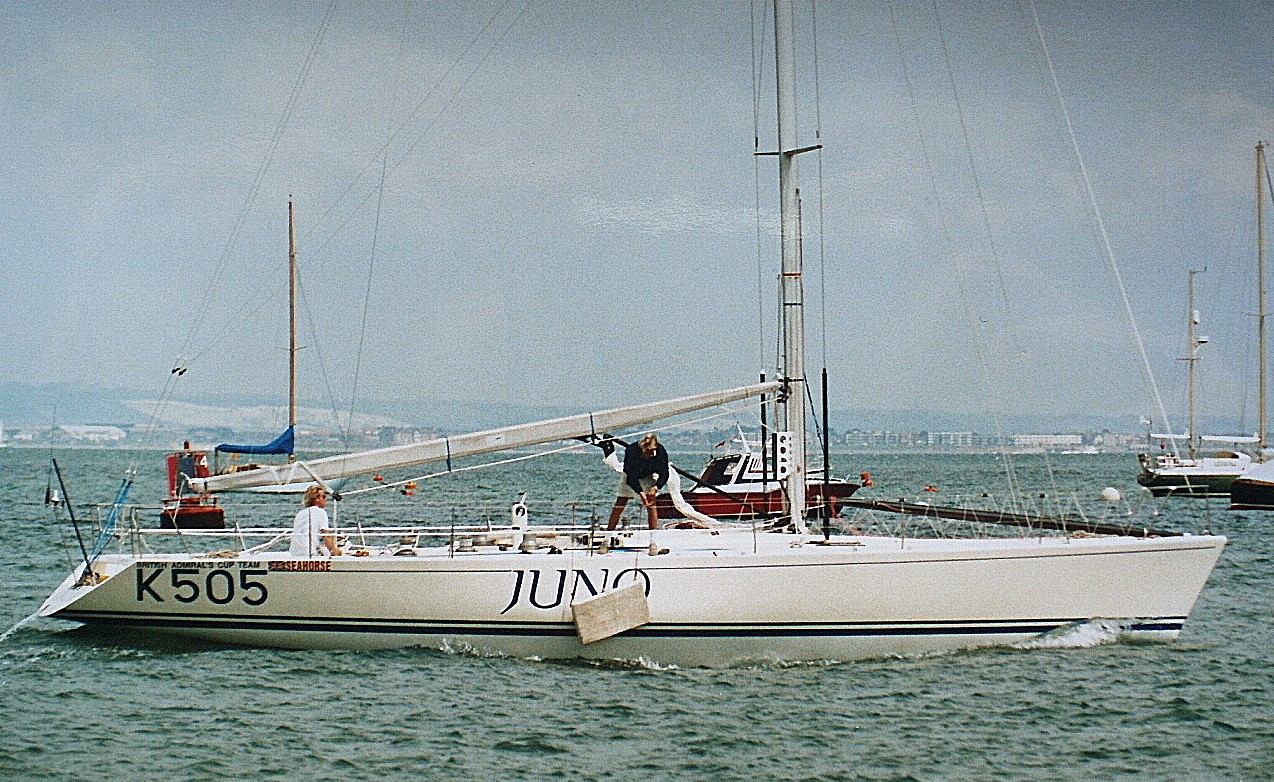
Juno V (Farr 50)

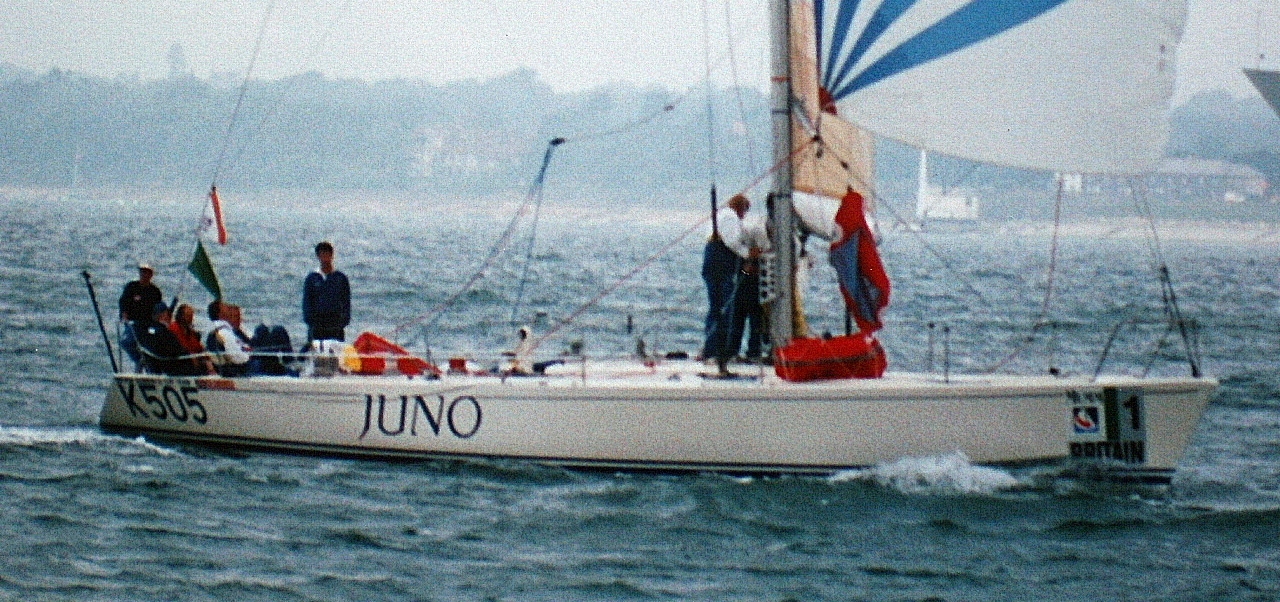
Juno V racing in the first 1991 50-Foot World Cup race at Key West (photo North Sails | Sailing World)
Juno V was English sailor Mike Peacock’s follow on yacht from his 1987 One Tonner Juno III, and 1989 Two Tonner Juno IV.  She was designed by Bruce Farr to compete in the highly competitive 50-foot circuit and the 1991 World Cup, and with a view towards filling the big-boat slot for Britain in the 1991 Admiral's Cup. Juno V was Farr design #224m, being a derivative of near sistership designs #224 Mandrake and Springbok. While her dimensions are not published, a comparison of design #224 to the earlier generation #203 Carat shows slightly less overall length (49.6ft) and more beam and a little more displacement. 
Juno V in Cowes
Juno V was built by Green Marine, all in carbon fibre with foam and honeycomb core in the hull and an all honeycomb core in the deck. Because she was built to race in the Admiral’s Cup, and would have to cope with the conditions that might be encountered in the Channel Race and Fastnet Race, she was built a little more heavily than the circuit-only Fifties, including carrying a stronger (and heavier) mast.
Juno V working up in early trials in Cowes (photo shockwave40 blog)
Juno V was sailed for the first time in the Solent in November 1990 (flying North working sails and Sobstad spinnakers) so that builder Bill Green could take care of any last-minute modifications before the boat was shipped to Miami for the World Cup Florida regattas in early 1991, including Key West, which featured a very competitive fleet of 15 boats.
Juno V in the thick of the action during the Key West regatta, 1991 (photo Yachting magazine)

Juno V on her way to winning Key West, January 1991 (photo Seahorse)
Juno V approaching Cowes Marina, possibly just prior to or during the 1991 Admiral's Cup (photo shockwave40 blog)
After a poor first race (10th) at Key West, Juno V put her mark on the series from Day 3, winning the first two races of the day. Although she finished the regatta with two ninths, the series was notable for the lack of dominance by any one boat, and she took out the event, just 2.25 points ahead of Heaven Can Wait and Champosa VII. She was lucky in the last race to just avoid a pile up at the first windward mark between Carat, Capricorno and Windquest, dipping just to leeward of the wreckage and then shoot the weather mark and continue racing. Juno V also benefited from improved reliability against the likes of Fujimo and Champosa VII who had encountered difficulties in the windier and warm-up races.
Juno V during the 1991 Admiral's Cup, above and below (photo shockwave40 blog)

For the 1991 Admiral’s Cup, Juno V was joined by the Farr Two Tonner Wings of Oracle and the Dubois One Tonner Port Pendennis. The Official History of the Admiral’s Cup notes that “Britain’s team served as an indication of how fast the pool of Admiral’s Cup boats was slipping away. Only Mike Peacock’s new Farr 50, Juno V, was the old style of yacht: owned by a private individual and sailed by pretty much a Corinthian amateur crew, headed in this instance by Mike McIntyre".
Juno V (right) ahead of Will during the 1991 Admiral's Cup
Unable to repeat her 50-Foot circuit form, Juno V finished fifth of the eight 50-Footers, with placings of 2/6/3/4/2/7, and while Port Pendinnis sailed strongly in the One Tonner division, Wings of Oracle was less impressive and the team finished fourth overall.
Juno V during the 1991 Admiral's Cup (photo Derek Stroud)
The 1991 World Cup concluded with a regatta in Miura, Japan, in early November 1991. Juno V didn’t make the podium in this series, but did enough to finish second in the overall World Cup standings, just 4.5 points behind Abracadabra.
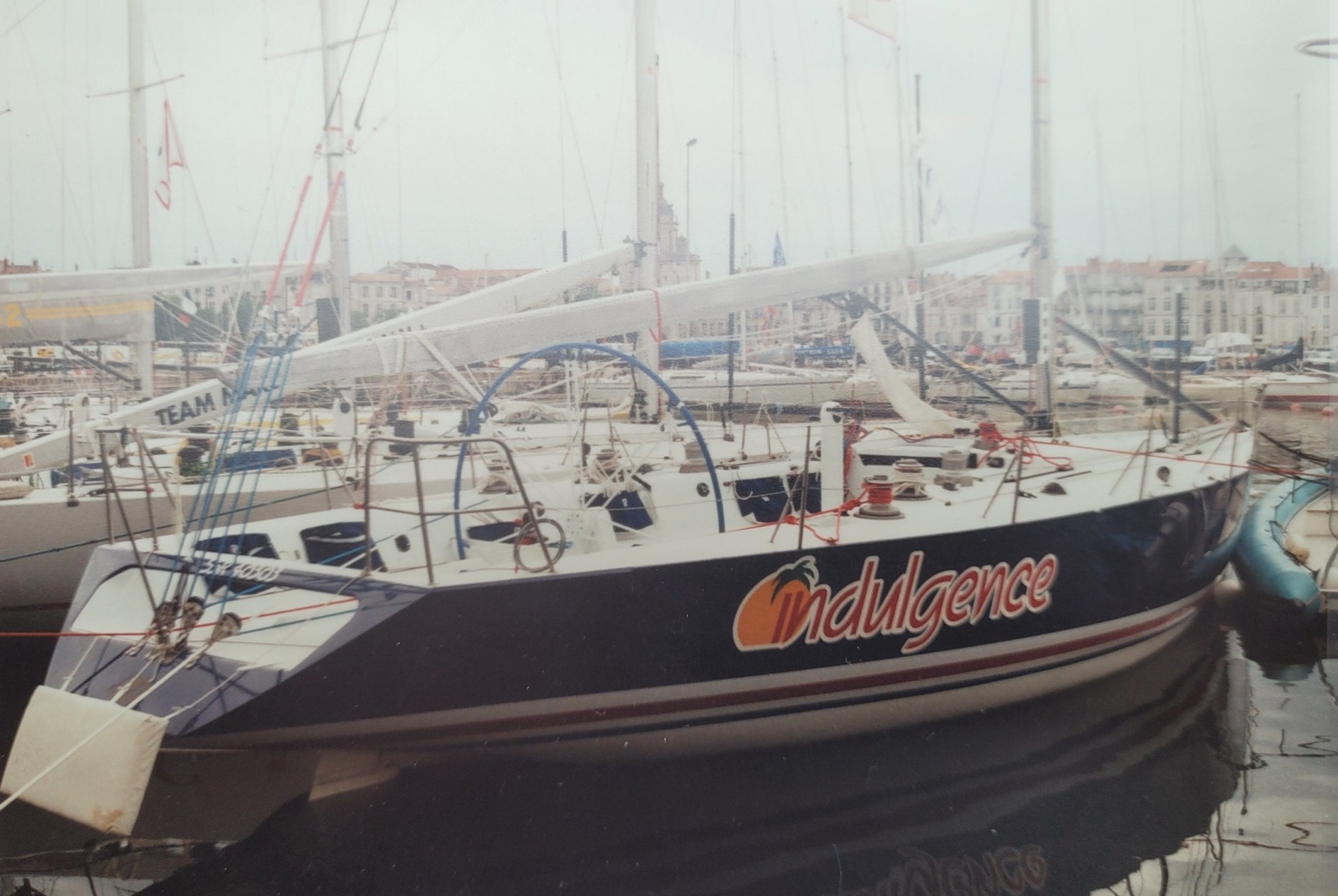
Indulgence (dark blue hull), ex-Juno V, during a Lymington Regatta ahead of the 1993 Admiral's Cup (photo Sharon Green | Ultimate Sailing)
Indulgence circa-1993 (photo Facebook)
Juno V was later bought by Graham Walker and became the latest (and eighth) Indulgence, and Walker then took it upon himself to line up two team-mates for the 1993 Admiral’s Cup – no small task as by this time IOR racing was all but dead save for a few pockets of interest: the One Ton circuit and 50-Foot World Cup. Walker’s ‘chef d’equipe’ Peter Morton secured GBE International (ex-Port Pendennis) and Provezza Source (ex-Unibank) from Turkey. The problem was, however, that the British took control of these two boats only days before the Admiral’s Cup started. Indulgence did not get into her stride until half way through the series, her original skipper Eddie Warden Owen being replaced by Chris Law, who had flown in from Australia just three days before the first race. Indeed she saved her best for the last race, leading the 50-Foot fleet home in the Fastnet, crossing the line just two lengths ahead of Syd Fischer’s Ragamuffin (Australia), with France’s Corum Saphir a further few lengths behind. But the perils of bringing together a last-minute team to race at Admiral's Cup level were clearly apparent, with the team finishing a lowly sixth overall.

The history of Indulgence through the 1992 and final 1993 year of the 50-Foot World Cup and the following years are not known, but she later became Manado, racing as a charter vessel in Sweden (photos above). She is now looking a bit worse for wear, at least below the waterline, and has recently been surveyed by Lars Klingstrom, of Flirt of Paget fame, and some of his photographs are shown below. 
The topsides still retain a high gloss finish (above and below) (photos Lars Klingstrom)

View aft, though the companionway towards the navigation station and aft pipe berths (photo Lars Klingstrom)

The navigation station above the engine, with the primary winch couplings close above (photo Lars Klingstrom)


30 October 2021

Kenwood Cup 1986

This post features a selection of great photographs by Sharon Green (Ultimate Sailing) that capture some of the action during the 1986 Kenwood Cup held in Hawaii. The 1986 edition of this famous regatta was the first with Kenwood as the new sponsor, with the event becoming the Kenwood Cup Hawaii International Ocean Racing Series, and the Waikiki Yacht Club turned over the helm for managing the event to the newly formed Royal Hawaiian Ocean Racing Club.

Startline action in the 50-footer division, with Australia's Great Expectations just to windward and ahead of US yacht Springbok

A total of 48 yachts entered the regatta, from Australia, Japan, New Zealand, Tahiti and the United States. The 1987 America's Cup had reduced the number of available offshore crew and the general downturn in IOR racing contributed to the decreased number of entries. With only two Maxis, the 50-footers in Class B would prove to be the most competitive fleet and included Dennis Conner and his crew from Stars & Stripes aboard the Frers 50 Springbok.

The One Tonners approach a leeward mark

An adjustment to the time allowance system provided a boost to the smaller yachts and the 40 and 43 footers had a field day on the Olympic triangle races off Waikiki, which became a three-way battle between the three New Zealand yachts Equity, Exador and Mad Max. Exador emerged the winner of the Hawaii Silver Jubilee Trophy with the other three tied only four points behind. It was a fitting return for Exador after the disappointment of her dismasting in the 1984 series during the Around the State Race.

Australia's Great Expectations, a Farr 50-footer

The line honours victors for the Molokai Race was of no surprise as the big red Maxi Sorcery easily beat her rival Windward Passage by 12 minutes. However the main contest was among the One Tonners who were all vying for the corrected time win. In the final tally One Tonners took the top four places with Exador leading Mad Max, General Hospital and Sagacious V.

Japanese yacht Rariko (Kanto design rating 34.5ft) flying a blooper, although these were much less popular by 1986

In the Around the State Race, Sorcery and Windward Passage match-raced for 775 miles, with Sorcery winning by just 1 minute 55 seconds. The Japanese 50-footer Zero easily won on corrected time after sticking to the rhumbline course on the long trek from Niihau to South Point.

Blade Runner (first overall in Class B) chases Tomahawk (ex-Margaret Rintoul III)

The top overall yacht and winner of the King Kamehameha Trophy was Crazy Horse who beat Sleeper by two points. The New Zealand team of Equity, Exador and Thunderbird turned in a strong performance to be the top team overall and winners of the Kenwood Cup on its first presentation.

US yacht Jubilation (third overall in Class B)

The New Zealand Davidson 40 One Tonner Mad Max (second overall in Class D)

US yacht Checkmate, a Peterson 55 (ex-Bullfrog)

US yacht Springbok, a Frers 50-footer

Thunderbird (a Farr 43), part of the winning New Zealand team
Crazy Horse, top yacht overall

Springbok rounds a leeward mark