Showing posts with label Flirt of Paget. Show all posts

28 August 2026

Admiral's Cup 1981

This article features a selection of photos from the 1981 Admiral's Cup from Guy Gurney and Phil Uhl, as well as a recently published video of the series (by retro yachting) as narrated by the late Bob Fisher. The series was won by Britain, with the USA second and Germany third, although the subsequent controversy over the rating of British yacht Victory of Burnham was considered by many to place something of a cloud over that result.

Part of the 1981 Admiral's Cup fleet Dusselboot, Intuition, Bribon III, Wee Willie Winkie, Panda and Attaque (photo Guy Gurney)

Light airs in the first race, with Woolly Jumper, Victory, Almagores and Scaramouche (photo Phil Uhl)

The crew of Canada's Pachena endure the light airs of the first day (photo Phil Uhl)

Bermuda's Caiman II, winner of the first race, runs aground and the crew scramble aloft to try to help the yacht break free (photo Guy Gurney)

Ireland's Woolly Jumper in light airs, likely during the first race (photo Phil Uhl)

The second race saw more favourable breezes - here the fleet sets off with (left to right, Wee Willie Winkie, Moonduster, Stars & Stripes, Ragamuffin, Intuition, Victory and Hurrycane), photo Guy Gurney

Stars & Stripes leads a group of boats on a reaching leg during Race 2 (photo Guy Gurney)

Ireland's Regardless tacks behind France's Tahiti during the 1981 Admiral's Cup (photo Phil Uhl)

Dragon, a Dubois-39 footer, was the small boat of the British team, and found her legs in the offshore races (photo Phil Uhl)

The start of the Channel Race, with Hong Kong's La Pantera to windward of France's Tahiti and Italy's Almagores (photo Phil Uhl)

Light air downwind sailing, possibly during the start of the Channel Race, with (left to right) Accanito, HurrycaneMoonduster, Runaway, Caiman and Ra Carat (photo Guy Gurney)

The start of the Channel Race, with Midnight Sun to leeward of Runaway and Accanito (photo Phil Uhl)

Pinta at the start of the Channel Race (photo Phil Uhl)

Runaway seen here again after the start of the Channel Race, with Flirt of Paget just ahead, and Container visible to the right (photo Phil Uhl)

Italy's Almagores is sandwiched in a pileup of Admiral's Cuppers with other yachts at a turning mark during the Channel Race (photo Guy Gurney)

Another view of Britain's Dragon (photo Guy Gurney)


More photographs from the 1981 Admiral's Cup can be seen here from Day 1 and Day 2 of the series.

Article published August 2026 

26 November 2022

Juno V (Farr 50)

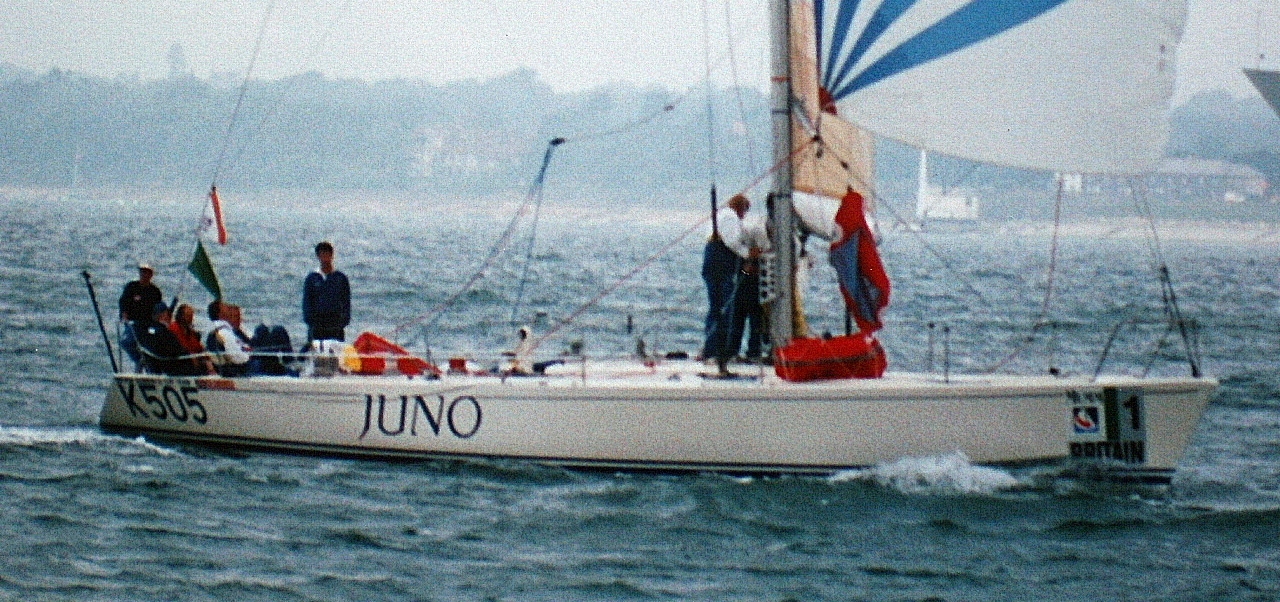
Juno V racing in the first 1991 50-Foot World Cup race at Key West (photo North Sails | Sailing World)
Juno V was English sailor Mike Peacock’s follow on yacht from his 1987 One Tonner Juno III, and 1989 Two Tonner Juno IV.  She was designed by Bruce Farr to compete in the highly competitive 50-foot circuit and the 1991 World Cup, and with a view towards filling the big-boat slot for Britain in the 1991 Admiral's Cup. Juno V was Farr design #224m, being a derivative of near sistership designs #224 Mandrake and Springbok. While her dimensions are not published, a comparison of design #224 to the earlier generation #203 Carat shows slightly less overall length (49.6ft) and more beam and a little more displacement. 
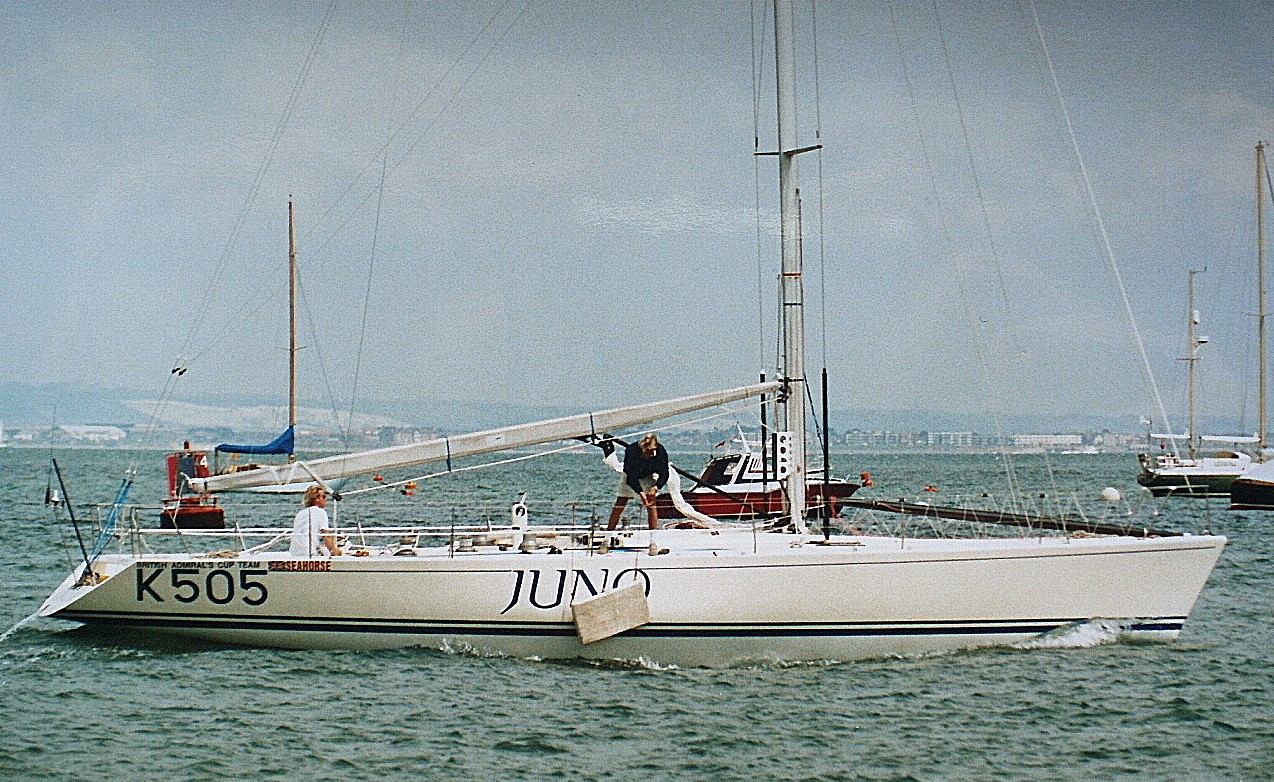
Juno V in Cowes
Juno V was built by Green Marine, all in carbon fibre with foam and honeycomb core in the hull and an all honeycomb core in the deck. Because she was built to race in the Admiral’s Cup, and would have to cope with the conditions that might be encountered in the Channel Race and Fastnet Race, she was built a little more heavily than the circuit-only Fifties, including carrying a stronger (and heavier) mast.
Juno V working up in early trials in Cowes (photo shockwave40 blog)
Juno V was sailed for the first time in the Solent in November 1990 (flying North working sails and Sobstad spinnakers) so that builder Bill Green could take care of any last-minute modifications before the boat was shipped to Miami for the World Cup Florida regattas in early 1991, including Key West, which featured a very competitive fleet of 15 boats.
Juno V in the thick of the action during the Key West regatta, 1991 (photo Yachting magazine)

Juno V on her way to winning Key West, January 1991 (photo Seahorse)
Juno V approaching Cowes Marina, possibly just prior to or during the 1991 Admiral's Cup (photo shockwave40 blog)
After a poor first race (10th) at Key West, Juno V put her mark on the series from Day 3, winning the first two races of the day. Although she finished the regatta with two ninths, the series was notable for the lack of dominance by any one boat, and she took out the event, just 2.25 points ahead of Heaven Can Wait and Champosa VII. She was lucky in the last race to just avoid a pile up at the first windward mark between Carat, Capricorno and Windquest, dipping just to leeward of the wreckage and then shoot the weather mark and continue racing. Juno V also benefited from improved reliability against the likes of Fujimo and Champosa VII who had encountered difficulties in the windier and warm-up races.
Juno V during the 1991 Admiral's Cup, above and below (photo shockwave40 blog)

For the 1991 Admiral’s Cup, Juno V was joined by the Farr Two Tonner Wings of Oracle and the Dubois One Tonner Port Pendennis. The Official History of the Admiral’s Cup notes that “Britain’s team served as an indication of how fast the pool of Admiral’s Cup boats was slipping away. Only Mike Peacock’s new Farr 50, Juno V, was the old style of yacht: owned by a private individual and sailed by pretty much a Corinthian amateur crew, headed in this instance by Mike McIntyre".
Juno V (right) ahead of Will during the 1991 Admiral's Cup
Unable to repeat her 50-Foot circuit form, Juno V finished fifth of the eight 50-Footers, with placings of 2/6/3/4/2/7, and while Port Pendinnis sailed strongly in the One Tonner division, Wings of Oracle was less impressive and the team finished fourth overall.
Juno V during the 1991 Admiral's Cup (photo Derek Stroud)
The 1991 World Cup concluded with a regatta in Miura, Japan, in early November 1991. Juno V didn’t make the podium in this series, but did enough to finish second in the overall World Cup standings, just 4.5 points behind Abracadabra.
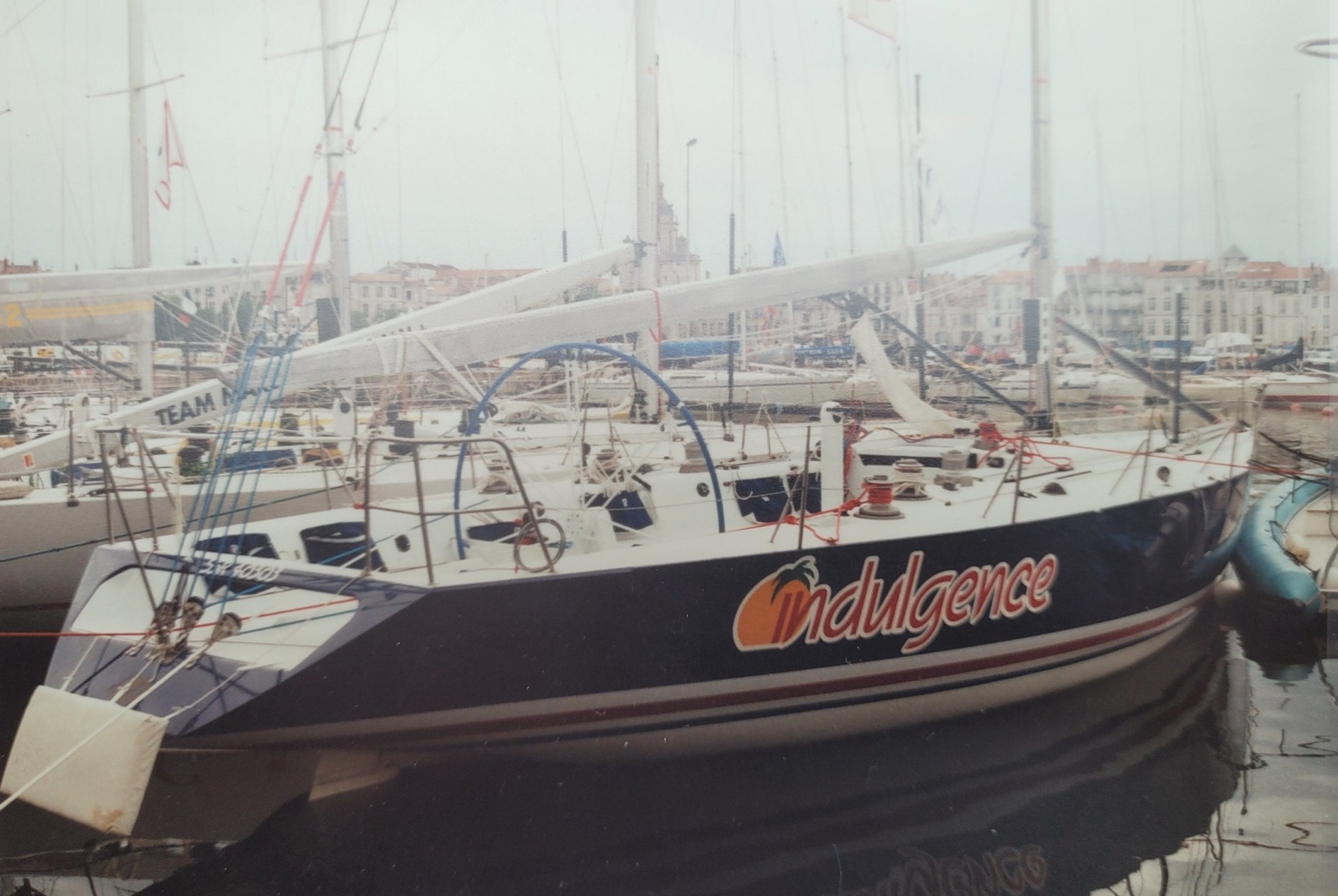
Indulgence (dark blue hull), ex-Juno V, during a Lymington Regatta ahead of the 1993 Admiral's Cup (photo Sharon Green | Ultimate Sailing)
Indulgence circa-1993 (photo Facebook)
Juno V was later bought by Graham Walker and became the latest (and eighth) Indulgence, and Walker then took it upon himself to line up two team-mates for the 1993 Admiral’s Cup – no small task as by this time IOR racing was all but dead save for a few pockets of interest: the One Ton circuit and 50-Foot World Cup. Walker’s ‘chef d’equipe’ Peter Morton secured GBE International (ex-Port Pendennis) and Provezza Source (ex-Unibank) from Turkey. The problem was, however, that the British took control of these two boats only days before the Admiral’s Cup started. Indulgence did not get into her stride until half way through the series, her original skipper Eddie Warden Owen being replaced by Chris Law, who had flown in from Australia just three days before the first race. Indeed she saved her best for the last race, leading the 50-Foot fleet home in the Fastnet, crossing the line just two lengths ahead of Syd Fischer’s Ragamuffin (Australia), with France’s Corum Saphir a further few lengths behind. But the perils of bringing together a last-minute team to race at Admiral's Cup level were clearly apparent, with the team finishing a lowly sixth overall.

The history of Indulgence through the 1992 and final 1993 year of the 50-Foot World Cup and the following years are not known, but she later became Manado, racing as a charter vessel in Sweden (photos above). She is now looking a bit worse for wear, at least below the waterline, and has recently been surveyed by Lars Klingstrom, of Flirt of Paget fame, and some of his photographs are shown below. 
The topsides still retain a high gloss finish (above and below) (photos Lars Klingstrom)

View aft, though the companionway towards the navigation station and aft pipe berths (photo Lars Klingstrom)

The navigation station above the engine, with the primary winch couplings close above (photo Lars Klingstrom)


12 November 2021

1981 New Zealand Admiral's Cup trials

This post features photographs taken from slides that form part of the Auckland's Maritime Museum's online collection. These photographs are from the 1981 New Zealand Admiral's Cup trials, that were contested by eight yachts over a course of observation races in March 1981 followed by a selection trials series proper. The trials were won by Swuzzlebubble III, a Holland-designed 40-footer, and she was joined in the New Zealand team by near sistership Epiglass New Zealand, renamed Wee Willie Winkie for the Admiral's Cup itself to avoid Rule 26 (sponsorship) complications, and Marac, a fractionally-rigged S&S 46-footer, later re-named Inca for the same reason. Other contenders in the series were Feltex Roperunner (a Farr designed 40 footer for Don Lidgard), Spritzer (a masthead Holland 40), Monique (a masthead Holland 42-footer), Ngaruru (S&S 46, sistership to Marac/Inca). Digby Taylor also used the series as a warm-up regatta for his Whitbread entry, the Davidson 50-footer Outward Bound. While Swuzzlebubble III went on to be the top individual yacht in the Admiral's Cup that year, Wee Willie Winkie and Inca could only manage 26th and 42nd respectively, and the New Zealand finished in sixth place overall.

Epiglass New Zealand to weather of Spritzer, soon after the start of one of the trial races in easterly conditions on the Auckland Harbour
Evan Julian's S&S 46-footer Marac (rating 34.5ft IOR) crosses Epiglass New Zealand and Feltex Roperunner (4499)
Ngaruru (4513) leads Monique (3325), Spritzer (4490) and Swuzzlebubble III (4466)

Epiglass New Zealand (30.6ft IOR) skippered by Stu Brentnall - note the hard turn in the sheer between the maximum beam point and the stern, as a way of maximising crew leverage between these two measurement points

Ian Gibbs' Swuzzlebubble III (30.2ft IOR) sails past Islington Bay towards the Motuihe Channel

Swuzzlebubble III sails into the Motuihe Channel in perfect easterly conditions

Marac sails back into Auckland Harbour
Feltex Roperunner, the lowest rating boat in the series (30.1ft IOR), runs downwind through the Motuihe Channel back into Auckland Harbour
Spritzer sailing past Motuihe Island - a similar design to Epiglass New Zealand and Swuzzlebubble III but masthead rigged (30.2ft IOR). She competed in the Admiral's Cup for Bermuda as Flirt of Paget.
Epiglass New Zealand sails downwind past Rangitoto Island with Sprizter to windward and Feltex Roperunner astern

Spritzer and Epiglass New Zealand head out into the Hauraki Gulf

Epiglass New Zealand sails past Gannet Rock 
Feltex Roperunner sails past Motuihe Island and out into the Hauraki Gulf in a fresh south-westerly


25 November 2014

Flirt of Paget - sailing again

After an incredible five year restoration, Flirt of Paget, a Holland 40ft ex-Admiral's Cupper (ex-New Zealand yacht Spritzer) has been relaunched during the past European summer. Congratulations to Lars Klingstrom who has applied an incredible level of workmanship to this project. That work can be seen in Lars' updates through Sailing Anarchy, and on the Swedish website blur.se. The earlier history of Flirt can be seen here.

Flirt of Paget's kauri timber topsides are gleaming after a painstaking restoration effort

15 November 2012

Flirt of Paget (Holland 40)

Flirt of Paget is a 40ft Ron Holland design built in New Zealand by Brin Wilson Yachts in 1981 for the Admiral's Cup of that year, and featured a kauri planked hull (around an aluminium space frame) and her varnished finish made her instantly recognisable. 

The yacht was designed as a 'minimum rater', coming in at 30.1ft on IOR, to meet the 30.0ft minimum set by the rules for the Admiral's Cup. Unusually for a racing yacht at this size she was fitted with a masthead rig, and this was expected to make her more competitive in lighter airs.  

Spritzer, as she was originally known, competed against other seven other yachts in the New Zealand trials, and finished in fifth place, with individual placings of 5/4=/4/5/3=/5. The line up for the series was notable for the resurgence of Holland designs (such as Ian Gibbs' Swuzzlebubble III) which had gained some ascendancy since the changes to the IOR that had severely penalised the light displacement designs of the likes of Bruce Farr and Laurie Davidson. There was little of the light airs which was expected to be her forte, but as it turned out her best results were in the fresher winds. Crucially, however, Spritzer couldn't foot it with the fractional-rigged yachts on a two-sail reach and although she was well sailed tactically, and often made up places by going the right way, she didn't have the boat speed of the others. 

Spritzer during the 1981 New Zealand Admiral's Cup trials
Spritzer crosses behind the larger Inca in the New Zealand Admiral's Cup trials 1981 (photo Sea Spray)
Spritzer in close company with Feltex Roperunner (4499) and Swuzzlebubble III in the NZ Admiral's Cup trials, and below, as Flirt of Paget during the 1981 Admiral's Cup


Flirt of Paget competing for Japan in the 1983 AC


Spritzer went on to compete for the Bermudan team in the 1981 Admiral's Cup, having been bought by a Mr Trimingham (of Paget) and renamed Flirt of Paget.  She generally failed to fire, although it was a year when Swuzzlebubble III was the top yacht of the series, and the Bermudan team finished last of 16 teams. Her result was not helped by losing her mast in the Channel Race. She went on to compete for Japan in the 1983 Admiral's Cup, although that team also finished last (from 15).
Being lifted for transport to the shed (L Klingstrom, 2007)


Flirt of Paget later competed in other regattas overseas, including the 1983 SORC where she finished third in Class E with placings of 11/9/3/3/2/4, and 27th overall. She also raced in the 1984 series, where she finished sixth in Class F, and 54th overall. 
Flirt of Paget competing in the 1984 SORC (photo Larry Moran)
In 2007 she was bought by Swedish yachtsman Lars Klingstrom. Lars has embarked on an incredible restoration of Flirt of Paget, and has applied a level of perfectionism and attention to detail that has drawn many admirers through his regular posts and updates in the Sailing Anarchy forums. She was shown to the public at the Gothenburg Boat Show (Sweden) in 2013, and more photographs from that and her restoration can be seen here. She was  relaunched in July 2014
Flirt of Paget's kauri hull gets the high gloss treatment (photo L Klingstrom, 2012)

 Rudder fitted and nearing completion, January 2013 (photo Claus Axtal)


Launched! July 2014