Showing posts with label Admiral's Cup 1983. Show all posts

12 February 2022

Lady Be (Frers 45)

Lady Be was the first of the production Beneteau 456, after Beneteau decided they needed a fast offshore yacht in their production range. She was designed by German Frers and, although supposedly a production yacht, the hull was constructed in Kevlar and carbon-fibre/foam sandwich with a stripped out interior. She was 13.8m (45.3ft) long, with a beam of 4.2m and displacement of 9,225kg, and carried a rating of 35.4ft.

Lady Be in hard reaching conditions (photo Facebook)
Eric Duchemin was recruited by Beneteau to campaign Lady Be for the French Admiral's Cup trials and just failed to gain a place. However, she came under the eye of Peter Blake, who was looking for a yacht to charter for the hastily prepared New Zealand Admiral's Cup team where she would join Neville Crichton's Frers 43 Shockwave
Lady Be 
Crichton had initially planned for Shockwave to be a member of a New Zealand team, but when no other boats came forth for selection, he campaigned Shockwave in the Australian trials. Despite her dominance of that series, however, Shockwave was not selected and Crichton found himself with a hot boat in need of team-mates. He managed to goad the New Zealand sailing fraternity into action, and Ian Gibbs joined the fray by chartering Swuzzlebubble IV, the former Epiglass New Zealand (Wee Willie Winkie), a Holland 40 and near sistership to his earlier Swuzzlebubble III which was top individual yacht in the 1981 Admiral's Cup.
Lady Be rounds a windward mark during the second race of the 1983 Admiral's Cup, just ahead of US yacht Locura

Blake thought that Lady Be could be made competitive for the Admiral's Cup, particularly if Duchemin stayed on, and chartered the French yacht. Following an unremarkable 16th place in the first race of the series (where Shockwave finished last after incurring a 23 place penalty), Blake proved his point in the second race when, in a reasonable breeze in the Solent, Shockwave and Lady Be had a great race together to finish third and fourth respectively. That was as good as it got however, as lighter winds in the two ocean races put the bigger boats like them out of the running. The Channel Race was a small boat benefit, and Lady Be finished in 41st place, with Shockwave not much better in 32nd. In better conditions in the fourth race, Lady Be finished 17th and then 16th in the Fastnet race finale, to finish as 19th yacht overall, with the New Zealand team taking sixth place.

Lady Be seen here during the 1983 Admiral's Cup, trying to outrun the smaller yacht Almagores (Peterson 43), which finished second on individual points and was part of the second placed Italian team (photo Phil Uhl)

Lady Be powers upwind under full main and no.3 genoa (photo Facebook)
Lady Be to windward to team-mate Shockwave at the start of the second race in the 1983 Admiral's Cup (photo Johnathan Eastland | Ajax)
Lady Be leads Scarlett O'Hara downwind during the second race of the 1983 Admiral's Cup (photo Alan Sefton | NZ Yachting)
The following sequence of photos are of Lady Be taken by Larry Moran on the long downwind leg of the St Petersburg to Ft Lauderdale race during the 1984 SORC. Lady Be was sailed by Francois Chalain and finished in 3rd place in Class C (and 14th overall) with division placings of 8/2/2/1/9/8.
Lady Be during the St Petersburg to Ft Lauderdale race during the 1984 SORC (photo Larry Moran)

Lady Be on her way to second place in the St Petersburg to Ft Lauderdale race (photo Larry Moran)
Lady Be with Bravura and Secret Love (overall winner of Class C) following (photo Larry Moran)
Lady Be with Bravura and Secret Love following, and Invictus out to the left (photo Larry Moran)

Lady Be with Bravura and Secret Love following (photo Larry Moran)

Another photo of Lady Be during the 1984 SORC, this time by Guy Gurney
It is understood that Lady Be was sold to Russell Hoyt in Newport, R.I. and renamed Destination where she was actively raced on the US east coast. In 2009 she took part in the ARC 2009 race under the ownership of Jurgen Dobbelaer and with her original name of Lady Be. Unfortunately she had to abandon the race due to leaks in the rudder post. She was transported to Muiden in the Netherlands in 2010 and is in service as a charter yacht for day trips on the IJsselmeer (as of 2016).

Article updated July 2024

12 November 2021

1981 New Zealand Admiral's Cup trials

This post features photographs taken from slides that form part of the Auckland's Maritime Museum's online collection. These photographs are from the 1981 New Zealand Admiral's Cup trials, that were contested by eight yachts over a course of observation races in March 1981 followed by a selection trials series proper. The trials were won by Swuzzlebubble III, a Holland-designed 40-footer, and she was joined in the New Zealand team by near sistership Epiglass New Zealand, renamed Wee Willie Winkie for the Admiral's Cup itself to avoid Rule 26 (sponsorship) complications, and Marac, a fractionally-rigged S&S 46-footer, later re-named Inca for the same reason. Other contenders in the series were Feltex Roperunner (a Farr designed 40 footer for Don Lidgard), Spritzer (a masthead Holland 40), Monique (a masthead Holland 42-footer), Ngaruru (S&S 46, sistership to Marac/Inca). Digby Taylor also used the series as a warm-up regatta for his Whitbread entry, the Davidson 50-footer Outward Bound. While Swuzzlebubble III went on to be the top individual yacht in the Admiral's Cup that year, Wee Willie Winkie and Inca could only manage 26th and 42nd respectively, and the New Zealand finished in sixth place overall.

Epiglass New Zealand to weather of Spritzer, soon after the start of one of the trial races in easterly conditions on the Auckland Harbour
Evan Julian's S&S 46-footer Marac (rating 34.5ft IOR) crosses Epiglass New Zealand and Feltex Roperunner (4499)
Ngaruru (4513) leads Monique (3325), Spritzer (4490) and Swuzzlebubble III (4466)

Epiglass New Zealand (30.6ft IOR) skippered by Stu Brentnall - note the hard turn in the sheer between the maximum beam point and the stern, as a way of maximising crew leverage between these two measurement points

Ian Gibbs' Swuzzlebubble III (30.2ft IOR) sails past Islington Bay towards the Motuihe Channel

Swuzzlebubble III sails into the Motuihe Channel in perfect easterly conditions

Marac sails back into Auckland Harbour
Feltex Roperunner, the lowest rating boat in the series (30.1ft IOR), runs downwind through the Motuihe Channel back into Auckland Harbour
Spritzer sailing past Motuihe Island - a similar design to Epiglass New Zealand and Swuzzlebubble III but masthead rigged (30.2ft IOR). She competed in the Admiral's Cup for Bermuda as Flirt of Paget.
Epiglass New Zealand sails downwind past Rangitoto Island with Sprizter to windward and Feltex Roperunner astern

Spritzer and Epiglass New Zealand head out into the Hauraki Gulf

Epiglass New Zealand sails past Gannet Rock 
Feltex Roperunner sails past Motuihe Island and out into the Hauraki Gulf in a fresh south-westerly


10 October 2020

SORC 1983 - Part 1

This article features some great photographs by Sharon Green/Ultimate Sailing from the 1983 SORC series, as well as some commentary based on a postscript article by Bruce Kelley in Seahorse magazine following the series.

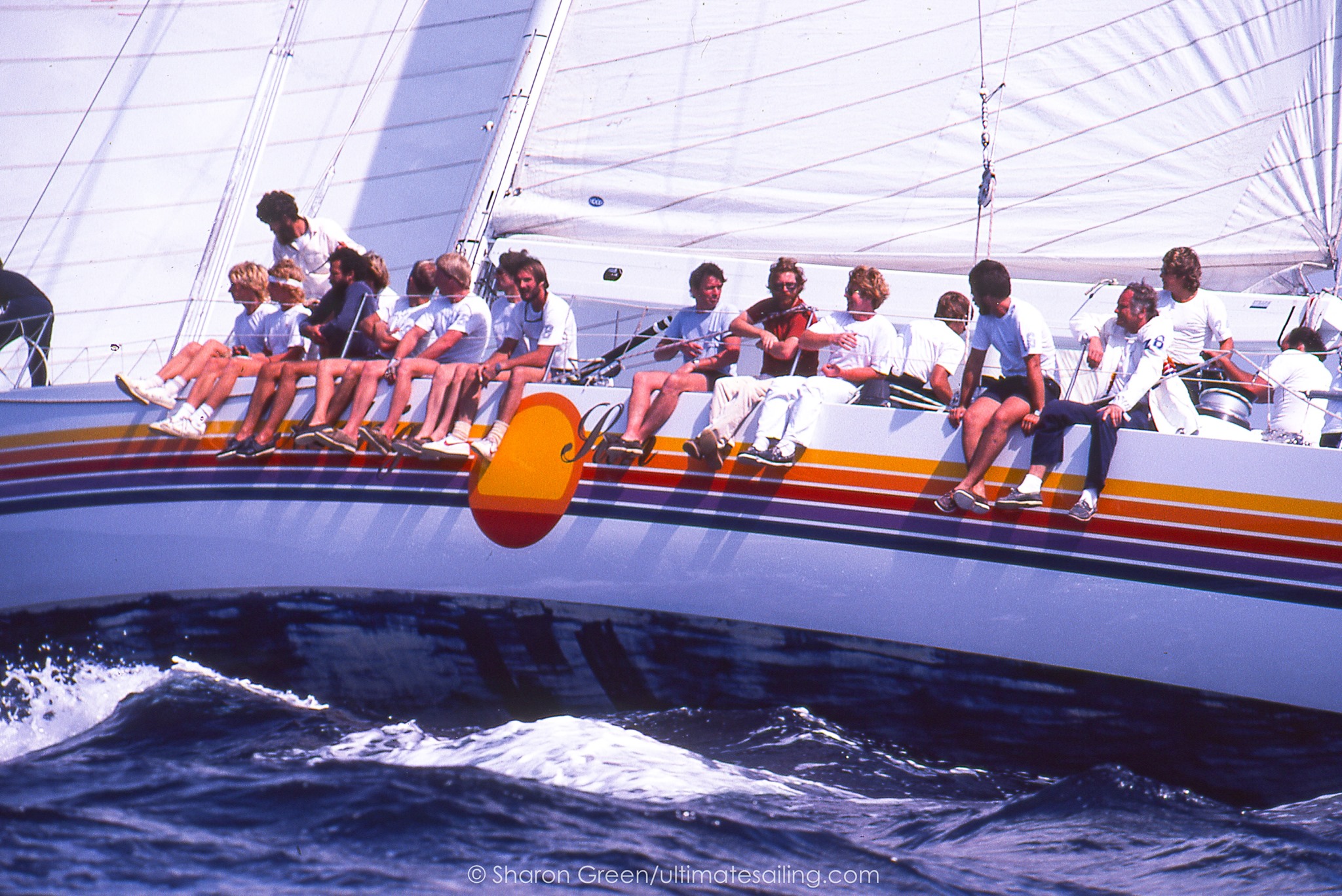
Scarlett O'Hara leads Brooke Ann and Glory during the 1983 SORC

The 1983 edition of the SORC was given added significance being in an Admiral's Cup year. Amongst the US Admiral's Cup team hopefuls, the Soverel-designed Locura and Peterson 43 Scarlett O'Hara were the outstanding performers. The pair led the SORC from start to finish both overall and in Class D, with Locura leading up until the last race, the 26-mile Nassau Cup final off the Bahamanian capital. 

Scarlett starts ahead and to weather of Thunderbolt (Nelson/Marek 40, fifth Class D and sixth overall)

Before the first gun for the Nassau Cup race, Locura and Scarlett circled each other each looking for an opening that would give an important jump at the start. A general recall brought the fleet back for a re-start, where Scarlett manoeuvred herself crisply to break out of the pack into clean air. Locura found herself in front of Thunderbolt, who was coming in on starboard, and had to gybe twice, first to keep clear and then to get back on course. Scarlett went on to sail a flawless race to take first in Class D and third in fleet, while Locura, starting virtually last, did come back up the through the class but could only manage fifth, and 12th in fleet, by far her worst race of the series. This was however enough to take the win in Class D, while Scarlett finished second in class but first overall, and winner of the Governor's Cup. The share of the class and overall fleet wins by these two yachts was just the way to end a great series between these two yachts who proved themselves to be a notch above the rest of the fleet in every area that counts: boatspeed, crew-work, preparation, strategy and tactics.

Scarlett O'Hara getting a strong start in one of the races in Class D

Locura was genuinely quick and her crew had both the talent and depth to put her speed to good use. Scarlett was an interesting winner. She and her near sisterships (Louisiana Crude amongst others) started life as a stock, five-year old Serendipity 43, built by New Orleans Marine with a relatively unsophisticated hull layup, but despite a minor disadvantage in terms of weight distribution she was extremely well sailed by Chris Corlett and Dee Smith (of Horizon Sails at the time).

Celebration (Cook 40), fifth in Class E and 29th overall
Mea Culpa, a Frers 41 and skippered by Tom Blackaller, had a strong series to finish third in Class D, and third overall

Carat (ex-Retaliation), a Frers 51, took out overall honours in Class B (22nd overall)

A tightly packed bunch in Class D

Locura (right) chases two unknown yachts (left and middle)

The fleet corrected out very evenly in the Nassau Cup, with five of the six classes represented in the top ten. Razzle Dazzle beat out Morning Star for top honours in the race by a mere two seconds. Scarlett had secured third by just one second over John Buchan's new Peterson 42 Glory. Further back, just three minutes and 22 seconds separated Migizi in fifth from Fiji Warrior in 22nd. 
Artemis (Peterson 51) chases Carat on a tight reach in Class B racing

By winning their respective classes in this race, Morning Star sealed up Class C, Carat locked up Class B, and Kialoa IV secured Class A, while Migizi finally moved into first in Class F. Shenandoah finished fifth in Class E, beating her closest rival Evelution, by two places to win that class for the series. 

The stampede at a Class A start, with Running Tide ahead of Windward Passage, Boomerang and Condor

The win in Class A by Kialoa IV was achieved through a combination of good speed and tactics and few gear failures, and she prevailed over Windward Passage after two years of disappointment. The Pedrick-designed Nirvana, while less well placed in the results, nevertheless showed comparable speed upwind and down with perhaps a touch less ability upwind in a breeze. The two boats were closely matched with Jim Kilroy's experience and determination being the deciding factor.

The new Midnight Sun scored a third and fifth in the two races she sailed or completed

Midnight Sun made an impressive showing in the two races that she completed particularly in light of her newness. Her performance and numbers made sense: she was by far the stiffest of the Maxis and carried the smallest rig relative to her displacement, and as might be expected she shone particularly in a breeze with the wind forward of the beam. Downwind Kialoa IV and Nirvana had an edge, but upwind, even in the light, the Peterson design had an advantage. 

Midnight Sun

The US team of Secret Love, Thunderbolt and Scaramouche, which was selected in a two-day series prior to the Boca Grande Race, beat the Canadian and Swedish teams to win the SORC team racing championship.This performance also gave the US the lead in the inaugural World Cup competition sponsored by Champagne Mumm. That series, which included the 1981 Southern Cross Cup, the 1982 Sardinia Cup and the 1983 SORC, would conclude with the 1983 Admiral's Cup, with the US and British teams in the front running. Locura and Scarlett practically selected themselves, and Shenandoah was picked as the third boat. They went on to finish third in the Admiral's Cup that year, but were well ahead of Britain in eighth, and so won the inaugural World Cup.

One of the US team yachts for the 1983 SORC, Bright Finish (Peterson 42) finished fourth in Class D and fourth overall

Morning Star (Frers 46), winner of Class C and fifth overall

Zero (Frers 51), finished third in Class B and 31st overall

Murphy's Law, a Nelson/Marek 41, finished seventh in Class D and 13th overall

Start of the Miami-Nassau race, Thunderbolt to weather and Scarlett can be seen half way down the line

A light air moment during the series, Shenandoah to the left

Canada's Amazing Grace VI (C&C 45) finished fifth in Class C and 19th overall

Evergreen (Frers 45) finished third in Class C and ninth overall

Stars & Stripes (Nelson/Marek 39), 16th in Class E and 58th overall


15 January 2019

Locura - reborn

It was great to hear from Mathieu in Naples, France, who is putting the final touches on what looks like a very comprehensive restoration of the Soverel 43, Locura, famous for her Class D win at the 1983 SORC, and which went on to compete for the US team in the 1983 Admiral's Cup. Details of her history over that period can be seen hereLocura is due to go back in the water in the next month or two (as of January 2019).


Locura sailing in or about 2022 (photo Facebook)

I was pleased to receive some recent (August 2024) photographs of Locura, now named One. She is presently located in Portugal (Povoa de Varzim). 


Updated August 2024