Showing posts with label Kialoa. Show all posts

10 October 2020

SORC 1983 - Part 1

This article features some great photographs by Sharon Green/Ultimate Sailing from the 1983 SORC series, as well as some commentary based on a postscript article by Bruce Kelley in Seahorse magazine following the series.

Scarlett O'Hara leads Brooke Ann and Glory during the 1983 SORC

The 1983 edition of the SORC was given added significance being in an Admiral's Cup year. Amongst the US Admiral's Cup team hopefuls, the Soverel-designed Locura and Peterson 43 Scarlett O'Hara were the outstanding performers. The pair led the SORC from start to finish both overall and in Class D, with Locura leading up until the last race, the 26-mile Nassau Cup final off the Bahamanian capital. 

Scarlett starts ahead and to weather of Thunderbolt (Nelson/Marek 40, fifth Class D and sixth overall)

Before the first gun for the Nassau Cup race, Locura and Scarlett circled each other each looking for an opening that would give an important jump at the start. A general recall brought the fleet back for a re-start, where Scarlett manoeuvred herself crisply to break out of the pack into clean air. Locura found herself in front of Thunderbolt, who was coming in on starboard, and had to gybe twice, first to keep clear and then to get back on course. Scarlett went on to sail a flawless race to take first in Class D and third in fleet, while Locura, starting virtually last, did come back up the through the class but could only manage fifth, and 12th in fleet, by far her worst race of the series. This was however enough to take the win in Class D, while Scarlett finished second in class but first overall, and winner of the Governor's Cup. The share of the class and overall fleet wins by these two yachts was just the way to end a great series between these two yachts who proved themselves to be a notch above the rest of the fleet in every area that counts: boatspeed, crew-work, preparation, strategy and tactics.

Scarlett O'Hara getting a strong start in one of the races in Class D

Locura was genuinely quick and her crew had both the talent and depth to put her speed to good use. Scarlett was an interesting winner. She and her near sisterships (Louisiana Crude amongst others) started life as a stock, five-year old Serendipity 43, built by New Orleans Marine with a relatively unsophisticated hull layup, but despite a minor disadvantage in terms of weight distribution she was extremely well sailed by Chris Corlett and Dee Smith (of Horizon Sails at the time).

Celebration (Cook 40), fifth in Class E and 29th overall
Mea Culpa, a Frers 41 and skippered by Tom Blackaller, had a strong series to finish third in Class D, and third overall

Carat (ex-Retaliation), a Frers 51, took out overall honours in Class B (22nd overall)

A tightly packed bunch in Class D

Locura (right) chases two unknown yachts (left and middle)

The fleet corrected out very evenly in the Nassau Cup, with five of the six classes represented in the top ten. Razzle Dazzle beat out Morning Star for top honours in the race by a mere two seconds. Scarlett had secured third by just one second over John Buchan's new Peterson 42 Glory. Further back, just three minutes and 22 seconds separated Migizi in fifth from Fiji Warrior in 22nd. 
Artemis (Peterson 51) chases Carat on a tight reach in Class B racing

By winning their respective classes in this race, Morning Star sealed up Class C, Carat locked up Class B, and Kialoa IV secured Class A, while Migizi finally moved into first in Class F. Shenandoah finished fifth in Class E, beating her closest rival Evelution, by two places to win that class for the series. 

The stampede at a Class A start, with Running Tide ahead of Windward Passage, Boomerang and Condor

The win in Class A by Kialoa IV was achieved through a combination of good speed and tactics and few gear failures, and she prevailed over Windward Passage after two years of disappointment. The Pedrick-designed Nirvana, while less well placed in the results, nevertheless showed comparable speed upwind and down with perhaps a touch less ability upwind in a breeze. The two boats were closely matched with Jim Kilroy's experience and determination being the deciding factor.

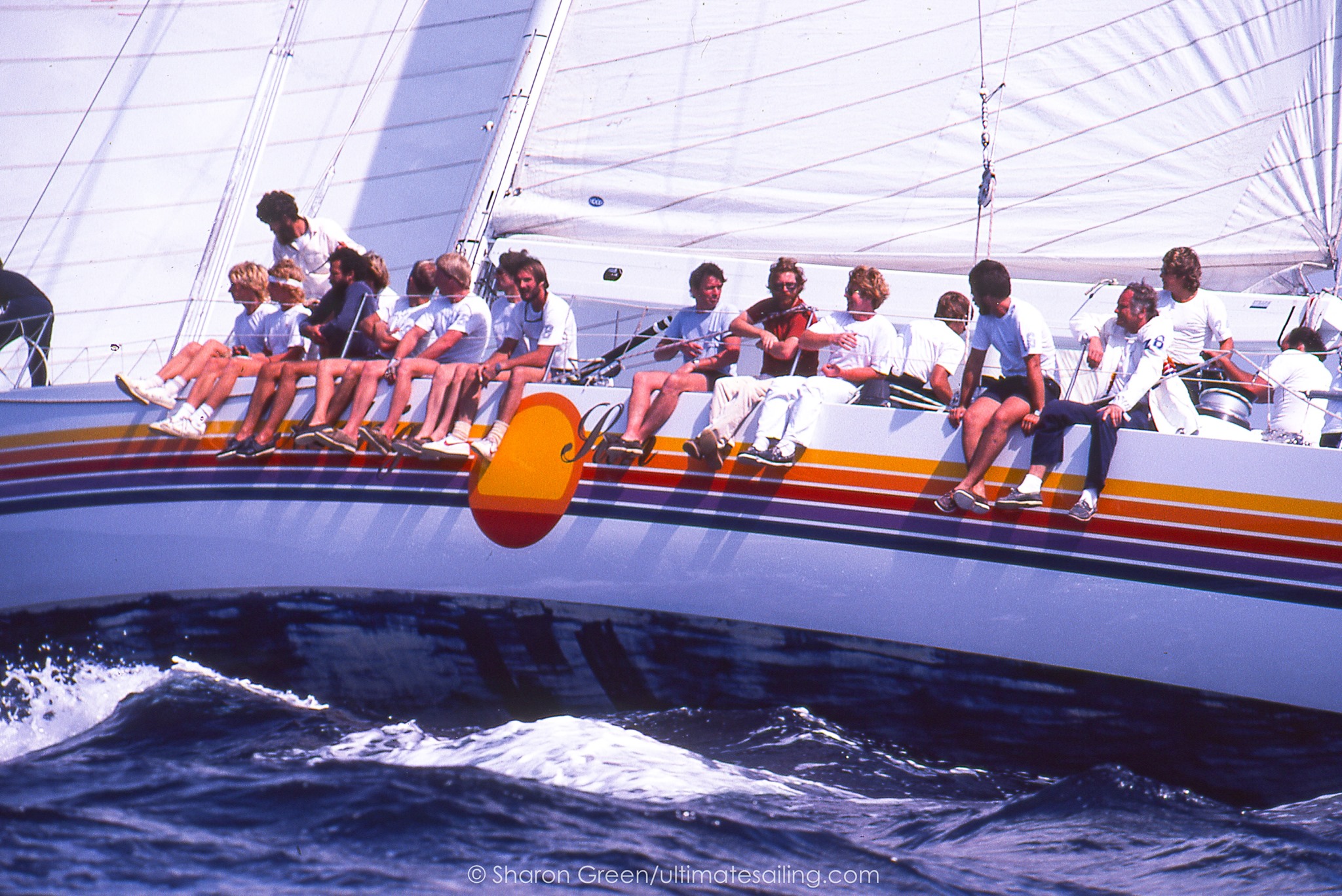
The new Midnight Sun scored a third and fifth in the two races she sailed or completed

Midnight Sun made an impressive showing in the two races that she completed particularly in light of her newness. Her performance and numbers made sense: she was by far the stiffest of the Maxis and carried the smallest rig relative to her displacement, and as might be expected she shone particularly in a breeze with the wind forward of the beam. Downwind Kialoa IV and Nirvana had an edge, but upwind, even in the light, the Peterson design had an advantage. 

Midnight Sun

The US team of Secret Love, Thunderbolt and Scaramouche, which was selected in a two-day series prior to the Boca Grande Race, beat the Canadian and Swedish teams to win the SORC team racing championship.This performance also gave the US the lead in the inaugural World Cup competition sponsored by Champagne Mumm. That series, which included the 1981 Southern Cross Cup, the 1982 Sardinia Cup and the 1983 SORC, would conclude with the 1983 Admiral's Cup, with the US and British teams in the front running. Locura and Scarlett practically selected themselves, and Shenandoah was picked as the third boat. They went on to finish third in the Admiral's Cup that year, but were well ahead of Britain in eighth, and so won the inaugural World Cup.

One of the US team yachts for the 1983 SORC, Bright Finish (Peterson 42) finished fourth in Class D and fourth overall

Morning Star (Frers 46), winner of Class C and fifth overall

Zero (Frers 51), finished third in Class B and 31st overall

Murphy's Law, a Nelson/Marek 41, finished seventh in Class D and 13th overall

Start of the Miami-Nassau race, Thunderbolt to weather and Scarlett can be seen half way down the line

A light air moment during the series, Shenandoah to the left

Canada's Amazing Grace VI (C&C 45) finished fifth in Class C and 19th overall

Evergreen (Frers 45) finished third in Class C and ninth overall

Stars & Stripes (Nelson/Marek 39), 16th in Class E and 58th overall


30 May 2018

Bullfrog (Peterson 55)

Bullfrog (photo Dick Foat/DPT FB Page)
Bullfrog was Doug Peterson-designed 55 footer (Design #116) that had a very successful racing career through the early 1980s. Bullfrog was built for Californian yachtsman David Fenix by Newport Offshore in aluminium using a method to glue and rivet the skins to the frames instead of welding. This allowed for much thinner aluminium skin to be used. She was finished in a deep green topsides with white bottom which, allied with a sleek bow and stern profile and flush deck, resulted in a striking looking yacht.   

Bullfrog was perhaps the archetype of the heavy and powerful, masthead-rigged IOR yacht of the 1980s, but one that displayed the more balanced and easily driven lines of Peterson's later design approach than his earlier pintail types. Her IOR rating certificate shows a Centre of Gravity Factor well above the minimum (0.984) for good windward performance, and a relatively low rating of 44.4ft (under Mk IIIA). When well sailed as Bullfrog was, this type remained competitive in a transition period towards lighter fractional-rigged yachts, and she was the dominant IOR 'A' boat on the US West Coast over three years - she won the Big Boat Series twice as well as Long Beach Race Week.

Bullfrog emerges from the shed at Newport Offshore and ready for launching, below (photos Doug Peterson Tribute page)
Bullfrog also formed part of the US "Blue" team in the 1982 Clipper Cup, the bi-annual international regatta held in Hawaii, where she sailed alongside Clay Bernard's Davidson 50 Great Fun, and Jim Kilroy's Holland Maxi Kialoa IV.  Bullfrog was helmed by Tom Blackaller in this series, and started the regatta strongly, with a second in the first and second races, both Olympic triangles, and like the rest of the regatta, was held in very windy conditions.
Bullfrog in San Francisco (photo Facebook)
Bullfrog sailing upwind in San Francisco (photo Diane Betson, Doug Peterson Tribute page)
Bullfrog powers upwind (photo Yachting magazine)
But Bullfrog experienced continual problems through the series with her mast, a small-section triple-spreader Stearn spar. It featured an internal spinnaker boom track which also served as a stiffening member, but this came adrift regularly and its fastenings, however bolstered, were never quite strong enough for the job. She was sailed conservatively in the 143-mile Molokai Race, in very fresh conditions that saw many breakages throughout the fleet, but still managed a creditable fourth place in Class B (of 15 boats - her overall position in that race is not known). 
Bullfrog sails downwind with spinnaker and blooper flying (photo Seahorse)
Bullfrog during the 1982 Clipper Cup (photo Phil Uhl/Facebook)
Bullfrog during the 1982 Clipper Cup (photo Facebook)
Bullfrog put in another strong performance in the fourth race, another Olympic triangle, finishing second, and went into the heavily weighted last race, the Round the State race, in first place overall, with team-mate Great Fun close behind in second. In the Round the State, Bullfrog again performed strongly in the early stages. But at the southern point of the island of Hawaii (not surprisingly known as South Point), while sailing alongside Jumpin' Jack Flash and several Class A boats in 15 knots of breeze, a toggle supporting the forestay at the masthead broke.  The repair took several hours and with it went any chance of winning the series, and dragged Bullfrog down to 11th place overall (and fourth in Class B). While Great Fun also dropped to fifth overall, Kialoa IV was well-placed in fourth after a dominant performance in the final race, and the US Blue team took out overall team honours for the series. The 1982 Clipper Cup also featured Monty Livingston's Peterson 50 Checkmate, which finished in ninth place overall. Both boats went on to race in the 1982 Big Boat Series, with Bullfrog (skippered by Steve Taft) posting dominant results of 1/3/2/1/1 to win Class B, with Checkmate finishing second (4/2/3/2/2).
Bullfrog during the 1983 Big Boat Series, where she won IOR Division 1 (photo Phil Uhl)
Bullfrog was later taken over by Livingston and his Checkmate team, and she went on to compete in the 1983 Big Boat Series, winning IOR Division I (the City of San Francisco Perpetual Trophy) with results of 2/1/1/2/3, edging out The Shadow and Tomahawk
Checkmate (ex-Bullfrog) in strong reaching conditions in the 1984 Clipper Cup, just to leeward of the Soverel 55 The Shadow

Checkmate (ex-Bullfrogslides downwind during the 1984 Clipper Cup
Bullfrog was subsequently renamed Checkmate, and this has caused some confusion over the years with the earlier Checkmate, with both boats retaining the same moniker. The new Checkmate (or 'Checkfrog' as she was nicknamed) sailed in the 1984 Clipper Cup for the US White team, alongside Tomahawk, a Frers 50 (ex-Margaret Rintoul III), and Camouflage, a Frers 44. 
Checkmate running downwind during the 1984 Clipper Cup (photo Phil Uhl)
An aerial shot of Checkmate during the 1984 Clipper Cup (photo Sharon Green | Ultimate Sailing)
Checkmate was again dominant through the first four races of the 1984 Clipper Cup, with placings of 1/1/3/1, and with team-mate Tomahawk they more than holding their own against the fast Farr 40's Exador and Pacific Sundance (sailing for the New Zealand 'A' team, alongside the Frers 43 Shockwave). While third team-member Camouflage was less impressive, the US White team went into the final triple-point Round the State race only just behind New Zealand A. 
Checkmate to leeward in close racing in Class B, with Orlanda to weather, along with Tomahawk, Black Sheep and Artemis (photo Phil Uhl)
Checkmate again came unstuck in the Round the State race, being punished for a conservative rhumb line course down to South Point, and her eventual long beat to this turning point in the course knocked her out of the running for overall honours, finishing 15th, and dropping to ninth overall, while Tomahawk also finished relatively poorly in 12th and dropping to fourth overall. This demonstrated the effect of the heavy points weighting of the Round the State, as Checkmate and Tomahawk were clearly the form boats to that stage, having captured all of the Class B firsts and seconds in the first four races. However, while Camouflage was the weak link in the team, she had a stronger showing in the Round the State (fifth), and with Exador losing her mast in a freak wave off South Point, the US White team were able to carry off an overall team win. 
Checkmate crosses behind Orlanda, likely during the 1984 Clipper Cup (photo Facebook)
Checkmate powers along in San Francisco (photo Facebook)

Aside from her forays and success in the Big Boat Series, the later racing exploits of Checkmate are unknown. However, a video exists from
2008 where she remained in her original livery and was part of a sailing school (image above). Later, she was advertised for sale in 2014 while based in San Diego (photo and link below).

Checkmate in a 2014 advertisement by Yachtfinders

Article updated March 2025

26 March 2017

Kialoa IV (Holland Maxi)

This post is a tribute to the late Jim Kilroy (1922-2016), who campaigned, with great distinction, a series of yachts named Kialoa from 1957 to 1989. This article features Kialoa IV, the replacement for his famous Sparkman & Stephens-designed ketch Kialoa III.

Kialoa IV was the first of a new breed of maxi-raters, just over 80ft long, and was designed by Ron Holland in 1979 and built using a composite sandwich-laminated hull and deck with aluminium reinforcing. The latter being in the shape of a space-frame chassis incorporated into the hull to take keel and rig loads. Kialoa IV was built by Holland's brother-in-law Gary Carlin at his Kiwi Yachts yard in Florida, which had also built the famous Imp which pioneered the space-frame concept. The composite laminate was influenced by studies carried out by both Kiwi Yachts and Dupont's research department in Wilmington. Holland noted at the time that "While all-up hull weight advantages were not a primary consideration, the tests showed lighter ends and deck were possible compared to Kialoa III".

Kialoa IV in early days, possibly during the 1981 SORC
Holland described the design philosophy at the time as incorporating aspects from his successful level rating and Admiral's Cup designs that had not yet been utilised at the Maxi scale. "Hull shape is as influenced by the IOR measurement procedure as my smaller designs. Keel and rudder designs are treated in a similar way. Choice of rated length, displacement and sail are the primary starting point for my IOR designs, attempted to hold proven relationships although there are aspects of the IOR rule that dis-proportionately penalises the larger yachts due to necessary low displacement length ratios and associated sail areas. Scaling effect needs to be handled carefully but decisions on this, and the earlier mentioned points relating to Kialoa's first series success speak for themselves".
Kialoa IV during the 1981 SORC (photo Seahorse)
Kialoa IV was launched in November 1980 and Kilroy immediately began a working-up programme for the new boat which involved her trialing against her predecessor, Kialoa III, which would later be converted for cruising. This was a unique opportunity, where use a pace boat had previously proven effective with Admiral's Cup size yachts (such as Big Apple and Marionette in 1977), but this was the first time that this had been done with ocean racing yachts at this scale.
Kialoa IV seen here with a full complement in Cowes in 1981 (photo Phil Uhl)

Kialoa IV powers upwind - 1981 (photo Hood sails)
Initial testing showed the new yacht had an advantage in light and medium conditions in the smooth waters of Tampa Bay. As the design philosophy had pushed towards speed potential in medium conditions, with the emphasis towards seeking an advantage over Kialoa III downwind, the early results were seen as encouraging. When the two yachts were paced against each other in fresher conditions and bigger seas, the speed difference was not marked to windward, with the new yacht showing slightly more heel angle and helm sensitivity, but downwind speed was as expected.
The bigger they are... (photo Colin Jarman/Seahorse, above, and Yachting, below)
Based on early testing results, as well as the fact that the boat still had approximately one foot of rating to play with (within the 70.0ft limit for the Maxi class), it was decided to optimise the speed/rating relationship with a reduction in displacement and an increase in stability. This was made easier through the built-in flexibility within the yacht, with stability-tuning cavities in the keel, and internal ballast being encased in the aluminium sub-structure rather than being glassed in. These changes saw the final rating settle at 69.5ft for the 1981 SORC and Maxi Boat Series.
Kialoa IV and Condor during the California Cup match race series in 1982, which was won by Condor (photo Sobstad sails)
The extensive tuning process had a significant effect on the early performance of Kialoa IV; she went straight into the fray and won races at the 1981 SORC, although there was something erratic about her earliest performances which was to be expected for a boat still at early stages in its development. Initially, and in certain narrow ranges of conditions, both Windward Passage and the Frers-designed Bumblebee IV showed similar speed to the new Kialoa. But Kialoa IV showed her strength over a wider wind range and looked dominant. Although the newest boat, she seemed relatively conservative, and was certainly the heaviest in terms of rated displacement (nearly 84,000lbs, against 70,600 for Bumblebee IV - although for that, Bumblebee carried a near 1% rating penalty).
Kialoa IV in fresh running conditions
Kialoa IV (photo Facebook)
Kialoa IV visible here through Condor's spinnaker, and trailing Flyer during the 1981 Seahorse Maxi Series (photo Phil Uhl | Facebook)

Kialoa IV during the 1981 Seahorse Maxi Series (photo Phil Uhl)
However, by mid-season she was more than good enough to win the 1981 Seahorse Maxi Series (for yachts rating between 50 and 70ft), and included Ceramco NZ which used the event as a build-up for the Whitbread Round the World Race later that year).  For the most part, Kialoa IV enjoyed close racing with her near sistership, the new Condor, but dominated the series with line placings of 2/1/1/1, and third on handicap (4/1/3/6). During this season, and before the Sardinia Maxi Series (which she won), her main boom (and mainsail) was lengthened by 3ft. This increased her rating closer to the 70.0ft IOR Maxi limit.
Kialoa IV romps off the startline to leeward and ahead of Windward Passage and Nirvana, and Condor to leeward (left) during a SORC regatta (photo Phil Uhl | Facebook)
Kialoa IV about to cross tacks with Condor (centre) during the 1982 Clipper Cup, with Windward Passage not far behind (right) (photo John Malitte/Sea Spray)
Kialoa IV in power reaching conditions during the 1982 Clipper Cup (photo Guy Gurney)
Kialoa IV went on to compete in many international series and regattas, including the 1982 SORC and the Clipper Cup, in the latter she performed strongly finishing as fourth yacht overall (just behind Condor) and helping the US team to an overall victory in the 1982 edition (alongside Bullfrog and Great Fun).
Kialoa IV to leeward and behind Condor during the 1983 SORC (photo Larry Moran)
Kialoa IV won Class A in the 1983 SORC against some new competition, including the new Peterson-designed Midnight Sun and the Pedrick-designed Nirvana, with a combination of good speed and tactics and few gear failures. All the Maxi fleet were well down in the overall standings however, with Kialoa IV managing just 38th within the whole fleet. 
Kialoa IV during the 1983 SORC (photo Larry Moran)
It was a similar situation in the 1984 SORC, except this time Kialoa IV had to settle for second in Class A behind the Soverel 55-footer The Shadow, and was 47th in the overall fleet standings.
Kialoa IV (photo Facebook)

Kialoa IV to leeward of Windward Passage in light airs during the 1983 SORC (photo Larry Moran)
Kialoa IV on a busy startline during the 1983 SORC with Windward Passage and Nirvana (photo Phil Uhl)

Kialoa IV finished as second yacht on individual points in the 1984 Clipper Cup (with placings of 5/13/3/3/14), behind the new Frers-designed Boomerang, but ahead of Sorcery, Nirvana and Condor
Kialoa IV in hard running conditions during the 1984 SORC, with Huaso (a Frers 81-footer) just behind (photo Guy Gurney)
Kialoa IV during the 1984 Clipper Cup - photo above by Sharon Green | Ultimate Sailing), and below by Phil Uhl
Kialoa IV was often at the forefront of sail development and pioneered the introduction of nascent Kevlar technology at the Maxi scale. Increasing quantities of Kevlar were used to support maximum allowable roach in the mainsail. Dacron was retained in lower sections, presumably for ease of handling, given that cloth weights for both materials were in excess of 8oz.
Kialoa IV with a new Kevlar "crescent cut" no.3 headsail - an article at the time by Hood sailmakers notes that "the leech hollow is at absolute minimum to ensure that the foretriangle is full. The no.3 sheets at 8.25 deg and allows full main to be carried at 30 knots apparent wind with the mainsheet traveller two-thirds down the track". Condor (below) opted for the new Norths vertical cut technology (photos William Payne/Seahorse)
The design was a successful one for Holland, and along with sistership Condor, she generated commissions for Round-the-World derivatives Lion New Zealand and Drum for the 1985-86 Whitbread, and the 'inshore' Maxi Sassy, although none of these boats made much an impression on the race course, being shorter than Kialoa and Condor, and heavy for their length. Lion New Zealand did, however, finish second in the 1985-86 Whitbread Round the World Race, with greater structural integrity than some of her rivals.
Kialoa IV - date and regatta unknown (photo Facebook)

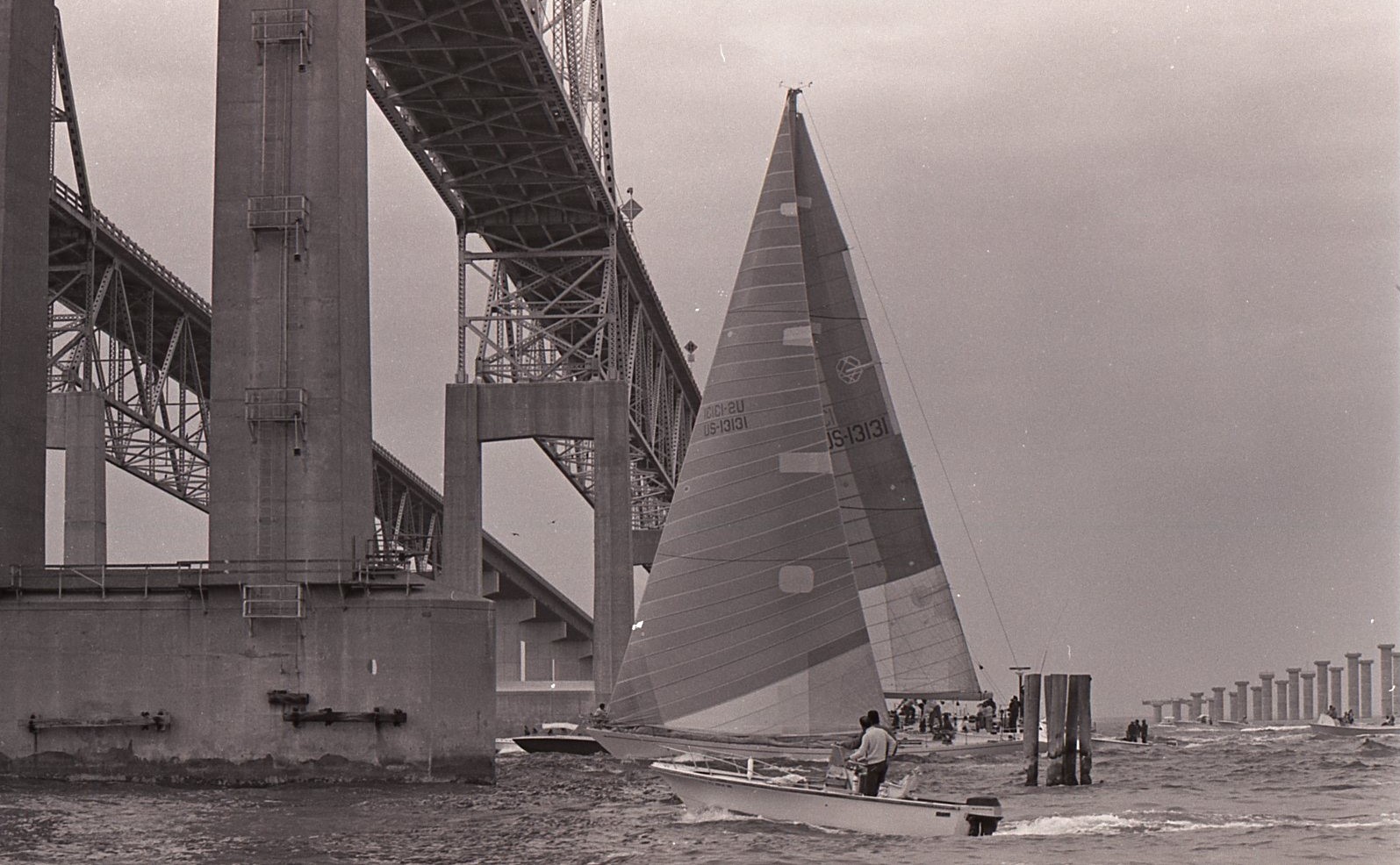
Kialoa IV during the 1985 SORC negotiates some new and old bridge infrastructure (photo 'cadee' Sailing Anarchy Forums) 
Kialoa IV's reign at the top of the Maxi class was relatively short however, and perhaps not long after finishing second to Boomerang in the 1985 SORC the decision was made in 1985 for the replacement maxi, the new Frers-designed Kialoa V. Kialoa IV went on to compete in the 1987 Antigua Race Series, before Kialoa V was commissioned that same year.
Kialoa IV in more recent times, seen here in La Rochelle, France (photo Sail-World)
I was pleased to receive a copy of a fantastic painting of Kialoa IV by marine artist John David Taylor (entitled "Rocket Ship", below). John David was part of the Southern California boating industry throughout the seventies and eighties and had the opportunity to watch Kialoa IV in action during the California Cup match races. He recalls that Kialoa IV was state of the art at that time and left a lasting impression which lead him to become a marine artist (ASMA member). Remarkably, this was his first painting, and was accepted into the West Coast ASMA show (May/June 2017) at the Channel Islands Maritime Museum.
More details (and photos) about Kialoa IV can be seen on the "Kialoa US-1: Dare to Win" website here, and a record of all her race results are here.

A Sail-World obituary for Jim Kilroy is here


Article updated December 2025