Showing posts with label Locura. Show all posts

10 June 2025

The Shadow (Soverel 55)

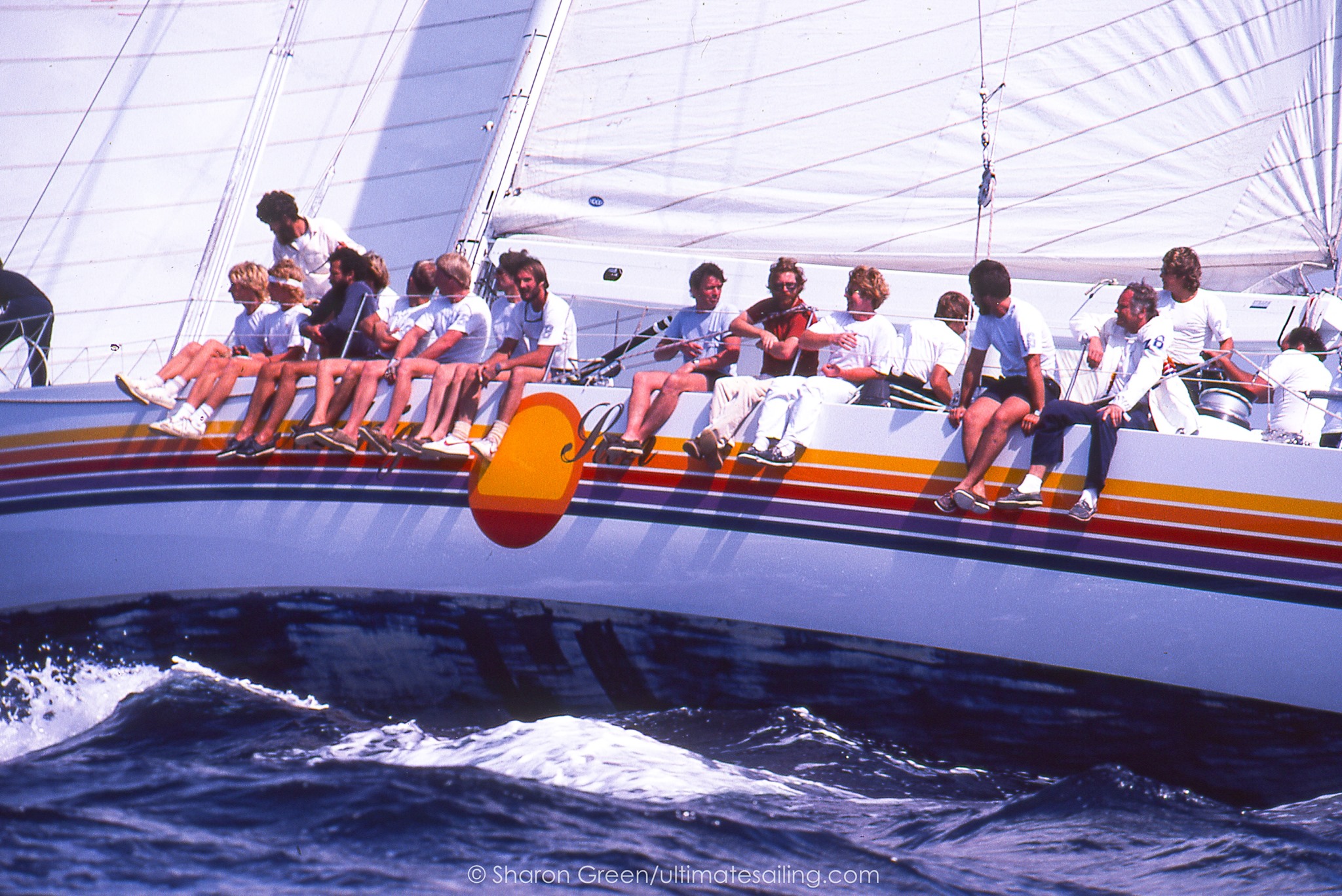
The Shadow was a 55-foot Mark Soverel design, commissioned and owned by Richard Rogers, who was based in California and a newcomer to ocean racing. The Shadow was of the same era as Soverel’s smaller 43-foot design Locura and in general design terms she had some similar characteristics, featuring a broad stern and notable ‘S’-curve in her hull profile that minimised hull depth around the After Girth Station, to offset width in this area and reduce the likely after girth penalty measurement that she would have incurred. She also had a proportionally generous sail plan, set on a 15/16th fractional rig, and carried a reasonably high rating of 47.0ft. According to a Sports Illustrated article at the time, the yacht was named after a pulp magazine hero and 1930s-40s radio detective – she had a small tender named Margot Lane (The Shadow’s girlfriend), and the crew played tapes of The Shadow’s eerie laughter when coming in to dock.
The Shadow rounding a mark during the 1984 Clipper Cup, with the Farr 58-footer Orlanda close behind (photo Phil Uhl)
The Shadow was launched in September 1983, just two weeks before the St Francis Yacht Club’s Big Boat Series of that year. She raced in the City of San Francisco Perpetual Class Trophy division, where she finished second to the Peterson 55 Bullfrog, with placings of 3/3/3/1/1.
The Shadow, seen here during the 1983 Big Boat Series (photo John Hooker)
With that strong start she went on to race in the 1984 SORC, by now with a much more optimised rating of 45.8ft. Rogers had hoped that The Shadow would be able to compete in Class B in the SORC, but then Running Tide, a 12-year-old 60-footer with an age allowance that gave her a slightly lower rating than The Shadow's, also arrived. Running Tide's owner, Al Van Metre, asked to compete, as he had before, in Class A with the 70- and 80-foot Maxis. Race officials deferred to his wishes and so moved the similarly-rated The Shadow up, too.
The Shadow ghosts along in light airs (photographer unknown)
With her favorable time allowance relative to the Maxis and weather conditions that benefited smaller boats, The Shadow dominated the results in Class A, finishing first on corrected time in five of the six races and taking overall class honours. She was a less impressive in the overall fleet results, placing 26th, but the top placings were dominated that year by yachts in the smaller divisions, and in particular the crack One Tonners in Class E (such as the German yacht Diva, the top boat in the 1983 Admiral’s Cup).

"The maxis were intensely disappointed that we were in (Class) A", said Rogers in his interview with Sports Illustrated at the time, "and I agree with them. I think they should have their own class. I think it would've been more fair and more fun. It's hard to race a business against a boat like The Shadow".
The Shadow in or about 1984 (photographer unknown)
"The business" Rogers referred to is that of maxi management. Running a Maxi yacht, with a crew of more than 22, with an elaborate shore-support system, a tender, a sail program, and much much more, and moving them from regatta to regatta around the world (because that's where the maxis race, everywhere) is a demanding business. The most visible of the Maxi owners was Jim Kilroy, the owner and campaigner of not one but two dominating maxi yachts— Kialoa IV, which finished second to The Shadow in Class A, and his older Kialoa III which was being readied to compete at Antigua Race Week.

Kilroy, too, didn't think The Shadow should have raced in Class A, but his complaint, like Rogers', was with the race officials. "A 23-foot racing spread is a lot for one class", was all he would say publicly, but as spokesman for the Maxi owners, the men who spend the most on the sport, he had much to say behind closed doors to the SORC officials. Not unreasonably, the Maxi owners felt that if they go to the trouble of showing up for an event, lending it glamour, prestige and publicity it wouldn't otherwise have, they should be treated with greater consideration.
The wide and powerful stern sections of The Shadow are visible here in this image from the 1984 Clipper Cup 
It is likely that The Shadow would have done pretty well in Class B. Her wide stern sections, which Rogers calls 'Soverel training wheels' because they prevent the boat from heeling excessively, ran counter to the current thinking in new boats, most of which have moderately tapered sterns. "I wouldn't call Soverel a radical departure, but he's certainly different", says Rogers. Because she resists heeling, The Shadow was never reefed in the whole of the SORC series. Her greatest sail reduction was during the big winds of the St. Petersburg to Fort Lauderdale race, and that was to change down to a No. 3 jib. "If The Shadow had had a masthead rig, I would have had to shift down to the #2 genoa as the wind came up", Soverel explained. "But with a fractional rig like this one, you have the flexibility to power the mainsail up or down. With a fixed foretriangle area you have no flexibility. You've got to change your headsails”. The power inherent in The Shadow's length and overall stability resulted in the reported need for extensions to be welded to her winch handles to ensure enough runner tension could be applied to her lofty rig.
The Shadow sets off on a reaching leg during the 1984 Clipper Cup with Swiftsure to the right (photo Yachting magazine)
The Shadow then went on to compete in the 1984 Clipper Cup in Hawaii. At this regatta she raced in Class B, with a slightly increased rating of 46.2ft, alongside such yachts as the Frers 51 Tomahawk (ex-Margaret Rintoull III), the Peterson 55 Checkmate (ex-Bullfrog), the Farr 58 Orlanda and the Frers 50 Carat (ex-Retaliation). She ended up a surprise winner of this class, with results of 4/4/4/6/1. Although she had a very capable crew, she was out-performed by Checkmate and Tomahawk in the first four races.
The Shadow leads (just) Checkmate in power reaching conditions during the 1984 Clipper Cup (photo Charles P. LeMieux III | Yacht Racing & Cruising magazine)
Adequate righting moment in the typically breezy conditions had proved to be an essential ingredient for the top boats in the fleet, as witnessed by the performance of Checkmate and Tomahawk, which were two of the stiffest boats there. Soverel said later that The Shadow was ballasted to give a minimum Centre of Gravity Factor (0.968), to minimise her rating, which in hindsight proved to a mistake.
Breezy conditions during the 1984 Clipper Cup put a premium on crew-work, here the foredeck crew prepare for a gybe aboard The Shadow (Bruce C. Brown | Yacht Racing & Cruising magazine)
However, in the final race, the Round the State, points were heavily weighted (three times that of the Olympic tracks). During that race, Soverel noted that they started to feel disturbed wind as far as 200 miles out from the Big Island, possibly from other smaller islands up to windward. Later the wind really started to act strangely, “The Shadow would be doing a steady eight knots, just about on the wind, in a nice 20-22 knot trade wind, when suddenly, boom, we’d run into a light spot – maybe 8-10 knots of wind – that would last five or ten minutes, then we’d be back in the breeze. That happened a few times, then we hit a big hole and the breeze went from NNW into the south, so we tacked over onto the starboard tack layline. From here, maybe 60 miles out from the island, the air was light and fluky – sometimes we used a spinnaker – all the way to South Point. Once around the point it turned back into another nice race. The trades just collapse on the back sides of those islands. You get all kinds of different things – thermals, back-eddies and so on”.
The Shadow, seen here leading Checkmate and Jubilation during the 1984 Big Boat Series (photo Sharon Green | Ultimate Sailing)
While Soverel and his team managed to keep The Shadow to the fore in the tricky breezes, Checkmate’s long beat out to South Point knocked her out of the running, opening the door for The Shadow to earn class honours for the race and, by a single point over Tomahawk, for the series. She also finished fifth in the overall fleet standings (with placings of 11/10/14/8/7). The Shadow also formed part of the New York YC team, alongside Nirvana and Artemis, which beat the Royal Akarana YC team from New Zealand (Anticipation, Exador and Shockwave) in the club teams competition.
The Shadow (on port) in a close race with Orlanda during the 1984 Big Boat Series (photo L Gee | Facebook)
The Shadow then returned to San Franciso for the 1984 Big Boat Series, where Tomahawk managed to prevail for Class B honours, with The Shadow finishing second. She competed again in 1985, but did not feature in the top places.
The Shadow races alongside Checkmate during the 1985 Big Boat Series (photographer unknown)
Her racing career after that is not known, and she didn’t compete in the large Class B fleet that assembled for the 1985 SORC, and did not compete in the 1986 Clipper Cup. However, she has been sighted more recently in Greece, and is understood to be in good sailing condition.
The Shadow, as seen in Lefkas, Greece in 2023 (photo Bohumil Kafka | Facebook)
   

Article dated June 2025

14 June 2024

SORC 1983 - Part 2

Kialoa IV (right), Windward Passage and Nirvana in a close tussle off the startline during one of the races during the 1983 SORC (photo Phil Uhl)

This post features photographs from the SORC 1983 series taken by Phil Uhl. For more about this series, see an earlier post and article here, and the regatta video here.

Brooke Ann, a Nelson-Marek 41-footer, just ahead of Glory and hard on the heels of Scarlett O'Hara, in close racing in Class D - Scarlett O'Hara would go on to finish second in class (and be top yacht overall), with Glory eighth (Peterson 42) and Brooke Ann 12th (photo Phil Uhl)

Leeward mark action in Class D during the 1983 SORC, with Locura leading Mea Culpa, Thunderbolt (US-31666) and Bright Finish (US-31177) (photo Phil Uhl)

Obsession, a S&S 46-footer, comes to grief in hard reaching conditions off Miami during the 1983 SORC, while chasing Secret Love (right) in the Class C division (photo Phil Uhl)

Fame, seen here to windward of Glory in a Class D start, likely the Miami-Nassau race (photo Phil Uhl)

Quest, a Rodgers 43-footer, to leeward of Glory (photo Phil Uhl)

The Peterson 45-footer Secret Love, to leeward of Avalanche, a Morgan 45-footer after a start in Class C - Secret Love went on to finish second in class (photo Phil Uhl)

Class B yacht Zero, a Frers 51-footer, in tight reaching conditions to leeward of Artemis (photo Phil Uhl)
The Farr 37 Migizi, top yacht in Class F, and 10th yacht overall (photo Phil Uhl)

A Maxi-fleet start (Class A), with Triumph seen here to windward of Nirvana, Kialoa IV and Windward Passage (photo Phil Uhl)

Quest in fresh downwind conditions (photo Phil Uhl)

Windward Passage in pre-start manoeuvres with Kialoa IV during the 1983 SORC - Kialoa IV went on to take overall honours in Class A, with Windward Passage second (photo Phil Uhl)

Stars & Stripes, a Nelson/Marek 39-footer, finished a lowly 16th in Class E (and 60th overall)

Alberta Bound, a Peterson 44-footer, finished 12th in Class C (photo Phil Uhl)

Another busy startline for the Maxis, with Windward PassageMidnight Sun and Condor, and Nirvana visible to windward (photo Phil Uhl)

The peculiar looking 'rule beater' Cascade, a Milgrim 38-footer rating just 23.3ft, finished ninth in Class F (photo Phil Uhl)

At the St Petersburg Yacht Club marina, with Thunderbolt and Charisma V, in the foreground, and Windward Passage (photo Phil Uhl)

Part of the SORC 1983 fleet at the St Peterburg Yacht Club marina (photo Phil Uhl)

More photographs from this series can be seen here.


Article dated November 2024


5 May 2023

Cascade (Milgram 38)

Cascade in her favoured reaching conditions
Cascade was radical cat-rigged ketch designed in 1972 by Professor Jerry Milgram (of the Massachusetts Institute of Technology), which challenged the current status quo of yacht design in terms of both the yacht itself and its rig, and is of some interest as a result. The 38-footer featured a stepped deck profile with high topsides for’ard with a sharply raked stem that together had a somewhat ungainly appearance, described at the time as “the ugliest ocean racer in sailing memory”, and despite fears at the time, she fortunately had no future influence on yacht design.

Cascade sported two stayed cat rigs, with masts of 50 and 52 feet height, with the for’ard mast positioned quite close to the bow with little room for headsail. The use of a dual cat rig set up was a canny way of side-stepping some of the complex sail area measurements applicable under the then Mark II version of the IOR. While she was able to present up to 800m2 of sail area by flying an assortment of staysails between the two masts, her rated sail area was just 325m2 (for comparison, the S&S yacht Lightnin’ had a rated sail area of 550m2 and rated 27.2ft). This was combined with other advantages in the Engine and Propellor Factor of the rule, along with rating contrivances around the bow and stern profiles and a displacement of some 17,000lbs and a 52% ballast ratio. The overall result was that Cascade rated a very low 22ft, little more than a Half Tonner.
The aesthetically challenging profile view of Cascade
Cascade nearly swept the New York Yacht Club cruise (a series of races) in the late summer of 1972, winning two races, finishing second twice, before losing one of her masts. Milgram then took her to the SORC regatta in January 1973. However, by that stage the Offshore Racing Council (ORC) of the then International Yacht Racing Union which administered the IOR had taken note of the radical newcomer. The ORC was empowered under Rule 101 of the IOR to “deal with any peculiarity of design and to give such rating as they consider equitable” where a boat was deemed to be exploiting a rules loophole. On the recommendation of its International Technical Committee (ITC), the ORC summarily raised Cascade’s rating by 10%, to 24.2ft. Milgram was able to have this reduced to 22.8ft in time for the 1973 SORC by shortening the rig and making a few other smaller adjustments.

Cascade in her original configuration
Milgram was reported at the time to say that while Cascade's rating should possibly be higher, the sail area was not as effective as a sloop’s big spinnaker or big-boy genoa which work better on a reach and run than Cascade’s staysails. He was somewhat bitter towards the ITC: “They cite the first sentence of [Rule 101] which allows the IYRU to invoke a penalty in exceptional cases so as to cover any radical departures, but I cite the last rule, 866E, which specifically prescribes how to rate cat-rigged ketches”. Rule 866E was:

"A cat‐rig may not carry a spinnaker unless accepting this as a basis for foretriangle measurement, in which classification and measurement would be as for a sloop or cutter. Conversely, a schooner, yawl or ketch which carries neither head, sails nor spinnaker may be rated without fore‐triangle measurement by following normal procedures outlined in the foregoing but using zero for, the fore‐triangle rated area".
Cascade seen here prior to a start in the 1975 SORC (photo Facebook)
At the start of the 1973 SORC it seemed the issue was something of a storm in a teacup. Cascade did not do very well in the opening St Petersburg-Venice Race and then, although finishing strongly in the St Petersburg-Fort Lauderdale Race, she missed a course marker and was penalised just over 3 hours. With four races to go, she lay 27th in a fleet of 125 boats. Conditions had been in Cascade’s favour, as she was very quick on a reach, but less impressive upwind or dead downwind. With reaching legs prevalent, Milgram could afford to take a very conservative approach to the starts, and then proceed to reel in his competitors.
Cascade seen here at the 1983 SORC (Yachting magazine)
In this fashion Cascade went on to win the Miami-Lucaya Race, and then the Lipton Cup off Miami. For the 176-mile Miami-Nassau Race, the SORC’s premier event, Cascade meandered off the startline last as usual, but as her staysail was hoisted and filled with a south-easterly on her beam she leapt ahead. Within 10 minutes she had Lightnin’ abeam in her own Class E and was fast catching up with Munequita which had started a full 15 minutes earlier in Class D and went on to cruise across the Gulf Stream and went on to take overall honours. But by then, Cascade’s crew knew there were not enough points available in the last race, the Nassau Cup, to overcome the Fort Lauderdale error.
Cascade competing in the 1983 SORC and now sporting a headsail, of sorts
The final epic contest in the Nassau Cup between Munequita, Lightnin’ and Robin for the top honours did not distract the ocean racing community for long from their preoccupation with Cascade, which had a poor showing in the final race to finish fifth overall. At its April 1973 meeting the ITC subsequently closed the measurement loophole exploited by Milgram on the basis of the newly issued Mark III version of the IOR. This version dropped the provisions of Rule 866E and Cascade’s rating shot up to 27.2ft.
Cascade during the 1983 SORC, note the backstay bumpkin, and the mizzen staysail being tacked to the weather rail - the tack of the mizzen also appears to be fixed to the bottom of the mast (photo Phil Uhl | Facebook)
Comments from a former Class E competitor in a ‘Scuttlebutt’ article about Milgrim (following his passing in December 2021) and Cascade is instructive, noting that upwind, Cascade was about as fast as a Half-Tonner, but when reaching, Cascade made good use of mizzen staysails and was about as fast as the One Tonners, which were about her same length overall but Cascade probably had an extra foot or so waterline length. As far as ‘design break-through’, the boat was considered a big step backwards. Although no genoas or spinnakers meant much less work for crew, her speed was considered poor to average for a 38-footer and the boat’s success was primarily due to its low rating. Others have described Cascade as a 38-footer that sailed like a 33-footer but rated like a 30-footer, and could not be described as a good boat. It is understood that Cascade also lost the US Half Ton championship around this time against a Scampi 30, due to damaged rigging in one race, and being beaten in light airs in another.
Cascade on an upwind leg during the 1983 SORC, with an unusually full shape to the lower part of the mizzen (photo Phil Uhl)
Ten years on, Cascade reappeared for the 1983 SORC, on charter to Russell Long, with changes that had reduced her rating to 24.0ft, the minimum allowed for the series. This was further reduced to 23.3ft through the age allowance factor used for the SORC regatta. Cascade's new set up included a headsail with a LP measurement of just 3.5ft, and it appeared to have a larger mizzen that necessitated the addition of a bumpkin to support the backstay. She remained able to sail much faster than her rating on reaching courses, but in the first and third races with their high proportion of windward work, she suffered badly. After a tenth place in Class F in the opening Boca Grande Race, she revelled in the heavy downwind conditions of the St Petersburg - Ft Lauderdale Race and won the race overall by nearly two hours on corrected time, from Locura. She went on to finish 16th (Lipton Cup) and 2nd (Ocean Triangle) but did not finish the Miami-Nassau Race and was unable to start the Nassau Cup finale, so finished up ninth in class and 55th overall.
Another view of Cascade sailing upwind during the 1983 SORC (photo Phil Uhl)
Later in 1983 the SORC administrators announced the removal of its specific age allowance and moved to limit the minimum rating for future entries to 24.5ft (Three-Quarter Ton size). This effectively disqualified Cascade from the series, although no doubt she could have been altered to reach this new rating limit.
Cascade being craned prior to relaunch as a cruiser (photo Facebook)
It is understood that Cascade later ended up at Even Keel in Yarmouth, Maine after being resurrected as a cruiser circa 1991. From there she was taken to the Caribbean and may have ended up in the Rio Dulce. 

10 October 2020

SORC 1983 - Part 1

This article features some great photographs by Sharon Green/Ultimate Sailing from the 1983 SORC series, as well as some commentary based on a postscript article by Bruce Kelley in Seahorse magazine following the series.

Scarlett O'Hara leads Brooke Ann and Glory during the 1983 SORC

The 1983 edition of the SORC was given added significance being in an Admiral's Cup year. Amongst the US Admiral's Cup team hopefuls, the Soverel-designed Locura and Peterson 43 Scarlett O'Hara were the outstanding performers. The pair led the SORC from start to finish both overall and in Class D, with Locura leading up until the last race, the 26-mile Nassau Cup final off the Bahamanian capital. 

Scarlett starts ahead and to weather of Thunderbolt (Nelson/Marek 40, fifth Class D and sixth overall)

Before the first gun for the Nassau Cup race, Locura and Scarlett circled each other each looking for an opening that would give an important jump at the start. A general recall brought the fleet back for a re-start, where Scarlett manoeuvred herself crisply to break out of the pack into clean air. Locura found herself in front of Thunderbolt, who was coming in on starboard, and had to gybe twice, first to keep clear and then to get back on course. Scarlett went on to sail a flawless race to take first in Class D and third in fleet, while Locura, starting virtually last, did come back up the through the class but could only manage fifth, and 12th in fleet, by far her worst race of the series. This was however enough to take the win in Class D, while Scarlett finished second in class but first overall, and winner of the Governor's Cup. The share of the class and overall fleet wins by these two yachts was just the way to end a great series between these two yachts who proved themselves to be a notch above the rest of the fleet in every area that counts: boatspeed, crew-work, preparation, strategy and tactics.

Scarlett O'Hara getting a strong start in one of the races in Class D

Locura was genuinely quick and her crew had both the talent and depth to put her speed to good use. Scarlett was an interesting winner. She and her near sisterships (Louisiana Crude amongst others) started life as a stock, five-year old Serendipity 43, built by New Orleans Marine with a relatively unsophisticated hull layup, but despite a minor disadvantage in terms of weight distribution she was extremely well sailed by Chris Corlett and Dee Smith (of Horizon Sails at the time).

Celebration (Cook 40), fifth in Class E and 29th overall
Mea Culpa, a Frers 41 and skippered by Tom Blackaller, had a strong series to finish third in Class D, and third overall

Carat (ex-Retaliation), a Frers 51, took out overall honours in Class B (22nd overall)

A tightly packed bunch in Class D

Locura (right) chases two unknown yachts (left and middle)

The fleet corrected out very evenly in the Nassau Cup, with five of the six classes represented in the top ten. Razzle Dazzle beat out Morning Star for top honours in the race by a mere two seconds. Scarlett had secured third by just one second over John Buchan's new Peterson 42 Glory. Further back, just three minutes and 22 seconds separated Migizi in fifth from Fiji Warrior in 22nd. 
Artemis (Peterson 51) chases Carat on a tight reach in Class B racing

By winning their respective classes in this race, Morning Star sealed up Class C, Carat locked up Class B, and Kialoa IV secured Class A, while Migizi finally moved into first in Class F. Shenandoah finished fifth in Class E, beating her closest rival Evelution, by two places to win that class for the series. 

The stampede at a Class A start, with Running Tide ahead of Windward Passage, Boomerang and Condor

The win in Class A by Kialoa IV was achieved through a combination of good speed and tactics and few gear failures, and she prevailed over Windward Passage after two years of disappointment. The Pedrick-designed Nirvana, while less well placed in the results, nevertheless showed comparable speed upwind and down with perhaps a touch less ability upwind in a breeze. The two boats were closely matched with Jim Kilroy's experience and determination being the deciding factor.

The new Midnight Sun scored a third and fifth in the two races she sailed or completed

Midnight Sun made an impressive showing in the two races that she completed particularly in light of her newness. Her performance and numbers made sense: she was by far the stiffest of the Maxis and carried the smallest rig relative to her displacement, and as might be expected she shone particularly in a breeze with the wind forward of the beam. Downwind Kialoa IV and Nirvana had an edge, but upwind, even in the light, the Peterson design had an advantage. 

Midnight Sun

The US team of Secret Love, Thunderbolt and Scaramouche, which was selected in a two-day series prior to the Boca Grande Race, beat the Canadian and Swedish teams to win the SORC team racing championship.This performance also gave the US the lead in the inaugural World Cup competition sponsored by Champagne Mumm. That series, which included the 1981 Southern Cross Cup, the 1982 Sardinia Cup and the 1983 SORC, would conclude with the 1983 Admiral's Cup, with the US and British teams in the front running. Locura and Scarlett practically selected themselves, and Shenandoah was picked as the third boat. They went on to finish third in the Admiral's Cup that year, but were well ahead of Britain in eighth, and so won the inaugural World Cup.

One of the US team yachts for the 1983 SORC, Bright Finish (Peterson 42) finished fourth in Class D and fourth overall

Morning Star (Frers 46), winner of Class C and fifth overall

Zero (Frers 51), finished third in Class B and 31st overall

Murphy's Law, a Nelson/Marek 41, finished seventh in Class D and 13th overall

Start of the Miami-Nassau race, Thunderbolt to weather and Scarlett can be seen half way down the line

A light air moment during the series, Shenandoah to the left

Canada's Amazing Grace VI (C&C 45) finished fifth in Class C and 19th overall

Evergreen (Frers 45) finished third in Class C and ninth overall

Stars & Stripes (Nelson/Marek 39), 16th in Class E and 58th overall