Showing posts with label Anticipation. Show all posts

10 June 2025

The Shadow (Soverel 55)

The Shadow was a 55-foot Mark Soverel design, commissioned and owned by Richard Rogers, who was based in California and a newcomer to ocean racing. The Shadow was of the same era as Soverel’s smaller 43-foot design Locura and in general design terms she had some similar characteristics, featuring a broad stern and notable ‘S’-curve in her hull profile that minimised hull depth around the After Girth Station, to offset width in this area and reduce the likely after girth penalty measurement that she would have incurred. She also had a proportionally generous sail plan, set on a 15/16th fractional rig, and carried a reasonably high rating of 47.0ft. According to a Sports Illustrated article at the time, the yacht was named after a pulp magazine hero and 1930s-40s radio detective – she had a small tender named Margot Lane (The Shadow’s girlfriend), and the crew played tapes of The Shadow’s eerie laughter when coming in to dock.
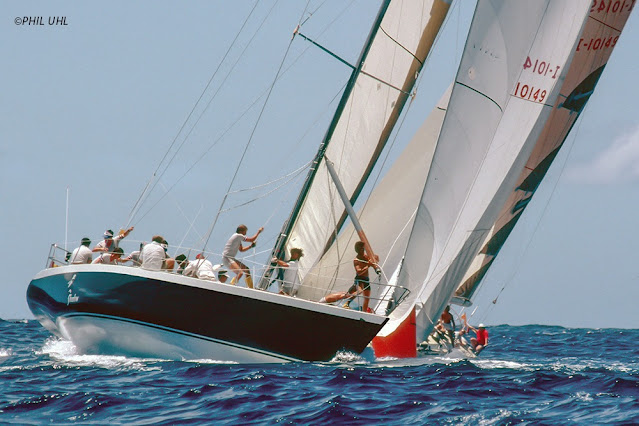
The Shadow rounding a mark during the 1984 Clipper Cup, with the Farr 58-footer Orlanda close behind (photo Phil Uhl)
The Shadow was launched in September 1983, just two weeks before the St Francis Yacht Club’s Big Boat Series of that year. She raced in the City of San Francisco Perpetual Class Trophy division, where she finished second to the Peterson 55 Bullfrog, with placings of 3/3/3/1/1.
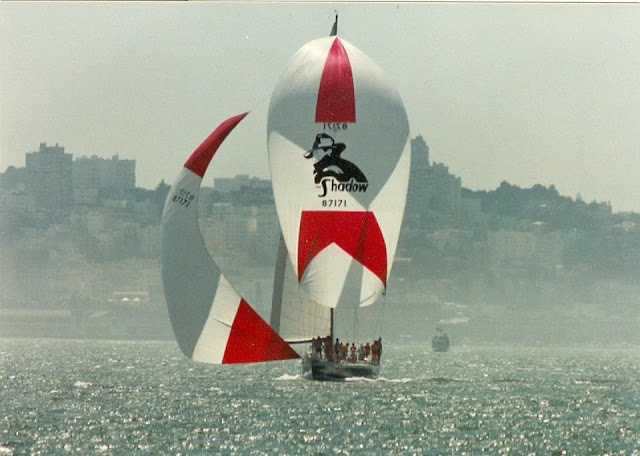
The Shadow, seen here during the 1983 Big Boat Series (photo John Hooker)
With that strong start she went on to race in the 1984 SORC, by now with a much more optimised rating of 45.8ft. Rogers had hoped that The Shadow would be able to compete in Class B in the SORC, but then Running Tide, a 12-year-old 60-footer with an age allowance that gave her a slightly lower rating than The Shadow's, also arrived. Running Tide's owner, Al Van Metre, asked to compete, as he had before, in Class A with the 70- and 80-foot Maxis. Race officials deferred to his wishes and so moved the similarly-rated The Shadow up, too.
The Shadow ghosts along in light airs (photographer unknown)
With her favorable time allowance relative to the Maxis and weather conditions that benefited smaller boats, The Shadow dominated the results in Class A, finishing first on corrected time in five of the six races and taking overall class honours. She was a less impressive in the overall fleet results, placing 26th, but the top placings were dominated that year by yachts in the smaller divisions, and in particular the crack One Tonners in Class E (such as the German yacht Diva, the top boat in the 1983 Admiral’s Cup).

"The maxis were intensely disappointed that we were in (Class) A", said Rogers in his interview with Sports Illustrated at the time, "and I agree with them. I think they should have their own class. I think it would've been more fair and more fun. It's hard to race a business against a boat like The Shadow".
The Shadow in or about 1984 (photographer unknown)
"The business" Rogers referred to is that of maxi management. Running a Maxi yacht, with a crew of more than 22, with an elaborate shore-support system, a tender, a sail program, and much much more, and moving them from regatta to regatta around the world (because that's where the maxis race, everywhere) is a demanding business. The most visible of the Maxi owners was Jim Kilroy, the owner and campaigner of not one but two dominating maxi yachts— Kialoa IV, which finished second to The Shadow in Class A, and his older Kialoa III which was being readied to compete at Antigua Race Week.

Kilroy, too, didn't think The Shadow should have raced in Class A, but his complaint, like Rogers', was with the race officials. "A 23-foot racing spread is a lot for one class", was all he would say publicly, but as spokesman for the Maxi owners, the men who spend the most on the sport, he had much to say behind closed doors to the SORC officials. Not unreasonably, the Maxi owners felt that if they go to the trouble of showing up for an event, lending it glamour, prestige and publicity it wouldn't otherwise have, they should be treated with greater consideration.
The wide and powerful stern sections of The Shadow are visible here in this image from the 1984 Clipper Cup 
It is likely that The Shadow would have done pretty well in Class B. Her wide stern sections, which Rogers calls 'Soverel training wheels' because they prevent the boat from heeling excessively, ran counter to the current thinking in new boats, most of which have moderately tapered sterns. "I wouldn't call Soverel a radical departure, but he's certainly different", says Rogers. Because she resists heeling, The Shadow was never reefed in the whole of the SORC series. Her greatest sail reduction was during the big winds of the St. Petersburg to Fort Lauderdale race, and that was to change down to a No. 3 jib. "If The Shadow had had a masthead rig, I would have had to shift down to the #2 genoa as the wind came up", Soverel explained. "But with a fractional rig like this one, you have the flexibility to power the mainsail up or down. With a fixed foretriangle area you have no flexibility. You've got to change your headsails”. The power inherent in The Shadow's length and overall stability resulted in the reported need for extensions to be welded to her winch handles to ensure enough runner tension could be applied to her lofty rig.
The Shadow sets off on a reaching leg during the 1984 Clipper Cup with Swiftsure to the right (photo Yachting magazine)
The Shadow then went on to compete in the 1984 Clipper Cup in Hawaii. At this regatta she raced in Class B, with a slightly increased rating of 46.2ft, alongside such yachts as the Frers 51 Tomahawk (ex-Margaret Rintoull III), the Peterson 55 Checkmate (ex-Bullfrog), the Farr 58 Orlanda and the Frers 50 Carat (ex-Retaliation). She ended up a surprise winner of this class, with results of 4/4/4/6/1. Although she had a very capable crew, she was out-performed by Checkmate and Tomahawk in the first four races.
The Shadow leads (just) Checkmate in power reaching conditions during the 1984 Clipper Cup (photo Charles P. LeMieux III | Yacht Racing & Cruising magazine)
Adequate righting moment in the typically breezy conditions had proved to be an essential ingredient for the top boats in the fleet, as witnessed by the performance of Checkmate and Tomahawk, which were two of the stiffest boats there. Soverel said later that The Shadow was ballasted to give a minimum Centre of Gravity Factor (0.968), to minimise her rating, which in hindsight proved to a mistake.
Breezy conditions during the 1984 Clipper Cup put a premium on crew-work, here the foredeck crew prepare for a gybe aboard The Shadow (Bruce C. Brown | Yacht Racing & Cruising magazine)
However, in the final race, the Round the State, points were heavily weighted (three times that of the Olympic tracks). During that race, Soverel noted that they started to feel disturbed wind as far as 200 miles out from the Big Island, possibly from other smaller islands up to windward. Later the wind really started to act strangely, “The Shadow would be doing a steady eight knots, just about on the wind, in a nice 20-22 knot trade wind, when suddenly, boom, we’d run into a light spot – maybe 8-10 knots of wind – that would last five or ten minutes, then we’d be back in the breeze. That happened a few times, then we hit a big hole and the breeze went from NNW into the south, so we tacked over onto the starboard tack layline. From here, maybe 60 miles out from the island, the air was light and fluky – sometimes we used a spinnaker – all the way to South Point. Once around the point it turned back into another nice race. The trades just collapse on the back sides of those islands. You get all kinds of different things – thermals, back-eddies and so on”.
The Shadow, seen here leading Checkmate and Jubilation during the 1984 Big Boat Series (photo Sharon Green | Ultimate Sailing)
While Soverel and his team managed to keep The Shadow to the fore in the tricky breezes, Checkmate’s long beat out to South Point knocked her out of the running, opening the door for The Shadow to earn class honours for the race and, by a single point over Tomahawk, for the series. She also finished fifth in the overall fleet standings (with placings of 11/10/14/8/7). The Shadow also formed part of the New York YC team, alongside Nirvana and Artemis, which beat the Royal Akarana YC team from New Zealand (Anticipation, Exador and Shockwave) in the club teams competition.
The Shadow (on port) in a close race with Orlanda during the 1984 Big Boat Series (photo L Gee | Facebook)
The Shadow then returned to San Franciso for the 1984 Big Boat Series, where Tomahawk managed to prevail for Class B honours, with The Shadow finishing second. She competed again in 1985, but did not feature in the top places.
The Shadow races alongside Checkmate during the 1985 Big Boat Series (photographer unknown)
Her racing career after that is not known, and she didn’t compete in the large Class B fleet that assembled for the 1985 SORC, and did not compete in the 1986 Clipper Cup. However, she has been sighted more recently in Greece, and is understood to be in good sailing condition.
The Shadow, as seen in Lefkas, Greece in 2023 (photo Bohumil Kafka | Facebook)
   

Article dated June 2025

30 August 2024

Lovelace (Farr One Tonner)

Lovelace, a Farr One Tonner from 1976, returned to New Zealand last year and is undergoing a full restoration in Whangārei. She was originally owned and campaigned by Keith Andrews and Jack Lloyd and was one of a number of yachts produced to Farr’s breakthrough One Ton design from 1976 (Design #51), and was a near sistership of 45 South and Jiminy Cricket which had performed well in the breezier races of the 1976 One Ton Cup. This design was 36’ 9” long and had an IOR rating of 27.5ft, the One Ton limit at that time. Lovelace was constructed in cold-moulded Kauri timber and was a striking looking yacht, with purple and white topsides and a Kiwi decal on the bow.
Lovelace leads Rockie during the 1976 New Zealand One Ton Nationals (photo DB Yachting Annual
Lovelace raced in the 1976 One Ton Nationals, where she competed alongside 12 other yachts and a number of variants of Design #51, including Country Boy, Mardi Gras, Rockie and Chick Chack. She was described in the DB Yachting Annual review of the series as "the purple Whangarei budget flyer", and counted Ray Haslar amongst her crew for the series. The regatta was affected by some issues in race management, with two races abandoned and Lovelace's performance was particularly impacted in this respect as she had won races 1 and 4 only to see here victories scrubbed. She eventually finished third overall, losing to the quicker and more customised Country Boy. Second was Mardi Gras. Some problem spots in her performance were evident for which crew work could not compensate, highlighted in a long beat from the Poor Knights Islands in the ocean race, where Lovelace lost touch with the leaders and no amount of trim or tweaking could make any difference. She later raced in the 1976 Auckland to Gisborne Race, finishing 11th of 19 boats.
Lovelace during the New Zealand 1977 One Ton Cup trials
Lovelace competed in New Zealand’s national trials series for the 1977 One Ton Cup that was held on the Hauraki Gulf in November of that year. By this stage the new generation centreboarders had arrived on the scene, and Farr’s fixed keel design from just a year previous, including Lovelace, Rockie and Country Boy, had now been eclipsed. Nevertheless, the trials to select six boats for New Zealand’s team produced some of the finest level-rating racing seen at that time, with 18 boats competing. The five races produced four different winners and, at the half-way stage of the ocean race finale, the four leaders were grouped together off Sail Rock off Whangarei Heads. The Whiting design Smackwater Jack went on to win the race and the series overall (with a DNF/5/1/3/1) record.
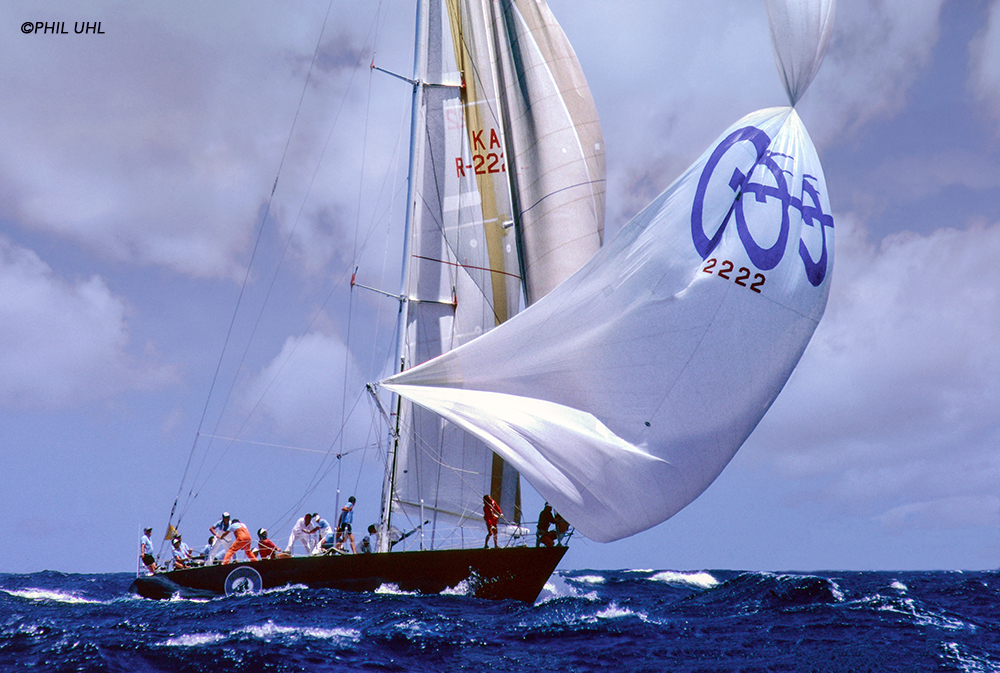
Lovelace, seen here competing in the 1978 Clipper Cup (photo Phil Uhl)
Four Farr designs were next – 
Mr Jumpa (3/1/4/4/3), Smir-Noff-Agen (2/2/DNF/1/2), Jenny H (DNF/4/2/6/4) and The Red Lion (1/3/6/5/5). Sixth was the Jim Young design Heatwave (DNF/10/3/2/6). Lovelace scored a fourth place in the first race, and this was the best that any of the keelers could manage in the series. This result was achieved in a race where three of the centreboarders (Smackwater Jack, Jenny H and Heatwave) were forced out with mast or sail damage. Lovelace was also the first keelboat overall, but was a distant 13 points back in seventh place (4/7/10/14/8). This left the host club, the Royal New Zealand Yacht Squadron, with no choice but to select a team comprised wholly of centreboarders.
Lovelace seen here to leeward of Magic Pudding during the 1978 Clipper Cup 
While some of the keelboats were subsequently chartered by overseas teams for the One Ton Cup, Lovelace was not. However, she went on to compete in the inaugural Clipper Cup held in Hawaii in August 1978, which was notable for the tight four-boat scrap in Class C with two other Farr keelboats, Carrie Ann V (US) and Country Boy (NZ) and the Peterson centreboarder, Magic Pudding (ex-B195). Country Boy was part of the New Zealand ‘A’ team (alongside Monique and Gerontius), while Lovelace was in the ‘B’ team (with Anticipation and Inca). 
Lovelace enjoying close racing in Class C alongside another New Zealand yacht, Country Boy (photo DB Yachting Annual)
The four One Tonners were always in a close group minutes ahead of the rest of their division, which was won by Carrie Ann V, with Magic Pudding second, Country Boy third (3/3/4/1/3), and Lovelace fourth (5/2/1/3/4). In overall fleet results, Magic Pudding was third, Carrie Ann V fourth, Lovelace eighth and Country Boy tenth. Lovelace had done well with a first, second and third overall in the Olympic courses, but lost out in the long offshore races to finish ninth overall in the 40-boat fleet. The New Zealand ‘B’ team finished third, behind Australia ‘A’ in first place and New Zealand ‘A’ in second. 
Sailing as Petard, in the US (photo Histoiredeshalfs, date and photographer unknown)
Changes to the IOR in late 1978, including a displacement-to-length formula, that penalised the Farr style of lighter displacement yacht severely impacted the likes of Lovelace, and her rating rose by around 1.5ft, making the design uncompetitive under the rule. Lovelace was however later bought by Alamo resident Keith Buck in 1982 who renamed her Petard (named after the explosive device used to blow down castle walls). He fitted a new Bob Smith-designed rudder in 1992 (with an elliptical shape), and a taller mast (off another version of Design #51, Sweet Okole) in 1994. She was noted in a Latitude 38 article in 2005 to have won well over 100 trophies over the years, and that she performed particularly well in heavy air. Her results recorded in Histoiredeshalfs shows that Buck raced Petard from 1982 before she was advertised for sale in 2022 in San Francisco, by then in a somewhat derelict state.
Lovelace as found in San Francisco, photo circa 2022

Lovelace was found in San Francisco and bought by Kurtis Andrews, son of the original owner Keith. She was found during the Covid era and at the time shipping prices had skyrocketed and it cost a fortune to relocate her to New Zealand. She was shipped to Auckland and then transported to Whangārei where she is being restored by one of her original builders, Ian Mason from Mason Boatbuilders. The last time Ian was on the the boat was in Whangārei back in 1978.

Lovelace seen here enroute to Whangārei 

Kurtis Andrews says “it’s a crazy project to have undertaken and one that would have been far easier not to do. The boat was 10,000 miles away in San Francisco and in a state of disrepair, but something was burning inside to get that boat back to New Zealand, and we did! Keith Andrews (my father) and Jack Lloyd were only 22 when they built the boat on a shoestring budget. Its an amazing feat to have done what they did, including shipping the boat to Hawaii and representing New Zealand in the Clipper Cup. I remember Jack telling me that they used plenty of glue when putting the thing together and when it returned to New Zealand, Ian Mason couldn’t believe the work it had done and that it was still holding together”.  

All going well, the family is aiming to have the boat completed and back in the water by Christmas 2025. 


Article dated September 2024

28 December 2023

Clipper Cup 1984

The Frers 81-foot Maxi Boomerang, top individual yacht of the 1984 Clipper Cup (photo Phil Uhl)
The 1984 Clipper Cup series attracted 69 of the world’s top IOR racing yachts from nine countries (Australia, Bermuda, Canada, Hong Kong, Italy, Japan, New Zealand, Sweden and the United States). The Maxi fleet included Boomerang, Kialoa IV, Nirvana, Sorcery and Winterhawk (ex-Ceramco New Zealand) from the United States, Condor from Bermuda and Ragamuffin (ex-Bumblebee IV) from Australia. Renowned marine photographer Phil Uhl was there to capture the action, and this article features a number of his photos from the series. 

Boomerang crosses ahead of Kialoa IV as they approach a windward mark during one of the Triangle races in the 1984 Clipper Cup (photo Phil Uhl)
The three Olympic triangle races were again the most hotly contested of the series, with the Maxis doing their best to save their time on handicap against the smaller yachts. The first two races were sailed in strong blustery winds before Hawaii’s standard tradewinds settled in. Boomerang had a slow start but by the second race was clearly the form yacht in Class A. Within the other classes, Monte Livingston’s Checkmate (ex-Bullfrogtook two firsts in Class B; US yacht Victory lead Class C with a second and first; Bondi Tram lead Class D with two first placings; and Exador lead the One Ton fleet that made up most of Class E, also with two first places.
The Soverel-designed 55-footer The Shadow, seen here rounding a windward mark in close company with Italian yacht Orlanda, a Farr 58-footer - The Shadow finished fifth yacht overall and first in Class B (photo Phil Uhl)
Kialoa IV (second yacht overall) powers upwind with Condor on her windward hip (photo Phil Uhl)
The rough conditions of the first two races caused some attrition in the fleet, and so only 58 boats motored out for the 150-mile double-points Kalua Koi Molokai Race. Conditions were fortunately much less extreme than in 1982, and saw Boomerang take line honours from Kialoa with a margin of nine minutes, but Kialoa only just edged out Sorcery by ten seconds. The Maxis also took overall handicap honours in the race, with Boomerang first, followed by Sorcery, Kialoa and Nirvana. In Class B, Australia’s Freight Train (Frers 62) finished first, ahead of The Shadow (with designer Mark Soverel at the helm), but Tomahawk (ex-Margaret Rintoull III) and Checkmate took first and second on corrected time. The vintage Peterson 43 Scarlett O’Hara, sailed by Dee Smith, took Class C honours from the Reichel/Pugh 43 Sidewinder.

Scarlett O'Hara rounds up during one of the reaches in one of the first two Triangle races, and below, running downwind during the Molokai Race (photos Phil Uhl)

Japanese yacht Zero, a Frers 52-footer and member of the eighth-placed Japan 'East' Team (alongside Karasu and Intuition, sails past the North Shore during the Molokai Race (photo Phil Uhl)

Bondi Tram extended her dominance of Class D, soundly trashing Revenge and the rest of the class, with a 13-minute lead on corrected time. Similarly, Exador continued to be the boat to beat in Class E, trouncing her sisterships Sundance, General Hospital and Indian Gibber, and correcting to fifth in fleet behind the four leading Maxis. 

Ragamuffin (ex-Bumblebee IV), 11th yacht overall and part of the fifth-placed New South Wales team, sailing upwind with Nirvana's mainsail visible in the foreground (photo Phil Uhl)

Condor, Nirvana and Ragamuffin on the charge towards a wing mark during one of the Triangle races (photo Phil Uhl)

Afterguard action aboard Boomerang (photo Phil Uhl)
Similar positions were recorded for the KHON/NBC triangle race, with Boomerang again winning the Maxi division and holding her time against the entire fleet, with Bondi Tram being again dominant in Class D. In Class E the Farr 40s again proved to be rocketships, with Exador surviving a collision and protest with Class D yacht Orihime to win the class. Checkmate added a second placing in Class B to her earlier firsts, and a second overall to secure the newly dedicated Hawaii Silver Jubilee Trophy for the top overall yacht in the combined ocean triangle races.
Close racing in Class C, with Hong Kong's Bandido Bandido seen here leading Shockwave (KZ-5070), Scarlett O'Hara and Bravura (photo Phil Uhl)

Bondi Tram, the dominant yacht of Class D, rounds a leeward mark in close company with US yacht Prism during the third Triangle race (photo Phil Uhl)

Above and below, the US yacht Bravura, a Frers 46-footer and member of the ninth-placed US 'Blue' Team, alongside Scarlett O'Hara and Libalia Flash (photos by Phil Uhl)

With only the 778-mile Around the State Race to go, Boomerang had accumulated 490 out of a possible 500 fleet points. Checkmate, however, lay just three points behind, and Tomahawk another three points further back. The performances of these latter two had bought their US ‘White’ Team within six points of the series-leading New Zealand ‘A’ Team of Exador, Shockwave and Sundance in the scoring for the Clipper Cup (also giving New Zealand a comfortable 34-point lead in that season’s Champagne Mumm World Cup). However, the Around the State Race counts for triple points, or three-eighths of the series scoring, which reduces the importance of all the preceding races by what some considered an excessive amount.

Boomerang crosses behind Condor, likely while the fleet played the windshifts off Maunalua Bay in the early stages of the Molokai Race (photo Phil Uhl)
The Dave Pedrick designed Maxi Nirvana finished fourth in Class A (with results of 2/3/4/3/5) (photo Phil Uhl)
The Around the State Race started in an easterly squall followed by light to moderate winds for the trek to Kauai and beyond Niihau. Fortunately the winds began to pick up again on the long reaching leg to South Point. Misfortune would strike when Exador was dismasted by a rogue wave off the Ka’u Coast off the Big Island. Boomerang was the first yacht around South Point, leading Kialoa by about six miles. As the wind freshened Boomerang extended her lead, finishing in 3 days, 22 hours and 34 minutes and beating the course record set by Kialoa in 1982 by an hour (and also beaten by Kialoa in 1984). Condor saved her best for the most important race, coming in third, followed by Sorcery, Nirvana, Ragamuffin and Class B’s leader Freight Train.
Close upwind racing in Class B, with Tomahawk to weather of Black Sheep (KZ-595), Artemis (US-31105), Orlanda (I-10149) and Checkmate (US-8997) (photo Phil Uhl)

The Frers 62-footer Freight Train sets off on a spinnaker reach during one of the Triangle races - she finished 13th= yacht overall and was a member of the fifth-placed New South Wales Team, alongside Ragamuffin and Sweet Caroline (photo Phil Uhl)
The Farr 40 General Hospital in strong upwind conditions - she finished 13th= overall and was a member of the third-placed USA 'Red' Team, alongside Sidewinder and Artemis (photo Phil Uhl)

US yacht Checkmate during the 1984 Clipper Cup - finished as fourth yacht overall with placings of 1/1/3/1/15 (photo Phil Uhl)

At about the time Boomerang finished, the Class C boats Camouflage and Sidewinder were sailing between Hawaii and Maui in the middle of the Class B group, involved in what would turn out to be a 165-mile match race to the finish. By late that night, the two were sailing less than ten boat-lengths apart under light spinnakers, passing Makanalua Peninsula in company with Class B yacht Zero. As they romped across the Molokai Channel, it became apparent that this race would not be another big-boat benefit: Camouflage beat Sidewinder across the line, but Sidewinder, rating some 2.2ft less, corrected to first easily, both in class and fleet, cementing a Class C win over Shockwave which had placed second for the race. 

The crew aboard the Farr 40 Sundance enjoying their work, and the warm conditions (photo Phil Uhl)

US yacht Camouflage, a Frers 44-footer and member of the winning US White team (photo Phil Uhl)

The Nelson-Marek -designed 49-footer Brooke Ann just under control in power reaching conditions (photo Phil Uhl)

Second in fleet for the race was Sundance, as the Farr 40 picked up where her dismasted sistership and team-mate had left off. In the process, Sundance also secured Class E honours for the series and third place overall. Bondi Tram came in third in fleet for the race, completing a sweep of five wins in Class D (and was sixth overall).

 Bandido Bandido, a Peterson 43, presses on with a tri-sail after presumably blowing out her mainsail (possibly during the first Triangle race as this was her worst result) - she was a member of the 11th (last) -placed Hong Kong team, alongside Tsunami and Bimblegumbie (photo Phil Uhl)

In Class B, Checkmate’s long beat to South Point knocked her out of the running, opening the door for The Shadow to take class honours for the race and, by a single point over Tomahawk, for the series. This was another obvious example of the effect of the heavy weighting of the Around the State Race, as Tomahawk and Checkmate had taken all the class firsts and seconds in the first four races (in comparison to The Shadow's results of 4/4/4/6).

Condor bashes into big seas on one of the first two days of racing, with Ragamuffin visible to windward (photo Phil Uhl)

Freight Train seen here with a twisted spinnaker (photo Phil Uhl)

Blast Furnace, above and below (with Orlando in the background, above), a 44-footer designed by Murray Ross that featured relatively clean aft sections resulting in a high 38.5ft rating - this approach was unsuccessful and she finished as 26th-placed yacht (results of 24/28/28/31/17) as a member of the seventh-placed New Zealand 'B' Team, alongside Anticipation and Black Sheep (photos Phil Uhl)

The one boat impervious to the last-race shuffling of the standings was Boomerang, which had finished first in class and tenth in fleet, and so won Class A easily as well as the King Kamehameha Trophy for the best individual yacht overall, ahead of Kialoa IV in second. In team scoring, Exador’s demise allowed the US ‘White’ Team to retain the Pan Am Clipper Cup, with New Zealand ‘A’ finishing second.

US yacht High Risk, a Frers-designed One Tonner, sails upwind during one of the Triangle races, with Sweet Caroline visible behind (photo Phil Uhl)

Tsunami, a Castro-designed 40-footer, in upwind mode (above) and below, rounding a windward mark alongside the Takai-designed Mimi and the Ohashi-designed Marie, and further below (and shortly afterwards) sliding down a big swell and still just ahead of Mimi.Tsunami was a member of the 11th-placed Hong Kong team (photo Phil Uhl)


Bandido Bandido surfs along on a windy reaching leg, this time with her mainsail intact (photo Phil Uhl)
Casa 7, a Takai 40-footer and member of Japan's sixth-placed Japan 'West' Team (alongside Saki VI and Mimi), with General Hospital to windward (photo Phil Uhl)

Casa 7 seen here on a reaching leg in one of the inshore triangle races, chasing Australia's Seaquesta, a Dubois 42-footer that finished 30th overall and sailed for the 10th-placed Victorian team (photo Phil Uhl)

Grey Fox, a fractionally-rigged J-41 One Tonner skippered by Lowell North - her performance did not suggest the change from the usual masthead configuration for this design was successful (photo Phil Uhl)
Seaulater, a Dubois-designed 40-footer,another member of the Victoria team, alongside Challenge III and Seaquesta (photo Phil Uhl)
Another image of Seaulater, with the bowman wrestling with a twisted spinnaker soon after rounding a windward mark (photo Phil Uhl)
The Peterson 42 Chimera (US)

Bloopers are deployed aboard Zero (above) and Prism (below) (photos Phil Uhl)

US yacht Flasher, a Frers One Tonner, rolls downhill mid-gybe, with the top yacht of the 1982 series, Tobiume, not far behind (photo Phil Uhl)
Another view of Flasher as she heads upwind, with Australia's Bandido Bandido on the charge on one of the reaching legs (photo Phil Uhl)

Scarlett O'Hara leads Challenge III and Bandido Bandido around a leeward mark (photo Phil Uhl)

Seaulater in close company on a reaching leg and keeping up with the higher rating yachts Commotion, High Noon and Expectation (a Farr 38, measuring in at 34.9ft IOR) (photo Phil Uhl)

Pre-regatta activity, with New Zealand yachts Blast FurnaceSundance and Exador being unloaded from the ship (above) and Nirvana undergoing final hull checks (below) (photos by Phil Uhl)

Other Clipper Cup series covered on this blog: Clipper Cup 1978, Clipper Cup 1980, Clipper Cup 1982, Kenwood Cup 1986, Kenwood Cup 1988, Kenwood Cup 1990


Article updated July 2026