Showing posts with label Intuition. Show all posts

8 August 2026

SORC 1981

The 1981 edition of the United States' SORC series was generally considered as a great success, but was subsequently clouded by questions raised over the ratings of several of the best performing yachts. This issue took on even more significance than usual, because the regatta doubled as the US selection series for that year’s Admiral’s Cup.
Louisiana Crude and Intuition seen here at the start of the Ocean Triangle Race in the 1981 SORC, with Wildflower to the right (photo Phil Uhl)
One of the stars of the regatta was the new Kialoa IV, the new Ron Holland design which dominated all other yachts in the Class A division. She was built in high-tech material (Kevlar, carbon fibre and unidirectional glass fibre), which provided maximum rigidity that put her out on the edge of the technological evolution of racing yachts at the time. At the other end of the technological spectrum was Pat Malloy’s Peterson 42 Intuition, which would eventually be declared the overall winner of the series (after initially finishing fourth). She was constructed in aluminium, but rivetted and glued rather than welded, which allowed significant weight savings as this allowed lighter plating as there was no loss of form or strength through welding, and less use of fairing putty. The robustness of this construction technique was proved in the second race (St Petersburg to Fort Lauderdale) when she not only survived a collision with Shockwave (a Davidson 46-footer), resulting in a damaged stem, but went on to finish second in class and fifth overall.
Intuition in breezy reaching conditions during the 1981 SORC (photo Guy Gurney)
Two predictably fast entries were the New Orleans yachts Acadia and Louisiana Crude. Acadia, a Frers 39-footer built as a one-off by New Orleans Marine. She rated 29.9ft IOR and even before the regatta began there were some reservations expressed about the accuracy of that figure. 
Acadia racing during the 1981 SORC (photo Tor Maverstaard | Seahorse)
Louisiana Crude was the latest version of Doug Peterson’s Design 33 (first seen as the Dutch 1979 Admiral’s Cup entrant Schuttevaer). Another near sister was Love Machine, and the design later reappeared as the stock-built Serendipity 43 (the most famous of which was Scarlett O’Hara). The Peterson design had returned to the SORC in 1980 as the earlier Acadia which won the event and which went on to help win the Sardinia Cup that year for the US. Louisiana Crude, owned by Tom Dreyfus and Dick Jennings, and skippered by Tom Blackaller, was the new high-tech version, built in uni-directional glass and carbon fibre, and a rating of 32.6ft.
Louisiana Crude in light air downwind conditions during the 1981 SORC
Louisiana Crude had a Class C finish record of 1/1/2/4/2/1 and took out overall fleet honours with results that were never out of the top ten, even though she was also never higher than third. It did not seem to matter whether the contest was a big boat benefit, such as the Boca Grande, or a small boat race like Ft Lauderdale, Louisiana Crude always managed to get home in good time, while Acadia faltered in both the Boca Grande and Lipton Cup races. In explaining their success with a conservative and three-year old design, Blackaller said, "When they get their kind of conditions, specialised boats win races, but when they don't, they are apt to lose big. A boat like Crude can win the series without winning a race". Dreyfus quipped, "Crude is plain, straight vanilla. A simple boat sailed by simple people".
Louisiana Crude, 1981 SORC
During the big-boat races Seymour Sinett’s latest Williwaw (the fourth of that line), a Peterson 48-footer with a rating of 37.1ft, skippered by Dennis Conner, finished first in Class B and third overall. Observers continued to wonder at the ability of Acadia and Williwaw to sail so far above their ratings when conditions were right for them.
Williwaw in fresh conditions off Miami during the 1981 SORC (photo Phil Uhl)
Before the series was over Bill Martin, the owner of Stars & Stripes, a Nelson 39-footer, protested Acadia’s rating. At the same time, the crew of Intuition felt that they were seeing a very different Williwaw being measured to the one they had been racing against, and appeared to be floating on a different set of lines, and Malloy filed a protest against her rating. The US Admiral’s Cup Team Selection Committee subsequently undertook some basic freeboard measurements of the top contenders in Nassau. Neither Acadia or Williwaw were close to the numbers on their rating certificates, and suddenly a protest that was pending on Acadia began to look serious. Despite this, Acadia, Scaramouche (a Frers 45-footer that finished fourth in Class B) and Williwaw were announced as the US Admiral’s Cup team, with Stars & Stripes named as an alternate member.
Scaramouche - seen here astern of the smaller Louisiana Crude (photo Phil Uhl)
Once the team yachts were back in Ft Lauderdale in Florida, they were remeasured in order to avoid any potential rating difficulties in England. The results were described as nothing short of shocking, with Acadia jumping from 29.9 to 31.1ft, and Williwaw from 37.1 to 38.1ft. The issue was further complicated when it was revealed that Williwaw had been measured twice in 1977, and had gone down one full foot in rating, with only the freeboard measurement changing. It was plain that over two tons of lead would have been necessary for the 3.5” measurement difference at her bow, and she measured as less stable that she actually was, by about 5%. Acadia floated higher than her measurement certificate had attested, and thus approximately a ton lighter while racing, and was also more stable than her certificate showed.
A haul-out area in Florida (Snead Island), with Midnight Sun and Aries to the left, and Infinity (in slings) and Leading Lady (photo Paul Mello)
The method employed was that both yachts were alleged to have been fitted with extra-large water tanks to sink the boats during measurement so that they could claim an IOR Mk IIIA credit, which had been devised ostensibly to benefit older, deeper-gutted yachts.
The Holland-designed fractionally-rigged Aries finished in sixth place overall - note the very coarse mainsheet purchase arrangement (photo Phil Uhl)
Scaramouche increased by 0.4ft (from 34.1ft) due to a discrepancy in her original stability data, while Intuition and Stars & Stripes increased by just 0.1ft, and within tolerances.
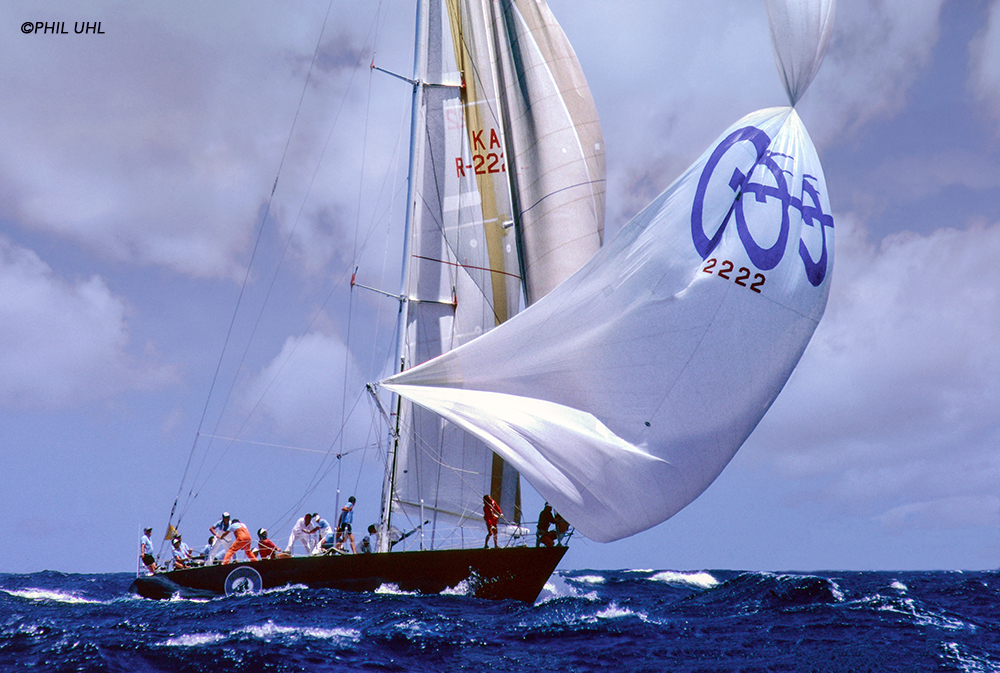
Intuition, 1981 SORC (photo Phil Uhl)
While all this was going on, Dreyfus and Jennings announced that Louisiana Crude had been sold to Victor Forss of Sweden. Forss also owned the older Acadia (renamed Bla Carat) which had raced in the SORC (Class B), and Louisiana Crude became Ra Carat (meaning ‘Rough Diamond’). Later, and while the boat was out of the water being repainted and prepared for shipping to Sweden, one of the USYRU measurers noticed that bumps on her hull looked a little extreme. On further inspection they were confirmed to be of too small a radius to be accepted without penalty (IOR rule 326.2). A comment from Dreyfus to a USYRU official about the measurement and number of sails on board revealed that 11 sails had been included during measurement, rather than the eight allowed (thereby affecting flotation). With that, and despite no protest being made about her rating during the SORC, the USYRU declared in late March 1981 that Louisiana Crude’s certificate was invalid, and that news was passed on to the SORC committee. Notably, however, no hearing was held to determine the exact nature of the infractions that cost her the title of SORC fleet champion.
Infinity and Canada's Amazing Grace during the 1981 SORC (photo Phil Uhl)
The USYRU could not therefore provide the SORC or Dreyfus and Jennings with a valid IOR certificate. This prompted Dreyfus to label the USYRU’s actions a witch-hunt and, and both owners filed civil action proceedings in a New Orleans court, with Dreyfus seeking $5M in damages for humiliation, injury to reputation and financial impacts. The New York Times reported on 28 March 1981 that an attorney acting for one of the owners denied any irregularities. Dreyfus noted that Louisiana Crude had exactly the same hull as the 1980 winner Acadia, and questioned how it could now be illegal.
Ted Hood's One Tonner Robin, winner of the St Petersburg - Fort Lauderdale Race (and winner of two races in the 1980 series), seen here off Tampa Bay during the 1981 SORC (photo Phil Uhl)
Nevertheless, the SORC committee determined to exclude Louisiana Crude as she did not have a valid certificate and undertook rescoring of the regatta based on new ratings. As a result, the boat that had truly dominated racing in Florida became an instant non-participant. Her new owners were given until 31 May 1981 to produce a valid certificate, but she had been shipped to Sweden in April and any measurement would have to accept the changes made by Forss, including the re-fairing of the measurement bumps. The revised results therefore remained provisional.
The Frers Maxi yacht Bumblebee IV during the 1981 SORC (photo Guy Gurney)
The rescoring in Florida showed some interesting changes in the standings, but not as much as had been expected. With Louisiana Crude missing entirely, everyone moved up one place. Acadia’s new rating pushed her down to third overall, although she still won Class D. Williwaw was pushed down to sixth overall, but also remained first in Class B. These rather minor changes in standings seemed to indicate that Louisiana Crude would have needed to have had an astronomical change in her rating to move her out of first place overall.
The fleet assembled at St Petersburg Yacht Club during the 1981 SORC (photo Guy Gurney)
The US Admiral’s Cup committee decided that there was such a cloud hanging over the ratings of Acadia and Williwaw that they could not successfully represent the US, and were dropped from the Admiral’s Cup team, which was comprised instead of Intuition, Scaramouche and Stars & Stripes. One effect of this shake-up was that the US team went to Cowes with a lower rating team than the one they had initially planned.
Class B get underway at the start of the Ocean Triangle Race during the 1981 SORC, with (left to right) Amazing Grace, Gem, Williwaw and Merrythought (photo Phil Uhl)
Immigrant, a Dubois 42-footer, raced in Class C (photo Phil Uhl)
Meanwhile, the select committee of the USYRU appointed to investigate the irregularities of Acadia and Williwaw determined that the infractions by Williwaw were sufficient to ban Sinett from racing for a period of two years, from 23 July 1981. The penalty was largely based on the testimony of Harvey Ward, Sinett’s former boat-keeper, who stated that he had used a hose to fill the bilges of the yacht with water before the most questionable measurement session, an allegation that Sinett himself denied, as was his request to testify on his own behalf.
Another image from the start of Class B in the Ocean Triangle, with Bravura (second overall in Class B) sneaking in at the boat end to weather of Infinity (photo Phil Uhl)
The situation with Acadia was also contentious, and owner Burt Keenan also contemplated a civil suit against the USYRU, and instituted his own investigation and remeasurement. Two measurers in New Orleans found the yacht to be back within acceptable tolerances for a 30ft-rater, and Keenan maintained that he had been unduly maligned by USYRU officials. Nevertheless, he also incurred a ban for one year.
Class A yacht, the 50-footer Congere, with the foredeck busy with an errant spinnaker, went on to finish third in Class A (photo Phil Uhl)
Despite all the controversy behind the SORC and the US team selection, the team went on to acquit itself well in the 1981 Admiral’s Cup, finishing in second place. The series, that started on 29 July, was won by Britain, which itself was to face its own rating controversy following the remeasurement of team yacht Victory of Burnham after she raced in the 1982 SORC. As it transpired, the lower ratings of the US team were better aligned than the original team to the conditions for the 1981 Admiral's Cup, and its second place result was led by the minimum-rater Stars & Stripes which finished in fourth place on individual points, with Intuition 11th and Scaramouche 21st. Ra Carat formed part of the ninth-placed Swedish team (of 16), sailing with a rating of 32.7ft, just 0.1ft higher than her rating for the SORC. She finished a creditable 12th on individual points, just one point behind Intuition, and scored a memorable second in Class 2 overall in the Channel Race.
The afterguard aboard Louisiana Crude during the 1981 SORC (photo Paul Mello)

Stars & Stripes, the standout performer in the US team in the 1981 Admiral's Cup, approaches a leeward mark during that series, ahead of New Zealand's Wee Willie Winkie and Canada's Runaway 


Article dated August 2026

This article is based on accounts set out in The World of Yachting 1981/82; The Official History of the Admiral’s Cup (Timothy Jeffery); Great Yacht Races (Bob Fisher); and Seahorse (May/June 1981 edition), including articles at the time by designer Bruce Kelley; the New York Times (28 March 1981) and Sports Illustrated.

4 January 2025

Victory of Burnham (Dubois 44)

Victory of Burnham was an Ed Dubois -designed 44-footer, commissioned by Peter de Savary for the 1981 offshore racing season and that year’s Admiral’s Cup in particular, and as a ‘warm-up’ for his bid for the 1983 America’s Cup. She was a good-looking yacht, with a low coachroof, raked transom and blue and gold paint scheme. Her design characteristics, with a return to more conservative design style, mast-head rig and narrower aft sections, marked something of a departure from Dubois’ previous breakthrough yacht, Police Car.
Victory during the 1981 Admiral's Cup (photo Phil Uhl)
Victory was skippered by Phil Crebbin and made it into Britain’s three-boat Admiral’s Cup team, alongside Yeoman XXIII (a Frers 45-footer) and Dragon (a Dubois 40-foot minimum rater), racing with a very competitive, but ultimately inaccurate, rating of 33.1ft IOR. She finished as top boat in the trials, only once dropping out of the top three places in nine races. While this gave some indication of the issues to come, Victory sailed well and her anomalous rating is not understood to have greatly affected the outcome of the British trials, although Robin Aisher, skipper of second-placed Yeoman, recalled that Victory was tough to beat on corrected time.
Victory (K-302), seen here on the right, pursues Marionette during the 1981 British Admiral's Cup trials, with Caiman visible in the centre (photo Guy Gurney)
After the windless first race of the Admiral’s Cup, Victory won the next inshore race, with team-mate Yeoman second, covering the poor result of Dragon in 42nd and lifting the team to fourth. The team had a strong Channel Race and leapt to first place, and in another light airs inshore race, Victory finished second, with Yeoman in sixth, which saw them take a commanding lead into the Fastnet Race finale. In contrast to the storm-affected 1979 edition of this ocean racing classic, the 1981 race was affected by calms throughout and was a long drawn-out affair. Incredibly, Victory finished just under three hours behind the line honours winner, the Maxi-yacht Kialoa IV. It was a minimum-rater benefit, however, and Victory just managed 15th on corrected time in the Admiral's Cup fleet. Nevertheless, this gave her second place overall, just one point behind New Zealand’s Swuzzlebubble III, and helped her to lead the British team to an Admiral’s Cup win, by a whopping 98 points over the second-placed US team.
Victory during the 1981 British Admiral's Cup trials (photo Seahorse)
The analysis of the Admiral’s Cup series contained in ‘The World of Sailing 1981-82’ noted that, in an immediate post-series review, the British victory could be attributed to three key factors – the first being that their boats suffered no broken gear, the second being the consistent sailing of Victory and Yeoman, and thirdly the performance of the minimum rating Dragon in the points-loaded offshore races. Of interest to the story that follows, it was also observed that only Britain completed the series without incurring a penalty, with team captain Aisher emphasising that the British team must keep out of trouble at all times.
Victory seen here during Cowes Week 1981 (photo Facebook)
Victory was later bought by Trevor Bailey of London, and she changed hands in January 1982, with a new measurement certificate issued by the RORC. She was transported to Florida for the 1982 SORC and put on a dominant performance, finishing first in Class C (1/1/3/5/2) and third overall.

Unfortunately, as it would transpire, Victory would be remembered mainly for the rating controversy in which she became embroiled after this success in the SORC. The preceding 1981 edition of that event, which doubled as the US Admiral’s Cup team selection series, had been impacted by controversy after the top three selectors’ choices of Louisiana Crude, Acadia and Williwaw were all found to have suspect ratings (and in the end the two reserve yachts, Stars & Stripes and Intuition were selected to join Scaramouche).
Victory has a strong start in the light-airs first race of the 1981 Admiral's Cup, seen here to weather of Australia's Apollo V, and US team-mates Scaramouche and Intuition 
There had been a feeling in the British fleet during the 1981 season that Victory's rating of 33.1ft was too good to be true. The designer, the late Ed Dubois, had even given the RORC’s rating office his predicted values for the hull depth measurements, because her rating was lower than he had expected and well below what Dubois thought was the best that could be achieved, at around 33.6ft. The inquiry on the issue that was conducted by the RORC noted that the original measurement was undertaken in April 1981, which came out at 33.3ft. Remeasurement was undertaken in June 1981 after some ballast relocation and Dubois’ recommended bumping of the CMD measurement point (to force another complete remeasurement of the boat), and again later that month (after the British Admiral’s Cup trials had commenced), with the rating now at 33.1ft. 

But the re-measurement of Victory, by another RORC measurer, concluded that the rating was correct. Based on this, and her performance during the trials as described above, Victory was duly selected for the British team and went on to finish second overall, and was the top scorer of that team.
Part way through the first race of the 1981 Admiral's Cup, Victory can be seen here just behind Italy's Almagores, with Scaramouche (US) to leeward, and Ireland's Woolly Jumper to windward (photo Phil Uhl)
However (as reported by the New York Times in March 1982), complaints were lodged after the SORC by two rival Class C skippers, William Power (High Roler) and Rodney Wallace (Thunderbird). Victory’s crew subsequently complied with the Race Committee’s request to return the yacht to Florida for remeasurement. When errors were discovered by the Chief Measurer of the US Yacht Racing Union (USYRU) they advised the RORC, who promptly sent one of their measurers over from Britain, and the boat was again remeasured, confirming the USYRU’s Chief Measurer’s work.
Victory struggles towards the finish line of the first race in the 1981 Admiral's Cup, with Germany's Pinta ahead on starboard gybe 
Victory’s remeasured freeboards showed her to float very slightly higher than expected, although this was of marginal consequence. The most significant issue, however, was that her out-of-water hull depth measurements were badly amiss (by an average of 1.65”) and all the errors added cumulatively to reduce the boat’s rating, as the computer rated the boat to be 1,675lbs heavier than she really was. The other major discrepancy related to her stability, with remeasurement showing her to be 13.5% more stable than originally assessed (noting that stability was a penalised feature in the IOR, up to a point). The USYRU remeasurement found that Victory’s rating was in fact 34.5ft.

The Chairman of the SORC disqualified Victory from that series on 23 March 1982, and High Roler was declared the winner of Class C.
A study in IOR sterns during the 1981 Admiral's Cup, with Victory on the right, alongside Australia's HitchhikerRebel Country and Sweden's Ra Carat (ex-Louisiana Crude) (photo Phil Uhl)
In early May 1982, therefore, it became clear to the RORC inquiry team that a full remeasurement of Victory was desirable, where the yacht was prepared for measurement by Dubois himself. This remeasurement was within the expected tolerances of the early USYRU measurements. The inquiry exonerated Dubois from any fault, noting that he had previously advised the RORC of his opinion that the depth measurements were too large and asked them to be checked, and he did all that could reasonably be expected to warn that something might be wrong.

The question was then whether Britain’s earlier victory in the 1981 Admiral’s Cup should be declared null and void and the Cup handed over to the second-placed US team. However, it does not appear that Victory’s measurement saga was the result of any effort by de Savary or Dubois, who were exonerated in the RORC’s inquiry. That inquiry also found no evidence of fraud or other malpractice, and the issue appeared to be the result of a rushed check of the mid-depths while relying on the original measurement stations. The blame thus lay with the RORC’s measurer and the rating secretary, both of whom subsequently resigned from their posts.
Victory during the 1981 Admiral's Cup, with Italy's Mandrake visible crossing ahead on starboard (photo Facebook)
Further, a re-calculation of the Admiral’s Cup scores, based on Victory’s corrected rating, did not suggest that Britain’s victory was in any way undeserved. Timothy Jeffery in his comprehensive Official History of the Admiral’s Cup noted that a re-calculation only dropped Victory’s contribution to the British winning total by 19 points, which would still leave Britain with a significant margin over the US. This is perhaps not surprising, as applying the formula typically used at the time to convert an IOR rating to a time correction factor (i.e., TCF = [R1/2 + 2.6] / 10) the difference in Victory’s rating would result in a TCF of 0.830, compared to 0.840. In a six-hour race, this would amount to just 3 minutes 36 seconds (approximately 1%). Seahorse also comments (January 2023) that "[i]n pure mathematical terms Victory of Burnham's re-rating would not have changed the outcome of the Admiral's Cup but it did substantiate the repeated urgings from Dubois himself, that the boat's RORC-issued rating needed checking because it was far better than projected...". 

It is also not apparent that this would have had a significant effect on the way that other yachts would have raced against Victory, even if they found her rating to be unduly ‘competitive’. Given her strong performance in the British trials, it seems equally unlikely that with a corrected rating she would have struggled to qualify for the team or would have been beaten by the fourth-placed Mayhem.
Victory racing in San Francisco, likely during the 1984 Big Boat Series
In any event, the 1981 Admiral’s Cup result stood 
as part of the historical record, along with Britain’s winning margin, as does Victory’s second place in the individual standings. This is, however, in some contrast to the USYRU's approach to the SORC results, albeit that the SORC is an individual event, rather than a teams-based regatta.
Victory bashes her way upwind during the 1984 Clipper Cup (photo Yachting)
Victory was later bought by US yachtsman Robert Butkus and competed in the 1984 Clipper Cup (by then with a rating of 34.2ft, and sail number 87312), sailing for the Cabrillo Beach Yacht Club, and with Dubois aboard. She finished in third place in Class C (results of 2/1/3/6/8). She went on to race in Class C in the 1984 Big Boat Series, although her results in that regatta are not known, other than the fact that she did not feature in the top four.
Victory lost her mast at some stage in her racing career (photo Facebook)


Article updated October 2025

28 December 2023

Clipper Cup 1984

The Frers 81-foot Maxi Boomerang, top individual yacht of the 1984 Clipper Cup (photo Phil Uhl)
The 1984 Clipper Cup series attracted 69 of the world’s top IOR racing yachts from nine countries (Australia, Bermuda, Canada, Hong Kong, Italy, Japan, New Zealand, Sweden and the United States). The Maxi fleet included Boomerang, Kialoa IV, Nirvana, Sorcery and Winterhawk (ex-Ceramco New Zealand) from the United States, Condor from Bermuda and Ragamuffin (ex-Bumblebee IV) from Australia. Renowned marine photographer Phil Uhl was there to capture the action, and this article features a number of his photos from the series. 

Boomerang crosses ahead of Kialoa IV as they approach a windward mark during one of the Triangle races in the 1984 Clipper Cup (photo Phil Uhl)
The three Olympic triangle races were again the most hotly contested of the series, with the Maxis doing their best to save their time on handicap against the smaller yachts. The first two races were sailed in strong blustery winds before Hawaii’s standard tradewinds settled in. Boomerang had a slow start but by the second race was clearly the form yacht in Class A. Within the other classes, Monte Livingston’s Checkmate (ex-Bullfrogtook two firsts in Class B; US yacht Victory lead Class C with a second and first; Bondi Tram lead Class D with two first placings; and Exador lead the One Ton fleet that made up most of Class E, also with two first places.
The Soverel-designed 55-footer The Shadow, seen here rounding a windward mark in close company with Italian yacht Orlanda, a Farr 58-footer - The Shadow finished fifth yacht overall and first in Class B (photo Phil Uhl)
Kialoa IV (second yacht overall) powers upwind with Condor on her windward hip (photo Phil Uhl)
The rough conditions of the first two races caused some attrition in the fleet, and so only 58 boats motored out for the 150-mile double-points Kalua Koi Molokai Race. Conditions were fortunately much less extreme than in 1982, and saw Boomerang take line honours from Kialoa with a margin of nine minutes, but Kialoa only just edged out Sorcery by ten seconds. The Maxis also took overall handicap honours in the race, with Boomerang first, followed by Sorcery, Kialoa and Nirvana. In Class B, Australia’s Freight Train (Frers 62) finished first, ahead of The Shadow (with designer Mark Soverel at the helm), but Tomahawk (ex-Margaret Rintoull III) and Checkmate took first and second on corrected time. The vintage Peterson 43 Scarlett O’Hara, sailed by Dee Smith, took Class C honours from the Reichel/Pugh 43 Sidewinder.

Scarlett O'Hara rounds up during one of the reaches in one of the first two Triangle races, and below, running downwind during the Molokai Race (photos Phil Uhl)

Japanese yacht Zero, a Frers 52-footer and member of the eighth-placed Japan 'East' Team (alongside Karasu and Intuition, sails past the North Shore during the Molokai Race (photo Phil Uhl)

Bondi Tram extended her dominance of Class D, soundly trashing Revenge and the rest of the class, with a 13-minute lead on corrected time. Similarly, Exador continued to be the boat to beat in Class E, trouncing her sisterships Sundance, General Hospital and Indian Gibber, and correcting to fifth in fleet behind the four leading Maxis. 

Ragamuffin (ex-Bumblebee IV), 11th yacht overall and part of the fifth-placed New South Wales team, sailing upwind with Nirvana's mainsail visible in the foreground (photo Phil Uhl)

Condor, Nirvana and Ragamuffin on the charge towards a wing mark during one of the Triangle races (photo Phil Uhl)

Afterguard action aboard Boomerang (photo Phil Uhl)
Similar positions were recorded for the KHON/NBC triangle race, with Boomerang again winning the Maxi division and holding her time against the entire fleet, with Bondi Tram being again dominant in Class D. In Class E the Farr 40s again proved to be rocketships, with Exador surviving a collision and protest with Class D yacht Orihime to win the class. Checkmate added a second placing in Class B to her earlier firsts, and a second overall to secure the newly dedicated Hawaii Silver Jubilee Trophy for the top overall yacht in the combined ocean triangle races.
Close racing in Class C, with Hong Kong's Bandido Bandido seen here leading Shockwave (KZ-5070), Scarlett O'Hara and Bravura (photo Phil Uhl)

Bondi Tram, the dominant yacht of Class D, rounds a leeward mark in close company with US yacht Prism during the third Triangle race (photo Phil Uhl)

Above and below, the US yacht Bravura, a Frers 46-footer and member of the ninth-placed US 'Blue' Team, alongside Scarlett O'Hara and Libalia Flash (photos by Phil Uhl)

With only the 778-mile Around the State Race to go, Boomerang had accumulated 490 out of a possible 500 fleet points. Checkmate, however, lay just three points behind, and Tomahawk another three points further back. The performances of these latter two had bought their US ‘White’ Team within six points of the series-leading New Zealand ‘A’ Team of Exador, Shockwave and Sundance in the scoring for the Clipper Cup (also giving New Zealand a comfortable 34-point lead in that season’s Champagne Mumm World Cup). However, the Around the State Race counts for triple points, or three-eighths of the series scoring, which reduces the importance of all the preceding races by what some considered an excessive amount.

Boomerang crosses behind Condor, likely while the fleet played the windshifts off Maunalua Bay in the early stages of the Molokai Race (photo Phil Uhl)
The Dave Pedrick designed Maxi Nirvana finished fourth in Class A (with results of 2/3/4/3/5) (photo Phil Uhl)
The Around the State Race started in an easterly squall followed by light to moderate winds for the trek to Kauai and beyond Niihau. Fortunately the winds began to pick up again on the long reaching leg to South Point. Misfortune would strike when Exador was dismasted by a rogue wave off the Ka’u Coast off the Big Island. Boomerang was the first yacht around South Point, leading Kialoa by about six miles. As the wind freshened Boomerang extended her lead, finishing in 3 days, 22 hours and 34 minutes and beating the course record set by Kialoa in 1982 by an hour (and also beaten by Kialoa in 1984). Condor saved her best for the most important race, coming in third, followed by Sorcery, Nirvana, Ragamuffin and Class B’s leader Freight Train.
Close upwind racing in Class B, with Tomahawk to weather of Black Sheep (KZ-595), Artemis (US-31105), Orlanda (I-10149) and Checkmate (US-8997) (photo Phil Uhl)

The Frers 62-footer Freight Train sets off on a spinnaker reach during one of the Triangle races - she finished 13th= yacht overall and was a member of the fifth-placed New South Wales Team, alongside Ragamuffin and Sweet Caroline (photo Phil Uhl)
The Farr 40 General Hospital in strong upwind conditions - she finished 13th= overall and was a member of the third-placed USA 'Red' Team, alongside Sidewinder and Artemis (photo Phil Uhl)

US yacht Checkmate during the 1984 Clipper Cup - finished as fourth yacht overall with placings of 1/1/3/1/15 (photo Phil Uhl)

At about the time Boomerang finished, the Class C boats Camouflage and Sidewinder were sailing between Hawaii and Maui in the middle of the Class B group, involved in what would turn out to be a 165-mile match race to the finish. By late that night, the two were sailing less than ten boat-lengths apart under light spinnakers, passing Makanalua Peninsula in company with Class B yacht Zero. As they romped across the Molokai Channel, it became apparent that this race would not be another big-boat benefit: Camouflage beat Sidewinder across the line, but Sidewinder, rating some 2.2ft less, corrected to first easily, both in class and fleet, cementing a Class C win over Shockwave which had placed second for the race. 

The crew aboard the Farr 40 Sundance enjoying their work, and the warm conditions (photo Phil Uhl)

US yacht Camouflage, a Frers 44-footer and member of the winning US White team (photo Phil Uhl)

The Nelson-Marek -designed 49-footer Brooke Ann just under control in power reaching conditions (photo Phil Uhl)

Second in fleet for the race was Sundance, as the Farr 40 picked up where her dismasted sistership and team-mate had left off. In the process, Sundance also secured Class E honours for the series and third place overall. Bondi Tram came in third in fleet for the race, completing a sweep of five wins in Class D (and was sixth overall).

 Bandido Bandido, a Peterson 43, presses on with a tri-sail after presumably blowing out her mainsail (possibly during the first Triangle race as this was her worst result) - she was a member of the 11th (last) -placed Hong Kong team, alongside Tsunami and Bimblegumbie (photo Phil Uhl)

In Class B, Checkmate’s long beat to South Point knocked her out of the running, opening the door for The Shadow to take class honours for the race and, by a single point over Tomahawk, for the series. This was another obvious example of the effect of the heavy weighting of the Around the State Race, as Tomahawk and Checkmate had taken all the class firsts and seconds in the first four races (in comparison to The Shadow's results of 4/4/4/6).

Condor bashes into big seas on one of the first two days of racing, with Ragamuffin visible to windward (photo Phil Uhl)

Freight Train seen here with a twisted spinnaker (photo Phil Uhl)

Blast Furnace, above and below (with Orlando in the background, above), a 44-footer designed by Murray Ross that featured relatively clean aft sections resulting in a high 38.5ft rating - this approach was unsuccessful and she finished as 26th-placed yacht (results of 24/28/28/31/17) as a member of the seventh-placed New Zealand 'B' Team, alongside Anticipation and Black Sheep (photos Phil Uhl)

The one boat impervious to the last-race shuffling of the standings was Boomerang, which had finished first in class and tenth in fleet, and so won Class A easily as well as the King Kamehameha Trophy for the best individual yacht overall, ahead of Kialoa IV in second. In team scoring, Exador’s demise allowed the US ‘White’ Team to retain the Pan Am Clipper Cup, with New Zealand ‘A’ finishing second.

US yacht High Risk, a Frers-designed One Tonner, sails upwind during one of the Triangle races, with Sweet Caroline visible behind (photo Phil Uhl)

Tsunami, a Castro-designed 40-footer, in upwind mode (above) and below, rounding a windward mark alongside the Takai-designed Mimi and the Ohashi-designed Marie, and further below (and shortly afterwards) sliding down a big swell and still just ahead of Mimi.Tsunami was a member of the 11th-placed Hong Kong team (photo Phil Uhl)


Bandido Bandido surfs along on a windy reaching leg, this time with her mainsail intact (photo Phil Uhl)
Casa 7, a Takai 40-footer and member of Japan's sixth-placed Japan 'West' Team (alongside Saki VI and Mimi), with General Hospital to windward (photo Phil Uhl)

Casa 7 seen here on a reaching leg in one of the inshore triangle races, chasing Australia's Seaquesta, a Dubois 42-footer that finished 30th overall and sailed for the 10th-placed Victorian team (photo Phil Uhl)

Grey Fox, a fractionally-rigged J-41 One Tonner skippered by Lowell North - her performance did not suggest the change from the usual masthead configuration for this design was successful (photo Phil Uhl)
Seaulater, a Dubois-designed 40-footer,another member of the Victoria team, alongside Challenge III and Seaquesta (photo Phil Uhl)
Another image of Seaulater, with the bowman wrestling with a twisted spinnaker soon after rounding a windward mark (photo Phil Uhl)
The Peterson 42 Chimera (US)

Bloopers are deployed aboard Zero (above) and Prism (below) (photos Phil Uhl)

US yacht Flasher, a Frers One Tonner, rolls downhill mid-gybe, with the top yacht of the 1982 series, Tobiume, not far behind (photo Phil Uhl)
Another view of Flasher as she heads upwind, with Australia's Bandido Bandido on the charge on one of the reaching legs (photo Phil Uhl)

Scarlett O'Hara leads Challenge III and Bandido Bandido around a leeward mark (photo Phil Uhl)

Seaulater in close company on a reaching leg and keeping up with the higher rating yachts Commotion, High Noon and Expectation (a Farr 38, measuring in at 34.9ft IOR) (photo Phil Uhl)

Pre-regatta activity, with New Zealand yachts Blast FurnaceSundance and Exador being unloaded from the ship (above) and Nirvana undergoing final hull checks (below) (photos by Phil Uhl)

Other Clipper Cup series covered on this blog: Clipper Cup 1978, Clipper Cup 1980, Clipper Cup 1982, Kenwood Cup 1986, Kenwood Cup 1988, Kenwood Cup 1990


Article updated July 2026