Showing posts with label Clipper Cup 1978. Show all posts

30 August 2024

Lovelace (Farr One Tonner)

Lovelace, a Farr One Tonner from 1976, returned to New Zealand last year and is undergoing a full restoration in Whangārei. She was originally owned and campaigned by Keith Andrews and Jack Lloyd and was one of a number of yachts produced to Farr’s breakthrough One Ton design from 1976 (Design #51), and was a near sistership of 45 South and Jiminy Cricket which had performed well in the breezier races of the 1976 One Ton Cup. This design was 36’ 9” long and had an IOR rating of 27.5ft, the One Ton limit at that time. Lovelace was constructed in cold-moulded Kauri timber and was a striking looking yacht, with purple and white topsides and a Kiwi decal on the bow.
Lovelace leads Rockie during the 1976 New Zealand One Ton Nationals (photo DB Yachting Annual
Lovelace raced in the 1976 One Ton Nationals, where she competed alongside 12 other yachts and a number of variants of Design #51, including Country Boy, Mardi Gras, Rockie and Chick Chack. She was described in the DB Yachting Annual review of the series as "the purple Whangarei budget flyer", and counted Ray Haslar amongst her crew for the series. The regatta was affected by some issues in race management, with two races abandoned and Lovelace's performance was particularly impacted in this respect as she had won races 1 and 4 only to see here victories scrubbed. She eventually finished third overall, losing to the quicker and more customised Country Boy. Second was Mardi Gras. Some problem spots in her performance were evident for which crew work could not compensate, highlighted in a long beat from the Poor Knights Islands in the ocean race, where Lovelace lost touch with the leaders and no amount of trim or tweaking could make any difference. She later raced in the 1976 Auckland to Gisborne Race, finishing 11th of 19 boats.
Lovelace during the New Zealand 1977 One Ton Cup trials
Lovelace competed in New Zealand’s national trials series for the 1977 One Ton Cup that was held on the Hauraki Gulf in November of that year. By this stage the new generation centreboarders had arrived on the scene, and Farr’s fixed keel design from just a year previous, including Lovelace, Rockie and Country Boy, had now been eclipsed. Nevertheless, the trials to select six boats for New Zealand’s team produced some of the finest level-rating racing seen at that time, with 18 boats competing. The five races produced four different winners and, at the half-way stage of the ocean race finale, the four leaders were grouped together off Sail Rock off Whangarei Heads. The Whiting design Smackwater Jack went on to win the race and the series overall (with a DNF/5/1/3/1) record.
Lovelace, seen here competing in the 1978 Clipper Cup (photo Phil Uhl)
Four Farr designs were next – 
Mr Jumpa (3/1/4/4/3), Smir-Noff-Agen (2/2/DNF/1/2), Jenny H (DNF/4/2/6/4) and The Red Lion (1/3/6/5/5). Sixth was the Jim Young design Heatwave (DNF/10/3/2/6). Lovelace scored a fourth place in the first race, and this was the best that any of the keelers could manage in the series. This result was achieved in a race where three of the centreboarders (Smackwater Jack, Jenny H and Heatwave) were forced out with mast or sail damage. Lovelace was also the first keelboat overall, but was a distant 13 points back in seventh place (4/7/10/14/8). This left the host club, the Royal New Zealand Yacht Squadron, with no choice but to select a team comprised wholly of centreboarders.
Lovelace seen here to leeward of Magic Pudding during the 1978 Clipper Cup 
While some of the keelboats were subsequently chartered by overseas teams for the One Ton Cup, Lovelace was not. However, she went on to compete in the inaugural Clipper Cup held in Hawaii in August 1978, which was notable for the tight four-boat scrap in Class C with two other Farr keelboats, Carrie Ann V (US) and Country Boy (NZ) and the Peterson centreboarder, Magic Pudding (ex-B195). Country Boy was part of the New Zealand ‘A’ team (alongside Monique and Gerontius), while Lovelace was in the ‘B’ team (with Anticipation and Inca). 
Lovelace enjoying close racing in Class C alongside another New Zealand yacht, Country Boy (photo DB Yachting Annual)
The four One Tonners were always in a close group minutes ahead of the rest of their division, which was won by Carrie Ann V, with Magic Pudding second, Country Boy third (3/3/4/1/3), and Lovelace fourth (5/2/1/3/4). In overall fleet results, Magic Pudding was third, Carrie Ann V fourth, Lovelace eighth and Country Boy tenth. Lovelace had done well with a first, second and third overall in the Olympic courses, but lost out in the long offshore races to finish ninth overall in the 40-boat fleet. The New Zealand ‘B’ team finished third, behind Australia ‘A’ in first place and New Zealand ‘A’ in second. 
Sailing as Petard, in the US (photo Histoiredeshalfs, date and photographer unknown)
Changes to the IOR in late 1978, including a displacement-to-length formula, that penalised the Farr style of lighter displacement yacht severely impacted the likes of Lovelace, and her rating rose by around 1.5ft, making the design uncompetitive under the rule. Lovelace was however later bought by Alamo resident Keith Buck in 1982 who renamed her Petard (named after the explosive device used to blow down castle walls). He fitted a new Bob Smith-designed rudder in 1992 (with an elliptical shape), and a taller mast (off another version of Design #51, Sweet Okole) in 1994. She was noted in a Latitude 38 article in 2005 to have won well over 100 trophies over the years, and that she performed particularly well in heavy air. Her results recorded in Histoiredeshalfs shows that Buck raced Petard from 1982 before she was advertised for sale in 2022 in San Francisco, by then in a somewhat derelict state.
Lovelace as found in San Francisco, photo circa 2022

Lovelace was found in San Francisco and bought by Kurtis Andrews, son of the original owner Keith. She was found during the Covid era and at the time shipping prices had skyrocketed and it cost a fortune to relocate her to New Zealand. She was shipped to Auckland and then transported to Whangārei where she is being restored by one of her original builders, Ian Mason from Mason Boatbuilders. The last time Ian was on the the boat was in Whangārei back in 1978.

Lovelace seen here enroute to Whangārei 

Kurtis Andrews says “it’s a crazy project to have undertaken and one that would have been far easier not to do. The boat was 10,000 miles away in San Francisco and in a state of disrepair, but something was burning inside to get that boat back to New Zealand, and we did! Keith Andrews (my father) and Jack Lloyd were only 22 when they built the boat on a shoestring budget. Its an amazing feat to have done what they did, including shipping the boat to Hawaii and representing New Zealand in the Clipper Cup. I remember Jack telling me that they used plenty of glue when putting the thing together and when it returned to New Zealand, Ian Mason couldn’t believe the work it had done and that it was still holding together”.  

All going well, the family is aiming to have the boat completed and back in the water by Christmas 2025. 


Article dated September 2024

17 June 2023

Clipper Cup 1980

The second edition of the Pan Am Clipper Cup attracted 64 yachts from Australia, Bermuda, Canada, Japan, New Zealand, Hong Kong, the United States and the United Kingdom. Fortunately renowned marine photographer Phil Uhl was there to capture the action, and this article features a number of his photos from the series. 

Winner of the 1980 Clipper Cup, Australian yacht Ragamuffin (photo Phil Uhl)

The fleet included three Maxis, Siska (Australia) and Windward Passage (US) and the smaller Mistress Quickly (UK). Condor of Bermuda had also planned to compete, but struck a coral atoll north of Tahiti enroute to Hawaii. 

The 73-foot Maxi, Windward Passage in her new configuration as a sloop, put in a dominant performance through the first four races of the series (photo Phil Uhl)
It was the Australian yacht Ragamuffin, a Peterson 45-footer owned by Syd Fischer (rating 35.2ft IOR), won the Clipper Gold Cup for the top individual yacht of the series, also winning on corrected time the final 775-mile Around the State Race, the Class B point score for the series and for the three inshore races. Ragamuffin was part of the Australia No.1 team, with Challenge and Sweet Caroline, that convincingly won the international teams prize, the King Kamehameha Trophy, with a runaway margin over the US Red team. Sweet Caroline, a Davidson Two-Tonner (31.9ft), also won the Class C point score for the series. 
Ragamuffin rounds a mark during the 1980 Clipper Cup (photo Phil Uhl)

This result meant that Australia, in less than a year, had won the Admiral's Cup, the Southern Cross Cup and the Clipper Cup, and was their second successive victory in the Clipper Cup teams series, having won the inaugural event in 1978 (with Fischer's earlier yacht, the Frers-designed Ragamuffin, being part of that victorious team). 

The US Red team was comprised of two Holland designs, Tomahawk and Shenandoah who performed consistently, but the 1976 Farr One Tonner, Carrie Ann V, turned in five average results.

The Australian 77-foot Maxi, Siska (67.2ft IOR) (photo Phil Uhl)
The first race, the Around Oahu Race, was a line honours battle between the Maxis with Siska setting a new record and beating Windward Passage by 3½ minutes and Mistress Quickly by 6 minutes, although the placings were reversed on corrected time.

The Bob Miller designed Maxi, Mistress Quickly (63.2ft IOR) sporting her unique and recognisable spinnaker (photo Phil Uhl)

Soon after a start in Class D, with yachts Sweet Caroline (3557), Brother Dominic (KZ-4264) and Unchu (J-2611) visible, amongst others (photo Phil Uhl)

The Olympic Triangle courses again provided a showcase for racing skills among the offshore yachts, although winds were unusually light. Windward Passage showed her style and versatility by winning the Maxi class in all three of these races, while New Zealand’s Anticipation (a Bob Miller 50-footer) and Gold Coast Express each did the same in Classes A and D.

The New Zealand Davidson 46-footer Shockwave (photo Phil Uhl)
The 775-mile Around the State Race would prove to be a race for the navigators and tacticians trying to avoid the windless holes in the lee of Kauai and the Big Island. Windward Passage again took line honours finishing in four days, 11 hours and 32 minutes, but this was not enough to set a new record. Mistress Quickly was 11½ hours behind while Siska withdrew after she hit a coral head on the windward side of Oahu shortly after the start. 

Kiwi Klipper (35.5ft IOR), a production Farr 38, from the US (photo Phil Uhl)
Ragamuffin, Fischer's fourth boat of the same name, was a member of the Australian team in the 1979 Admiral's Cup and finished the series with results of 7/3/1/3/1, with her win of the quadruple points Round the State Race being enough to displace Windward Passage from the point score lead. 
Windward Passage leads Siska and Mistress Quickly off Oahu (photo Phil Uhl)

US yacht Shenandoah (30.9ft IOR) leads Shockwave and Challenge during the Laihana Sauza Cup, a warm-up event before the Clipper Cup - Challenge would suffer a collision during this race but was repaired in time for the start of the series (photo Phil Uhl)
It was noted at the time that Fischer's new Ragamuffin had been the least successful member of the winning Australian team in the previous year’s Admiral’s Cup. It was considered a good boat, but not outstanding at that level of competition. She seemed to be inferior to another member of the Australian No.1 team, the S&S 46-footer Challenge (34.5ft), owned by Lou Abrahams. Challenge had been the outstanding boat of the 1979 Southern Cross Cup series, and beat Ragamuffin in three out of the five races in the Clipper Cup, including winning the Around Oahu Race. She would have made it four if the ball joint at the top of her forestay had not failed on the final beat of the third race. A quick bear-away saved the mast, and with halyards rigged as a jury forestay she managed to finish the race at 17th on corrected time, after earlier looking likely to be third.

The US yacht Saudade, a S&S design (35.1ft IOR) (photo Phil Uhl)

Shockwave trails closely behind another Davidson design Snow White II (NZ, 37.4ft IOR) (photo Phil Uhl)
Ragamuffin's other team-mate Sweet Caroline was sailed consistently well throughout the series and was one of several Davidson designs which performed strongly in the Hawaiian trade-wind conditions. Shockwave, a Davidson 46-footer (33.6ft IOR) owned by New Zealander Neville Crichton, gave Ragamuffin and Challenge strong competition in Class B and finished second overall in the Round the State Race to finish second in the Clipper Cup overall point score, just two points behind Ragamuffin

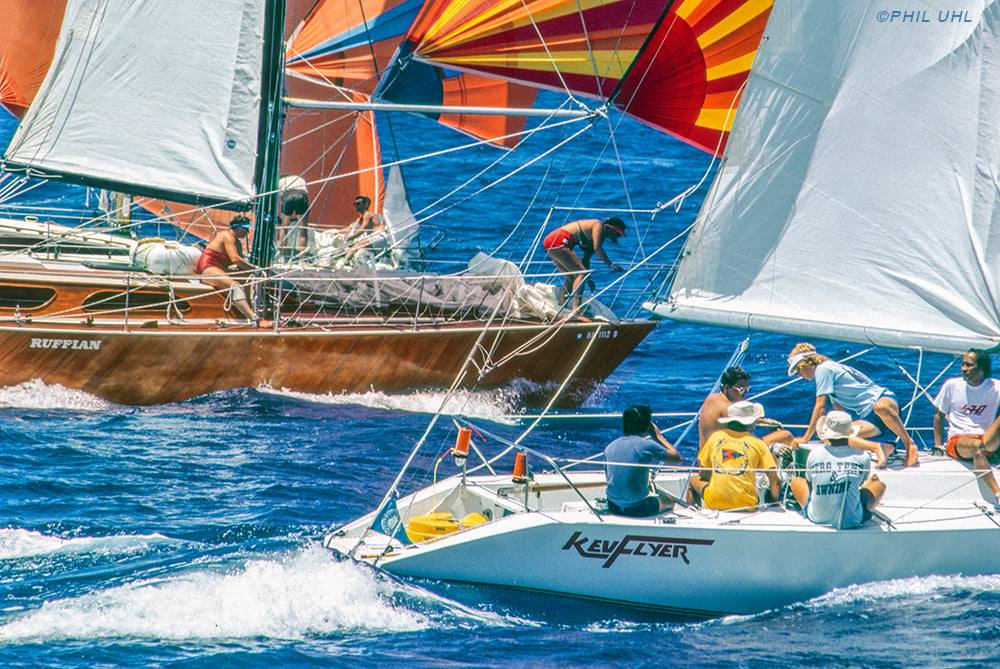
The smallest yacht in the series, the Farr-designed Kev Flyer (20.0ft IOR), seen here alongside the Wilson-designed Ruffian (30.7ft) (photo Phil Uhl)
Other yachts which topped RagamuffinShockwave and Challenge at times included Anticipation, a Lexcen 50-footer that benefitted from an age allowance (39.2ft IOR) that had been the leading yacht after three races (and was third going into the final race), and the new Farr designed 52-footer Zamazaan (41.7ft) which won Class A overall (and finished sixth overall).
Shockwave leads ex-New Zealand yacht Inca (both trailing Gerontius) during the 1980 Clipper Cup (photo Phil Uhl)

Shenandoah with Unchu to leeward and New Zealand's Brother Dominic (another Davidson design) passing Koko Head (photo Phil Uhl)
The time-on-distance system used for calculating the handicap results appeared to favour the big yachts in the regatta. Apart from taking line honours in four of the races, Windward Passage (67.7ft IOR) also posted corrected time scores of 3/1/1/2, before falling to 13th in the Round the State finale and finishing third overall, behind Shockwave

Gold Coast Express, convincing winner of Class D (photos Phil Uhl)
The performance of Gold Coast Express, another Davidson design, was also notable as she won every race in Class D on both line and corrected time. She was unique in that she had 60 owners, all members of the small Southport Yacht Club on the Gold Coast of Queensland. She was a development of Davidson's famous Half Ton champion Waverider, and rated only 27.1ft with the centreboard fixed. But despite outclassing her competition in Class D, she could not figure higher than 15th in the overall fleet in a series dominated by higher rating boats. 
Foredeck action aboard Windward Passage (photo Phil Uhl)

Japanese yacht Unchu - this photo seems to be from the fourth race (third inshore) which she won, as she looks to be ahead of many larger yachts (photo Phil Uhl)  
One exception to the big boat hegemony was the result of the the 40-foot Japanese yacht Unchu (30.3ft) which won the fourth race, the final Olympic triangle after picking a favourable windshift. Unchu was designed by Ichiro Yokoyama, who had designed Magician V, the winner of the 1978 Quarter Ton Cup held in Japan. This was the first win for a Japanese yacht in a major offshore series outside Japan.

Japanese yacht Unchu, winner of the final inshore race (photo Phil Uhl)

The increase from 1978 in the number of competing yachts in 1980 was considered a good sign that the regatta was popular with offshore sailors, and attracted another quality fleet in 1982.

The 45-foot S&S design Inca (which sailed for NZ in 1978 but was US-owned by 1980) rounds a leeward mark followed by Timber Wolf (Farr, USA), Darth Vader (Tarrabochia, NZ) and Uin na Mara III (Farr, USA)

The Farr Half Tonner Don Quixote (rating 22.7 ft), not much bigger than Kev Flyer, rounds a leeward mark (photo Phil Uhl)

Mile High, a 50-foot fractional Peterson design (rating 39.0ft) from Hong Kong, seen here off Koko Head - she went on to finish third in Class A (photo Phil Uhl)

Another Davidson design, Brother Dominic, seen here rounding a windward mark (NZ, 32.1ft IOR) (photo Phil Uhl)

The Britton Chance-designed Glory (US, 43.7ft IOR) leads Snow White II (photo Phil Uhl)
The Tarrabochia-designed Darth Vader (33.4ft IOR) from New Zealand at a gybe mark during one of the inshore races (photo Phil Uhl)

Another view of Siska on one of the downwind legs (photo Phil Uhl)

Australia's Impetuous (Holland 42) leads Canada's Kanata (photo Phil Uhl)

Ragamuffin completing a gybe while rounding a wing mark (photo Phil Uhl)

The Australian yacht Mary Muffin, a Frers 47-footer (photo Phil Uhl)
Mile High, a Peterson designed 50-footer sailing for Hong Kong (39.0ft IOR), finished third in Class A, behind Zamazaan and Anticipation (photo Phil Uhl)
An aerial view of Snow White II on a downwind run (photo Phil Uhl)
Snow White II seen here alongside Ruffian, with the Farr 36 Country Boy (29.0ft) and Gold Coast Express in the background, during a pre-regatta race (photo Phil Uhl)


Article updated May 2026

18 December 2017

Checkmate (Peterson 50)

Checkmate is a 50 foot Doug Peterson design (Design #61, with input from Design Associates Bill Tripp and Bill Hardin) for US yachtsman Monte Livingston, and which was launched in April 1978. She was notable for her varnished topsides that showed off a Meranti veneer over her Cedar plank construction (and her glossy finish remains to this day). Checkmate was lighter and featured wider stern sections than typical Peterson designs of the time, and was aimed at doing well in the light air downwind races to Mexico on the US West Coast. These characteristics contributed to a reasonably high rating for a 50-footer of 42.6ft IOR. 
Checkmate on launching day, 7 April 1978 (photo courtesy Doug Peterson Collection)
Profile, sail plan and interior arrangement drawing of Checkmate
Checkmate on her launching day, 7 April 1978 (photo courtesy Doug Peterson Collection)
Checkmate raced in the inaugural 1978 Clipper Cup where she finished a very creditable 7th place in the 39-boat fleet. She went on to establish an outright elapsed time record in the La Paz Race in 1979 (where she also finished second overall and first in Class A), and held this record for about 20 years.
Checkmate sailing off Molokai in 1978, before that year's Clipper Cup (photo Phil Uhl)
Checkmate during the Laihana Sauza Cup in Maui, possibly before the 1978 Clipper Cup (photo Phil Uhl)
Checkmate seen here during the 1980 Lahaina Sauza Cup (photo Phil Uhl)

Checkmate seen here during the 1981 Big Boat Series in San Francisco, with Zamazaan to leeward (photo Phil Uhl)
The original Checkmate is sometimes confused with the Peterson 55 Bullfrog, which she campaigned alongside in the 1982 Clipper Cup, where Checkmate managed a podium position in Class B (third) after Bullfrog broke her forestay while leading overall and in class (finishing fourth in Class B). She later raced in the 1982 Big Boat Series, where she finished second in Class B with results of 4/2/3/2/2, behind class winner Bullfrog.
Checkmate seen here tacking out of Hanauma Bay followed by Great Fun and Jumpin' Jack Flash (photo Phil Uhl)

Checkmate, seen here during the 1982 Big Boat Series (photo Phil Uhl)
Checkmate leads Zamazaan and Great Fun during the 1982 Big Boat Series in San Francisco (Yachting magazine cover, photo J Eisberg, Doug Peterson Tribute page)
Bullfrog was later taken over by Livingston and his Checkmate team, and was renamed accordingly. This later Checkmate sailed with great success in the 1984 Clipper Cup, finishing fourth overall (1/1/3/1/15) and was a member of the winning USA White team, alongside Tomahawk and Camouflage.
Checkmate and the Farr-designed Sangvind running downwind in San Francisco, likely during either the 1982 or 1983 Big Boat Series (Doug Peterson Tribute page)
Checkmate seen here leading Jubilation on San Francisco Harbour, likely during the 1986 Big Boat Series (photo Phil Uhl)
It was expected that the original Checkmate would sail in the 2017 Rolex Sydney-Hobart Yacht Race as Checkmate of Hollywood, but unfortunately the boat wasn't quite ready on time. The yacht profile from the Sydney-Hobart 2017 website provides some detail on the boat and her crew for the race:

"A change of pace for Ray ‘Hollywood’ Roberts who has chartered the 40 year-old IOR Doug
Peterson designed Checkmate, built in San Diego by the famous Carl Eichenlaub, but updated in 2000 to make her a fast, comfortable boat. Roberts sailed Hollywood Boulevard, his Farr 55, to 36th overall for fifth in Division 1 in the Sydney Hobart last year, then placed fourth overall in the Brisbane Gladstone Race.... Roberts says Checkmate is a special (yacht), one of the last cold-moulded wooden boats. "It’s a showpiece and with her age allowance, we could be half a chance.”

Checkmate sailing upwind (above and below) after a recent restoration and while still based in the US
While Checkmate wasn't ready for the Sydney-Hobart, she made the startline for the 360nm Pittwater to Paradise Race (from north Sydney to the Gold Coast), and now featured a small cabin top (rear of the mast). Crew member Michael Spies reported that, with some good yardsticks in the fleet, including the Australian IRC champion Nine Dragons, it provided the perfect race to see where the boat was at performance-wise. Checkmate was fitted with a complete new sail inventory including main, J1, J2, J5, S2, S4, staysails and even a blooper. Headsails were intentionally built smaller to reduce the IRC rating (to 1.113). The bottom was completely re-done and the foils faired and optimised. 
Checkmate after a recent restoration and while still based in the US
All the work paid off, and Checkmate won all the handicap prizes (IRC, ORCi and PHRF), and finished fifth on line (in the 17 boat fleet). Spies commented afterwards that "It was our first Australian race, after the disappointment of missing the Hobart. We backed ourselves. The competition wasn’t soft. Nine Dragons is an Australian champion. It wasn’t ideal conditions for our boat, but the boat lived up to our expectations – more than! Having run grand prix boats for 30 years, with a world champion crew, a mix of youth and experience, Checkmate was vastly different. It’s a 40 year-old timber boat, not carbon fibre. She’s a lot harder to steer, but more forgiving in motion, not as hard on the body. It was nice to have a hot meal and good sleep. We actually had an oven! It just proves the IRC rule is doing its job". 
Checkmate of Hollywood on her way to overall honours in the 2017 Pittwater to Paradise Race (photo Sailworld/Howard Wright IMAGE Professional Photography)
Spies added "Full credit to Ray Roberts and his enthusiasm for Checkmate and supporting this event. He had a vision and supported getting this boat back to Australia. For the crew, it was different, we worked hard without breaking the boat, learning about it on the way. There’s a lot of depth of talent and we prepared well for Hobart with new sails, which were flying for the first time in the P2P.”
Checkmate, possibly at one of the ports during the 2017 Pittwatr to Paradise race

Regatta information and results here.

Checkmate, in Sydney Harbour 2025 (photo Vicsail)
As of April 2025, Checkmate was for sale and languishing somewhat on a mooring off Gladesville Bridge in Sydney Harbour.


Article updated October 2025