Showing posts with label SORC 1984. Show all posts

10 June 2025

The Shadow (Soverel 55)

The Shadow was a 55-foot Mark Soverel design, commissioned and owned by Richard Rogers, who was based in California and a newcomer to ocean racing. The Shadow was of the same era as Soverel’s smaller 43-foot design Locura and in general design terms she had some similar characteristics, featuring a broad stern and notable ‘S’-curve in her hull profile that minimised hull depth around the After Girth Station, to offset width in this area and reduce the likely after girth penalty measurement that she would have incurred. She also had a proportionally generous sail plan, set on a 15/16th fractional rig, and carried a reasonably high rating of 47.0ft. According to a Sports Illustrated article at the time, the yacht was named after a pulp magazine hero and 1930s-40s radio detective – she had a small tender named Margot Lane (The Shadow’s girlfriend), and the crew played tapes of The Shadow’s eerie laughter when coming in to dock.
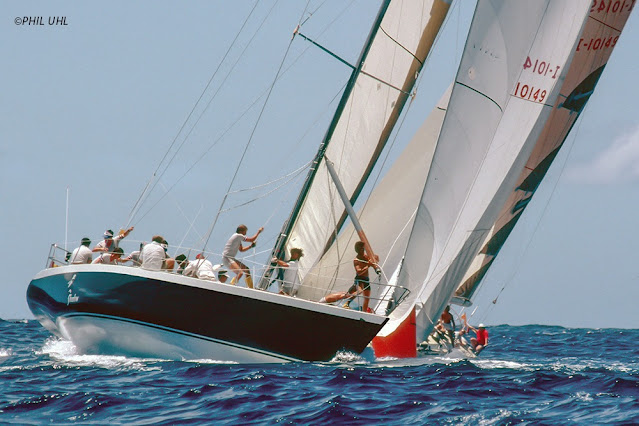
The Shadow rounding a mark during the 1984 Clipper Cup, with the Farr 58-footer Orlanda close behind (photo Phil Uhl)
The Shadow was launched in September 1983, just two weeks before the St Francis Yacht Club’s Big Boat Series of that year. She raced in the City of San Francisco Perpetual Class Trophy division, where she finished second to the Peterson 55 Bullfrog, with placings of 3/3/3/1/1.
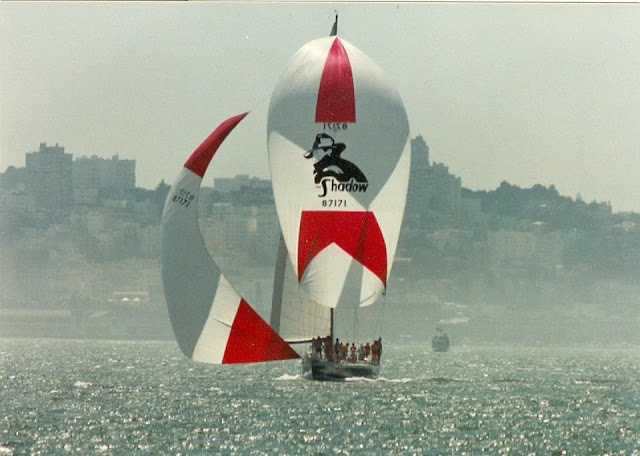
The Shadow, seen here during the 1983 Big Boat Series (photo John Hooker)
With that strong start she went on to race in the 1984 SORC, by now with a much more optimised rating of 45.8ft. Rogers had hoped that The Shadow would be able to compete in Class B in the SORC, but then Running Tide, a 12-year-old 60-footer with an age allowance that gave her a slightly lower rating than The Shadow's, also arrived. Running Tide's owner, Al Van Metre, asked to compete, as he had before, in Class A with the 70- and 80-foot Maxis. Race officials deferred to his wishes and so moved the similarly-rated The Shadow up, too.
The Shadow ghosts along in light airs (photographer unknown)
With her favorable time allowance relative to the Maxis and weather conditions that benefited smaller boats, The Shadow dominated the results in Class A, finishing first on corrected time in five of the six races and taking overall class honours. She was a less impressive in the overall fleet results, placing 26th, but the top placings were dominated that year by yachts in the smaller divisions, and in particular the crack One Tonners in Class E (such as the German yacht Diva, the top boat in the 1983 Admiral’s Cup).

"The maxis were intensely disappointed that we were in (Class) A", said Rogers in his interview with Sports Illustrated at the time, "and I agree with them. I think they should have their own class. I think it would've been more fair and more fun. It's hard to race a business against a boat like The Shadow".
The Shadow in or about 1984 (photographer unknown)
"The business" Rogers referred to is that of maxi management. Running a Maxi yacht, with a crew of more than 22, with an elaborate shore-support system, a tender, a sail program, and much much more, and moving them from regatta to regatta around the world (because that's where the maxis race, everywhere) is a demanding business. The most visible of the Maxi owners was Jim Kilroy, the owner and campaigner of not one but two dominating maxi yachts— Kialoa IV, which finished second to The Shadow in Class A, and his older Kialoa III which was being readied to compete at Antigua Race Week.

Kilroy, too, didn't think The Shadow should have raced in Class A, but his complaint, like Rogers', was with the race officials. "A 23-foot racing spread is a lot for one class", was all he would say publicly, but as spokesman for the Maxi owners, the men who spend the most on the sport, he had much to say behind closed doors to the SORC officials. Not unreasonably, the Maxi owners felt that if they go to the trouble of showing up for an event, lending it glamour, prestige and publicity it wouldn't otherwise have, they should be treated with greater consideration.
The wide and powerful stern sections of The Shadow are visible here in this image from the 1984 Clipper Cup 
It is likely that The Shadow would have done pretty well in Class B. Her wide stern sections, which Rogers calls 'Soverel training wheels' because they prevent the boat from heeling excessively, ran counter to the current thinking in new boats, most of which have moderately tapered sterns. "I wouldn't call Soverel a radical departure, but he's certainly different", says Rogers. Because she resists heeling, The Shadow was never reefed in the whole of the SORC series. Her greatest sail reduction was during the big winds of the St. Petersburg to Fort Lauderdale race, and that was to change down to a No. 3 jib. "If The Shadow had had a masthead rig, I would have had to shift down to the #2 genoa as the wind came up", Soverel explained. "But with a fractional rig like this one, you have the flexibility to power the mainsail up or down. With a fixed foretriangle area you have no flexibility. You've got to change your headsails”. The power inherent in The Shadow's length and overall stability resulted in the reported need for extensions to be welded to her winch handles to ensure enough runner tension could be applied to her lofty rig.
The Shadow sets off on a reaching leg during the 1984 Clipper Cup with Swiftsure to the right (photo Yachting magazine)
The Shadow then went on to compete in the 1984 Clipper Cup in Hawaii. At this regatta she raced in Class B, with a slightly increased rating of 46.2ft, alongside such yachts as the Frers 51 Tomahawk (ex-Margaret Rintoull III), the Peterson 55 Checkmate (ex-Bullfrog), the Farr 58 Orlanda and the Frers 50 Carat (ex-Retaliation). She ended up a surprise winner of this class, with results of 4/4/4/6/1. Although she had a very capable crew, she was out-performed by Checkmate and Tomahawk in the first four races.
The Shadow leads (just) Checkmate in power reaching conditions during the 1984 Clipper Cup (photo Charles P. LeMieux III | Yacht Racing & Cruising magazine)
Adequate righting moment in the typically breezy conditions had proved to be an essential ingredient for the top boats in the fleet, as witnessed by the performance of Checkmate and Tomahawk, which were two of the stiffest boats there. Soverel said later that The Shadow was ballasted to give a minimum Centre of Gravity Factor (0.968), to minimise her rating, which in hindsight proved to a mistake.
Breezy conditions during the 1984 Clipper Cup put a premium on crew-work, here the foredeck crew prepare for a gybe aboard The Shadow (Bruce C. Brown | Yacht Racing & Cruising magazine)
However, in the final race, the Round the State, points were heavily weighted (three times that of the Olympic tracks). During that race, Soverel noted that they started to feel disturbed wind as far as 200 miles out from the Big Island, possibly from other smaller islands up to windward. Later the wind really started to act strangely, “The Shadow would be doing a steady eight knots, just about on the wind, in a nice 20-22 knot trade wind, when suddenly, boom, we’d run into a light spot – maybe 8-10 knots of wind – that would last five or ten minutes, then we’d be back in the breeze. That happened a few times, then we hit a big hole and the breeze went from NNW into the south, so we tacked over onto the starboard tack layline. From here, maybe 60 miles out from the island, the air was light and fluky – sometimes we used a spinnaker – all the way to South Point. Once around the point it turned back into another nice race. The trades just collapse on the back sides of those islands. You get all kinds of different things – thermals, back-eddies and so on”.
The Shadow, seen here leading Checkmate and Jubilation during the 1984 Big Boat Series (photo Sharon Green | Ultimate Sailing)
While Soverel and his team managed to keep The Shadow to the fore in the tricky breezes, Checkmate’s long beat out to South Point knocked her out of the running, opening the door for The Shadow to earn class honours for the race and, by a single point over Tomahawk, for the series. She also finished fifth in the overall fleet standings (with placings of 11/10/14/8/7). The Shadow also formed part of the New York YC team, alongside Nirvana and Artemis, which beat the Royal Akarana YC team from New Zealand (Anticipation, Exador and Shockwave) in the club teams competition.
The Shadow (on port) in a close race with Orlanda during the 1984 Big Boat Series (photo L Gee | Facebook)
The Shadow then returned to San Franciso for the 1984 Big Boat Series, where Tomahawk managed to prevail for Class B honours, with The Shadow finishing second. She competed again in 1985, but did not feature in the top places.
The Shadow races alongside Checkmate during the 1985 Big Boat Series (photographer unknown)
Her racing career after that is not known, and she didn’t compete in the large Class B fleet that assembled for the 1985 SORC, and did not compete in the 1986 Clipper Cup. However, she has been sighted more recently in Greece, and is understood to be in good sailing condition.
The Shadow, as seen in Lefkas, Greece in 2023 (photo Bohumil Kafka | Facebook)
   

Article dated June 2025

28 March 2024

Razzle Dazzle (Irwin 42)

This article is about two of the 42-foot Razzle Dazzle yachts designed by Ted Irwin. The first competed in the 1983 and 1984 SORC regattas. The second was built to make her debut for the 1985 edition. An earlier Razzle Dazzle had sailed well in the 1982 SORC and the design became the basis of the Irwin 41.

Razzle Dazzle sails downwind during the 1984 SORC (photo Larry Moran)
The original Razzle Dazzle was considered to be one of the fastest yachts upwind and close-reaching in a breeze in the 1983 and 1984 editions of the SORC, but didn't manage to finish all the races it started. In 1983 she was forced to retire from two races and couldn't start in a third, finishing ninth in Class E (with race results of 3/DNF/DNS/2/DNF/1) and 53rd overall. In 1984 she finished five of the six races and sixth in Class E (1/DNF/3/5/8/1) and 16th overall. Over that period she twice won the Nassau Cup in the Bahamas and not only topped her class but was the overall winner in the 1984 St Petersburg - Boca Grande race. 

Razzle Dazzle in hard running conditions during the St Petersburg to Ft Lauderdale race during the 1984 SORC (photo Larry Moran)

For 1985 Irwin did not come out with an exact twin of the earlier Razzle Dazzle, as the new boat featured a centreboard instead of a keel. While such appendages became popular for a brief and controversial period in offshore racing in the late 1970s, it was a radical departure from the norm by the mid-1980s. Irwin nevertheless considered that the centreboard would be an advantage in SORC conditions. The board was on the small side (as was the previous Razzle Dazzle's keel), but nevertheless weighed over 5,000lbs, with an elliptical trailing edge. The board was lifted hydraulically about three feet into the hull, and was fitted with a gasket to reduce turbulence around the trunk.

Razzle Dazzle performs a spectacular wipe-out during the 1984 SORC as captured by Guy Gurney
The centreboard's retractability gave a considerable reduction in wetted surface area off the wind, as recognised by the IOR and leading to a 0.3ft rating penalty. As the boat featured a high sail area/wetted surface area ratio already, removing half the foil area suggested the potential for good speeds in light airs downwind. 
The centreboard trunk and hydraulic mechanism of Razzle Dazzle in photo 1 (left) and her complex genoa car set-up in photo 2 (Yachting magazine) 

Razzle Dazzle leads the Italian yacht Almagores in light airs during the 1985 SORC (photo Paul Mello)

Apart from this notable feature, Irwin was focused on retaining the phenomenal ability of the original Razzle Dazzle to go fast to windward in a breeze, and her other distinguishing feature was a chine running along her stern counter. With similar livery and the same sail number as her predecessor (which had since been sold to a New England yachtsman and re-named Mohuaki) it could be a little difficult to outwardly tell the difference between the two boats, although the open transom of the new boat did help in this regard. She was also designed to be eligible for the US trials series for the 1985 Admiral's Cup, and her 31.7ft rating (for the 1985 SORC) fell easily within the 33.5ft upper limit that organisers had set for the team. 

Razzle Dazzle rounds a windward mark in close company with Lobo during the 1985 SORC (photo Sharon Green | Ultimate Sailing)
Compared to other similar-sized entries in the Class 4 division of the SORC in 1985 (e.g., Snake Oil, Sidewinder and Scarlett O'Hara), the new Razzle Dazzle was smaller in absolute terms (shorter and lighter) but had the highest displacement/length ratio, and the smallest sail area/displacement ratio. Similar to the earlier boat, Razzle Dazzle had a large proportion of her total displacement as internal ballast, which was expected to reduce pitching moment and improve her performance in a seaway. However, she was also noted to have the widest beam of her group, which provides a rating advantage but can also be a handicap in wavy conditions. 

Razzle Dazzle follows High Roler and Sleeper during the 1985 SORC (photo Sharon Green | Ultimate Sailing)

In the end, however, Razzle Dazzle was only able to manage eighth in the 21-boat fleet in Class 4, with placings of 6/12/11/10/7/17, and 37th overall, in the 1985 SORC. She went on to compete later that year in the US Admiral's Cup trials (presumably with some alterations designed to increase her speed as her rating had increased for that regatta to 32.0ft), but was not successful. 
Razzle Dazzle during the 1985 SORC (photo Paul Mello)

Razzle Dazzle rounds a weather mark during the 1985 Brenton Reef US Admiral's Cup trials (photo Phil Uhl)

Razzle Dazzle with a twisted spinnaker during the 1985 Brenton Reef series (photo Facebook)
A recent photograph (date unknown) shows that the yacht has since been laid up and looks somewhat forlorn.


Article dated March 2024

12 February 2022

Lady Be (Frers 45)

Lady Be was the first of the production Beneteau 456, after Beneteau decided they needed a fast offshore yacht in their production range. She was designed by German Frers and, although supposedly a production yacht, the hull was constructed in Kevlar and carbon-fibre/foam sandwich with a stripped out interior. She was 13.8m (45.3ft) long, with a beam of 4.2m and displacement of 9,225kg, and carried a rating of 35.4ft.

Lady Be in hard reaching conditions (photo Facebook)
Eric Duchemin was recruited by Beneteau to campaign Lady Be for the French Admiral's Cup trials and just failed to gain a place. However, she came under the eye of Peter Blake, who was looking for a yacht to charter for the hastily prepared New Zealand Admiral's Cup team where she would join Neville Crichton's Frers 43 Shockwave. Crichton had initially planned his boat for a New Zealand team, but when no other boats came forth for selection, he campaigned Shockwave in the Australian trials. Despite her dominance of that series, however, Shockwave was not selected and Crichton found himself with a hot boat in need of team-mates. He managed to goad the New Zealand sailing fraternity into action, and Ian Gibbs joined the fray by chartering Swuzzlebubble IV, the former Epiglass New Zealand (Wee Willie Winkie), a Holland 40 and near sistership to his earlier Swuzzlebubble III which was top individual yacht in the 1981 Admiral's Cup.
Lady Be rounds a windward mark during the second race of the 1983 Admiral's Cup, just ahead of US yacht Locura

Blake thought that Lady Be could be made competitive for the Admiral's Cup, particularly if Duchemin stayed on, and chartered the French yacht. Following an unremarkable 16th place in the first race of the series (where Shockwave finished last after incurring a 23 place penalty), Blake proved his point in the second race when, in a reasonable breeze in the Solent, Shockwave and Lady Be had a great race together to finish third and fourth respectively. That was as good as it got however, as lighter winds in the two ocean races put the bigger boats like them out of the running. The Channel Race was a small boat benefit, and Lady Be finished in 41st place, with Shockwave not much better in 32nd. In better conditions in the fourth race, Lady Be finished 17th and then 16th in the Fastnet race finale, to finish as 19th yacht overall, with the New Zealand team taking sixth place.

Lady Be seen here during the 1983 Admiral's Cup, trying to outrun the smaller yacht Almagores (Peterson 43), which finished second on individual points and was part of the second placed Italian team (photo Phil Uhl)

Lady Be powers upwind under full main and no.3 genoa (photo Facebook)
Lady Be to windward to team-mate Shockwave at the start of the second race in the 1983 Admiral's Cup (photo Johnathan Eastland | Ajax)
Lady Be leads Scarlett O'Hara downwind during the second race of the 1983 Admiral's Cup (photo Alan Sefton | NZ Yachting)
The following sequence of photos are of Lady Be taken by Larry Moran on the long downwind leg of the St Petersburg to Ft Lauderdale race during the 1984 SORC. Lady Be was sailed by Francois Chalain and finished in 3rd place in Class C (and 14th overall) with division placings of 8/2/2/1/9/8.
Lady Be during the St Petersburg to Ft Lauderdale race during the 1984 SORC (photo Larry Moran)

Lady Be on her way to second place in the St Petersburg to Ft Lauderdale race (photo Larry Moran)
Lady Be with Bravura and Secret Love (overall winner of Class C) following (photo Larry Moran)
Lady Be with Bravura and Secret Love following, and Invictus out to the left (photo Larry Moran)

Lady Be with Bravura and Secret Love following (photo Larry Moran)

Another photo of Lady Be during the 1984 SORC, this time by Guy Gurney
It is understood that Lady Be was sold to Russell Hoyt in Newport, R.I. and renamed Destination where she was actively raced on the US east coast. In 2009 she took part in the ARC 2009 race under the ownership of Jurgen Dobbelaer and with her original name of Lady Be. Unfortunately she had to abandon the race due to leaks in the rudder post. She was transported to Muiden in the Netherlands in 2010 and is in service as a charter yacht for day trips on the IJsselmeer (as of 2016).

Article updated July 2024

10 January 2014

Infinity (Holland 47)

This post features a selection of photographs of the Ron Holland-designed 47-footer Infinity, taken by Phil Uhl and Larry Moran (and some others) during the 1981, 1983 and 1984 SORC. Infinity was commissioned and owned by US yachtsman John B Thomson Jr, and was in some ways a standard design approach for Holland, with a reasonably high freeboard, masthead rig, medium displacement and a flush deck, which was not dissimilar to many of her competitors during that era. She featured a straighter transom than Holland's previous designs which arguably gave the yacht a more elegant appearance than some of his earlier boats that had a pronounced curve in the transom profile. She had a rating of 36.2ft IOR for the 1983 SORC, which was reduced slightly for the 1984 series to 36.1ft.

Infinity finished 10th in Class B in the 1981 SORC series (after placings of 6/7/10/11/14/13). She was fourth in Class B in the 1983 series (after placings of 6/7/1/5/1/3), behind a trio of Frers 51 yachts Carat, Bla Carat and Zero, and finished 33rd overall. In 1984 she came up against the likes of the Frers 50s Morning Star and Retaliation, and the Peterson design Artemis in Class B, and finished eighth, and was 42nd overall. 

A photo of Infinity in a nice upwind mode during the 1981 SORC (photo Guy Gurney | Facebook)

Infinity competing in the 1981 SORC (photo Phil Uhl)
Another photo from the 1981 SORC, with Infinity to leeward of Canadian yacht Amazing Grace (photo Phil Uhl)

Infinity powers upwind during the 1983 SORC (photo Larry Moran)


Infinity and Ichiban cross tacks during the 1984 SORC (photo Larry Moran)
Infinity at the Truman Annex after the Ft Lauderdale to Key West race in early 1982, with Aries alongside (left), and Locura and Rolling Time (right) (photographer unknown)


Infinity goes into a death roll (photographer unknown)

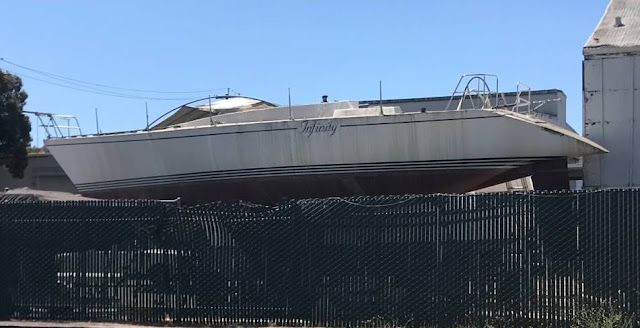
Infinity in somewhat dilapidated condition as of June 2021, as sighted in Richmond USA (photo Facebook)


Article updated March 2025

13 January 2013

Locura (Soverel 43)

The previous post on Swuzzlebubble IV featured a photo of her crossing behind the US yacht Locura, commissioned from designer Mark Soverel by George de Guardiola. This was a yacht that I found quite an interesting design at the time of her launching in 1983. At 42ft 10in, or 13m, she was an extension of a smaller 39ft design that Soverel and de Guardiola had campaigned successfully in the 1981 SORC. Locura rated 33.7ft IOR, and was lighter (about 1,500 pounds, or 680kg), shorter (about 1.5ft, or .45m) than other yachts of a similar rating. 

The 13ft (4m) beam was carried well aft, although to maintain a competitive rating this width had to be offset with a significant bustle to reduce the after girth station penalty. Locura also carried about 10% more sail for her rating, and this was set on a tapered three-spreader Sparcraft masthead rig, with a large main and narrow and tall foretriangle. This arrangement mandated narrow spinnakers, which were something of a drawback in light running conditions. The yacht was constructed with skins of E-glass with a Klegecell core capped with carbon fibre.


Locura sails downwind during the 1983 SORC (photo Larry Moran)
Winning the SORC was a priority for the yacht, and so she was designed to excel on reaching and running legs in the medium to heavy air that prevails in that regatta. For an IOR yacht of the 1983 era she was considered to be easily driven (due to her narrow entry), and powerful (due to her wide aft sections) with a weight and shape that would let her surf early and often. Her stern sections were also felt to dampen pitching, add form stability and increase the contribution of the crew to her righting moment.
Locura during early sailing trials 1983 (photo Sail magazine)
Locura proved to be strong performer and qualified for the 1983 US Admiral's Cup team after winning Class D - she was also in line to win the regatta overall but was edged out by the Peterson 43 Scarlett O'Hara in the last race. The two boats were similar in rated dimensions, with Locura being only slightly longer, wider and heavier, and sailed with a rating approximately half a foot higher.
Above and below - Locura during the 1983 SORC (photo Seahorse (above), Yachting World (below))

Locura seen here in hard reaching conditions during the 1983 SORC (photo Robert D. Hagan)
Locura seen here during the 1983 SORC, leading Thunderbolt (US-31666), Mea Culpa and Bright Finish (US-31177) around a leeward mark (photo Phil Uhl)
For the Admiral's Cup Locura was skippered by Soverel and Ted Turner was enticed out of retirement to join the yacht as tactician. The size and moding of Locura was not well suited to the light conditions that prevailed in the 1983 series, but the US proved a point on the second race when Scarlett O'Hara and Locura finished first and second respectively, and the team were the top performers of the day. The US team finished third overall, with Locura at 20th in the individual standings with placings of 13/2/36/20/22.
Locura approaching a windward mark during the 1983 Admiral's Cup, with pole set ready for the spinnaker hoist and the lower-rated Australia's Bondi Tram just to windward - this is likely during the first race when Bondi Tram had her best race, finishing 8th and Locura in 13th (photo Phil Uhl)

Locura with an army of crew stacked in the aft deck sailing downwind during the 1983 Admiral's Cup
Locura was renamed Dawn Patrol by the time of the 1984 SORC, after her new owner the Dawn Patrol Syndicate.  She finished sixth in Class C, and 33rd overall. Changes to the IOR around this time sought to check the reliance of yachts such as Locura on crew weight - she had been sailed with as many as 15 such was her sensitivity to crew weight. Off the wind in light air, four of the crew would troop forward to the forestay to lift her full after sections. The new rule limited crew to the formula 0.3R - 4, giving Locura a maximum number of ten.
A close-up view of Locura by Guy Gurney during the 1983 Admiral's Cup
The yacht was later renamed Barrister III and painted red. She continued to enjoy success at various regattas around the east coast. However, in early 1999 Barrister III fell off its cradle and onto her side, breaking stringers and puncturing the hull. She was later sold to a French yachtsman who sailed her from Maine to Bordeaux.
Dawn Patrol ploughs into a wave during the 1984 SORC (photo Larry Moran)
Dawn Patrol (above and below) during the 1984 SORC (photos Larry Moran)

Locura with a new colour scheme and featuring a truss boom, Block Island Race Week in 1991 (Facebook)

Barrister III (ex-Locura) in a forlorn state, 1999
Barrister III more recently, sailing in France
More recent photographs of Locura can be seen here.

A feature on another interesting Soverel design of the same era, the 55-foot The Shadow, can be seen here.


Article updated June 2025