Showing posts with label Kialoa III. Show all posts

10 June 2025

The Shadow (Soverel 55)

The Shadow was a 55-foot Mark Soverel design, commissioned and owned by Richard Rogers, who was based in California and a newcomer to ocean racing. The Shadow was of the same era as Soverel’s smaller 43-foot design Locura and in general design terms she had some similar characteristics, featuring a broad stern and notable ‘S’-curve in her hull profile that minimised hull depth around the After Girth Station, to offset width in this area and reduce the likely after girth penalty measurement that she would have incurred. She also had a proportionally generous sail plan, set on a 15/16th fractional rig, and carried a reasonably high rating of 47.0ft. According to a Sports Illustrated article at the time, the yacht was named after a pulp magazine hero and 1930s-40s radio detective – she had a small tender named Margot Lane (The Shadow’s girlfriend), and the crew played tapes of The Shadow’s eerie laughter when coming in to dock.
The Shadow rounding a mark during the 1984 Clipper Cup, with the Farr 58-footer Orlanda close behind (photo Phil Uhl)
The Shadow was launched in September 1983, just two weeks before the St Francis Yacht Club’s Big Boat Series of that year. She raced in the City of San Francisco Perpetual Class Trophy division, where she finished second to the Peterson 55 Bullfrog, with placings of 3/3/3/1/1.
The Shadow, seen here during the 1983 Big Boat Series (photo John Hooker)
With that strong start she went on to race in the 1984 SORC, by now with a much more optimised rating of 45.8ft. Rogers had hoped that The Shadow would be able to compete in Class B in the SORC, but then Running Tide, a 12-year-old 60-footer with an age allowance that gave her a slightly lower rating than The Shadow's, also arrived. Running Tide's owner, Al Van Metre, asked to compete, as he had before, in Class A with the 70- and 80-foot Maxis. Race officials deferred to his wishes and so moved the similarly-rated The Shadow up, too.
The Shadow ghosts along in light airs (photographer unknown)
With her favorable time allowance relative to the Maxis and weather conditions that benefited smaller boats, The Shadow dominated the results in Class A, finishing first on corrected time in five of the six races and taking overall class honours. She was a less impressive in the overall fleet results, placing 26th, but the top placings were dominated that year by yachts in the smaller divisions, and in particular the crack One Tonners in Class E (such as the German yacht Diva, the top boat in the 1983 Admiral’s Cup).

"The maxis were intensely disappointed that we were in (Class) A", said Rogers in his interview with Sports Illustrated at the time, "and I agree with them. I think they should have their own class. I think it would've been more fair and more fun. It's hard to race a business against a boat like The Shadow".
The Shadow in or about 1984 (photographer unknown)
"The business" Rogers referred to is that of maxi management. Running a Maxi yacht, with a crew of more than 22, with an elaborate shore-support system, a tender, a sail program, and much much more, and moving them from regatta to regatta around the world (because that's where the maxis race, everywhere) is a demanding business. The most visible of the Maxi owners was Jim Kilroy, the owner and campaigner of not one but two dominating maxi yachts— Kialoa IV, which finished second to The Shadow in Class A, and his older Kialoa III which was being readied to compete at Antigua Race Week.

Kilroy, too, didn't think The Shadow should have raced in Class A, but his complaint, like Rogers', was with the race officials. "A 23-foot racing spread is a lot for one class", was all he would say publicly, but as spokesman for the Maxi owners, the men who spend the most on the sport, he had much to say behind closed doors to the SORC officials. Not unreasonably, the Maxi owners felt that if they go to the trouble of showing up for an event, lending it glamour, prestige and publicity it wouldn't otherwise have, they should be treated with greater consideration.
The wide and powerful stern sections of The Shadow are visible here in this image from the 1984 Clipper Cup 
It is likely that The Shadow would have done pretty well in Class B. Her wide stern sections, which Rogers calls 'Soverel training wheels' because they prevent the boat from heeling excessively, ran counter to the current thinking in new boats, most of which have moderately tapered sterns. "I wouldn't call Soverel a radical departure, but he's certainly different", says Rogers. Because she resists heeling, The Shadow was never reefed in the whole of the SORC series. Her greatest sail reduction was during the big winds of the St. Petersburg to Fort Lauderdale race, and that was to change down to a No. 3 jib. "If The Shadow had had a masthead rig, I would have had to shift down to the #2 genoa as the wind came up", Soverel explained. "But with a fractional rig like this one, you have the flexibility to power the mainsail up or down. With a fixed foretriangle area you have no flexibility. You've got to change your headsails”. The power inherent in The Shadow's length and overall stability resulted in the reported need for extensions to be welded to her winch handles to ensure enough runner tension could be applied to her lofty rig.
The Shadow sets off on a reaching leg during the 1984 Clipper Cup with Swiftsure to the right (photo Yachting magazine)
The Shadow then went on to compete in the 1984 Clipper Cup in Hawaii. At this regatta she raced in Class B, with a slightly increased rating of 46.2ft, alongside such yachts as the Frers 51 Tomahawk (ex-Margaret Rintoull III), the Peterson 55 Checkmate (ex-Bullfrog), the Farr 58 Orlanda and the Frers 50 Carat (ex-Retaliation). She ended up a surprise winner of this class, with results of 4/4/4/6/1. Although she had a very capable crew, she was out-performed by Checkmate and Tomahawk in the first four races.
The Shadow leads (just) Checkmate in power reaching conditions during the 1984 Clipper Cup (photo Charles P. LeMieux III | Yacht Racing & Cruising magazine)
Adequate righting moment in the typically breezy conditions had proved to be an essential ingredient for the top boats in the fleet, as witnessed by the performance of Checkmate and Tomahawk, which were two of the stiffest boats there. Soverel said later that The Shadow was ballasted to give a minimum Centre of Gravity Factor (0.968), to minimise her rating, which in hindsight proved to a mistake.
Breezy conditions during the 1984 Clipper Cup put a premium on crew-work, here the foredeck crew prepare for a gybe aboard The Shadow (Bruce C. Brown | Yacht Racing & Cruising magazine)
However, in the final race, the Round the State, points were heavily weighted (three times that of the Olympic tracks). During that race, Soverel noted that they started to feel disturbed wind as far as 200 miles out from the Big Island, possibly from other smaller islands up to windward. Later the wind really started to act strangely, “The Shadow would be doing a steady eight knots, just about on the wind, in a nice 20-22 knot trade wind, when suddenly, boom, we’d run into a light spot – maybe 8-10 knots of wind – that would last five or ten minutes, then we’d be back in the breeze. That happened a few times, then we hit a big hole and the breeze went from NNW into the south, so we tacked over onto the starboard tack layline. From here, maybe 60 miles out from the island, the air was light and fluky – sometimes we used a spinnaker – all the way to South Point. Once around the point it turned back into another nice race. The trades just collapse on the back sides of those islands. You get all kinds of different things – thermals, back-eddies and so on”.
The Shadow, seen here leading Checkmate and Jubilation during the 1984 Big Boat Series (photo Sharon Green | Ultimate Sailing)
While Soverel and his team managed to keep The Shadow to the fore in the tricky breezes, Checkmate’s long beat out to South Point knocked her out of the running, opening the door for The Shadow to earn class honours for the race and, by a single point over Tomahawk, for the series. She also finished fifth in the overall fleet standings (with placings of 11/10/14/8/7). The Shadow also formed part of the New York YC team, alongside Nirvana and Artemis, which beat the Royal Akarana YC team from New Zealand (Anticipation, Exador and Shockwave) in the club teams competition.
The Shadow (on port) in a close race with Orlanda during the 1984 Big Boat Series (photo L Gee | Facebook)
The Shadow then returned to San Franciso for the 1984 Big Boat Series, where Tomahawk managed to prevail for Class B honours, with The Shadow finishing second. She competed again in 1985, but did not feature in the top places.
The Shadow races alongside Checkmate during the 1985 Big Boat Series (photographer unknown)
Her racing career after that is not known, and she didn’t compete in the large Class B fleet that assembled for the 1985 SORC, and did not compete in the 1986 Clipper Cup. However, she has been sighted more recently in Greece, and is understood to be in good sailing condition.
The Shadow, as seen in Lefkas, Greece in 2023 (photo Bohumil Kafka | Facebook)
   

Article dated June 2025

27 May 2023

Windward Passage (Sydney 1977)


Windward Passage on a reaching leg during the 1977 Southern Cross Cup series (photo Guy Gurney)
Following on from my recent article about Windward Passage, renowned photographer Guy Gurney has published some great close-up images of this famous Maxi, while she was racing as part of the US team in the 1977 Southern Cross Cup series, and in her original ketch configuration. She had teamed up for this series with Phantom as one of the two 2-boat US teams (Kialoa III and Bravura forming the other team). 
Windward Passage on a reaching leg during the 1977 Southern Cross Cup series (photo Guy Gurney)

The series was notable for a major collision between Windward Passage and Kialoa III in the first race of the regatta, with Windward Passage hitting Kialoa III on her port quarter during a leeward mark rounding, resulting in a large hole in Kialoa III’s hull above the waterline and significant deck damage, caused by a combination of the bow and the sawing action of Windward Passage’s heavy wire bobstay. This also put Windward Passage at serious risk of losing her main mast as the bowsprit and headstay were no longer supported. Kialoa III protested Windward Passage (and won), but was unable to race again until the Sydney-Hobart finale. Windward Passage had to sit out the second race, and finished 20th in the third race.

Windward Passage on a reaching leg during the 1977 Southern Cross Cup series (photo Guy Gurney)

Above and below, Windward Passage shows her power under spinnaker and blooper as she slides past the photographer (photo Guy Gurney)


6 April 2023

Clipper Cup 1978

New Zealand's Monique, a Farr 42-footer (rating just under the Two Ton limit at 31.9ft IOR) was the top individual yacht of the inaugural 1978 Clipper Cup (photo Phil Uhl)
Forty-one yachts, representing Australia, France (Tahiti), New Zealand, Japan, Taiwan and the United States, competed in the inaugural Clipper Cup regatta held in 5-12 August 1978. The series incorporated a 100-mile race around Oahu, three 30-mile offshore Olympic Triangle courses and the 775-mile Around the State race (the latter race had been held six times since 1972).

Kialoa III with all extras set during one of the offshore races during the 1978 Clipper Cup (photo Phil Uhl)
Fortunately renowned marine photographer Phil Uhl was there to capture the action, and this article features a number of his photos from the series.
One Tonners Country Boy (left) and Magic Pudding (ex-B195) enjoy a close battle during the 1978 Clipper Cup - Magic Pudding went on to finish as third yacht overall in the individual standings, and Country Boy was 10th (photo Phil Uhl)
Leeward mark action, with New Zealand's Inca (1730) visible (photo Phil Uhl)
Adding prestige to the regatta were two of the world’s fastest Maxi yachts, Jim Kilroy’s 79-foot ketch Kialoa III and Huey Long’s 79-foot sloop Ondine. Ondine completed the Around Oahu Race in a record 13 hours and 18 minutes, edging out Kialoa by a scant six seconds, in one of the then closest boat-for-boat finishes in yacht racing history (although Ondine owed Kialoa time on handicap due to a 3.2ft difference in rating). The balance of the fleet completed the course during the night and the following morning. Taiwan’s small 30-foot Don Quixote (a Farr Half Tonner rating 21.6ft IOR), stole the show with an overall win on handicap (though team results were limited to yachts with a minimum rating of 27ft).
The Farr Half Tonner Don Quixote won the Around Oahu Race, and finished as 12th yacht overall
The New Zealand Farr-designed One Tonner Lovelace finished ninth overall and formed part of the third placed New Zealand 'B' team (photo Phil Uhl)
The next three Olympic course races held of Waikiki resulted in the finest exhibition of offshore racing ever seen in Hawaii. With blustery trade winds of 20-25 knots with a warm Hawaiian sun, competition amongst the fleet was outstanding. Particularly keen was the racing among the One Tonners, New Zealand’s Country Boy and Lovelace, Hawaii’s Carrie Ann V and Australia’s Magic Pudding (ex-B195). Australia’s Ragamuffin (Syd Fischer), a Frers 47-footer and New Zealand’s Monique (Jim Dowell), a Farr Two Tonner, each dominated their respective Class A and Class B divisions by sweeping all three Olympic events.
Syd Fischer's Ragamuffin, second yacht overall and part of the winning Australian team (photo Phil Uhl)
Big Schott, a Peterson 41 Two Tonner (rating 32.1ft), finished seventh overall and helped the Australian 'A' Team to win the King Kamehameha Trophy 
The Around the State Race presented the fleet with every sailing condition known to sailors. A light but steady breeze gave some hope that Phantom’s record set in 1977 would be bettered. On the 300-mile reach from Niihau to South Point on the Big Island, conditions varied from heavy winds to almost nothing as they approached the Point. After rounding South Point, the fleet immediately hit strong winds and began beating up the treacherous Ka’u Coast. 
The Bruce King-designed 48-foot bilgeboarder Hawkeye (part of the US 'Blue' team) carried a high 42.3ft rating and struggled upwind but nevertheless finished 14th overall (photo Phil Uhl)
Ondine with spinnaker and blooper set (photo Phil Uhl)
Finally Ondine, after battling Kialoa for nearly five days, claimed line honours off Waikiki, with Kialoa finishing three hours later. Magic Pudding had showed great speed in the light air stages, allowing her to finish six hours ahead of the next One Tonner, Carrie Ann, and was the handicap winner.
Magic Pudding sails upwind past South Point on her way to winning the Round the State Race (photo Phil Uhl)
Monique took first place overall on handicap for the series, winning the Clipper Cup, with Ragamuffin second and Magic Pudding third. Australia’s ‘A’ Team of Ragamuffin, Big Schott and Magic Pudding won the King Kamehameha Trophy for the top team. The New Zealand ‘A’ Team (Monique, Country Boy and Gerontius) were second, and New Zealand ‘B’ (Inca, Lovelace and Anticipation) were third. In the battle of the Maxis, Kialoa edged out Ondine in the overall results, finishing 17th and 18th respectively.
Big Schott in fresh upwind conditions (photo Phil Uhl)

Inca, a 45-footer rating a low 32.7ft, off the North Shore of Molokai - she finished fifth overall (photo Phil Uhl)

Hawkeye seen here to the lee of Oahu during the Round the State Race (photo Phil Uhl)

Japan's Sunbird V, a S&S 54-footer (with a low 39.0ft rating) finished 24th overall (photo Phil Uhl)

Kialoa III charges her way through some white water (photo Phil Uhl)

Another view of Hawkeye on a reaching leg (photo Phil Uhl)

Gekko V from Japan (above and below), a Frers 41-footer, finished 19th overall (photos Phil Uhl)

Another photo of Australian yacht Big Schott (photo Phil Uhl) 
Checkmate (left), which finished in seventh place overall, and Hawkeye in close proximity after a windward mark during the 1978 Clipper Cup (photo Phil Uhl)


Article updated April 2026

22 December 2022

Windward Passage (Gurney Maxi)

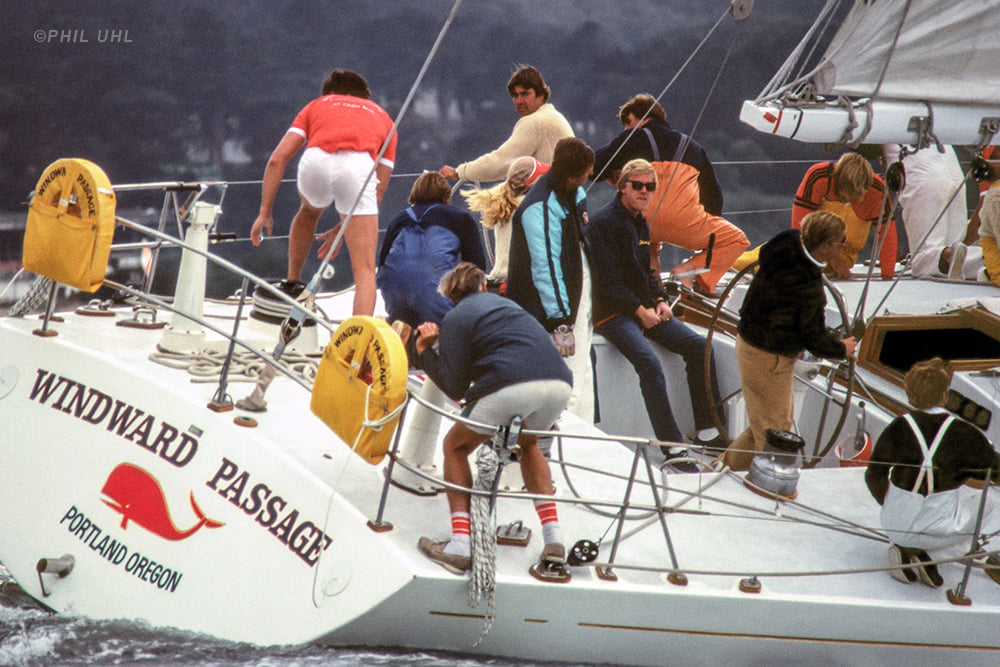
Windward Passage, seen here racing in the 1980 Clipper Cup (photo Phil Uhl | Facebook)
Windward Passage was one of the best-known Maxi yachts of the IOR period, and greatly admired for her longevity that spanned much this era, thanks to continual upgrades and the age allowance provisions of the rule. Windward Passage was designed by Alan P Gurney for Robert Johnson of the New York Yacht Club, to replace his earlier yacht Ticonderoga, and the ocean racer was built by Grand Bahama Yacht Builders. She was 72ft 9in long, just below the 73ft maximum length then imposed for the Bermuda Race, with a relatively light displacement of 80,000lb and an easily driven dinghy-like hull form, and a balanced blade rudder without a skeg – a combination that was markedly different to any other large yachts of her time. Her original configuration was that of a ketch (where the rudder was set abaft the mizzen), with the mainmast forestay set off a short bowsprit.
The original design for Windward Passage (above) and interior profile and plan arrangement (below)
Windward Passage’s unusual design reflected Gurney’s thinking at the time for a truly competitive yacht, and incorporated some unique features in her construction, utilising triple diagonal spruce planking, covered with Dynel set in epoxy resin, laid over longitudinal Douglas fir and spruce stringers and plywood structural bulkheads approximately 6ft apart, to laminated fir floor timbers, stem, keel and beams (at the time she was considered to be the second-largest spruce structure in the world, after the massive Spruce Goose airplane - she was in fact the largest such structure because the Spruce Goose incorporated a variety of other types of wood). Her plywood deck was also covered in Dynel. Passage was built under a tent in an empty lot in Freeport, Grand Bahama. The first shipment of lumber for the boat was unloaded in November 1967, and she was launched just one year later.
An early photo of Windward Passage (photo Facebook)
Within a month, and with an IOR rating of 70.9ft (replacing her original CCA rating issued in December 1968 of 76.8ft), Windward Passage had won her first race, the Miami to Palm Beach event, which she won again in 1969, and took top honours in the Miami/Nassau race, and the Transpac, setting new records for both. Johnson died in 1969 but his sons, Mark and Fritz, continued to campaign the yacht. In 1971 she broke her own Transpac record (with a time that stood until 1977 when Merlin snatched the prize). 
Windward Passage during the record-breaking Sydney-Hobart race in 1975
She competed in the 1975 Southern Cross Cup, sailing as part of the South Australian team (which finished eighth), and enjoyed an epic battle with Kialoa III in that year’s Sydney to Hobart race. An early easterly gave way to hard running north-easterly conditions, with all of the fleet clocking high mileages. Passage and Kialoa were within sight of each other all the way to the finish, with Kialoa taking line honours in a new record time of 2 days 14 hours and 36 minutes (nearly 11 hours faster than the previous record set in 1973 by the 73-footer Helsal, with Passage just 23 minutes behind, although both boats finished well down in the fleet on corrected time). A video of this race can be seen in the Kialoa link above.
Windward Passage crosses Kialoa III in San Francisco, date unknown (photo Facebook)
Windward Passage then joined Kialoa III and others in the 1976 Hobart-Auckland race, with Kialoa setting another record time (just over seven days) and beating Passage by nearly three hours. Following her regular beatings by Kialoa, Fritz Johnson added 20ft to both of Passage’s masts, and although this boosted her rating to 72.6ft, she re-emerged as a winner in the 1977 Big Boat Series.
Windward Passage surges towards the finish line of the 1977 Transpac Race (photo Phil Uhl | Facebook)
Later, Windward Passage travelled back to Australia for the 1977 Southern Cross Cup, teaming up with Phantom for one of the two 2-boat US teams (with Kialoa III joining Bravura). This series was notable for a major collision between the two maxis in the first race of the regatta, with Passage hitting Kialoa on her port quarter during a leeward mark rounding, resulting in a large hole in Kialoa’s hull above the waterline and significant deck damage, caused by a combination of the bow and the sawing action of Passage’s heavy wire bobstay. This also put Passage at serious risk of losing her main mast as the bowsprit and headstay were no longer supported. Kialoa protested Passage (and won), but was unable to race again until the Sydney-Hobart finale. Passage had to sit out the second race, and finished 20th in the third race.
Windward Passage racing in Sydney in the 1977 Southern Cross Cup (photo Guy Gurney)
The Sydney-Hobart race that year was a storm-tossed affair that resulted in a heavy retirement rate and a subsequent inquiry by the event organiser, the Cruising Yacht Club of Australia. The wind abated at the end of the race for much of the fleet, but Kialoa III and Windward Passage made it across the finish before the breeze really dropped out, with Kialoa taking out a corrected time victory and Passage taking third (behind Australia’s Ragamuffin).
The conversion of Windward Passage to a sloop in 1978
Kilroy made further changes to Kialoa III on his return trip to the US via Auckland, with significant underbody modifications, and this was the trigger for Windward Passage to be re-rigged as a sloop and fitted with a new keel before the 1978 Big Boat Series.
Windward Passage after conversion to a sloop (photo Facebook)
Windward Passage, now with a lower rating of 67.7ft, contested the 1980 Clipper Cup, with the Maxis dominating overall results in the first three races, with Mistress Quickly winning opening Around Oahu race and Passage taking line and handicap honours in the first two Olympic triangles. Going into the final race, the Round the State, Passage had a clear lead on individual points, but despite taking line honours in the series finale ended up as third yacht overall (and first Maxi) after Ragamuffin and Shockwave sailed strongly to put enough lower rated boats between them and Passage. 
Above and below, Windward Passage during the 1980 Clipper Cup (photos by Guy Gurney)

Above and below, Windward Passage during the 1980 Clipper Cup (photos by Phil Uhl | Facebook)
Windward Passage seen here during the 1980 Big Boat Series (photo Phil Uhl | Facebook)
An aerial view of Windward Passage by Guy Gurney during the 1981 SORC
Bill Johnson of Atlanta (no relation) bought Windward Passage in the early 1980s, describing it as a “once-in-a-lifetime boat”. He commissioned Doug Peterson, with the assistance of Gurney, to redesign the underbody with a new keel and a titanium rudder and installed a lot of new gear, from the engine to winches and navigation, and a new 110ft-tall mast. These changes increased her rating to 68.3ft but also her competitiveness, and she went on to win her class at the 1982 SORC. 
Windward Passage in action (above and below) during the 1982 SORC (photos by Guy Gurney | Facebook)

Condor of Bermuda and Windward Passage in close windward mark action during the 1982 Clipper Cup (photo Phil Uhl | Facebook)
Windward Passage runs downwind during the 1982 Clipper Cup with her spinnaker and blooper in perfect trim (photo Phil Uhl)
Later that year she joined eight other Maxis for the 1982 Clipper Cup, including Kialoa IV, Condor and Condor of Bermuda. The series was affected by stronger than usual winds, but Passage took it in her stride, surfing past Condor and Kialoa on the downwind blast on the return leg to Molokai, taking line honours in a record setting 15 hours 33 minutes. However, she lost her mast in the Round the State race, and so finished the series in fourth place in Class A (3/1/1/3/DNF).
Windward Passage in strong winds typical of the 1982 Clipper Cup (photo Phil Uhl | Facebook)
Windward Passage powers upwind in the Molokai Channel during the 1982 Clipper Cup (photo Phil Uhl)
The lost mast was replaced by one from Hood Yacht Systems with a Proctor boom. This had to be installed in Florida which ruled our Johnson’ original plan to compete in the 1982 Big Boat Series.
A contrast in design styles and eras, Windward Passage in light airs during the 1983 SORC, alongside Kialoa IV (photo Larry Moran)
By the time of the 1983 season Windward Passage was benefitting significantly from the IOR Mk IIIA age allowance formula (qualifying in ‘Division 1’ of the rule that applied to yachts with hull date of 12/1972 or earlier), as well as the age allowance administered under the SORC regatta. This factor yielded a rated length measurement ‘L’ some 10ft less than her competitors, which offset higher 'DLF' and 'SHR' measurements (see table below). Her rating for this series reduced to 67.0ft, some 3ft less than the 70.0ft Maxi limit. 
Key IOR measurements for some of the Maxis at the 1983 SORC (Seahorse)
Startline action during the 1983 SORC, with Windward Passage to leeward of Kialoa IV, Nirvana and Condor (photo Phil Uhl | Facebook)
Windward Passage alongside Nirvana and Kialoa IV during a downwind start in the 1983 SORC (photo Phil Uhl)
It was noted in previews to the 1983 SORC that her speed producing characteristics, following her keel and rig modifications in 1982, were such that she would be in a position to perform at least as well as her rivals while benefitting from her new rating advantage. She was some 9,000 to 10,000lbs lighter than the newer boats on an effective waterline only fractionally shorter than her competition, while sporting a rig of equal size to the others in absolute size and considerably larger when compared to her lighter displacement.
Windward Passage powers to windward during the 1983 SORC (photo Larry Moran)
Windward Passage and Kialoa IV (and Nirvana just visible on the right) in pre-start manoeuvres during the 1983 SORC (photo Phil Uhl | Facebook) 
So it proved, and Windward Passage finished second in Class A (but 57th overall) behind Kialoa IV and with results of 1/3/DNF/2/2/7. Notably, she finished ahead of newer boats such as Boomerang, Condor, Midnight Sun and Nirvana. The DNF occurred in the Lipton Cup, which featured some very tight racing in the Maxi fleet. At the Lauderdale mark, Midnight Sun bore away to pass to leeward as Passage heeled to a gust while the crew were dousing the spinnaker - as she heeled the head of the spinnaker and its halyard blew to leeward, forming a loop into which Midnight Sun poked her bow. As she pressed forward, Midnight Sun was pulled into the side of Passage by the halyard. At the same time a crewman had been flicked into the water when she heeled and was entangled with the spinnaker, and only swift action by another crew member in cutting the spinnaker halyard saved him from a potentially serious injury. Passage retired while the crewman was rushed to hospital by the Coast Guard (and later discharged). 
Windward Passage during the St Petersburg to Ft. Lauderdale Race during the 1983 SORC (photo Larry Moran)
Windward Passage seen here during a start in the 1983 SORC, to leeward of the S&S62 War Baby (photo Sharon Green Ultimate Sailing | Facebook)
Windward Passage along with other Maxis Midnight Sun, Condor, Nirvana and Kialoa IV at the start of the Nassau Cup finale during the 1983 SORC (photo Phil Uhl | Facebook)
Windward Passage seen here during a stopover in the 1983 SORC, with smaller yachts Thunderbolt (Class D) and Charisma V (Class E) visible in the foreground (photo Phil Uhl)
Windward Passage went on to compete in the 1984 SORC, where she again entered the record books with a strong easterly arriving for the second race, the 365-mile St Petersburg-Fort Lauderdale race. These conditions suited her perfectly and she finished in 39 hours 14 minutes, often sustaining speeds in excess of 16 knots, and allowed her to beat Kialoa IV by a full 15 minutes. However, she finished the series in third place in Class A (placings of 3/2/5/7/4/5), behind The Shadow (a Soverel 55-footer) and Kialoa, and 45th overall in what turned out to be a small boat bonanza that year.
Windward Passage under new ownership and sailing in Australia (photo Historiedeshalfs website)
She was then bought by Australian Rod Muir in 1985, who took the yacht to Tim Gurr’s yard in New Zealand for a complete refit, where she was stripped to her bare hull and her keel and stern were redesigned. The floors were replaced with an aluminium space-frame and new bulkheads of ply over foam were installed, along with a new composite deck and cockpit. She raced in the 1985 Sydney-Hobart race, finishing 60th on corrected time.
Windward Passage - the poster yacht for the 1986 Kenwood Cup
Having missed the 1984 Clipper Cup series, Windward Passage was back for the 1986 edition, now re-named the Kenwood Cup, although the only other Maxi to sail that year was Sorcery. Sorcery beat Windward Passage in the Molokai Race by 12 minutes, but it was much closer in the series finale, the 775-mile Round the State race, with Sorcery edging out Passage by just under 2 minutes and taking overall honours in Class A (Passage was third, behind Marishiten, a Nelson-Pugh 62-footer). She then raced in the 1986 Sydney-Hobart, finishing 15th on corrected time.
Windward Passage in power reaching conditions during the 1986 Kenwood Cup (photo Sharon Green Ultimate Sailing | Facebook), and below, from a different angle (photo Guy Gurney)

Above and below, images of Windward Passage during the 1986 Kenwood Cup (photos Facebook)

Muir then commissioned a new boat, a fractional maxi designed by German Frers, named Windward Passage 2. He campaigned both yachts in 1989, including the Sydney-Newcastle race.
Windward Passage and Windward Passage 2 at the end of the Sydney-Newcastle Race in 1988
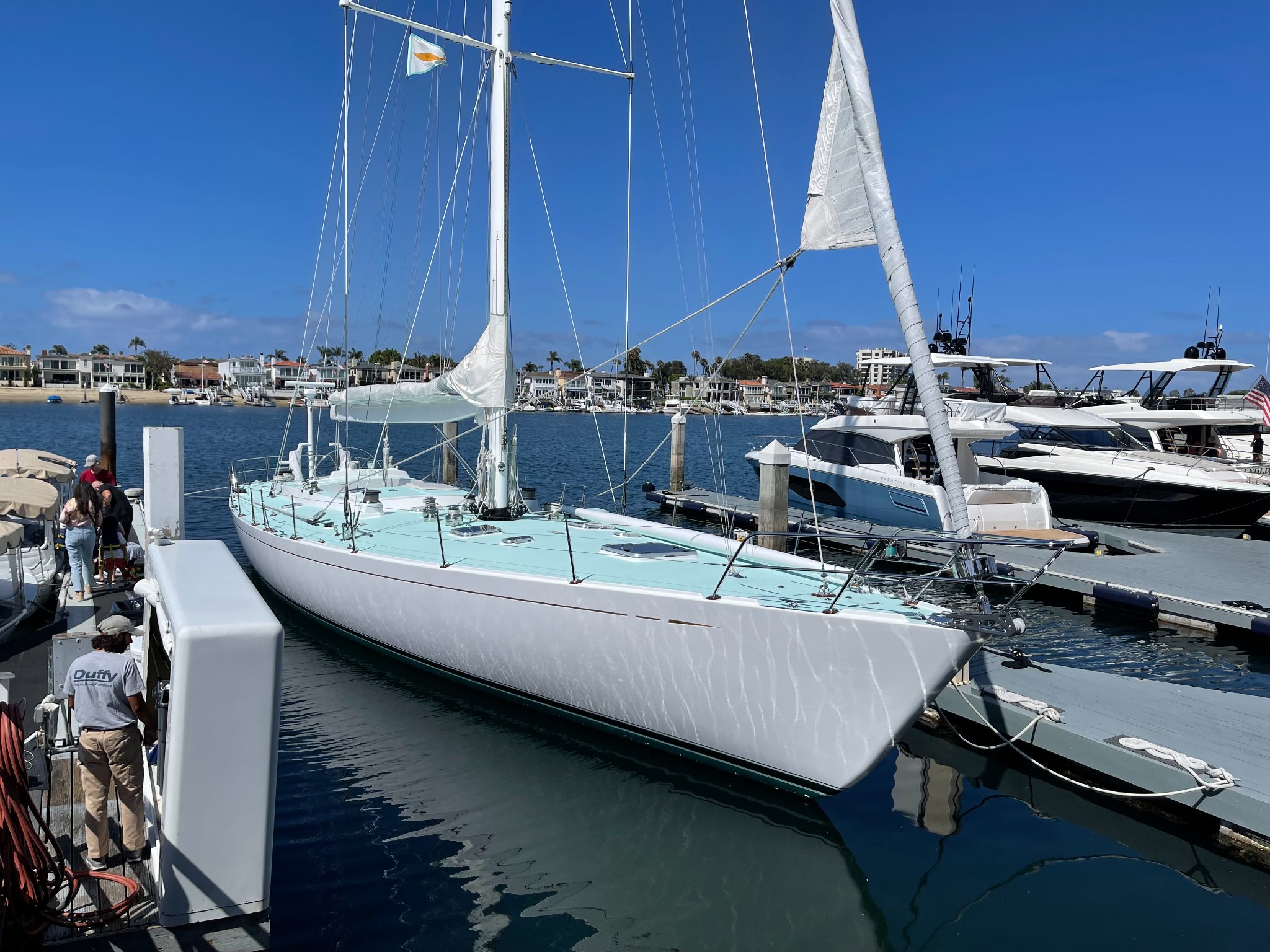
Peterson designed further modifications for the boat after she was retired from racing by Muir, with a shorter rig and shoal keel, along with interior and deck modifications. It appears she had a second life as a charter yacht in the early 1990s, and she has undergone further upgrades and modernisation and is now looking as good as ever, and being sailed from Newport Beach, California.
Windward Passage looks to be in fine form in these photographs (Facebook) from 2022


A new book about Windward Passage ('Windward Passage - A Maxi-yacht in her Sixth Decade', by Randall Peffer) is now available here.

Article updated May 2024