Showing posts with label Judel/Vrolijk. Show all posts

24 May 2016

Quarter Tonners at the Vice-Admiral's Cup 2016

12 Quarter Tonners lined up for the 2016 RORC Vice-Admiral's Cup (20-22 May), including the top four teams from 2015. Sam Laidlaw's Aguila was back to defend last year's final race win, along with last year's runner up, Rickard Melander's Alice II, as well as Tony Hayward's Blackfun and Louise Morton's Bullit (third and fourth respectively last year).
Louise Morton's Bullit, early leader of the Quarter Ton division in the 2016 Vice-Admiral's Cup (photo RORC/Paul Wyeth)
Day 1
Bullit placed third in the first race and went on to win the last two races to lead the Quarter Tonner Class ahead of Sam Laidlaw's Aguila. Blackfun was third.

"We had a really good day today despite the tricky conditions with wind against tide and breaking our pole in the first race was not ideal" commented Morton. "We did have a couple of wipe-outs but we were not alone, Quarter Tonners can be a handful downwind. Well done to Stuart Childerley and his team for getting six classes off for three good races each, I am sure the race committee was as tired as us by the end of the day."
Windward mark action in the Quarter Ton division at the RORC Vice-Admiral's Cup (photo Rick Tomlinson/Sailing Anarchy)
Day 2
Bullit started of the second day of racing with a bullet and a second to take a firm grip on the class, but was adjudged over the line at the start of the last race of the day and having restarted correctly slipped to ninth place. Bullit still leads the class but only by a single point from Sam Laidlaw's Aguila. Tony Hayward's Blackfun remains in third. Rickard Melander's Alice II is fourth having scored two podium finishes today and Eric Reynolds' Magnum Evolution won race five to end the day in fifth position.

Joker bashes her way upwind on Day 2 of the Vice-Admiral's Cup (photo Rick Tomlinson/1/4 ton zeilers Facebook page) 
"Bullit is going well but we can still catch her" commented Aguila's Brett Aarons. "Bullit is a bit larger than Aguila, so she goes a bit better in the heavier air but tomorrow looks to be a bit lighter, so we definitely have a chance. The standard of racing in the Quarter Ton fleet is as good as it gets in the Solent. The boats may be old but a lot of time is spent getting them into perfect condition, and as we sail at about the same speed, it is just like one design racing."
Bullit in action on Day 2 of the Vice-Admiral's Cup (photo RORC/Rick Tomlinson)
Day 3
Aguila won the very last race to take the series by a half point. Aguila, designed by the German design duo Judel/Vrolijk in 1990, was helmed by Sam Laidlaw; all of his crew, from the Isle of Wight, were not born when the boat was built. Bullit had led the regatta from the first day and agonisingly lost the title by just half a point.

Aguila on her way to winning the Quarter Ton division of the 2016 Vice-Admiral's Cup (photo RORC/Rick Tomlinson)
"Very tough close racing" summed up Laidlaw. "I felt that we were capable of beating them in both races but if it hadn't been for Magnum Evolution getting between us, we would have lost by half a point, so we were very fortunate in that respect. This fleet produces really close racing, which is also good fun and bodes well for the Quarter Ton Cup."
The immaculate Aguila, winner of the 2016 Vice-Admiral's Cup Quarter Ton division - seen here during the 2016 RORC Easter Challenge (photo RORC/Paul Wyeth)

26 March 2014

One Ton Cup 1989

1989 One Ton Cup winner Brava
The 1989 One Ton Cup was held in Naples, Italy, three months ahead of that year's Admiral's Cup series, and although the number of IOR yachts worldwide was continuing to thin out, the intensity of competition in the Cup definitely wasn't. Some 28 yachts lined up for the event, of which 19 were less than a year old - commissioned, built and worked up very much with the One Ton Cup and Admiral's Cup double in mind. Of the 28 yachts, Farr could claim 12, with four to Denmark's Neils Jeppesen, although only one, Stockbroker, was a serious contender, while the German duo of Judel/Vrolijk could count three.

The one major aspect of the regatta that detracted from the calibre of the event was the weather. Naples Bay has a regular afternoon gradient wind but it blew for only two of the three inshore races, but never more than 12 knots, and generally only about 6-8 knots. The wind was at its most capricious in the first race, which descended into farce such that the race committee was on the brink of calling it off twice during the first beat, but the international jury urged that the race be able to run its course. The first leg took over an hour, and only four legs were completed. The race was won by the Daniel Andrieu designed Indulgence, skippered by Eddie Warden-Owen, with Germany's Farr design ABAP/4 second and Aria third. 

Indulgence during some of the windier conditions of the 1989 One Ton Cup
The offshore races also suffered from light winds, and light as they were during the day, at night they died to nothing, resulting in long 'park ups', with positions changing dramatically as the breeze arrived each morning. Even with the offshore races reduced to just 145 and 95 miles, they took 27 and 24 hours to complete. "It was the Hare Krishna school of sailing", joked Graham Walker, who's crew aboard Indulgence burnt joss sticks at night to try to detect the direction of the wind. The overnight races utterly exhausted the crews, for the level of concentration required to coax their boats along was enormous. Their cause was not helped by the race committee setting the weather mark in the short offshore race in the windless lee of Capri Island.
Above and below - startline action during the 1989 One Ton Cup
It was Indulgence which looked like a possible winner half way through the series. She won the first two races and was points leader until the fourth, the short offshore race. She was leading that too in the early morning when the dawn breeze brought a group of six, including the Farr designed Brava, owned by Italian yachtsman Pasquale Landolfi, to the front. In the chase, Indulgence cut too close to the island of Ischia and struck a rock. The crew had to extricate themselves by using the spinnaker pole as a punt to push the boat off backwards. She managed to salvage an 11th placing. 
Indulgence approaches a windward mark
In the end it was all Brava, which was sailed well throughout the Cup, and her 9/5/4/2/4 record showing the consistency that Indulgence lacked with a 1/1/13/11/13 which dropped her to second place. 
Brava
In design terms, the Farr boats were considered a gentle progression a proven all-round design. Brava and seventh-placed Bellatrix were more light air oriented than the previous year's design, and near sisterships ABAP/4 (fifth) and Bravura (ninth) all seemed to have a slight edge downwind, while their upwind penetration was as good as ever. Brava had a Sail Hull Ratio (SHR) of 15.70 and a Righting Moment Corrected (RMC) of 133.4, coupled with a relatively short rated Length (L) of 10.09m. 
Australia's Joint Venture, sailing upwind above, and leading the pack below (possibly in the fourth race where she finished in fifth place)
In contrast, the Australian Farr design Joint Venture, which was similar to the New Zealand yacht Propaganda (which did not attend as she was being optimised for the Admiral's Cup), had a longer L of 10.19m, with a lower SHR of 15.4 and an RMC of 140, which was considered stiff. She tended to lose out badly in the light airs during the offshore races, dropping hard-won places to slower boats and finished 16th overall. 
The Andrieu design CGI, sistership to Indulgence
In Indulgence, and her erratically sailed French sistership CGI (20th), Daniel Andrieu had attempted to get some windward bite without giving up his design's well known reaching and running speed. Indulgence was finer for'ard than previous Andrieu boats, and she was fast upwind in light ghosting conditions, and in more than 12 knots of wind. But in a slight chop and 6-10 knots she appeared to labour in both height and speed.  Indulgence was optimised for Naples, with a relatively large sailplan, resulting in a high SHR of 15.92, and was considered short relative to the Farr boats, with an L of 10.085. The Andrieu boats also had 2cm less freeboard than the others, to lower total weight and the centre of pitch.
Norway's Fram XI, finished 13th overall
Indulgence was due to undergo substantial modifications before the British Admiral's Cup team was to be announced, and to be reconfigured for more wind than had been expected in Naples, including a new keel and rig.
Stockbroker crosses ahead of Indulgence
Leeward mark action aboard Japan's Are Can Bay
Italy's Shardana 2 finished sixth overall (photo Facebook)
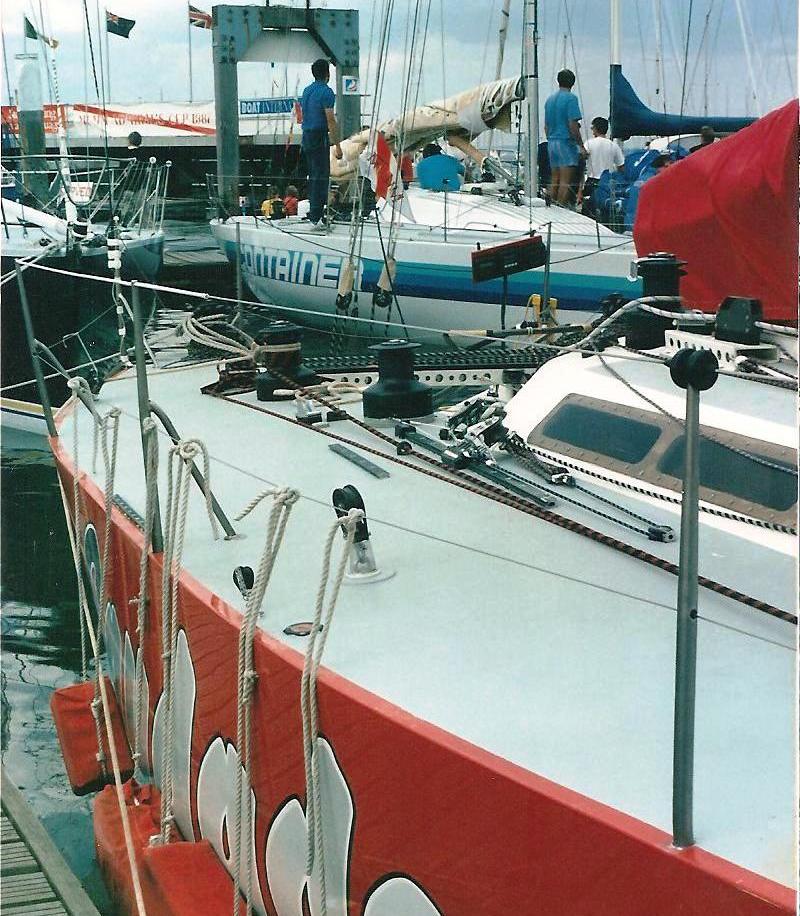
In designing Stockbroker, Jeppeson had noted that rated lengths in the 1988 fleet were around 10.05-10.15m, and that waterline beams varied less than 5cm. Noting the success of Propaganda and Container (renamed Aria for 1989), he chose a high stability boat with a RMC of 150, much higher than the Naples average of some 138-140. To pitch the boat more to light airs, the engine was moved aft, a strut drive installed and the keel's lead shoe removed to get the RMC down to 147. Like Indulgence, Stockbroker was good in flat water, and she finished the series in third place, after a 8/4/20/5/6 series.
Key rating statistics for a range of boats from the 1989 One Ton Cup
Full results for the 1989 One Ton Cup
CGI

22 February 2014

Rubin XI (Judel/Vrolijk Two Tonner)

Rubin XI surfs downwind
This post features a number of photos from a collection contained in a German yachting magazine that followed the design, construction and launching of Rubin XI, a Two Tonner commissioned by German yachtsman Hans-Otto Schumann for the 1989 Admiral's Cup. The German teams had been dominant in the Admiral's Cup during the 1980s, winning the 1983 and 1985 events. However, they had slipped off the pace in 1987, and were keen to re-assert their previous form for the 1989 series.  

Rubin XI was the latest in a long line of Rubin's that had been part of nine previous Admiral's Cups, and Schumann had been part of winning German efforts in 1973 and 1985 (Rubin G VIII).


Computer generated lines plan for Rubin XI
In early November 1988 3:1 scale models of the new yacht are ready for testing, including the latest elliptical keel profile here being attached (photo Heiner Mueller-Elsner).
Rubin XI was designed by the German design duo of Frierich Judel and Rolf Vrolijk, who had delivered most of their country's Cup winning designs throughout their earlier winning campaigns. She was approximately 44 feet in length, designed as a Two Tonner (34.5ft IOR), but her rating was optimised at 34.33ft for Admiral's Cup competition. The hull and appendage designs were subject to extensive computer analysis and tank testing, and construction utilised the latest in carbon fibre technology.

The design is tested in November 1988 in a 300 metre long tank testing facility (photo Heiner Mueller-Elsner).
By December 1988 construction is well underway at Yachtwerft Wedel - the hull is baked at 180 degrees celsius overnight in an aluminium furnace to cure the carbon fibre layers (photo Heiner Mueller-Elsner).
Construction proceeds apace during January 1989 - the mast support structure being put in place (photo Heiner Mueller-Elsner).
Mid-February 1989 - deck fittings and winches are put in place (photo Heiner Mueller-Elsner).
3 March 1989 - construction and rigging are completed, and Rubin XI, weighing approximately six tonnes, is ready for launching in Kiel (photo Heiner Mueller-Elsner).

Rubin XI in trials before the 1989 Admiral's Cup (photo unknown)
Unfortunately, and despite their apparent promise and no compromise approach to preparation, the 1989 German effort did not deliver the results that had been expected of it. In a year where the new 50 footers were dominant, Germany had arrived with 2 Two Tonners (Rubin XI and Pinta) and a One Tonner (Becks Diva) and it was an unsuitable combination. Worse, the capricious breezes of the first race spelt calamity for the German team - by the time a sea breeze filled in the whole German team were well down the placings and Rubin XI finished in last place (42nd). It followed this with placings of 26/12/23/9 and a 17th in the Fastnet race to finish 21st overall. Becks Diva was the best placed of the German team finishing 12th, while Pinta was 26th to give the team a disappointing eighth place in the series.

Rubin XI heads out to race in the 1989 Admiral's Cup (photo Shockwave40 blog)
Rubin XI made another appearance for the 1991 Admiral's Cup, or at least, parts of her did - the deck, winches and rig were married to a new hull to create Rubin XII, but was jokingly referred to as Rubin XI 1/2. The team was again unsuccessful in 1991, finishing fifth (Rubin XII was fourth in the Two Tonner division) but Rubin XII formed part of the team that bounced back in 1993 to win the series by the slimmest of margins, by just 0.25 points.

Rubin XII sails back to the marina after a race during the 1991 Admiral's Cup (photo Shockwave40 blog)
Rubin XII was later bought by a yachtsman from Northern Ireland and she was renamed Hesperia IV.

Hesperia IV ex-Rubin XII

18 September 2013

Rubin VIII & Saudade (Judel/Vrolijk One Tonners)

Saudade was a One Ton design from the German design duo of Judel/Vrolijk, one of a series of boats of this size that developed from the success of their earlier Sudpack during the 1984 One Ton Cup, and from the bigger Container and Pinta designs. Compared to its 43 foot predecessors, the new One Ton design utilised a lower beam to length ratio for better performance in light airs. With a change to the stability factor in the IOR, the new boat retained the same stability as Sudpack, with an optimised sail to hull ratio of 16.11, near to the maximum under IOR before penalties would be incurred. The boat was designed to rate at the One Ton limit of 30.5ft, but could be optimised down to 30.3ft for the Admiral's Cup. 

The first boat to the new design was finished at the end of 1984 as Rubin VIII (G-3388), the latest in a long line of boats owned by German yachtsman Hans-Otto Schumann to carry the Rubin name. In keeping with Schumann's fascination with the technology of fast boats, he fitted an elliptical keel, based on concepts tested at Heidelberg University. Rubin VIII
joined the German team for the 1985 Admiral's Cup, alongside the 44ft Diva G and another new One Tonner Outsider. Rubin VIII was considered to have a smoother shape than Outsider, and to be a better all-rounder and less cranky in fresh downwind conditions.   
Rubin VIII demonstrating her upwind form (above) and downwind (below)


Both Outsider and Rubin VIII sailed a patchy series in the 1985 One Ton Cup in Poole, the month before the Admiral's Cup, but had managed a first and second between them during the five race series. However, the German team put together a solid performance in the Admiral's Cup to successfully defend their previous win in 1983. 

Deck plan of Rubin VIII
In a reversal of pre-regatta form and predictions, Outsider was the top German yacht, finishing second overall, while Rubin VIII also placed strongly and together they were able to overcome the handicap of the larger Diva G in a series where the smaller boats dominated.
Outsider - second overall and the top German boat in the 1985 Admiral's Cup
The new Rubin IX (G-1919)


Rubin IX during the 1986 Sardinia Cup
Rubin IX during the 1986 Sardinia Cup (photo Guy Gurney)
For the 1987 Admiral's Cup Schumann elected to commission a larger 43-foot sistership to the new Pinta (Rubin IX), while Albert Bull built a new One Tonner Saudade, as an update of the earlier Rubin VIII.  The boat was wintered in Palma, Mallorca, which allowed the crew to work up her speed in 15-20 knots, and she made the German team, alongside the new One Ton Container and the latest Diva. 
Saudade powers upwind (photo Peter Neumann)
But the German effort came adrift midway through the series, with the third race being disastrous for the team's hoped-for defence. Saudade followed Diva's error at the fourth mark, when helmsman Uwe Mares underestimated the tide and brushed the buoy. When the crew re-rounded they managed to interfere with several other yachts. Back in the jury room Saudade dropped from 26th to 42nd. The team finished fifth overall, while Saudade was 15th yacht in the individual standings.
Saudade can be seen here in the middle of a crowded startline during the 1987 Admiral's Cup
Saudade after the finish of the 1987 Fastnet Race, with team-mate Diva G in the background (photo Shockwave40 blogspot)
Saudade went on to compete in the 1987 One Ton Cup, where she finished in 24th place in the 34 boat fleet.
Above and below - cockpit details of Saudade (photos courtesy of Ian Watson)


The updated Saudade, a 1988 Farr design, can be seen here.

Saudade is still sailing and maintained in good condition, as seen below, and carries the Heatwave name, having been bought by the yachtsman who had owned the ex-New Zealand One Tonner featured in a previous post.

Rubin VIII meanwhile has been in the ownership of the Pannanen family for nearly 30 years, who have kept her in excellent shape, and a functional lightweight interior for the boat was built during 1992-1995 along with a new keel. The mast is still original, but all new rod rigging was made by Baltic Yachts also in 1995.


Article updated December 2025