Showing posts with label Jamarella. Show all posts

9 November 2024

Jamarella - Farr One Tonner (Part 2)

 This post features some photographs by Guy Gurney featuring the Farr-designed One Tonner Jamarella (UK) during the 1987 Admiral's Cup, and in close quarters racing amongst other yachts in this closely fought series. Jamarella finished as second placed yacht overall, behind New Zealand's Propaganda, and an earlier article on Jamarella can be seen here.

Jamarella rounds a leeward mark in close company with Australia's Swan Premium II, another Farr One Tonner that finished in tenth place overall (photo Guy Gurney)

Jamarella (K-180) seen here in the middle of the pack soon after a start during the 1987 Admiral's Cup, with (left to right) Insatiable (US-41241), Swan Premium I (KA-2), Diva (G-2994), Caiman (H-36), Juno (K-505), Blue Yankee (US-41110), Royal Blue (S-10010) and Swan Premium III (KA-3000) (photo Guy Gurney)
Jamarella on a reaching leg during the 1987 Admiral's Cup (photo Guy Gurney)
Jamarella in a different view from an inshore race, just to leeward of Val Maubuee (F-9229) and ahead of CGI (F9213) and Propaganda (KZ-6191) and Insatiable (US-41241) - Mean Machine (H-189) is visible to the left (photo Guy Gurney)

Jamarella crosses on port behind Mean Machine - Irish Independent Full Pelt is ahead on port and Container (G-1909) can be seen to windward on starboard tack (photo Guy Gurney)


Article dated November 2024

24 June 2022

Juno IV (Castro 44)

Juno IV prior to the 1989 Admiral's Cup (photo Seahorse)
Juno IV is a 44-footer designed by Tony Castro for Mike Peacock to seek selection for the British team in the 1989 Admiral’s Cup. It was one of the earliest all-carbon race yachts, with the structural design developed by the Castro design team, and was built by Killian Bushe in England.
Juno IV sails upwind in light airs (Riggarna Rigging advertisement)
Peacock had commissioned the earlier One-Tonner Juno for the 1987 Admiral’s Cup, and as part of the second-placed British team and had finished 9th in the individual standings. He was drawn to a mid-size yacht for 1989 because it was a vacant slot for the British team, with Alan Gray’s 50-footer Jamarella looking likely to gain the big-boat position, and because Graham Walker already had a well-advanced plan to try to win the 1989 One Ton Cup, and the One Ton position on the team, with his new Indulgence. Changes to the Time Modification Factor (TMF) for 1989 would benefit bigger boats, but they would still need to perform well.
Juno IV - note curved genoa tracks (photo Facebook)
After a late launch, early racing indicated that Juno IV was too stiff, although this yielded good results in a breeze. This lead to a series of keel changes, reducing the boat’s stability and rating, but also affecting her speed. In the pre-Admiral’s Cup analysis, Seahorse magazine noted that Juno IV had trialed different sails from three lofts but was still performing below expectations.
A view of Juno IV's underwater shape, at Lymington Marina (photo Shockwave40 blog)
The selection of the British team proved to be controversial. The team selectors, headed by Harold Cudmore, decided to send boats to Kiel Week, the last part of the German and Dutch trials, to measure them against the opposition. Jamarella generally proved her case, but Hitchhiker II, the ex-Jamarella (One Ton) was making a claim for either of Juno IV or Indulgence’s berth. Despite a poor result in Kiel Week, where Juno IV finished last of the serious contenders for a team place and appeared off the pace against the German 34-raters, the selectors decided there was sufficient time to re-adjust all of Juno IV’s parameters to give her more speed. Indulgence was selected because of her results in Naples, but as only a single One Tonner was sought, the nod went against Hitchhiker II in preference to Juno IV.
Juno IV in light air downwind conditions 
Said Cudmore at the time, “the third boat was a difficult choice and the selectors were in a quandary, as the bigger boats were proving to be more success with the new TMFs. Within the mid-size category, Juno’s performance had been disappointing. Hitchhiker was a proven boat with a proven owner…Juno was in extreme rating mode, more similar to the Kiwi boats, which was wrong for Kiel and wrong for the Admiral’s Cup. Whether in correct rating mode she would be more competitive was unknown. Size was the deciding factor, and Juno was selected”.
Juno IV (photo Peter Ludlow)
With only a month left to tune the British boats, Castro planned a longer, lower boom for Juno IV to increase her sail area by 5 percent, which was combined with the removal of 200kg of internal ballast (to reduce stability and the CGF measurement of the IOR) and further bow-down trim to offset the consequent rating increase of sail area changes. This lead to a final rating of 35.17ft for the Admiral's Cup, while the team also settled on a North Sails wardrobe, with the boat skippered by Mike McIntyre, a 1988 Star class gold medallist.
Juno IV (photo Facebook)
Observers remained sceptical that Juno IV was the best choice and Seahorse opined before the series that “something special needs to happen if Juno is to find the speed of the German team, and unless she does, this boat will be the weak link in the British team”.
Juno IV seen here leaving Lymington Marina (photo Shockwave40 blog)
The results of the initial stages of the 1989 Admiral's Cup suggested these concerns were well placed, with Jamarella’s first and Indulgence’s third in the first race being let down somewhat by Juno IV’s lowly 26th, after she was boxed in at the start and was never able to properly recover.
Juno IV
Juno IV was 24th in the Channel Race, although fortunately this was enough when combined with Jamarella’s third and Indulgence’s seventh, for the British team to move into the series lead.
Juno IV in the midst of (possibly) Admiral's Cup trials action, with Jamarella (K-180) visible to windward (photo Bateaux magazine, Histoiredeshalfs website)
Juno IV during the 1989 Admiral's Cup (photo Auckland Maritime Museum)
The team then put in a dominant display in the third race, the second inshore, with Juno IV improving strongly to finish 11th. This was a good result considering the time lost on the last run, where she had tried to shake off Librah with a gybe set but managed to tangle the boom in a running backstay. The resulting broach led to a torn spinnaker which had to be replaced.
Juno IV sails downwind during the 1989 Admiral's Cup (although is sailing with an inshore mainsail without reefing patches) (photo Facebook)
The third inshore was less impressive, with Juno IV finishing 21st, although this was better than Indulgence’s uncharacteristic 27th. Jamarella’s third, however, kept the team in first position in the overall standings.
Juno IV powers along upwind (photo Bateaux magazine, Histoiredeshalfs website)
Juno IV went on to finish 11th in the fourth inshore and 12th in the Fastnet Race, to finish the series in 13th place overall, and this was enough to help Britain to overall Admiral's Cup victory after their second place in 1987 (Jamarella was the top individual yacht and Indulgence was 11th). 

Juno IV went on to race in the 1989 Southern Cross Cup as part of the British team, with owner Peacock leading the UK challenge for the Cup which they won. She then competed in the 1990 Sardinia Cup, finishing second (either individually or as part of the British team) and was winner of the 1990 Setimana Del Boque, also in Sardinia.
Juno IV arriving at Lymington Marina (photo Shockwave40 blog)
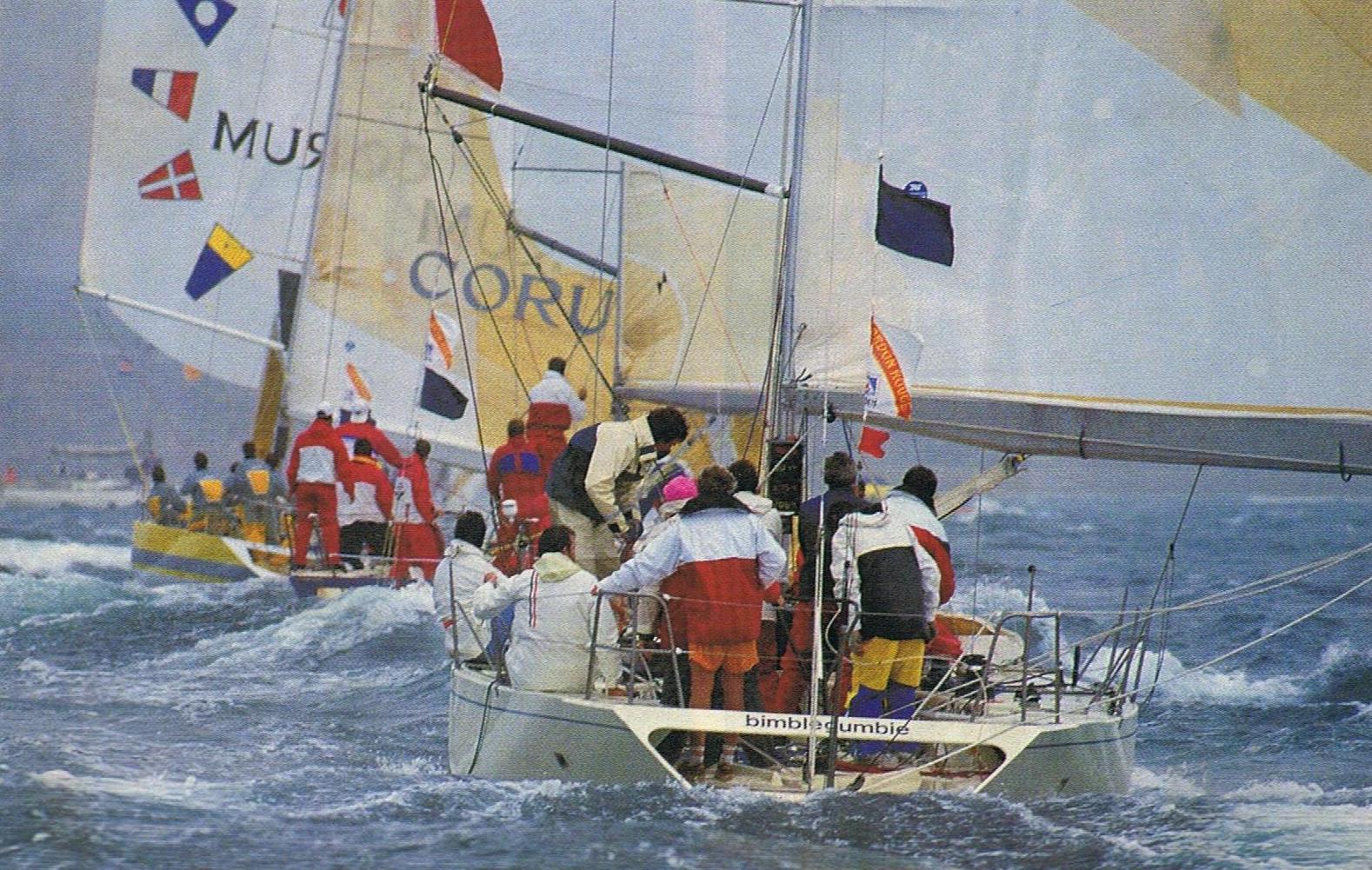
Juno IV as Australian entry in the 1991 Admiral's Cup Bimblegumbie (and photo below)
In 1991 Juno IV filled the Two-Tonner slot in the Australian team for that year's Admiral's Cup as Bimblegumbie, but finished seventh of the eight Two Tonners, although she collected more points than her team-mates Cyclone, the team's 50-footer, and Shardana II, the One Tonner. The Australian team finished last overall.
Juno IV was converted in the early 1990’s in private ownership to a cruiser/racer specification with easier deck gear to allow her to be easily sailed two-handed. In 2013 she was sold to another private owner who put her back into the racing circuit after 14 years and entered in the Round the Island 2014. Despite the lack of wind around the Needles, she was able to keep moving and won two trophies, the Field Barnacle (line honours) and the Renaissance Trophy.
Juno IV in more recent times (photo Challenge Yachting)
Juno IV was then re-established as a true racer. Further investment and improvements followed and she was entered in the Round the Island Race in 2015. Conditions were perfect for this classic racer and again the Juno IV team won the Field Barnacle trophy. The original aluminium mast was replaced with a carbon-fibre version in 2019, but it is understood that the boat is now being used purely as a cruising yacht and is based in Scotland.

Article updated May 2023

1 October 2021

Will (Farr 50)

The sad sight of the yacht Will languishing on a mooring in Auckland has spurred me to look into its history, alongside its other namesakes, all Farr-designed IOR 50-footers that were owned and campaigned by Japanese yachtsman Ryuoji Oda during the heyday of the 50-foot class in the late 1980s and early 1990s.
Will sailing upwind during the 1989 Admiral's Cup on her way to second place overall
As discussed in earlier articles (Part 1 begins here), the World Cup events for the 50-foot class had evolved by the late 1980s to a focus on short-course inshore racing. However, the Fifties still had an offshore purpose, and their fortunes in mixed fleet ocean racing received a boost for the 1989 Admiral's Cup when the Royal Ocean Racing Club resolved to reduce the previous dominance of the One Tonners. This was done by changing the time multiplication factor (TMF) curve in favour of the Fifties, to reduce the points loading for the offshore races and by adding a fourth (and long) inshore race. These moves coincided with the continued evolution and performance gains of the 50-foot class in response to the increasing competition within its World Cup circuit. 
The sailplan for design #203, on which Will was based (Farr Yacht Design) 
The first Will (Design # 203) was built at Cookson Yachts in Auckland from the same female mould as Farr's other 50-footers of that time, Carat (#203), Windquest (#206, for Richard DeVos) and SpringbokWill (sail number J-4001) sported a deep blue hull finish and flew Diamond sails on Sparcraft spars, and rated very close to the maximum for the Admiral's Cup and 50-foot class at 40.03ft. Although she was probably initially commissioned by Oda for the 50-footer circuit, the changes to the format for the 1989 Admiral's Cup made her a primary candidate for the Japanese team, where she was joined by the One Tonner Arecan Bay and the 1985 vintage Two Tonner Turkish Delight, both of which were campaigned by the Nippon Challenge America's Cup syndicate.
Will seen moored here at the Hamble River during the 1989 Admiral's Cup (photo shockwave blog)
As was predicted by some, the 1989 Admiral's Cup did indeed become the year of the Fifties, with the new breed of these Admiral's Cup 'maxis' having line and handicap wins in five of the six races, and they took four of the top five places overall. Alan Gray's 50-footer Jamarella (Farr design #213), led the charge for the British team to be top individual performer in the 42-boat fleet (from 14 nations), and spearheaded Britain's first Cup win since 1981. Will was second overall (with placings of 8/1/4/6/4/5). Arecan Bay and Turkish Delight finished down in the standings at 27th and 34th respectively, but thanks to Will's performance the Japanese team finished a respectable seventh overall (of 14 teams).
Will approaching a windward mark during the 1989 Admiral's Cup
Will sails upwind during the 1989 Admiral's Cup
After the 1989 Admiral’s Cup the Fifties gathered again in Newport Rhode Island for the sixth and final event in the 1989 World Cup. This was won convincingly by Windquest, with Will and Jamarella, which had been shipped over from England after the Admiral’s Cup, taking second and third.
Interior profile view (Farr Yacht Design)
The 1990 World Cup for the International 50-Foot Yacht Association (IFYA) got underway with a one-off series in Japan, in November 1989 – a notable series for the fact that Mark Morita, the Japanese owner of Champosa V, underwrote the shipping costs of all the yachts, containers and crews to the tune of an estimated $5m - half of which was raised from seven major Japanese corporations under the aegis of the International 50-Foot Yacht Association of Japan, which Morita formed.
Will in fresh conditions during the second race of the November 1989 50-foot series in Japan
While the event was notable for the impressive size of the fleet (the largest to ever compete in an IFYA event), the conditions in Miura, a commercial fishing village in Sagami Bay south of Yokohama (close to the 2021 Olympic sailing venue), were less so. Conditions were cold and the winds swung between very heavy and very light, and the race committee barely got in the minimum four (out of seven scheduled) races to constitute a series. The second race was in the very upper limit for the fragile Fifties, sailed in breezes that reached a steady 39 knots. Windquest took out the honours again (helmed by Terry Neilson and John Bertrand), while Will, after a second place in the light air last race, took second place overall.
Andelstanken leads Will and Windquest on a blustery run in Sagami Bay
Will in a strong position during a IFYA World Cup event in Key West in 1991, to windward of Carat, Container, Windquest (US-42450), Mandrake, Heaven Can Wait, Promotion and Springbok (photo Sailing World)
Will can be seen here behind Springbok and Carat during a Key West Race Week (photo Sharon Green/Ultimate Sailing)
Will seen here in a 1991 International Regatta, rounding a leeward mark behind Champosa
Windquest follows Container around a mark during the Tortola World Cup series in 1990, with Container going on to win and Windquest finishing fifth
Will raced in the 1990 Kenwood Cup (by then with a rating of 40.27ft), alongside a new smaller sister, the One Tonner Will, Jr. The series attracted several other 50-footers, including Cyclone, Heaven Can Wait and team-mate Tiger. In the windy final race, the 390-mile Kaula Race, Will finished with only 2 feet of her rudder blade intact and had continued to race so as to gain the vital team points for finishing, and this helped the Japan Blue Team of Swing (ex-Librah), Tiger and Will to win the 1990 Kenwood Cup, beating the Australian team by 17 points.
Will (left) and Cyclone during the 1990 Kenwood Cup (photo Offshore Magazine | Facebook)
Oda then commissioned a new boat, the second Will (hereafter "Will 91") (Design #260) was a development of Farr's earlier 50-foot designs, and the Farr website design notes outline the philosophy behind the new boat:

Design 260 has a higher sail area to wetted surface ratio and lower drag keel and rudder arrangements. She has significantly higher stability and lower displacement. The deeper keel will give a large performance improvement in stronger upwind conditions and without any loss downwind, particularly as refinements in keel shape improve downwind speed.

To illustrate these changes, it can be seen from the published specifications that Will 91 had a keel depth of 2.99m and displacement of 11,570kg, compared to the earlier generation, typified by Carat, with 2.81m and 11,836kg. Further changes included alterations to the deck layout and geometry to reflect efforts to improve crew work and efficiency, and was longer and more open. The mainsheet was moved aft in line with the boom end, behind the helmsman, and the large diameter wheel was placed further forward than usual. 
Will 91 (Design #260) profile view (Farr Yacht Design)
These latter features were a noticeable difference from the earlier tiller steered Will, which had her mainsheet further forward and in front of the helmsman. The stern on Will 91 was also of a slightly different design, with the end of the transom being cut off to a more upright angle in the area of the backstay attachment points. Both yachts had the usual narrow cutaway along the aft-most part of the deck, a device that was used to move the measurement point of the transom and After Girth Station to a position further forward and aligned with the corresponding bustle at the rudder skeg position.
Will 91 at the Admiral's Cup 1991 (photo shockwave blog)
Construction of the $700,000 yacht was specified to include use of pre-preg intermediate modulus carbon fibre fabrics over Nomex honeycomb cores for improved stiffness without any increase in weight. Tim Jeffery's 'Official History of the Admiral's Cup' (1994) comments that Will 91, built by McConaghy Boats, "was being marked down in the chronicles of yachting as the finest and the last big IOR racing yacht outside of the maxis for the 1993-94 Whitbread Race". Of her construction, he notes that she "was one of the very first yachts to be built from T800 carbon fibre. This made her no lighter but some 25 per cent stronger for an added material cost of some $50,000. The gain those dollars bought was a stiffer structure, allowing 16-17,000lb to be loaded on the running backstay - instead of the normal 12,000lb found on a 50-footer - to produce a straighter headstay for better upwind pointing". 
Will 91 during the 1991 Admiral's Cup
Will 91's carbon construction went beyond just the hull however. Jeffery goes on to say that "Will was the carbon fibre boat. Seemingly everything was made from the black, magic material, the winch grinding pedestal, the steering wheel, the stern light bracket, the mast collar, the guy blocks, the companionway ladder, the bunk frames...", and that "even the kitchen sink was made from carbon. Not that it was ever going to be used". But as the boat was a fixed price contract, it was just as easy for McConaghy to build the items in carbon as to buy them in. It was suggested, however, that things had perhaps gone too far when McConaghy even built the fuel tank in carbon fibre.
Will 91 seen here sailing back to Cowes after finishing a race during the 1991 Admiral's Cup (photo shockwave blog)
Will 91 can be seen here, second from left (to leeward of Container) during the 1991 Admiral's Cup
Will 91 crosses ahead of Corum Saphir during the 1991 Admiral's Cup
IOR measurements of some of the IOR Fifties at the 1991 Admiral's Cup, showing Will 91 to be in the shorter (L and LOA) and lighter (DSPL) end of the (narrow) range, with less sail area (Bateaux magazine)
Will 91 was once again the star performer for the Japanese team in the 1991 Admiral's Cup, with placings of 3/2/5/1/4 culminating with a close second place in the Fastnet, after chasing down the French 50-footer Corum Saphir in the closing stages, and finishing second overall (to Corum Saphir) in the 50-footer division (a class scoring system was used in the 1991 regatta). Will 91's effort was however not backed up by her team mates Carino (Two Tonner) and Spica (One Tonner), with Carino losing her rig in the second inshore race and Spica failing to fire in the One Ton division, and Japan finished a disappointingly seventh of eight teams.
Ragamuffin (ex-Will 91) leads a fleet of Fifties at a regatta prior to the 1993 Admiral's Cup (photo Sharon Green/Ultimate Sailing)

Ragamuffin (ex-Will 91) in power reaching mode during the 1993 Admiral's Cup
Meanwhile, both Will and Windquest competed in the Key West World Cup regatta in 1991, finishing 12th and 13th overall respectively. Windquest's overall result was not helped by a  calamitous top-mark rounding in the last race. She and Carat approached the mark on port, but Carat was to leeward and tacked first below the starboard tack bunch, hoping to lay the top mark, and also hoping that Windquest would be able to duck her stern. Windquest left her tack as late as possible such that Carat was unable to clear Windquest's stern and hit her transom, locking the two boats together and wheeling Windquest back onto port. Capricorno (ex-Corum Saphir) meanwhile was left with nowhere to go and ran into both boats, with the combined effect of the collision and enormous rig tension resulting in her bow being torn off. 
Will 91 was then bought by British sailing interests (sporting the sail number GBR-4681, possibly as Graham Walker's interim Indulgence before he bought Juno V) before being acquired by Syd Fischer, the famous Australian yachtsman who has campaigned numerous champion offshore yachts, and she became the latest boat to be awarded the famous Ragamuffin name. She formed part of the Australian Admiral's Cup team for 1993, and exceeded her earlier impressive form in 1991 to be the stand-out 50-footer in the 1993 series and finish as the top points scorer overall. This effort was almost enough to allow the Australian team to lift the Cup for what turned out to be its final edition, but the loss of Great News II (the former Wings of Oracle) in the Fastnet race finale and team-mate Ninja (ex-Spica) not able to make up the difference saw Australia lose out to Germany by the narrowest of margins (0.25 points). 
Ragamuffin (ex-Will 91)
The original Will was also bought by Fischer and both yachts were campaigned in what I believe was the 1992 Kenwood Cup, as seen in the images above and below. By this time it appears that there had been some changes to both boats, with the former Will 91 now sporting the same deep blue colour scheme, and from the above photograph, which looks like Will 91 (due to the placement of the mainsheet and wheel), the lower part of the transom has been lengthened to match the angle of the rest of the transom. In the photograph below both yachts are rounding a weather mark at the same time, but suggests that Windquest has become the latest Will as she now sports Windquest's sail number and has the same rigging details (perhaps Oda, having sold his previous Will's, wanted to keep racing in the 50-foot circuit so had created a third Will)This sail number remains on the bow of the current Will as seen in the photographs at the end of this article. 
Ragamuffin (left) and Will rounding a mark during the 1992 Kenwood Cup

Will (above and below) off Diamond Head during the 1992 Kenwood Cup (photos by Phil Uhl | Facebook)
From here the history of the Will boats becomes even more uncertain, but it is understood that the original Will lost her outer hull skin in the 1993 Sydney to Hobart race, 100 miles east of Flinders Island and retired to Ulladulla. She became Ragamuffin 95 which was a new 50-foot IMS hull using Will’s deck, and which was launched in September 1995. Initially it retained the inline spreaders but these were later converted to swept spreaders. Will 91 later became Ragamuffin 97, with a new IMS 49 hull under the Will 91 deck, and did the 1997 Admiral’s Cup (held under IRC) and was then sold to Italy. 
Ragamuffin during the start of the 1994 Sydney to Hobart race
Ragamuffin 97 (I think) after the 2001 Sydney to Hobart race with the ex-Will 91 deck
The third Will, the ex-Windquest, was imported to New Zealand from Honolulu and was converted to a cruiser-racer, with the addition of some basic cruising amenities, at Phil Wilson's yard in Silverdale (Auckland) in the early 2000s (a bit later than Champosa, which arrived in New Zealand in about 1995). She was bought without a mast, as two had been broken during road transport in Honolulu.
 Will was raced in Auckland with the RNZYS by Eric Henry for the next seven or so years, and at some point a bulb was added to the keel for additional stability. Following her sale to a new owner, primarily for weekend cruising, she was moved onto a mooring in the Tamaki River in Auckland, and now looks very forlorn, with her mainsail having been left on the boom (uncovered), and slowly gathering more and more moss on deck, and extensive marine growth on her hull. She was hauled by the local marina operator some 15 years ago to clean her hull, and they pump water from her every so often. It is understood that the bulb has also parted company from the keel, and the interior (including batteries and engine) have been affected by water ingress, although the leather seating is apparently in good condition. 
Stern view of Will as seen in 2018
My estimation is that this is the original Windquest (sistership to Will), primarily due to the sail number on her bow and the similarity of details to Windquest in terms of mainsheet traveller and deck compass positions, steering wheel details, pushpit design, exhaust outlet location, engine throttle placement and the winch arrangement etc (see deck image of Windquest below). 
Windquest deck detail (from the Japan 1989 regatta)
If anyone has additional information that clarifies the history of the Will yachts, and the more recent history of Will / Windquest, please leave a comment below, or use the email address above.
Will as seen in 2019 on the Tamaki River in Auckland
Will as seen in 2019 on the Tamaki River in Auckland (note Windquest sail number on the bow)
Another recent photograph (November 2021) posted on Facebook here

Acknowledgements: Thanks to histoiredeshalfs for finding some of the images and details for this article.


Article updated August 2025