14 December 2012

Featured Photos - 1984 SORC

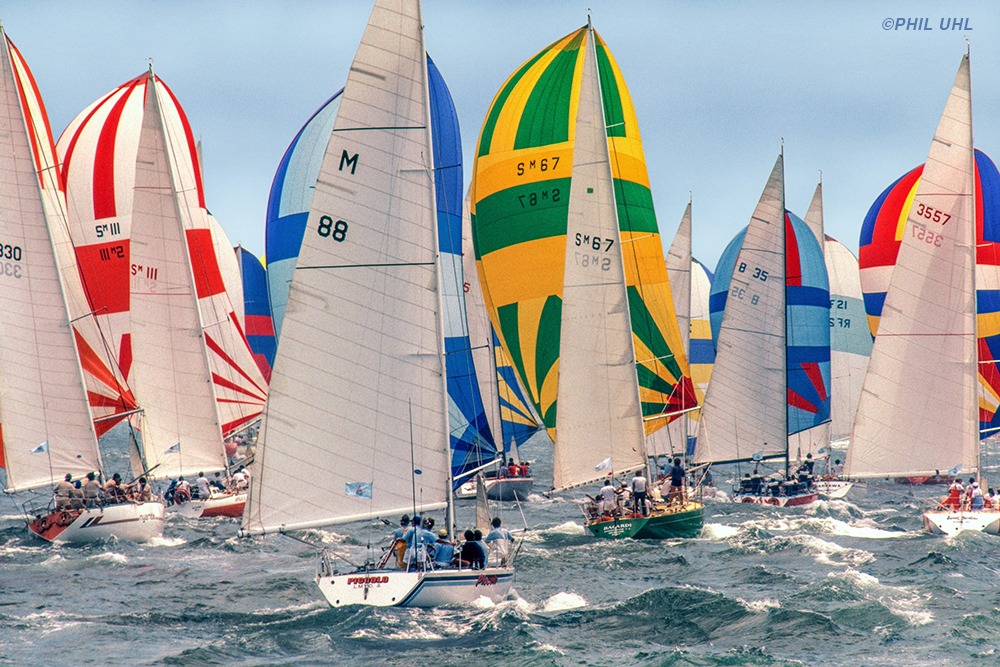
These photographs feature some US and European yachts competing in the St Petersburg to Ft Lauderdale race during the Southern Ocean Racing Conference (SORC) in 1984. At this time most of the yachts had been developed to the limits of the IOR rule with increased displacement and relatively fine ends. Because masthead rigs were still popular they often used shooters (or bloopers in US parlance)  to provide stability when running dead downwind, especially in a breeze as during this race.

The photos have featured in a number of threads by Larry Moran (Chicago) on the Sailing Anarchy forums. Larry was an active semi-professional yachting photographer at the time, and has kindly granted permission to post some of my favourite images from his collection.

Bravura - Frers 46 (Irving Loube), 35.4ft IOR, 8th in Class C, 34th overall (photo Larry Moran, Chicago)
Morningstar, Frers 50 (John Ambrose Jr), 40.0ft IOR, 1st Class B, 4th overall (photo Larry Moran, Chicago)
Dawn Patrol, Soverel 43 (George de Guardiola), 33.7ft IOR, 6th Class C, 33rd overall (photo Larry Moran, Chicago)
Lady Be, Frers 46 (F Chalain), 35.3ft IOR, 3rd Class C, 14th overall (photo Larry Moran, Chicago)
Intuition, Peterson 42 (Patrick Malloy), 32.7ft IOR, 13th in Class D, 68th overall (photo Larry Moran, Chicago)
Pinta, Judel/Vrolijk 42 (W Illbruck), 32.6ft IOR, 8th in Class D, 24th overall (photo Larry Moran, Chicago)
Gauntlet, Kaufman 45 (G Freidrichs), 34.3ft IOR, 9th in Class C, 31st overall (photo Larry Moran, Chicago)
Quest, Rodgers 43 (R Lynds), 31.9ft IOR, 3rd in Class D, 9th overall (photo Larry Moran, Chicago)
Thunderbolt, Nelson-Marek 41 (Rodney Wallace), 32.1ft IOR, 5th in Class D, 22nd overall (photo Larry Moran, Chicago)

11 December 2012

Smackwater Jack (Whiting One Tonner)


Smackwater Jack was another joint Paul Whiting and Murray Ross effort, following the Quarter Tonner Magic Bus and Half Tonner Newspaper Taxi. While Newspaper Taxi had been designed with the 1977 Half Ton Cup in mind, Whiting and Ross elected to enter the larger higher profile One Ton class with a new boat. 

As a development of the Newspaper Taxi concept, Smackwater Jack featured a broad stern with a long sloping transom and pronounced beam amidships. As with Whiting's earlier designs, volume forward that was lost through an aggressively concave waterline was replaced through a deeper forefoot, with a steep profile abaft the bow knuckle. A further topside concavity occurred near the transom in order to reduce volume and thereby minimise the after girth penalty. She had a longer rated length than her Farr-designed competitors (9.95m), and this was offset by a higher measured displacement (4,519kg), but also allowed more sail area, set on a relatively simple but bendy single-spreader rig.

Smackwater Jack on launching day - Okahu Bay, Auckland (above and below)

Smackwater Jack during the One Ton Cup trials (photo Jenny Green/Sea Spray)
Smackwater Jack sailing upwind, her concave bow shape clearly evident
Smackwater Jack cockpit detail
Whereas the Farr boats carried ballast within their centreboard fin, the centreboard on Smackwater Jack was only weighted sufficiently to ensure that it would sink (90kg), and the yacht thereby relied entirely on internal ballast to achieve the required minimum level of stability. The yacht was found to have insufficient headroom, and a new boxy cabin top was hastily constructed to meet regulations. The cockpit lockers shown in the above photograph were also deemed to be non-compliant and had to be filled in just before the One Ton Cup series.
Sailing to windward in the Hauraki Gulf, with her new the boxy cabin in view
Approaching a windward mark during the 1977 One Ton Cup trials
Smackwater Jack during the 1977 One Ton Cup trials (photo Maritime Museum)
Smackwater Jack started her racing career with wins in local coastal races, then went on to win the New Zealand One Ton Cup trials, held in September 1977. This did not look likely after the first race, when the yacht was forced to retire after breaking her forestay. This was followed by an indifferent fifth in the second race, but she went on to win the intermediate offshore race after holding out Jenny H. A third in the fourth race was followed by another win in the final offshore, for a clear win overall.
Sailing downwind during the 1977 One Ton Cup trials (photo Maritime Museum)
Smackwater Jack was the feature yacht on the cover of the 1977 One Ton Cup programme
However, alterations to the yacht before the Cup series proper seemed to have a detrimental effect on her performance, and a lack of on the water preparation seemed to affect her reliability. Some of her competitors sailed in the Southern Cross Cup trials which allowed them to develop their charges and overtake the Whiting design. The Cup regatta started disastrously for the crew, with the yacht again having to retire from the opening race, this time with a propeller that refused to close. She also had to retire from the gale-afflicted long ocean race finale, suffering from a host of gear damage after the second leg bash to windward where she began taking on large amounts of water. In the three races that she finished, Smackwater Jack failed to fire, scoring places of 6/4/6.
Smackwater Jack hauled out at Westhaven Marina (photo Facebook)
Smackwater Jack sails upwind with The Red Lion in close company to weather during the 1977 One Ton Cup
Sliding along in a light seabreeze on the Hauraki Gulf (photo Maritime Museum)
Smackwater Jack during one of the offshore races during the One Ton Cup 1977 (photographer unknown)
Smackwater Jack was later modified with a new rig, cabin and conventional companionway, and slightly more subdued gunmetal grey colour scheme, and joined Anticipation and the Farr 1104 Chick Chack in the New Zealand 'North' team for the 1979 Southern Cross Cup series. Smackwater Jack was now slightly out of One Ton trim, with a rating of 28.2ft, but had a good series, with an impressive second place in a light-air Sydney to Hobart race boosting her to fourth yacht in the individual standings, although the team finished a disappointing fifth overall.
Above and below - Smackwater Jack during the 1979 Southern Cross Cup series


Smackwater Jack seen here at the start of the 1979 Sydney-Hobart race, with Police Car visible to leeward and Anticipation towards the lee shore (photo Facebook)
A close-up view of the crew of Smackwater Jack at the start of the 1979 Sydney-Hobart race, with skipper and designer Paul Whiting in a red t-shirt to the left, and below, Smackwater Jack can just be seen to leeward and ahead of Bacardi (SM67) (photos Phil Uhl)


This panorama view by Guy Gurney shows how well-placed Smackwater Jack was at the start of the 1981 Sydney to Hobart race (fourth yacht from the right), where she would go on to finish as second yacht overall

A satellite photo of Cyclone Paul - 9 January 1980
Whiting and his crew then started in the 1980 Hobart to Auckland race, getting underway in calm conditions on 4 January. However, a storm developed in the Gulf of Carpentaria which crossed the north Australian mainland and entered the Tasman Sea as a full-blown cyclone, and tracked directly into the path of the Hobart-Auckland fleet. The Smackwater Jack crew managed to complete their scheduled radio call on 9 January, reporting that they were in difficult and heavy seas approximately 580 miles from Cape Reinga. That was, however, the last word ever heard from the boat, and a full scale search and rescue operation failed to find any trace of the yacht or crew. The NZ Herald reported in January 2008 that wreckage of part of the cockpit had been found on Ripiro Beach, on the west coast of the North Island, but this was never verified (and the wreckage did not look likely to come from Smackwater Jack in my opinion).


Updated December 2024

8 December 2012

Titus Canby (Farr Half Tonner)

Back to the boat that signalled the start of a new era - Bruce Farr's first keelboat, the Half Ton design Titus Canby. This yacht was designed in the early 1970s for Auckland sailor Rob Blackburn - he required a yacht around 8m in length that would have a low building cost. The basic design concept heralded something quite new - light displacement married to broad aft sections, and fine for'ard sections for cutting through the Hauraki Gulf chop. A modest length of 8.1m allowed a fair and easily driven hull that would not require a large sail plan. The idea was to achieve a boat that would have enough weight for stability but still be light enough to plane and surf downwind.Titus Canby looked very different to the types of boat popular at the time, and was relatively high wooded and blocky looking, with a long cabin almost equal in height to the yacht's freeboard.

Farr designed a fractional 7/8th rig for Titus Canby with a small headsail and, for the times, a relatively large main. At the time that the design was being conceived the RORC rule was being phased out in deference to the new IOR. Small adjustments were made to the design of the yacht so that it could be made into a Half Tonner. This led to a little more beam amidships and more depth in the midship area. A careful arrangement of the for'ard girth stations around the stem knuckle allowed the FIGS measurement point to be pushed slightly aft relative to FGS which helped the Forward Overhang Correction measurement. 
Titus Canby in her original white colour scheme in 1972 (photo DB Yachting Annual)
The stern of Titus Canby was cut off almost vertically to achieve a lower rated length. But to achieve a Half Ton rating Blackburn had to cut some lead out of the trailing area of the keel and replace the missing area with wood, and place 8kg of lead under the foredeck.
Tohe Candu on her way to winning the 97-mile short ocean race during the South Pacific Half Ton Trophy series  (DB Yachting Annual)
The formula worked and the performance of Titus Canby in the 1972 South Pacific Half Ton Championship exceeded all expectations, and a five minute win in the opening 40-miler was a stunning first effort by a crew that were still learning the yacht's idiosyncracies. A 14 minute win in the 180 mile ocean race cemented an overall victory. She was later bought by Ian Gibbs, who renamed the yacht Tohe Candu (the name meaning "I try harder"). He campaigned Tohe Candu in the 1974 South Pacific Half Ton Trophy series in a fleet of 33 boats, clinching victory with a nail-biting fifth place in the light airs of the long offshore final race to win the Trophy (series places of 1/1/3/5).
Titus Canby as Tohe Candu (Farr Yacht Design website)

Tohe Candu sails to weather on the Hauraki Gulf
Gibbs had set himself and his crew a target in the series that if they could win the South Pacific Trophy he would take steps to have the boat shipped to La Rochelle for the world Half Ton Cup in August and September 1974. Having indeed won the series, Gibbs had her shipped Tohe Candu to Europe. Although Tohe Candu was dominant in a warm-up series in Cowes against some forty English Half Tonners, she finished eighth overall in the Cup itself which was held in generally light conditions. However, the campaign was significant in that it represented the first New Zealand design to compete in international competition. 
Tohe Candu competing in the 1974 Half Ton Cup (photo Beken | Farr Yacht Design website)
Tohe Candu returned to New Zealand and survived several rule changes to remain extremely competitive in local racing even five years after the lines were first put to paper. This was helped by a new taller 3/4 rig for the 1976 Half Ton Championship, which extracted a little more potential from the boat. Tohe Candu almost won the series, initially finishing just over one point ahead of Peter Spencer's S&S design Cotton Blossom, but was relegated to runner up after a controversial points award by the race committee that went in favour of Cotton Blossom.
Tohe Candu with her larger 3/4 rig during the 1976 Half Ton Championships (photo DB Yachting Annual)

Another photo of Tohe Candu during the 1976 Nationals (photo Maritime Museum)

Titus Canby in early 2010s (Farr Yacht Design)
The yacht has now reverted to her original name and until recently was sailed out of the Royal Port Nicholson Yacht Club in Wellington (with a PHRF of 0.685).
Titus Canby during the March 2017 Port Nicholson Line 7 Regatta (photo Chris Coad/SailWorld)
Titus Canby in recent times (photo Facebook)
Titus Canby has recently returned to Auckland, and since early 2022 was undergoing a thorough restoration at The Landing in Okahu Bay.
Titus Canby (July 2022) sporting newly painted topsides and antifouling, with a new more balanced rudder

Titus Canby has been relaunched and is currently berthed at Westhaven Marina (photo below).
Seen here at Westhaven, May 2023

Interior photo (as viewed by the author during the 2026 Wooden Boat Festival)

Titus Canby during a Wednesday night race on the Waitemata Harbour (15 November 2023, photo Richmond Yacht Club)

Titus Canby (and Pacific Sundance) during a Wednesday night race on the Waitemata Harbour (15 November 2023, photo Richmond Yacht Club)

Titus Canby seen here during a Wednesday Night Race (24 January 2024, photo Richmond Yacht Club)

More photographs and information on Titus Canby can be viewed on a dedicated webpage here.

Article updated April 2026