Showing posts with label Fair Share. Show all posts

25 June 2016

Full Pelt (Dubois One Tonner)

Full Pelt was a One Tonner, designed by Ed Dubois and built by Neville Hutton for Stephen Fein in 1986, with that year's Sardinia Cup and later, the 1987 Admiral's Cup, in mind. The design featured an aggressive approach to the IOR, with an apparent close attention to minimising weight and maximising any hull shape advantages available under the rule.  
Full Pelt during the 1987 British Admiral's Cup trials (photo Rick Tomlinson | Seahorse)
While those were traits employed on most of her serious competitors, Dubois took it further, with flat decks (presumably to lower the overall centre of gravity of the boat) and a minimum sized coachroof, that finished just aft of the mast. With no windows, halyards and other control lines were led aft along the side of the cabin, while halyard winches were mounted on the deck to lower their centre of gravity. As with many IOR boats of that era, Dubois extended the maximum beam at the deck aft and between the 'BA' and 'BAI' measurement stations so as to maximise the leverage of crew weight. This was a response, in part, to changes to the IOR in November the previous year regarding the effect of crew weight on stability ('CSAF'), which encouraged reductions to maximum beam ('BMAX').
Full Pelt alongside the Tony Castro designed Maiden Hong Kong in 1986, both showing distinctive kinks in the deckline between the BA and BAI measurement points (photo Seahorse/histoiredeshalfs.com)
Dubois was quoted at the time (in Yachting magazine) that the IOR incorporated a "silly rule" that produces such slab-sided yachts, but if the ORC hadn't changed the rule to try to control beam he would have designed even wider yachts for the 1986 season. Structurally, Full Pelt was simple but strong. Her flat deck (weighing just 0.6lb/sq.ft.) effectively resists compression forces where shroud tention tries to pull the sides of the hull together, while longitudinal members inside do a similar job for and aft, creating a light but rigid hull. To meet minimum headroom requirements, a boxy, windowless doghouse of flimsy construction is perched between the cockpit and the mast, its sides forming a convenient site for cleats to hold control lines that don't involve high loads.
Full Pelt during the 1986 Sardinia Cup (photo Bruce Banks Sails/Seahorse)
Full Pelt proved her pedigree and the designer's approach when she emerged as the top individual yacht in the 1986 Sardinia Cup. In a regatta where One Tonners filled seven of the first ten places (and comprised half of the fleet), Full Pelt revelled in the typically light airs. She displayed a boat speed advantage attributed to her small keel and low wetted surface area that provided good acceleration when puffs would arrive and allowed her to get out of trouble in difficult moments, while pushing her to the front when unopposed. Jo Richards and Geoff Meek worked together to make a formidable team, with Meek seeming to give the boat an injection of new life after a very disappointing showing in the 1986 One Ton Cup where the boat never featured in the results.
Full Pelt during the 1986 Sardinia Cup (photo One Ton Facebook page)
Full Pelt won both the short offshore and third Olympic race to boost her impressive individual performance for the British team, winning by 20 points over Germany's Rubin IX (with placings of 5/1/2/1/3). Supported by Marionette (15th) and Pocket Battleship (17th), Full Pelt led the British team to victory in the series over second-placed Germany. 
Full Pelt rounds a leeward mark during the 1986 Sardinia Cup (photo Seahorse)
The photographic record is unclear, but it seems that Full Pelt may have been altered after the Cup, with her original sloping transom remodelled and made more upright, but retaining the measured transom and deck intersection (the AGS measurement point) in the same position.  This would have allowed crew weight to be moved further aft when required. Many other yachts, such as the New Zealand One Tonners Propaganda and Fair Share, made similar amendments for the 1989 series.
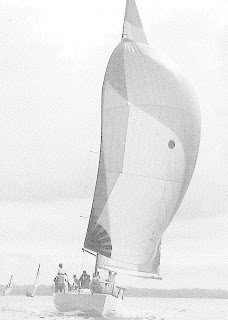
Full Pelt during the 1986 Sardinia Cup (photo Bruce Banks Sails/Seahorse)
Full Pelt narrowly missed selection for the British team for the 1987 Admiral's Cup, with Flying Dutchman helmsman Joe Richards at the helm. After good early season performances, she lost impetus after losing her mast in the De Guingand Bowl event, the first race of the trials, allowing Jamarella and Juno to make the running. 
Full Pelt during the 1987 Admiral's Cup, as Irish Independent Full Pelt (photo Seahorse)
However, after sailing the Irish selection trials in the the chartered Irish Independent (ex-Mean Machine, ex-Rubin 85), Tom Power quickly negotiated a charter of Full Pelt when it became apparent that she was not going to make the British team. Power organised sponsorship with the Irish Independent newspaper, with the boat renamed as Irish Independent Full Pelt, and she joined another Dubois One Tonner, Jameson Whiskey and the bigger 34.2ft rating Turkish Delight (ex-Itzanotherpurla). She was skippered by Tim Goodbody as helmsman, but kept the bulk of Fein's original crew, including Dubois, Joe Richards and Graham Deegan.
Full Pelt in light airs and sporting her near transparent Banks no.1 genoa (photo Sailing Year 1987-88)
Irish Independent Full Pelt rounding Fastnet Rock during the 1987 Admiral's Cup - she made good time to the Rock and went on to win this ocean racing classic (photo by Michael Mac Sweeney)
Full Pelt had a somewhat average Admiral's Cup series overall, with results during the inshore and Channel Race of 13/15/18/31. However, she found her legs in the Fastnet race finale - Full Pelt two-sail reached to the Fastnet Rock along the rhumb line, while those who went west looking for a forecast windshift sailed needless additional miles. Unfortunately, as the main prizes were not at that time awarded to sponsored yachts, the Fastnet Trophy was awarded to second-placed Juno. Nevertheless, this result lifted her final placing to fifth overall, and elevated the Irish team to fourth overall. An interesting and recent postscript to Full Pelt's Fastnet Race achievement, and a late award of first place, can be seen here.
Irish Independent Full Pelt seen here in Queen Annes Battery Marina in Plymouth after winning the 1987 Fastnet race (photo Shockwave40 blog)
Full Pelt seen here in Sandhamm, Sweden, before the 1988 Gotland Runt offshore race (photo Facebook)
Full Pelt seen here racing in Kiel in 1989 (photo Bateaux magazine)
Full Pelt was acquired by Swedish yachtsman Bo Bernholm for the 1989 Admiral's Cup, sailing alongside the former New Zealand 43-footer Kiwi and Greve Duckula. The boat underwent a major refit, with a new mast and rigging, keel, rudder and deck layout for the series, but despite still being fast in light airs, she had a disappointing regatta, finishing in 38th place (of 42), with placings of 14/39/35/25/37/39. The Swedish team finished 12th overall.
Full Pelt was chartered for the Swedish team for the 1989 Admiral's Cup, seen here leaving Lymington Marina (photo Shockwave40 blog)
Her history from that time onwards is undocumented, but she has been featured recently on the One Ton Class Facebook page, and appears to have been upgraded and is now looking like new.
Full Pelt as seen in 2016 and following a recent upgrade, and below sailing off Denmark in 2017 (photo One Ton Facebook page)

As seen in July 2022, lying in Faaborg, Denmark (photo Facebook)

Full Pelt - May 2024 (photo Facebook)


Article updated June 2024

7 May 2015

Propaganda - found!

The legendary New Zealand yacht Propaganda has been found - thanks to a post on the One Ton Class page, it appears that Propaganda is located in Hakata, Japan (photo below, 2015, and photo left from 1995). The paintjob is a little different, but she still sports her original Sparcraft spars.

Propaganda, a Farr-designed One Tonner, was the top individual yacht in the 1987 Admiral's Cup, and formed part of the winning New Zealand team of that year, along with Kiwi and Goldcorp. She went on to win the 1988 One Ton Cup in convincing style, before again competing for New Zealand in the 1989 Admiral's Cup.

The history of Propaganda over the 1987-90 period can be seen here.


Update November 2015 - Propaganda has now been bought by a US sailor based in South Korea, as part of the "Elephant Lightning" racing team. and she is now located in the island of Jeju.


Further update photographs August 2021, now looking a bit worse for wear:


Updated August 2021


28 August 2014

One Ton Cup 1988

The 1988 One Ton Cup was hosted by the St Francis Yacht Club in San Francisco during 3-15 September. The One Ton fleet (30.5ft IOR) had over the preceding years been the most competitive and best supported class in ocean racing, and the Cup was attracting the most sophisticated boats and best crews around. 

The fleet in San Francisco numbered 25, with the Farr office responsible for the design of ten of the boats. The defending champion, the Crown Prince Harold of Norway, arrived in San Francisco early with his yacht Fram X which had won the 1987 even held in Kiel, Germany, and remained a serious contender a year later. Other top boats included Bravura, a new 1988 Farr design under the direction of Geoff Stagg and a Farr works team. Bravura had taken top honours at the Kenwood Cup in Hawaii a month earlier. Another entrant that arrived from Hawaii was Australian Gary Appleby's Sagacious V, a veteran of the 1986 Southern Cross Cup and 1987 Admiral's Cup.
Propaganda - 1988 One Ton Cup winner
The New Zealand challenge was spearheaded by Propaganda, the top scoring boat in the 1987 Admiral's Cup which was by this time owned by a syndicate of Tim Bailey, Michael Fay and David Richwhite. Propaganda had not raced since the Admiral's Cup and instead had been tuned in Auckland with sistership Fair Share, and had been given a new keel and rudder prior to the series to try to improve downwind performance. Propaganda was skippered by Rick Dodson, and included US sailor John Bertrand who provided excellent local knowledge.
Startline action during the 1988 One Ton Cup
Other notable entries included the 1983-era Pacific Sundance, skippered by Chris Dickson, and local entry Pendragon, a Davidson design skippered by Kimo Worthington.
Part of the 1988 One Ton Cup fleet - Propaganda just to the left of KA-Sm-6 has an average start but will soon be up with the leading bunch.
The first inshore race was held inside San Francisco Bay in typically perfect conditions for which the Bay is known, but working the shore of Angel Island in the adverse tide on the upwind legs was critical. By the second to last beat Pendragon and Propaganda were leading and engaging in a close duel barely feet apart and taking each other into the middle of the course and into the current. Pacific Sundance was able to take advantage and lead around the penultimate weather mark, and it wasn't until the final beat was able to move into the lead, winning by 20 seconds, with Pacific Sundance second and Pendragon third.
Challenge 88 to windward of Propaganda during the 1988 One Ton Cup

Victoria (left) and Propaganda run downwind ahead of the chasing pack
Bravura
The second race, the long offshore, took the fleet under the Golden Gate Bridge and out into light and shifty coastal waters, and on a large ocean triangle course of around 150 miles (with the Farollan islands acting as a wing mark), followed by a smaller triangle of 75 miles and then back into the Bay to finish off the Yacht Club. This proved to be more a test of nerves and frustration than sailing skill. Sagacious V lead the fleet after 50 miles, from Rush (ex-Jamarella) but with Fram X and Propaganda close behind. But during the night Propaganda had played the shifts to perfection and moved up to second, and managed to round the Farollan Islands without coming to a standstill and put a large gap between Sagacious and the rest of the fleet. For the rest of the race Propaganda was on her own, managing to keep moving in the very light air and finishing just before the ebb tide became too strong - Sagacious was shut out and Propaganda finished the race 8 hours ahead. Fram X came in third, followed by Pendragon.
Propaganda heads upwind and avoids a competitor's errant spinnaker
Conditions could not have been more different for the third race, the second inshore, with 25-30 knots blowing against the tide and forming short sharp seas. Pendragon was an early casualty, breaking her boom after throwing a covering tack over Propaganda. The fleet was closely bunched at the weather mark and while Sagacious was in the leading bunch her mast failed soon afterwards. Both Bravura and Fair Share managed to blow out spinnakers on the downwind legs, while top marks for presentation went to British entry Juno for showing her entire keel during a wipe-out at the gybe mark. 
An unknown competitor grapples with its spinnaker
As in the first race, the Angel Island shore was again paying in the strong tidal conditions, forcing a line of port tackers up the first half of the weather legs. Propaganda had an immense tussle with the Takai design Victoria, just taking the lead after the final bottom mark and stretching away to win by a minute after Victoria broke her boom. Skedaddle, a Reichel-Pugh design, came in second, followed by Bravura and Fair Share.

After three races Propaganda was the clear leader going into the fourth race, the 150 mile short offshore. Given the light conditions for the long offshore, the race committee elected to reduced the length of the race to 139 miles, but with just 70 miles outside the Bay, and the remainder within the Bay, taking the competitors right up into the container areas and the eastern end of the Harbour, where there were still light and shifty breezes, and periods of total calm. In fickle conditions Fram X (left and below) and Propaganda finished 11 and 12th respectively, although Propaganda had been lying in 15th for a time.
Fram X on a downwind run and to leeward of Pacific Sundance (photo One Ton Class Facebook page)
Sagacious loses her mast in the third race
Despite the trials of the offshore races, most competitors were happy to this point with the organisation of the regatta. The checking of yachts was conducted on a random basis both before and after races, and involving checks of sails, freeboards and the internal positioning of gear by very thorough measurers - the race committee working hard to prevent a repeat of issues in Kiel the year before. However, most thought this thoroughness went too far when both Sagacious and Black Jack were precluded from installing their spare rigs following their breakages, and forcing the crews to repair the broken ones. Pendragon was unable to fix their boom in time for the short offshore and so had to miss the race.

The final race was again held in 18-20 knots, and saw Fair Share jump out to an early lead. Skippered by Russell Coutts, Fair Share was improving throughout the series and was clearly on form by the closing stages. She ended up covering Bravura and Pacific Sundance which let Propaganda sail her own race and go on to win by over a minute. With a 1/1/1/12/1 record, Propaganda won the series by a comfortable margin on 142.25 points, with Bravura second on 121.5, Fram X third (118.5), followed by Team Cirkeline, Sagacious and Fair Share. The first non-Farr boat was Challenge 88 in seventh place, a Bruce Nelson design.
Fair Share sails past Alcatraz
Propaganda's dominance was due to a number of factors. Much care was taken to develop her keel and rudder shapes to provide better all round performance to balance out the blistering upwind speed that she had at the Admiral's Cup. The boat and crew arrived early in San Francisco and spent a full ten days fine tuning the mast and rigging for the conditions and sail testing against Fair Share. Significantly, the crew found that their Sparcraft mast was flexing too much in San Francisco's 25 knot winds, and so extended the jumper struts and replaced the rigging with cobalt rod to limit stretch - the resulting more powerful and stiffer rig showed its worth from the first race onwards. 
Bravura
Missing the Kenwood Cup series allowed the Propaganda crew to focus on the One Ton Cup, and avoided issues such as those that beset Juno which suffered a collision at the earlier regatta, and winners of the regatta Bravura were perhaps left with a false sense of security. Challenge 88 had had to scramble to make it to San Francisco after winning their victory at the Canada's Cup. 
Juno has a spectacular wipe out during one of the windy inshore races during the 1988 One Ton Cup (photo One Ton Class Facebook page)
Sagacious (left) follows Victoria into a gybe mark
The crew work was excellent and all of them had raced with skipper Rick Dodson which allowed fine tuning of the yacht to take precedence over crew work. The combination of John Bertrand as tactician and John Newton as navigator was also a great asset, with the boat sailed on a consistent and percentage basis, with no protests and no close incidents which allowed the crew to keep sailing the boat at its fastest. 

Bodacious (US Farr 40) - under control above, but less so below (with Brazil's Black Jack to the left)

It was, overall, a remarkable performance, equaling the four-win record set by Chris Bouzaid in another famous New Zealand yacht, Rainbow II, which won the Cup in 1969. Afterwards, Propaganda co-owners Fay and Richwhite announced their intention to build a second, larger Farr design to campaign alongside Propaganda in the New Zealand team for the defence of the Admiral's Cup in 1989 - that boat would be known as Librah. Propaganda and Fair Share stayed in San Francisco for the 1988 Big Boat Series, where the ever improving Fair Share turned the tables on the One Ton Cup winner to take second place behind Pendragon, with Propaganda third.
The One Ton Cup

Results (top 10)

1. Propaganda (NZL) - Farr - 142.25pts
2. Bravura (USA) - Farr - 121.50
3. Fram X (NOR) - Farr - 118.50
4. Team Cirkeline - Farr - 114.50
5. Sagacious V (AUS) - Farr - 112
6. Fair Share (NZL) - Farr - 106
7. Challenge 88 (USA) - Nelson - 103
8. Pacific Sundance (NZL) - Farr - 98
9. The Esanda Way - Davidson - 90
10. Skedaddle - Reichel-Pugh - 84

6 October 2013

Librah (Farr 44)

Librah was a Farr 44-footer, designed to fill the 'big boat' slot for New Zealand's hoped-for defence of the Admiral's Cup team in 1989. She was commissioned and owned by banking merchants Michael Fay and David Richwhite, who by this time were well known in sailing circles following their sponsorship of Lion New Zealand in 1984-85 and the New Zealand America's Cup effort in 1987. Librah was named after the owners' wives, Sarah and Libby.

With few boats remaining in the New Zealand IOR fleet, it was fortunate that Propaganda and Fair Share, the latter an unsuccessful trialist in 1987, were able to be counted on as the nucleus of a defence team. After much analysis of RORC's new time multiplication factor (TMF) by the New Zealand team, in conjunction with the Farr office, Fay and Richwhite elected to proceed with a 44-footer, as a 50-footer was seen as too much of a risky proposition. 

Librah under construction at Marten Marine
Librah emerged as a highly refined mid-sized yacht, encompassing an extremely aggressive approach to weight saving in all departments, and the use of many small-boat systems in her set up. Her high tech construction and weight savings led to the achievement of a reported 75% ballast ratio. 
Librah works up in light airs on Auckland Harbour in preparation for the 1989 Admiral's Cup (photo Seahorse)
The clean and efficient deck layout of Librah, with her team-mate Propaganda in the backgound
The yacht was long and narrow for her rating of 34.43ft, aimed at fast running and reaching, with a slight reduction in sail area in compensation. She had a very fair overall shape, as a result of changes to the IOR in 1989 in response to increased measurement stations which reduced the bumping encouraged under earlier versions of the rule. 
Librah during early sailing trials in New Zealand
In a trial series held just after her launching, and with an expert team led by Peter Lester with Rod Davis as tactician, Librah was able to more than hold her own against her smaller opposition. She went on to perform strongly at a pre-Admiral's Cup series, the Lymington Regatta, establishing herself as a clear contender for possible top honours in the Admiral's Cup
The Librah crew in action as they go into a gybe set
The Librah crew set the spinnaker soon after a windward mark rounding in the 1989 Admiral's Cup (photo Roger Lean Vercoe)
In the end, however, New Zealand's defence fell short, although Librah finished an impressive third place overall, with consistent individual race placings of 2/11/7/12/6/6. She was clearly the leading mid-rater in the fleet, suffering from only one error, and that was in race four when Lester and Davis misjudged the tide at two marks and never really got into full swing. Librah was the only yacht to break up the otherwise complete takeover of the series by the new generation 50-footers.
Librah has a good start in this race during the 1989 Admiral's Cup (above), to leeward with clear air
Librah sails upwind during the 1989 Admiral's Cup (photo Seahorse)
The RORC had changed the TMF to give some easement to the bigger boats following near domination by One Tonners in earlier editions of the Cup, and to reduce the points loading for the offshore races. Combined with a significant jump in the performance of the 50-footers, the Cup became something of a bonanza for the bigger boats and was instrumental in Britain's victory in the regatta, with the standout Farr 50 Jamarella taking out the top individual yacht honours. 
Librah showing her windward form during the 1989 Admiral's Cup
The 50-footer equation was a major factor in New Zealand's failure to successfully defend the Cup won so convincingly two years prior. Had the 1987 TMF and points loadings remained in place from that earlier series, New Zealand would have won again, and Librah would have been the top individual performer by a comfortable margin. In the circumstances, however, New Zealand was never going to win without an Admiral's Cup 'maxi', so it achieved everything it realistically could in its third place finish.
Librah in close mark rounding action during the 1989 Admiral's Cup (photo Leon Sefton)
But it was also generally considered that its campaign was not as polished as that in 1987 and while Librah's campaign was almost flawless, those of Propaganda and Fair Share did not meet the high standards the Kiwi's had set themselves, finishing 19th and 14th respectively. Unfortunately too, 1989 would be the last of New Zealand's Admiral's Cup efforts. 
Librah as Swing, seen here winning the 1989 Japan Cup (photo Offshore magazine)
Librah was bought by a Japanese yachtsman and was renamed Swing - she won the 1989 Japan Cup Offshore Series, ahead of Arecan Bay (Farr 40) and Aphrodite (a Farr Three-quarter Tonner). She went on to compete in the Japanese 'Blue' team in the 1990 Kenwood Cupalongside the One Tonner Will and the 50-footer Tiger. She finished first in Class D and ninth yacht overall (with placings of 11/5/10/15/14/6), contributing to the team's overall win, Japan's first team victory in an international ocean racing championship.
Swing (J-3553) can be seen here approaching the wing mark during an inshore race in the 1990 Kenwood Cup (photo Guy Gurney)
Her whereabouts after the 1990 Kenwood Cup are not known. She was replaced by a new Swing, designed by Judel-Vrolijk, which competed for Japan in the 1992 Kenwood Cup.


Article updated May 2025