Showing posts with label Gunboat Rangiriri. Show all posts

29 August 2019

The end of the IOR

I recently came across an article penned by well-known yacht designer Julian Everitt and which had been shared to the One Ton Class Facebook page. Julian has been kind enough to allow me to publish his insightful and thought-provoking article here (to which I've added a few images):

A while back David Macfarlane posed the question: “Why did the IOR die?” The answer is surprisingly simple and has little to do with economic downturns, crazy, escalating costs or the perception that the boats were unseaworthy and slow.

 Australia's Ragamuffin during the last Admiral's Cup under IOR in 1993, not long before the eventual demise of the IOR altogether 
The very people, the members of the International Technical Committee (ITC), who were tasked to protect and develop the rule for the benefit of the owners signed the death warrant some six years before the beast was finally deemed extinct. It wasn’t a deliberate act, by any means, it was just kind of allowed to happen as interests grew in the development of a new ‘super’ rule that would cure all the ‘ills’ of offshore handicapping. It was called IMS. The International Measurement System.

IMS was very much an American based initiative formulated by a burgeoning interest in the power of computers as envisioned by ‘idealists’ at the Massachusetts Institute of Technology (MIT). This belief in a ‘perfect’ system filtered into the ITC who then increasingly believed that IMS could replace IOR as THE rule for Grand Prix Offshore Racing. At a stroke IMS was perceived as a handicapping system that would allow the return of ‘wholesome’ cruiser racers to the Grand Prix level.

ILC40s, as a level-rating derivative of the IMS rule, seen here competing in the 1995 Admiral's Cup
The 1976 French cat rigged Mini Tonner L'Effraie
And so the scene was set for a showdown between the two rules. Funnily enough however, this ‘conflict’ largely took place behind closed doors - the closed doors of the ITC. This erstwhile Group of designers and boffins had done a reasonable job of helping to develop the original, Olin Stephens/Dick Carter created Mk 1 IOR, into an ever more complex Mk III IOR. They had dealt with the slings and arrows of ‘cat’ rigs, unballasted daggerboards, extreme overhangs, bumps, chines and many other rule dodgers thrown at it by a vast army of new, young designers. The rule really was the ultimate mathematical, but organic and holistic challenge imaginable and so it required a lot of policing and an awful lot of tweaking.
The Farr One Ton centreboarder, Jenny H, 1977
At the annual ITC meeting always held in November and euphemistically called The November Meetings informal submissions were invited from the ‘floor’ for what would eventually become IOR Mk IV. But the minds of the powers that be were elsewhere. Despite impassioned pleas from designers including Tony Castro, Geoff Stagg, representing Bruce Farr, the Dubois office, myself and several owners to use IOR as the ‘baseline’ for producing more user friendly designs, the ITC elected to promote IMS as the rule for the future. Gary Mull, chairman of the ITC at this time, seemed to be heavily influenced by a growing love affair from American designers, like Dave Pedrick, Bill Tripp and the ‘scientist’ Jerry Milgram, with IMS. Together they envisioned a new breed of fair hulled, moderate designs, with great stability, proper cockpits and fitted out interiors.

The IOR Mk IV, proposed from the audience at the 1988 November meetings promulgated similar outcomes, but utilising the proven and robust linear formulas of IOR rather than the largely unknown reliance on unproven Velocity Predictions inherent in the IMS formula.

Turkish Delight trying to stay on her feet during the 1987 Irish Admiral's Cup trials
In the proposed revisions to IOR, stability would be unmeasured getting rid, at a stoke, of the dreaded Centre of Gravity Factor - a measurement fraught with inaccuracies and held largely responsible for producing unstable boats and ones overly dependent on crew weight on the rail. CGF was also directly responsible for such undesirable idiosyncrasies as beam waterline bumps.

Gone too would be the ubiquitous 150 percent overlap on headsails which gave unrated sail area. This change would have opened the door to the development of non-overlap rigs.

Victory (left), Hitchhiker and Pinta sporting their big no.1 genoas during the first race of the 1981 Admiral's Cup 
The accursed creases and distortions around the aft girth measurements was to be addressed also. One simple suggestion was to rule out any form of reverse inflection in the aft profile. The days of the bustle were virtually over anyway and of course all of our proposed rule changes could be easily ‘grandfathered’ to prevent the existing fleet suffering too much. In reality small changes to the aft girth stations and most particularly the girth differences between inner and outer girth stations would have produced fuller, wider and fairer sterns in short order, while maintains an element of choice. Choice being a factor missing from today’s rules.

While the outcomes of such changes cannot ever be accurately predicted, cause and effect is highly influential in a formula like IOR. The simple removal of the penalty on stability would have quickly allowed designers to create lighter boats as stability could have been found in low CG keels rather than hull form and brute overall weight. In turn lighter and more powerful boats would have pointed the way to fuller sterns.

Gunboat Rangiriri - one of the new breed of Farr-designed light displacement centreboarders of 1977, showing the relatively clean lines that were possible before the ITC forced an increase in displacement
But the ITC very systematically destroyed these arguments as unworkable and felt IMS was a much more effective way of achieving the same outcomes. In fairness to the ITC a number of designers, including Rob Humphries - a member of the ITC board at the time - had IMS designs out racing that did showcase the rule rather well. But this was to be a short lived moment.

And so the ITC policy was set at that fateful November meeting in 1988. The two rules would run in parallel while the anomalies inherent in the VPP-driven IMS were sorted out and a new era of dual purpose offshore racers would begin.

Work would continue on the development of IOR, but with none of the suggested fundamental changes implemented. A Mk IV Rule was duly drafted, but few in authority had any real enthusiasm for it. As far as they were concerned IOR was dying and IMS was the new kid on the block to be nurtured.

The Whitbread Maxi ketch Steinlager 2 
In an earlier attempt by the ITC to be more inclusive of heavier, more cruising orientated boats an IOR MK IIIA was introduced, but this backfired spectacularly when Bruce Farr, in particular, exploited the carelessly drafted rule by producing the heavier, but much longer Steinlager 2 Whitbread Maxi in 1989. This amazing own goal of a rule amendment created by the ITC finally allowed the creation of the all conquering inshore Maxi Matador2. Far from allowing the development of heavier, more fitted out boats, the Mk IIIA rule simply promoted heavier stripped out boats which in the case of the Maxi’s allowed them to effectively gain 3ft, or so, of unmeasured length. This was one of many misdirections the ITC took in trying to ‘protect’ the rule and it had a seriously deleterious effect on owner confidence.
Matador 2, the biggest and fastest of the IOR Maxis 
But back to the ITC meetings of November 1988. I remember it like yesterday, Geoff Stagg’s final reaction to the ITC intragency. “We don’t really care what you do. Just give us any rule and we’ll go off and design winners for it”.

Gaucho (above and below)
And that is precisely what happened. Within two years Farr had produced the ultimate Grand Prix IMS boat in the form of the 43ft Gaucho. But it wasn’t the beginning of the new era predicted by the rule makers of elegance and internal comfort. Gaucho signalled a very different future. Her overhangs were very short, freeboard was high, the sheer line straight and the interior just as stripped as an IOR boat except for the introduction of a door on the ‘head’ compartment. Other required features like a galley and saloon table were treated with token gestures expensively built in carbon. But much more significantly, in order for velocity predictions to work ‘accurately’, actual stability had to be measured. It wasn’t long before lead was being replaced by wood at the bottom of keels. Not exactly the promised land of wholesome cruiser racers envisioned by the rule makers.

But while IMS continued to be promoted as the solution to ‘fair’ global offshore yacht racing IOR struggled on, shouldering virtually all of the blame for declining racing fleets.


I remember talking to Olin (Stephens) about it all. He was very sanguine - perhaps even a little surprised by the way IOR had developed, but ever the enthusiast for a mathematical solution he liked the theories behind IMS and perhaps felt that the apparent shortcomings in the IOR could be addressed more effectively by the overarching qualities of IMS. It was a mathematically-based theory that wasn’t born out in practice.

With the advantage of a 21st century perspective and taking into account yacht racing developments since the death of IOR in 1994, would keeping IOR been better for the sport as a whole? In terms of continuity and preventing the explosion of multiple, fleet sapping alternative classes, it would assuredly have been beneficial. But it did need a major shot in the arm at the end of the 1980s to reassure an ever more cynical owner base that their worries were being addressed.

Cookson's High 5 followed the Gaucho theme and was dominant in the 2000 Kenwood Cup 
In the rarefied atmosphere of Whitbread sponsored global racing, Bruce Farr, once again, showed the way. As IOR lay on its deathbed - an outcome accelerated by clumsy attempts to update events like the Admiral’s Cup with the proposed introduction of one designs and IMS handicapping - Farr, in tandem with the foresight of the Whitbread race committee who allowed asymmetric spinnakers to be flown, discarded the ‘heavy’ design route he had produced with Steinlager 2 and produced a new Maxi design that was some 7,500kgs lighter. This much lighter design was a great deal quicker around the world and potentially showed a new beginning for lightweight IOR racers. Sadly, however, these three Farr ketches, La Poste, Merit Cup and New Zealand Endeavour, were one of the last throws of the dice for IOR.
New Zealand Endeavour - one of three new Farr-designed Whitbread Maxi ketches for the 1993-94 race 
But back to theorising about where IOR could have led in design terms. Would keeping a highly modified version of the rule kept ocean racing on its feet? Would it have prevented the almost total demise of classic events like the Ton Cups, the Admiral’s Cup, the Kenwood, the Southern Cross, the Onion Patch, the SORC? Who knows? Maybe it was all about economics or personal time management, but what I do know is that the defining legacy of IOR was its success at global continuity in offshore racing. To have made the decision to ditch this in favour of a hugely more flawed IMS was a grave mistake.

Would a boat designed to an updated version of IOR as suggested back in 1988 at the ITC meetings evolved into something equivalent to today’s high performance designs as typified by the IRC racers, TP52’s and Fast 40’s? Yes. Is the simple answer. Advances in lightweight construction, appendage design, carbon spars would have all contributed hugely, but the biggest single factor effecting overall design and concept would have been the removal of attempting to measure stability. Just as is the case today, boats would not have become more stable, but would simply have become significantly lighter and capable of carrying larger rigs effectively. These are the primary elements driving the performance in today’s designs.


To have arrived at this point in the genesis of the offshore yacht within the IOR style framework would have resulted in far more fleet continuity across the globe and possibly allowed the major offshore championships to survive the various financial challenges and rule uncertainties that killed them off.


Julian's article concludes with the above image of his 43 footer Backlash, with the caption "It's not easy to pick a single picture that represents the entire IOR era from 1970 to 1994, but this comes from a high point of the rule in 1985. Fleets were huge and there was enormous variety of design from a multitude of designers".


Article dated August 2019

22 May 2019

Italian Half Ton Cup 2019

From May 9th to 12th the Italian Open Half Ton Classics Championship was held on May 9th to 12th, hosted by the Tecnomar Nautical Club in Fiumicino. This year's event was attended by two strong foreign crews, an Irish team led by David Cullen, winner of the last Half Ton Cup, who chartered local boat Gunboat Rangiriri from Claudio Massucci, and the Finnish and Belgian team of Toni Stoshek who brought his fast Superhero (photo, right) to Italy for the series.
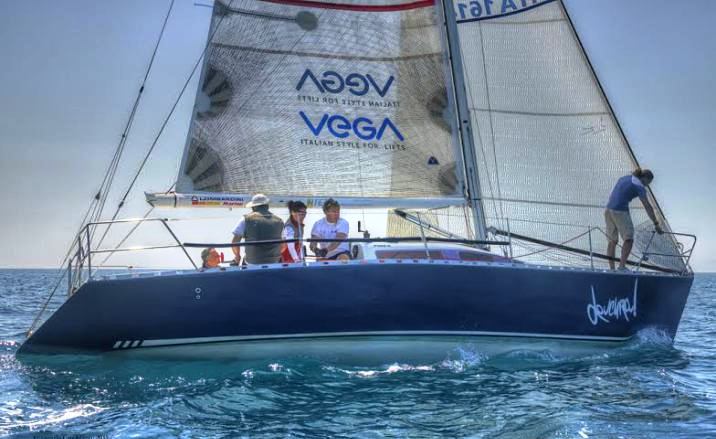
Claudio Massucci's Gunboat Rangiriri- chartered by the Dave Cullen's Irish "Checkmate" team for the 2019 Italian Half Ton series
There was a modest fleet of ten boats, most of whom were largely original but Superhero has been modified and is now a “modern” Half Tonner so was the expected winner being only one of its type at the regatta. Massucci has taken great pride and effort to keep Gunboat Rangiriri in its original configuration and so she still sports running backstays, and a centreboard.
Superhero chases Gunboat Rangiriri during the Italian Half Ton series
Conditions on the first day forced the race committee to cancel the scheduled races, but three races were held on the following day in winds between 8 and 12 knots. This saw close racing between Gunboat Rangiriri, Superhero, Pili Pili (Gorgio Martini) and Stern (Massimo Morasca), with the Irish crew posting 3,1,1, against Superhero's 1,3,2 and Pili Pili's 2,2,3, while Stern couldn't break past fourth place.
The start of the long coastal race, with the Elena Celeste in the foreground
The next day was the 22-mile Long Coastal Race with a points loading of 1.5 and was also the first round of the traditional Tiber Grand Prix event dedicated to all IOR boats. Light winds from the south-east allowed for timely start in which Gunboat Rangiriri and Stern took an early lead, with Superhero and Pili Pili lagging behind. Gunboat Rangiriri rounded the buoy in front of Ostia first, after a five-mile haul, followed by Stern,Superhero, Pili Pili and Prydwen (Davide Castiglia, with Gunboat's Massucci also on board).
Superhero (left) and Massimo Morasca's Stern round the mark off Ostia during the long coastal race
In the following leg of 11 miles and at the next mark off Fregene Superhero and Pili Pili pulled through to match the early leaders, with Prydwen also threatening the front boats. The breeze dropped for the final 6-mile beat, into adverse current from the nearby mouth of the Tiber. Superhero managed to control their opponents and took the race win, followed by Pili Pili and Gunboat Rangiriri.
Gunboat Rangiriri being worked up between races by her Irish crew
To take the Cup, Cullen and his crew needed a win in the last race, a short coastal race of 11 miles, with Superhero third. In winds starting at 2 knots and finishing in 16, it looked like Gunboat Rangiriri had pulled it off and were congratulated by Superhero. As the crews packed up their boats, Prydwen came in to take the win on corrected time to take away Gunboat Rangiri’s victory - but it was a bittersweet win for Massucci,Gunboat Rangiriri’s owner, who was sailing on Prydwen and ended up having a hand in scuppering his own boat’s victory.
Prydwen - fifth overall, but winner of the final race, the short offshore
So the Italian title went to Superhero in first place overall, and also collecting the Half Ton Europe trophy and the coveted challenge cup "Peppino Morasca" for line honours in the Long Coastal Race. Pili Pili received the Challenge Half Ton Class Italia Trophy for victory in the Italian Campinato.
Pili Pili, took third overall 
Visit the Half Ton Class Italia website here, and a story on the event on the Irish "Afloat" website here.

1 July 2015

Italian Half Ton Classics 2015

Gunboat Rangiriri, the legendary and revolutionary Bruce Farr-designed Half Ton world champion in 1977, has won the 2015 Italian Championship Half Ton Classics. Gunboat Rangiriri owned and skippered by Claudio Massucci with tactics from Palermo Maurizio D'Amico and the sailmaker Antonio Incarbona dominated by winning six of the seven races, in a well organised series run by CVFiumicino that attracted eight Half Tonners. 
Claudio Massucci's Gunboat Rangiriri - winner of the Italian Half Ton Classics Cup 2015
Loucura, the Farr 31 owned Fabrizio Gagliardi, finished in second place, and benefitted from tactician Pino Stillitano's knowledgeable of the course off Fiumicino. In third place was Stern-Pragma Multimedia (Morasca / Orestano / Sorge), the former Stern Weber designed by G.Ceccarellli in 1987 and third in the Half Ton Cup in the same year, and assisted by sailmaker Alessandro Scarpa. Her overall points tally was affected by a poor sixth place in the long race.
Defending champion Loucura finished second in 2015
In fourth place was the Vallicelli designed Moments, which has been recently restored by owner Luciana Morino, and helped on the first day of racing by the Olympic yachtsman Gabrio Zandonà. Eulimene, the Comet 303 (Pietro Fois), was well sailed by Francesco Codacci, taking an excellent third place in the long race.
Stern-Pragma Multimedia finished third
Charts and other news is here, and some video footage of the racing is here. Photos by Christophe Julliand.

Loucura leads off the startline, ahead of Cicci 7
Moments finished fourth overall
Gunboat Rangiriri to weather of Stern-Pragma Multimedia
Gunboat Rangiriri rounds a weather mark
Prydwen (Davide Castiglia), a Ziggurat 9.10, finished seventh overall

12 June 2015

Italian Half Ton Class - Asteria Cup 2015

The Italian Half Ton fleet have had a recent warm up for their National Championship during the five race Asteria Cup held from 30 May to 2 June.  This was won by the Farr design Loucura overall on IRC (Fabrizio Gagliardi), following a 1/2/2/2/1, and confirming victory after the final race by one point over Claudio Massucci's Gunboat Rangiriri (3/1/1/1/2), another Farr design, by just one point, with Moments (Luciana Morino) taking third (2/3/4/4/3).  

Loucura - winner of the 2015 Asteria Cup (photo Half Ton Class Italia)

The series started with a 115 mile long race, from Anzio to Ponza and Ventotene which carried a 1.5 points loading. Two days were allowed for this race, but was completed by Stern-Pragma Multimedia in just 25hr 40m, just 8 minutes ahead of Loucura, which took out the win on corrected time. This was reported in the Italian Half Ton Class website as "A beautiful route between the most beautiful islands in the Mediterranean with a sunset to remember and an exciting step in Ventotene, the wind on 8 knots allowed good speed and continued to blow the night allowing a good upwind in the ascent towards Anzio". 
Gunboat Rangiriri has a good start in the mixed IRC Class 1 and 2 fleet
However, the breeze faded at Circeo and that was the turning point of the race.  Loucura choose the edge on the ground, while Gunboat Rangiriri stood off, Stern-Pragma Multimedia held between the two, followed by Moments. Stern gained the wind from the west first, but it was not enough to overcome the time allowance for Loucura, which also finished third in the overall IRC fleet. 
Gunboat Rangiriri finishing a race in first place in the earlier Anzio Winter Cup
The two days of racing following the long race involved inshore races in breeze of between 5 and 10 knots with smooth seas. Gunboat Rangiriri carried sailmaker Antonio Incarbona and tactical Maurizio D'Amico aboard and demonstrated incredible pace, winning three races and just missing a fourth win to Loucura by two seconds. Some new sails are planned for Gunboat Rangiriri which should fill the gap in her wardrobe and see her become even faster.
Moments during the 2015 Asteria Cup
The 2015 Italian Half Ton National Championship will be held in Fiumicino on 24-28 June.
The Ceccarelli designed Stern-Pragma Multimedia finished fourth overall with placings of 4/4/3/OCS/4


4 January 2015

Screw Loose (Holland Half Tonner)

With the success of Wild Rose in the 2014 Sydney-Hobart race, and favourable conditions that led to the predominance of the smaller and mid-sized yachts in the corrected time results, it is perhaps timely to recall a much earlier edition of the race when lighter winds had also brought success to those yachts at the back of the fleet. Screw Loose, a production Holland-designed Half Tonner, just 30 feet long (21.7ft IOR), was the smallest yacht to ever win the Tattersall's Cup in the benign conditions that characterised the 1979 Sydney-Hobart race.
MASH leaves the Mundle factory at The Spit, Sydney (photo courtesy Michael Spies/Doug Sharpin)
Screw Loose had started life as MASH, a customised Holland Half Tonner built by Doug Sharpin (from the 'Golden 30' mould) for the 1977 Half Ton Cup. She was built in lightweight vinylester at Rob Mundles facility at The Spit in Sydney Harbour, and was given a taller rig than her production sisterships, with a double spreader spar supported by running backstays. The name MASH was an acronym of Mundle, Anderson (John Anderson, the 1972 Gold Medalist in the Star class and North Sails representative), Sharpin and Holland.

However, by the time of the the 1977 Cup series, held in Sydney, her design features of moderate to heavy displacement, masthead rig and narrow stern, that had been a successful combination in the 1976 Half Ton Cup, had been outclassed by the new fractional-rigged centreboarders in the 1977 series. MASH was well off the pace and finished a lowly 12th place overall (the Cup was won that year by Farr's Gunboat Rangiriri, while a Holland design Silver Shamrock III finished a close second). The boat was considered too light (relative to its designed displacement), and lacked stability and suffered upwind. Some improvements were achieved when the crew carried lots of drinking water in the bilge.
MASH is seen here at Rob Mundle's facility at The Spit, alongside a standard production Holland 30 (photo courtesy Michael Spies/Doug Sharpin)
Tasmanian sailor Bob Cumming bought MASH in late 1978, for just under $30,000, for local offshore racing (and re-named her Screw Loose), but was told by the Ocean Racing Club of Victoria (ORCV) that they would not accept its entry for the annual race across Bass Strait, as ORCV officials did not consider the yacht sufficiently seaworthy for the potential rigours of such a crossing. It is understood that the boat had suffered some gear failures in her early days, and the ORCV may have been aware of this. However, Cumming set out to prove them wrong, and strengthened the hull with additional ring frames and put in his entry for the 1979 Sydney-Hobart. Six weeks before the Sydney-Hobart, and after her entry had been accepted by the Cruising Yacht Club of Australia (CYCA), Screw Loose developed a serious leak in an overnight club race from Cumming's home club at Devonport (on the north coast of Tasmania). Although the yacht was the subject of a search and rescue operation, she managed to make it to port without outside assistance. 
Screw Loose charges downwind under spinnaker and blooper (photo courtesy Michael Spies/Doug Sharpin)
It is apparent that had the CYCA been aware of some parts of Screw Loose's history, she may never have been accepted as a starter in the Sydney-Hobart, particularly in the period soon after the 1979 Fastnet race disaster. The CYCA was unaware that Screw Loose was the former MASH, nor did they know of the rejection by the ORCV for its entry in the Bass Strait race, nor of the serious leak and subsequent seach and rescue alert during the Devonport club race.  A special committee did screen all entries, but somehow Screw Loose slipped under the radar, although one or two other entries were rejected. As it turned out, light conditions meant that Screw Loose or other yachts avoided any problems, but had there been a blow it could have been a different story (a similar type of oversight occurred with tragic consequences for the yacht Business Post Naiad in the stormy 1998 race).

But as journalist Peter Campbell reported at the time, none of that background should detract from the sailing skill and fine seamanship demonstrated by Cumming and his crew, who sailed Screw Loose brilliantly. They sailed the boat to the limit as the fleet came surfing southwards before a continuing nor'easter which gave them a spinnaker run for almost the entire race.
Screw Loose at the Sydney-Hobart race start (photo Histoiredeshalfs)
It had been the Frers-designed maxi Bumblebee IV that took line honours in the race (against a then record of 147 entries), and initially looked to have no chance on corrected time. But as thick fog continued on the Tasmanian east coast, and the fleet ran into lighter and lighter winds, her prospects for the line and handicap double began to improve dramatically. Bumblebee IV held her time against the bigger Admiral's Cup yachts, then the Two Tonners and One Tonners, until the Half Tonners began to sweep across Storm Bay and up the Derwent before a fresh sou' easter.

Cumming and his crew finished almost a day and a half after Bumblebee IV (in four days, 23 hours and 3 minutes), taking almost 109 hours to complete the journey, with an average speed of 5.76 knots, to claim her Sydney-Hobart victory. She scored a narrow four minute win over Sydney yacht Wheel Barrow, a Carter 30, followed by Tasmanian Half Tonner Apali taking third another six minutes later. In the cold morning hours and through to dawn the Half Tonners kept crossing the finish line and Bumblebee IV slipped further down the list on corrected time, finally finishing 15th overall. Half Tonners took out the first eight places, and 11 of the first 15 places. Such a sweep of the results by small yachts would not be repeated in later editions of the race, although the later Half Tonner Zeus II (Peter Joubert design owned by Jim Dunstans) won in 1981. Screw Loose was also the first Tasmanian yacht to win the race on corrected time since Westward won in 1948.

Screw Loose was later owned by Wayne Brighton in the mid to late 1980s and was the New South Wales Division 3 (displacement) JOG champion. The boat was then sold to Chris Walmsley in 1988, who also campaigned Screw Loose with some success in Papua New Guinea. She made the trip from Cairns to Port Moresby without mishap, but lost her mast during a coastal race in Moresby. The boat was hard running when the rig went over the bow. The rig was retrieved and repaired with an internal sleeve, and the crew were back racing in a couple of weeks.
Screw Loose circa 2010 (photo mysailing.com.au)
The distinguished history of Screw Loose had become a distant memory by 2010 by which time the Hobart champion had became a roost for resident sea birds in the Royal Papua Yacht Club Marina in Port Moresby, and appeared somewhat neglected. Fortunately, it was reported in 2011 that a new owner had decided to refurbish the yacht in Airlie Beach, and fit her out as a comfortable cruising sloop. It is not known if the refurbishment was completed.

Sources:

This article has been compiled from a variety of sources including Peter Campbell's article 'Surprise victory for a Half Tonner', The World of Yachting 1980-81, Editions de Messine, Paris;  'Tiny Sloop Packs Mighty Wallop', The Age, 1 January 1980; Michael Spies and Doug Shaplin; and 'Screw Loose sails again in the Whitsundays', Ian Grant, mysailing.com.au (13 Sept 2010).

30 October 2014

2269 - Sailing Again

The restoration of the Farr Half Tonner 2 Farr (the ex-2269 from the 1977 Half Ton Cup series, and sistership to Gunboat Rangiriri and Swuzzlebubble), has recently been completed and she was re-launched in early October 2014.
The restoration of 2 Farr has been a long project for her Australian owner Will Baum, who saved the yacht after she was wrecked on a Melbourne beach.
2 Farr had her first sail in October 2014 (the 'G' on the sail denotes the Royal Geelong Yacht Club).
A more recent photograph from 2021 (via Facebook) is shown below, indicating a new mast has been fitted (higher forestay and no jumpers) and a new set of sails.

The history of the yacht can be seen here.

Two Farr, racing in Ireland in 2024 (photo Robert Bateman | Afloat magazine)
More recently, Two Farr has been sold to Irish sailing interests, and has now joined other refurbished Half Tonners, including Swuzzlebubble, in local racing. With an IRC rating of 0.955, and still retaining her original '2269' sail number (with Irish registration), she finished tied on points (but second on countback) to Swuzzlebubble in the IRC2 division of the Wave Regatta, hosted by the Howth Yacht Club in late May 2024.
Two Farr and Swuzzlebubble - back on the same race track again after some 46+ years (photo 'cill123', Sailing Anarchy Forums)


Article updated May 2024

Halfton Class Italia

After the 2014 Laser Masters Worlds in France I travelled to Rome and had the opportunity to have a look at a few Italian Half Tonners, while my family and I enjoyed the hospitality of the Massucci family (Claudio and Roxana) who own the ex-New Zealand Farr Half Tonner Gunboat Rangiriri.

Gunboat Rangiriri - October 2014
Unfortunately Rangiriri's engine was being repaired, having developed a serious fault just before I arrived, so I wasn't able to get out for a sail on this iconic yacht. However it was great to see this Rangiriri in largely original condition, with some adaptations for cruising but otherwise looking almost as she did when she won the Half Ton Cup in 1977. She still sports the name of the Royal Akarana Yacht Club (Auckland) on her transom, and the owners are keen to reinstate the Maori 'tiki' emblem that was also originally painted on the other side of the stern.

Further down the coast, in Anzio, a couple of other Half Tonners had assembled at the marina off Anzio Yacht Club, being the Farr 31 Loucura, winner of the Italian Half Ton Nationals in 2013 and looking in immaculate condition, and the Ceccarelli designed Stern (ex-Stern Weber which finished third in the 1987 Half Ton Cup) - a replacement for Massimo Morasca's 2014 winning yacht Elana Celeste. Other Half Tonners were expected to arrive over the week for an upcoming regatta off Anzio.
Aboard Loucura with Claudio Massucci (left, Gunboat Rangiriri) and owner Fabrizio Gagliardi (right)
Aboard Stern with her new owner Massimo Morasca
While at the Anzio Yacht Club I had the unexpected honour to be presented with a burgee and other official mementos of the Halfton Class Italia, by Massimo Morasca (Class President) and  Marina Maffei (Class Secretary, Prydwen), in appreciation of the coverage of the Association's national regattas on this website. I look forward to seeing the Italian fleet develop further and will watch their results with interest.
Stern competing in the Half Ton Cup in 1987
The Halfton Class Italia burgee