Showing posts with label 2269. Show all posts

30 October 2014

2269 - Sailing Again

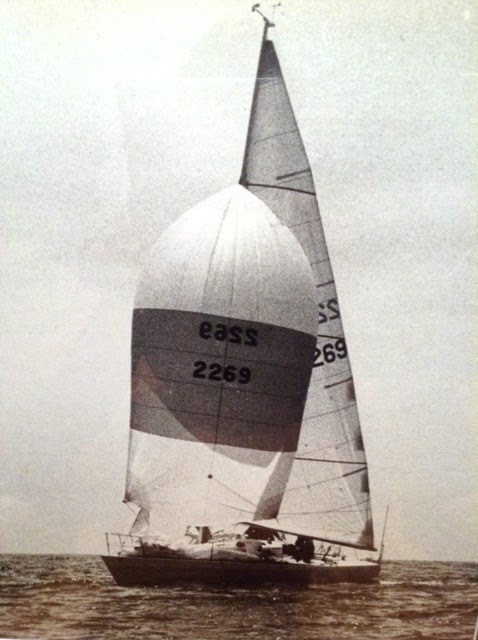
The restoration of the Farr Half Tonner 2 Farr (the ex-2269 from the 1977 Half Ton Cup series, and sistership to Gunboat Rangiriri and Swuzzlebubble), has recently been completed and she was re-launched in early October 2014.
The restoration of 2 Farr has been a long project for her Australian owner Will Baum, who saved the yacht after she was wrecked on a Melbourne beach.
2 Farr had her first sail in October 2014 (the 'G' on the sail denotes the Royal Geelong Yacht Club).
A more recent photograph from 2021 (via Facebook) is shown below, indicating a new mast has been fitted (higher forestay and no jumpers) and a new set of sails.

The history of the yacht can be seen here.

Two Farr, racing in Ireland in 2024 (photo Robert Bateman | Afloat magazine)
More recently, Two Farr has been sold to Irish sailing interests, and has now joined other refurbished Half Tonners, including Swuzzlebubble, in local racing. With an IRC rating of 0.955, and still retaining her original '2269' sail number (with Irish registration), she finished tied on points (but second on countback) to Swuzzlebubble in the IRC2 division of the Wave Regatta, hosted by the Howth Yacht Club in late May 2024.
Two Farr and Swuzzlebubble - back on the same race track again after some 46+ years (photo 'cill123', Sailing Anarchy Forums)


Article updated May 2024

17 April 2014

Swuzzlebubble - the transformation

Ian Gibbs' original Swuzzlebubble, a Farr designed Half Tonner, was designed and built to contest the 1977 Half Ton Cup, where she represented New Zealand and then went on to form part of New Zealand's winning three-boat team in the 1977 Southern Cross Cup. Later she competed in the 1979 Half Ton Cup, and the history of that period can be seen here.

Swuzzlebubble during the New Zealand Half Ton Cup trials in 1977
As found in Greece, 2012
Swuzzlebubble was found in 2012 by Peter Morton (of Anchor Challenge and Bullit fame) in a very sorry state in Rhodes, Greece. Her hull was largely intact, although the bow was damaged and her keel was in very bad shape and she had been stripped of all gear. Morton has gone about rescuing Swuzzlebubble from what might have otherwise been her final resting place, and is currently refurbishing her so that she can join the strong European Half Ton fleet. As a 'long' Half Tonner and with an impeccable racing pedigree and experienced new owner she is bound to be a serious campaigner on the Half Ton circuit.
Arrival in England - April 2013
Hull fairing and repair of the broken bow section - October 2013
Nearing completion in early April 2014, with new cockpit and deck gear being fitted
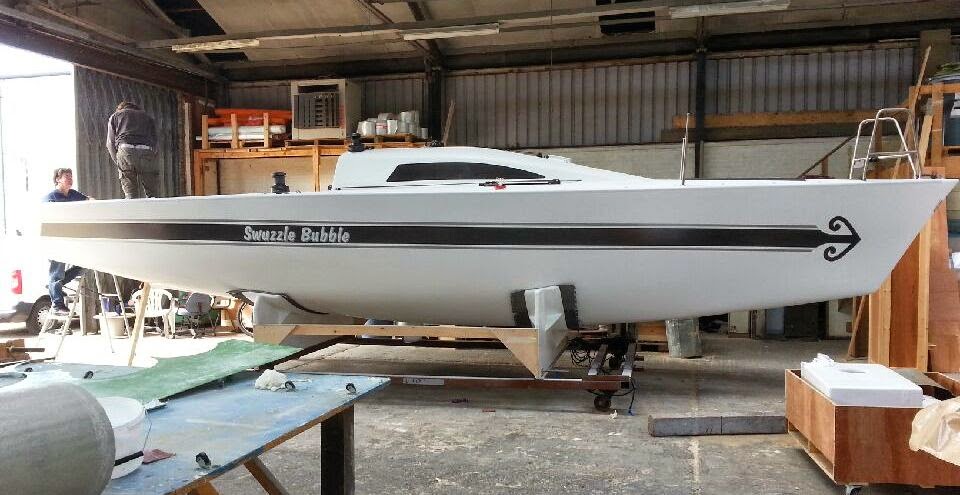
Swuzzlebubble outside her shed in the Isle of Wight - 7 April 2014
The new hull graphics are added (9 April 2014), retaining her Kiwi heritage with a black and white theme and use of the same koru design on sistership Gunboat Rangiriri
The keel is fitted mid-April, the latest in IRC thinking and showing a distinctive concavity in the trailing edge
Looking sharp and ready for her new rig
Launched! 18 April 2014
First sail - 22 April 2014, and sporting her original 'KZ-3494' sail number!
These photos documenting the transformation of Swuzzlebubble are courtesy of Peter Morton, and there are more on the Alpha Plus UK site too, and some of the design work can be seen on the BR Yachting Developments blog. For more about the appendage and rig design for Swuzzlebubble, and about the optimisation of former Quarter and Half Tonners, see the comments by Mark Mills here.
Swuzzlebubble still going strong, seen here during the 2022 Half Ton Cup (photo Facebook)
Swuzzlebubble is now sailed in Ireland by current owners David and James Dwyer, and in December 2023 was awarded the Irish Cruiser and Racing Association (ICRA) Yacht of the Year Award.
Swuzzlebubble sailing under the burgee of the Royal Cork Yacht Club (photo Afloat magazine)

Swuzzlebubble sailing in 2024 (photo by Robert Bateman | Afloat magazine)

Swuzzlebubble raced her sistership Two Farr (also transformed in recent years), the ex-2269, in the IRC2 division of the Wave Regatta in late May 2024, hosted by the Howth Yacht Club, with Swuzzlebubble clinching the win on countback.


Article updated May 2024

16 November 2013

Silver Shamrock III (Holland Half Tonner)

Silver Shamrock III was Ron Holland’s first centreboard yacht, designed for the 1977 Half Ton Cup which was held in Sydney just before the Southern Cross Cup series of the same year. Given the pedigree of its designer and crew, which included Harold Cudmore and Butch Dalrymple-Smith, the tiger-striped yacht was expected to perform strongly in the series. The boat was constructed in a highly developed timber and carbon fibre layup, with a fractional rig. Her maximum beam was more amidships compared with her main competition, namely the Bruce Farr-designed boats such as a Gunboat Rangiriri and Laurie Davidson's Waverider. She also carried a degree of tumblehome, and a transom only half the width of the Farr and Davidson boats - the stern was distinctive in the way that it tapered to a narrow rounded tuck. 
Silver Shamrock III racing during the 1977 Half Ton Cup (photographer unknown)
Despite her lightweight construction, she displaced twice that of the Farr and Davidson boats, weighing in at some 7,000lb. Some of that displacement was attributable to last minute additions of ballast to bring Silver Shamrock III up to her Half Ton rating (21.7ft IOR). The crew ran out of time with the boat and the ability to optimise its rating. Approximately 625lb of ballast was added to the boat, and this was considered, not surprisingly, to affect the yacht's reaching performance.
Holland had adopted a different approach to the more upright centreboards of her lighter displacement opposition, with the centreboard case piercing the deck for’ard of the mast and the centreboard angling back at a reasonably acute angle. 
An unusual sight on an ocean-racing yacht - Harold Cudmore and crew fitting the centreboard to Silver Shamrock III before racing in the 1977 Half Ton Cup
As with the preceding One Ton Cup held earlier in Auckland, the Half Ton Cup proved again the superiority of the lifting foil. Within the first 10 minutes of the first race, the 22 boat fleet split into two divisions – the six centreboarders in ‘division 1’ and the keelers in ‘division 2’. With nothing between Silver Shamrock III and her main opposition (Gunboat Rangiriri, Swuzzlebubble, 2269 and Waverider), the 250 mile ocean race finale became the decider - this after Silver Shamrock III had a near disaster in the short ocean race when her mast fell over the side just 400 yards of the finish line.
Silver Shamrock III during the 1977 Half Ton Cup (photo DB Yachting Annual)
Silver Shamrock III needed to finish two places ahead of either Gunboat Rangiriri or Waverider in the long ocean race to win the contest. It was a light wind affair, and Silver Shamrock III gave herself the best possible chance by finding more breeze in the early stages and clearing out to an unassailable lead, leaving the regatta result hinging on the placings astern. Both Swuzzlebubble and Waverider held too close into the windless Botany Bay, which let Gunboat Rangiriri in for the second place she needed to win the title, finishing some three hours behind Silver Shamrock III, and just beating 2269, to take the Half Ton Cup from Silver Shamrock III by the narrowest of margins – just one point, with placings of 5/1/2/2/2 against Silver Shamrock III’s 1/4/3/5/1.
Silver Shamrock III climbs out to weather after a start in the 1977 Half Ton Cup, with Newspaper Taxi (3223) to leeward and Gunboat Rangiriri astern (3426) (photo Ajax)
That Silver Shamrock III dropped her mast in the short ocean race was therefore a deciding factor in the outcome of the regatta, although it was also fortunate that Silver Shamrock III lost her mast so close to the finish and lost just one place. Had it gone a few miles earlier, it would have been very costly. The loss of an earlier mast on Silver Shamrock III before the series also demonstrated the lengths that crews were going to in order to shave weight in all areas, and not just the hull. It was Holland’s view that in the first incident the bottom of the mast was probably due to too much chemical milling. During the contest itself, the toggle system attaching the runners to the mast seemed to have failed, similar to a problem experienced by B195 in the One Ton Cup. Still, Silver Shamrock III was exceptionally well sailed by defending champion Cudmore, and proved to be at her best in light winds, winning the first race as well as the long ocean race finale.
Silver Shamrock III follows Swuzzlebubble out to a start in the 1977 Half Ton Cup
The difference in performance between Gunboat Rangiriri, in the light corner, and Silver Shamrock III, in the heavy corner, or, as Farr put it at the time, “about as heavy as people want to go these days”, was minimal, and showed the IOR was coping with the differences in displacement concept, at least in the light to moderate conditions that prevailed off Sydney. They represented the development of two entirely different boat types to a similar pitch and were very similar in performance, and similar over a wide range of conditions, although Shamrock was faster downwind in the light, while the Farr and Davidson boats were faster downwind in the fresh. Between those extremes, observed Farr "they were so similar they really could have been the same design."
Silver Shamrock III leads the fleet back to port, with Gunboat Rangiriri and Waverider astern
Silver Shamrock III went on to sail for the EEC (the former European Economic Community) team in the Southern Cross Cup series (with Pinta and Variag), while Swuzzlebubble stayed on to compete in the New Zealand team (alongside the centreboard One Tonners Jenny H and Smir-Noff-Agen). Although they had been similar in speed in the Half Ton Cup, in the stronger breezes of the Southern Cross Cup the heavier Silver Shamrock III proved to be no match for the lighter Swuzzlebubble, with placings of 20/6/12 before the Sydney-Hobart race, compared to Swuzzlebubble's 9/4/2. 
Silver Shamrock III battles her way out of Sydney Harbour in light and choppy conditions at the start of the 1977 Sydney-Hobart race
Both boats, however, failed to finish the storm-afflicted Sydney-Hobart race, which saw only 70 yachts finish of the 130 that started. Silver Shamrock III suffered minor damage to her frames and withdrew. Cudmore commented when he reached the fishing port of Ulladulla, “We are not out to kill ourselves – the storm was very bad and we didn’t want to take any risks.” The other two boats in her team managed to finish, and helped the EEC team to a fourth placing overall. 
Silver Shamrock III (photo Peter Cavill)
Silver Shamrock III was sold in Australia (and replaced by a less successful version, Silver Shamrock IV for the 1978 Half Ton Cup held in Poole). She was found on a swing mooring in 1982 in Sydney Harbour by Australian sailor Peter Cavill. She was transported to Brisbane for a big renovation, including shallowing the cockpit to make it self-draining. The original 'mackerel' paint scheme was too difficult to replicate so the Unchu (Clipper Cup yacht) design was adopted instead. With a shortage of time and money the boat was re-launched for the local Gladstone race, with the Stern rig which promptly fell over 1 hour into the race. 
Silver Shamrock III showing good upwind form in the 1980s, possibly with the older Stern mast (photo Peter Cavill)
Cavill then put in a narrower and lighter triple spreader rig and some new North sails and started winning everything he entered, except the downhill coastal races. She was sold in 1985. Some years later it came into the hands of the Hodder family, by which time the centreboard case was falling out. The un-ballasted centreboard was changed for an elliptical keel and the mast was modified to be keel stepped. It was sold in the early 1990s, and her whereabouts are unknown, with some variability in her eventual fate judging by the comments below. 
Silver Shamrock III with a new paint job and new rig (photo Peter Cavill)

Update: Photo below of Silver Shamrock III (April 2024) on the hard at Airlie Beach (photo Facebook)

Article updated May 2024


17 February 2013

2269 (Farr Half Tonner)

That's Life (2269) during the Dunhill series
2269 was an Australian sistership to the New Zealand Farr centreboarders Gunboat Rangiriri and Swuzzlebubble, designed for the Half Ton Cup held in Sydney in December 1977. The yachts were 'big' Half Tonners, with more length and sail area than Farr's earlier 920 design, and a higher ballast ratio. The engines on all three yachts was placed alongside the centreboard and just behind the mast - this assisted with bow down trim for rating purposes, but was central enough to reduce the yacht's pitching moment and ensure that it would be fast through the expected Sydney chop.

2269 was built in New Zealand and then transported to Australia for the Dunhill sponsored Australian Half Ton trial series. The centreboard class of 1977 were a step ahead of their fixed keel competitors, although 2269 had not enjoyed the same tuning period as Gunboat Rangiriri and Swuzzlebubble and was not up to speed with her New Zealand sisterships. After the Dunhill series their Fraser sails were changed to Norths and John Bertrand was brought on as tactician.
Hull profile and deck plan of Farr's 1977 Half Ton design (Farr Yacht Design)
Aside from the controversy that was developing at the time about the stability and construction of the new centreboarders during the 1977 season, the owner of 2269 Graham Oborn found himself in the middle of further debate about the yacht's original name, That's Life. Oborn had gained some sponsorship from the electronics firm Sanyo and the organising authority the Royal Sydney Yacht Squadron presumably recognised the name as the company's slogan, with obvious commercial overtones. Like the Australian One Tonner of the same period, B195, Oborn elected to change the yacht's name to her sail number so that his entry for the Half Ton Cup could be accepted.
That's Life (2269) during the Dunhill series with her original Fraser sails (photo courtesy Graham Oborn)
2269 enjoyed some very close racing in the Half Ton Cup with her New Zealand sisterships and the Irish yacht Silver Shamrock III and the other New Zealand entrant, Waverider. 2269 took advantage of some poor performances by Swuzzlebubble and Waverider in the light airs of the final ocean race to finish in third place overall, with placings of 4/6/4/7/3.
2269 is seen here in the 1977 Half Ton Cup to leeward of Swuzzlebubble (photo DB Yachting Annual)
The strong effort by 2269 in the final race meant that she held the fate of both Gunboat Rangiriri and Silver Shamrock III in her hands - the resurgent 2269 hammered away at Gunboat Rangiriri on the final 40 mile leg up the New South Wales coast, with the yachts coming into the shallow waters off the coastal cliffs to keep out of the southerly set. Peter Walker had to fight every inch of the way to the finish to secure second place and take the Half Ton trophy from Silver Shamrock III by the narrowest of margins, just one point.
2269 in her later guise as Night Raider above (photo Chris Furey) and below
The yacht was later renamed Night Raider and was painted black. As with her sisters, the centreboard was removed and a keel fitted.
Night Raider seen here in or about 1991 (photo Facebook)

A sad sight as Night Raider washes up on the beach
Night Raider was later beached in a storm in or about 2013 and was considered an insurance write off, with lots of damage to the hull and holes in the deck. However, her new owner undertook a complete rebuild in Melbourne and was expected to be back in the water in late 2013. Modifications included installing a new Yanmar 13hp engine under the companionway stairs, and new swept spreader rig and an open transom, and strengthening of the deck which had become soft over time. 
Night Raider arrives at her new owner's home for her rebuild
With only three of these original boats in existence, the rebuild of 2269 was great news and coincided with Peter Morton's rebuild of Swuzzlebubble in England.
External hull fairing and painting completed April 2013
Deck fittings in place and just awaiting electrical work, October 2013
Close to completion (January 2014)
Photos of 2269, now named 2 Farr, can be seen here.

2 Farr is now heading overseas to join the European Half Ton fleet.

Updated February 2023


16 January 2013

Waverider (Davidson Half Tonner)

Waverider is perhaps New Zealand's most famous IOR yacht, and one of the most successful level rating yachts of the IOR era. Waverider was designed by Laurie Davidson in 1976 for Tony Bouzaid, and accomplished dinghy sailor at the time (brother of Chris Bouzaid of Rainbow II fame) who had also enjoyed success locally in an earlier Davidson design Half Tonner Blitzkreig.  

The design for Waverider followed the theme established in Davidson's earlier Quarter Tonner Fun (see earlier post, October 2012), with light displacement of just 5,200lb and utilising a centreboard (of 250lb, with a draft of 6ft) and a hefty amount of internal ballast (2,600lb), an approach that had proved successful both by Fun and, on a heavy displacement platform, by the Britton Chance One Tonner Resolute Salmon. The major difference to Fun was in the hull design, which was narrower (10ft 1in) with less depth forward than the Bruce Farr and Paul Whiting boats of the era. By having less beam Davidson believed the yacht would have less inclination to get out of balance in fresh conditions and would not lift its stern or bury its bow when overpowered. She also featured flared topsides to provide greater righting moment from the crew.


Waverider under construction at John Rea's yard
 The stern shape was similar to Fun, being wide and low, with a long sloping transom which met the long flat stern buttock lines which extended beyond the trademark crease at the after girth station measurement point. Where other designs utilised a double curve in the run aft around the after girth and after inner girth stations, Davidson's approach was to round the run up quite suddenly, leading it straight up to the flat of the counter. This overhang, which stretched the yacht out to 31ft 6in length overall, provided power and sailing length upwind, and encouraged early surfing downwind. Waverider looked small due to her distinctively low freeboard. This characteristic made the cabin appear more prominent. Waverider was expertly built by John Rea in light timber, with two veneers of just 9mm over many stringers and frames.
Waverider on a tight spinnaker reach during the 1977 New Zealand Half Ton Cup trials (photo Jenny Green)
Waverider joined the Farr designed centreboarders Gunboat Rangiriri and Swuzzlebubble as the stand-out performers in the 1977 New Zealand Half Ton trials, and these three fought out an incredibly close series (see earlier Gunboat Rangiriri post). In the middle distance ocean race, the three yachts finished within three boat lengths of each other. Waverider won the fourth race by just 11 seconds, but her chance to win the series came adrift when she had to retire from the long ocean race finale with a broken rudder.
Waverider leads Gunboat Rangiriri during the New Zealand Half Ton trials (photo John Malitte)
Waverider being loaded aboard a ship for Sydney (photo John Malitte)
All three yachts were shipped to Sydney for the 1977 Half Ton Cup, where they were joined  by other top centreboarders, including the Australian Farr design 2269 and the Ron Holland design Silver Shamrock III. Waverider was re-masted before the series as the original rig had proved to be too heavy and soft. The new spar was unsleeved, while the 'P' dimension was increased and the boom raised to give more bending moment at the top of the mast. 
Waverider scored consistent places throughout the series of 2/3/1/3, giving her a chance to win the Cup in the 250 mile ocean race finale. Although Silver Shamrock III won, Gunboat Rangiriri finished in second, which was enough to win the Half Ton title, by just one point.  Although Waverider was in contention they missed a crucial windshift on the second night and crossed the line in a lowly ninth place, to finish fourth overall for the series.
Sailing downwind to victory in the 1978 Half Ton Cup, Poole (photo Seahorse)
Photo courtesy Jonathan Eastland
After the introduction of new requirements for centreboarders meant that some alterations were required to Waverider to keep her in class for the 1978 Half Ton Cup to be sailed in Poole, England. This involved shortening the centreboard, and further reducing its weight. Other changes were made to her rig. With its return to Europe, the 1978 series was something of a high-water mark in IOR level rating events, with a fleet of no less than 50 yachts, a significant contrast to both the previous editions of the championship. 

The regatta finally bought success to Bouzaid's Half Ton campaign. Waverider stamped her mark on the fleet in the first race, the only one to feature any breeze, but she didn't have it all her own way in the subsequent races, entering the final ocean race with only the narrowest of leads over Phil Crebbin's Indulgence, after placings of 1/8/3/2. The final race was sailed in the lightest of winds, back and forth across the English Channel, and Bouzaid and his crew of Helmer Pedersen, John Sumitch, John White and Tony Basadone sailed brilliantly to win the race convincingly, and defend the Cup for New Zealand.
Sailing upwind during the 1978 Half Ton Cup
Bouzaid was determined to defend his title, and kept Waverider in Europe before transporting her to Scheveningen, Holland, for the 1979 series. By then further changes to the IOR, bought on as a reaction to the light displacement revolution spearheaded by Farr, Davidson and Paul Whiting, had taken effect, and like Waverider required extensive surgery to bring her into class for the series. This involved much padding and filling out of the hull and more ballast to increase her displacement, and the placement of weight for'ard, while the centreboard had to be pinned in place.  The advantage for the lightweights had been removed, but they were still some of the quickest yachts that year. Waverider started and finished the series strongly, but her series was marred by a disastrous 21st in the short offshore race. The crew bounced back to win the fourth race, and then the final offshore race to win the Half Ton Cup for the second time.
Waverider during the 1979 Half Ton Cup (photo courtesy of Jonathan Eastland archives)
Waverider during the 1979 Half Ton Cup (photo Facebook)
Waverider never made it back to New Zealand and was sold in Europe, and still campaigns successfully today under Belgian ownership and races in the reinstated Half Ton Cup (sailed in various European venues) which is now raced under the IRC rule.
Waverider competing in the 2009 Half Ton Cup


Fairing work on  the underside of Waverider's long counter (photo Halfton Class Europe)

Waverider, May 2012
It is understood that Waverider was severely damaged in about 2015, when a crane fell and tore off the transom. The boat was declared wrecked and was bought by the Florizoone family to be renovated. She was later registered for the Half Ton Classics Cup in 2018.
Waverider after her transom was torn off (photo Facebook)

Waverider as seen in August 2024 (photo Facebook)


Article updated September 2024