|
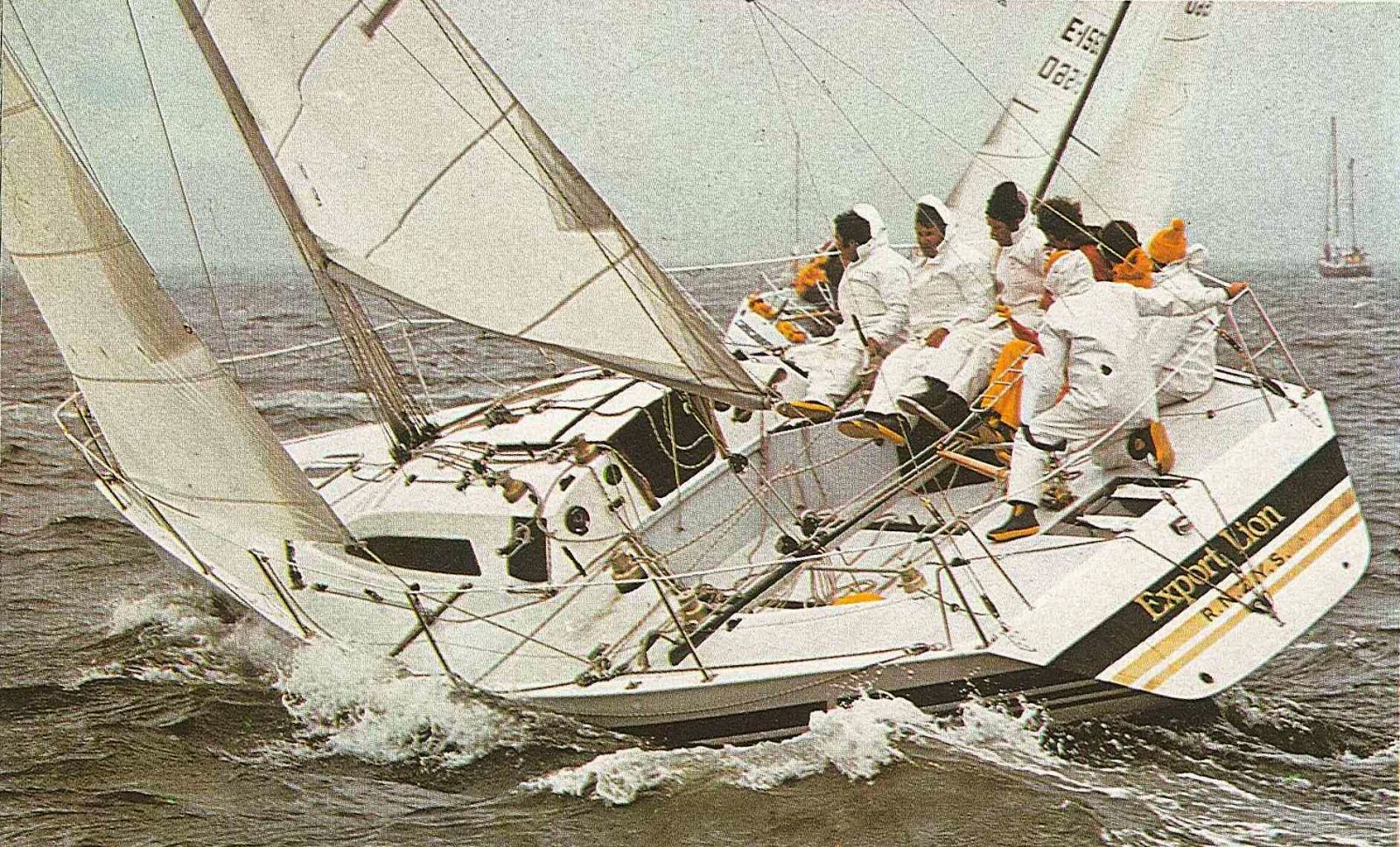
| Sailing trials soon after launching |
Her most distinctive characteristics were perhaps a fractional rig and use of a centreboard and internal ballast - this was an approach that became almost mandatory in the summer of 1977 following the failure of the Offshore Rating Council to plug the centreboard loophole the previous year.
 |
| B195 under construction in Bruce Keir's Melbourne yard (photo Doug Peterson Tribute page) |
 |
| Deck plan of B195 (Doug Peterson Tribute page) |
 |
| The B195 half model |
 |
| Hydraulic bobstay detail |
B195 appeared to be quite close in a number of parameters with the Farr centreboarders that had arrived on the scene for the 1977 Cup, and her stern shape was reminiscent of the previous generation of Farr designs, if a little narrower. She could perhaps best be described as a development of Peterson's 1976 Quarter Ton design Star-Eyed Stella. In an interesting turnaround between the Farr and Peterson approaches, B195 had a measured displacement some 500kg less than the Farr boats, but this was traded for slightly less length and more beam.
The overall result was a shallower, smaller boat that carried only fractionally more sail than the Farr boats. As another point of difference, B195 relied almost entirely on internal ballast, with a light centreboard, whereas Farr had sought additional stability with centreboards that made up approximately 20 percent of their overall ballast.
 The B195 campaign was underwritten by the electronics manufacturer Pioneer Sound and the yacht originally sported her sponsors name. However, Rule 26 of the international yacht racing rules at the time dictated that the name could not stand, and, after a fruitless geographical search to find a water body of the same name as the sponsor, the yacht became known simply as her sail number. This problem mirrored similar issues in New Zealand with the likes of The Red Lion and Smir-Noff-Agen, and was a somewhat farcical situation given that the Cup races, and the preceding national trials, were normally named after their commercial sponsors.
 B195 won her Australian trial series, with close competition provided by the winner of the 1976 Sydney-Hobart, the stock Farr 1104 Piccolo, and another 1104 Wild Turkey and the Farr centreboarder Hecate. All four boats made the trip to Auckland for the Cup. In the first race B195 came in fifth, seemingly overpowered compared with the Farr centreboarders, and the crew felt that their sails were too full compared to the New Zealand boats. But of more immediate concern was the discovery of a long crack along the starboard side of the hull which necessitated urgent repairs overnight, and for the rest of the series B195 sported a prominent patch on her waterline.
In the next race B195 had her worst result, finishing eighth. It was apparent that B195 was more tender upwind and gave away speed to the Farr centreboarders on this point of sail. This was offset in part by good downwind speed, though her lighter displacement and a centre of gravity that didn't change whether the centreboard was up or down. B195 bounced back in the middle distance race, however, finishing second behind The Red Lion. She also started strongly in the fourth race, but was unable to hold off the New Zealand charge on the final beat and finished fifth.
 B195 had the worst possible start to the final race for the White Horse Trophy (325 miles). The start was moved into the harbour due to high winds, and soon after the port runner popped out of the mast and a crewman had to be hoisted aloft to reattach it during the beat out of the Rangitoto Channel. By the time the recalcitrant runner had been tamed B195 was trailing the fleet, with only Heatwave astern after they had also experienced rig problems. B195 bounced back, however, in gale force winds on the beat to Channel Island. Jenny H and Hecate had to pull out with hull damage in the big seas experienced on the first night, but B195 handled the conditions well and was really flying on the downwind leg, and later pushed into the lead on the leg to the Poor Knights Islands. The race in the top group remained close to the end, but B195 found herself too far offshore in calms on the way to the finish and had to settle for fourth, which gave her fourth place overall.
Afterwards Stephenson acknowledged the speed of the Farr centreboarders that had filled the first three places, but did feel that B195 was more of an all rounder, with untapped potential in light airs and a leftover sea.
B195 returned to Australia in time to sail for the Victorian team in the 1977 Southern Cross Cup, and was the only boat to get close to the New Zealand team of Jenny H, Smir-Noff-Agen and the Half Tonner Swuzzlebubble, with placings in the first three races of 4/3/5. She was lucky to avoid disqualification in the middle distance race for an infraction of the radio schedule rules. Stephenson claimed radio failure, although this did not impress the race committee given that B195 was still owned at that stage by an electronics manufacturer (Pioneer). Like Smir-Noff-Agen and Swuzzlebubble, B195 retired from the fourth race, the Sydney-Hobart classic, after she cracked her hull about 80 miles off Gabo Island. She retired to Eden to wait out the gale force winds and huge seas that saw a record number of retirements from the race.
The overall result was a shallower, smaller boat that carried only fractionally more sail than the Farr boats. As another point of difference, B195 relied almost entirely on internal ballast, with a light centreboard, whereas Farr had sought additional stability with centreboards that made up approximately 20 percent of their overall ballast.

 |
| B195 sails upwind in one of the inshore races of the 1977 One Ton Cup (photo Jenny Green/Sea Spray) |
 B195 won her Australian trial series, with close competition provided by the winner of the 1976 Sydney-Hobart, the stock Farr 1104 Piccolo, and another 1104 Wild Turkey and the Farr centreboarder Hecate. All four boats made the trip to Auckland for the Cup. In the first race B195 came in fifth, seemingly overpowered compared with the Farr centreboarders, and the crew felt that their sails were too full compared to the New Zealand boats. But of more immediate concern was the discovery of a long crack along the starboard side of the hull which necessitated urgent repairs overnight, and for the rest of the series B195 sported a prominent patch on her waterline.
 In the next race B195 had her worst result, finishing eighth. It was apparent that B195 was more tender upwind and gave away speed to the Farr centreboarders on this point of sail. This was offset in part by good downwind speed, though her lighter displacement and a centre of gravity that didn't change whether the centreboard was up or down. B195 bounced back in the middle distance race, however, finishing second behind The Red Lion. She also started strongly in the fourth race, but was unable to hold off the New Zealand charge on the final beat and finished fifth.
 |
| Close up view of B195 during the 1977 One Ton Cup (photo Maritime Museum) |
 |
| B195 slides downwind (photo Doug Peterson Tribute page) |
 |
| B195 seen here at the start of the middle distance offshore race, with Mr Jumpa (left) and Smackwater Jack (right) |
 B195 had the worst possible start to the final race for the White Horse Trophy (325 miles). The start was moved into the harbour due to high winds, and soon after the port runner popped out of the mast and a crewman had to be hoisted aloft to reattach it during the beat out of the Rangitoto Channel. By the time the recalcitrant runner had been tamed B195 was trailing the fleet, with only Heatwave astern after they had also experienced rig problems. B195 bounced back, however, in gale force winds on the beat to Channel Island. Jenny H and Hecate had to pull out with hull damage in the big seas experienced on the first night, but B195 handled the conditions well and was really flying on the downwind leg, and later pushed into the lead on the leg to the Poor Knights Islands. The race in the top group remained close to the end, but B195 found herself too far offshore in calms on the way to the finish and had to settle for fourth, which gave her fourth place overall.
 |
| B195 sails dead downwind under spinnaker and blooper during one of the offshore races |
 |
| B195 slides along during one of the offshore races alongside Smackwater Jack |
 |
| B195 nears a windward mark in pursuit of Jenny H during the 1977 One Ton Cup (photo Maritime Museum) |
 |
| B195 in Port Phillip Bay and providing some exposure for the boat's sponsor |
 |
| B195 on Sydney Harbour during the 1977 Southern Cross Cup |
 |
| B195 (left) to weather of Lovelace and Country Boy |
Later the yacht was renamed Magic Pudding after being bought by a syndicate headed by John Karrasch. Her next international appearance was in the inaugural 1978 Clipper Cup held in Hawaii, where she came up against Farr keelboats Country Boy and Lovelace from New Zealand and Carrie Ann V from Hawaii in Class C. Honours were fairly even until the long ocean race (around the Hawaiian islands) when Magic Pudding held the breeze in the vital stages to finish a whopping six hours ahead of Carrie Ann V and 11 hours ahead of Country Boy to win the race overall, giving her third place in the fleet standings (second in Class C), and backing up team-mate Ragamuffin's second place to secure the King Kamehameha Trophy for Australia.
 |
| B195 (as Magic Pudding) to weather of Love Lace at the 1978 Clipper Cup (photo Facebook) |
 |
| B195 (as Magic Pudding) powers along to leeward of Country Boy during the 1978 Clipper Cup (photo Phil Uhl/Facebook) |
 |
| Magic Pudding sails past South Point of the big island of Hawaii during the 1978 Clipper Cup (photo Phil Uhl/Facebook) |
The boat was later sold in the US and was sailed to San Diego, where she came to a sad and untimely end when she caught fire in a marina. Her bow section graced Doug Peterson's garden for many years after.
 |
| Doug and the bow of B195 (photo Doug Peterson Tribute page) |
 |
| A sistership to B195, Australian yacht Deception |