7 October 2022

Fastnet Rock 1987

This gallery of photographs were taken during the 1987 Fastnet Race by Michael Mac Sweeney, most of which feature the iconic Fastnet Rock, the turning mark for the race which sits just off the southern coast of Ireland. The Fastnet Race formed part of the famous Admiral's Cup event, which was won by the New Zealand team in 1987, spearheaded by the top individual boat in the series Propaganda

Irish Independent/Full Pelt, winner of the Fastnet Race after sailing a fast rhumb-line course to the Rock (photo Michael Mac Sweeney)

Propaganda, finished in fourth place in the Fastnet (photo Michael Mac Sweeney)

The Andrieu-designed Two Tonner Indulgence, part of the second placed British team, finished in 25th place (photo Michael Mac Sweeney)

The 45-foot US yacht Insatiable designed by Nelson-Marek, finished 31st (photo Michael Mac Sweeney)

The Briand-designed Two-Tonner Mandrake-Krizia, sailing for Italy, finished 28th (photo Michael Mac Sweeney)

Turkish Delight, a Castro-designed Two Tonner, sailing for Ireland, finished 23rd (photo Michael Mac Sweeney)

Irish entrant Jameson Whiskey, a sistership to Full Pelt and also sailing for Ireland, seen here heading back upwind after rounding Fastnet Rock, finished 13th (photo Michael Mac Sweeney)

Australia's Swan Premium II (Farr One Tonner) finished 16th (photo Michael Mac Sweeney) 

I-Punkt, finished 33rd (photo Michael Mac Sweeney) 


30 September 2022

Maxi Worlds 1990

This post features another great selection of photographs by Sharon Green (Ultimate Sailing) of the action during the second stage of the 1990 Maxi Worlds, held in Maimi in late October 1990. The photos feature the increasingly dominant Matador 2 (launched in the previous spring and which would go on to win the 1990 Worlds overall following the third stage of the series in St Thomas), Longobarda, Passage (the ex-Windward Passage 2) and Vanitas (the ex-Il Moro di Venezia III).

Vanitas ahead of Longobarda, Matador 2 and Passage

Vanitas leads Longobarda, Matador 2 and Passage 

Matador 2 - the longest and heaviest Maxi in the fleet

Vanitas leads Passage (left) and Longobarda (right)

Longobarda, suffered from breakages on the first day of racing, including blowing out her mainsail clew

Passage

Matador 2

Longobarda

Vanitas

Matador 2 chases Longobarda and Vanitas around a gybe mark
Big boats, big gear and big crews - Vanitas seen here running ahead of Longobarda and Matador 2

Matador 2 on a downwind run with Longobarda just behind

Vanitas leads Passage on a reaching leg


24 June 2022

Juno IV (Castro 44)

Juno IV prior to the 1989 Admiral's Cup (photo Seahorse)
Juno IV is a 44-footer designed by Tony Castro for Mike Peacock to seek selection for the British team in the 1989 Admiral’s Cup. It was one of the earliest all-carbon race yachts, with the structural design developed by the Castro design team, and was built by Killian Bushe in England.
Juno IV sails upwind in light airs (Riggarna Rigging advertisement)
Peacock had commissioned the earlier One-Tonner Juno for the 1987 Admiral’s Cup, and as part of the second-placed British team and had finished 9th in the individual standings. He was drawn to a mid-size yacht for 1989 because it was a vacant slot for the British team, with Alan Gray’s 50-footer Jamarella looking likely to gain the big-boat position, and because Graham Walker already had a well-advanced plan to try to win the 1989 One Ton Cup, and the One Ton position on the team, with his new Indulgence. Changes to the Time Modification Factor (TMF) for 1989 would benefit bigger boats, but they would still need to perform well.
Juno IV - note curved genoa tracks (photo Facebook)
After a late launch, early racing indicated that Juno IV was too stiff, although this yielded good results in a breeze. This lead to a series of keel changes, reducing the boat’s stability and rating, but also affecting her speed. In the pre-Admiral’s Cup analysis, Seahorse magazine noted that Juno IV had trialed different sails from three lofts but was still performing below expectations.
A view of Juno IV's underwater shape, at Lymington Marina (photo Shockwave40 blog)
The selection of the British team proved to be controversial. The team selectors, headed by Harold Cudmore, decided to send boats to Kiel Week, the last part of the German and Dutch trials, to measure them against the opposition. Jamarella generally proved her case, but Hitchhiker II, the ex-Jamarella (One Ton) was making a claim for either of Juno IV or Indulgence’s berth. Despite a poor result in Kiel Week, where Juno IV finished last of the serious contenders for a team place and appeared off the pace against the German 34-raters, the selectors decided there was sufficient time to re-adjust all of Juno IV’s parameters to give her more speed. Indulgence was selected because of her results in Naples, but as only a single One Tonner was sought, the nod went against Hitchhiker II in preference to Juno IV.
Juno IV in light air downwind conditions 
Said Cudmore at the time, “the third boat was a difficult choice and the selectors were in a quandary, as the bigger boats were proving to be more success with the new TMFs. Within the mid-size category, Juno’s performance had been disappointing. Hitchhiker was a proven boat with a proven owner…Juno was in extreme rating mode, more similar to the Kiwi boats, which was wrong for Kiel and wrong for the Admiral’s Cup. Whether in correct rating mode she would be more competitive was unknown. Size was the deciding factor, and Juno was selected”.
Juno IV (photo Peter Ludlow)
With only a month left to tune the British boats, Castro planned a longer, lower boom for Juno IV to increase her sail area by 5 percent, which was combined with the removal of 200kg of internal ballast (to reduce stability and the CGF measurement of the IOR) and further bow-down trim to offset the consequent rating increase of sail area changes. This lead to a final rating of 35.17ft for the Admiral's Cup, while the team also settled on a North Sails wardrobe, with the boat skippered by Mike McIntyre, a 1988 Star class gold medallist.
Juno IV (photo Facebook)
Observers remained sceptical that Juno IV was the best choice and Seahorse opined before the series that “something special needs to happen if Juno is to find the speed of the German team, and unless she does, this boat will be the weak link in the British team”.
Juno IV seen here leaving Lymington Marina (photo Shockwave40 blog)
The results of the initial stages of the 1989 Admiral's Cup suggested these concerns were well placed, with Jamarella’s first and Indulgence’s third in the first race being let down somewhat by Juno IV’s lowly 26th, after she was boxed in at the start and was never able to properly recover.
Juno IV
Juno IV was 24th in the Channel Race, although fortunately this was enough when combined with Jamarella’s third and Indulgence’s seventh, for the British team to move into the series lead.
Juno IV in the midst of (possibly) Admiral's Cup trials action, with Jamarella (K-180) visible to windward (photo Bateaux magazine, Histoiredeshalfs website)
Juno IV during the 1989 Admiral's Cup (photo Auckland Maritime Museum)
The team then put in a dominant display in the third race, the second inshore, with Juno IV improving strongly to finish 11th. This was a good result considering the time lost on the last run, where she had tried to shake off Librah with a gybe set but managed to tangle the boom in a running backstay. The resulting broach led to a torn spinnaker which had to be replaced.
Juno IV sails downwind during the 1989 Admiral's Cup (although is sailing with an inshore mainsail without reefing patches) (photo Facebook)
The third inshore was less impressive, with Juno IV finishing 21st, although this was better than Indulgence’s uncharacteristic 27th. Jamarella’s third, however, kept the team in first position in the overall standings.
Juno IV powers along upwind (photo Bateaux magazine, Histoiredeshalfs website)
Juno IV went on to finish 11th in the fourth inshore and 12th in the Fastnet Race, to finish the series in 13th place overall, and this was enough to help Britain to overall Admiral's Cup victory after their second place in 1987 (Jamarella was the top individual yacht and Indulgence was 11th). 

Juno IV went on to race in the 1989 Southern Cross Cup as part of the British team, with owner Peacock leading the UK challenge for the Cup which they won. She then competed in the 1990 Sardinia Cup, finishing second (either individually or as part of the British team) and was winner of the 1990 Setimana Del Boque, also in Sardinia.
Juno IV arriving at Lymington Marina (photo Shockwave40 blog)
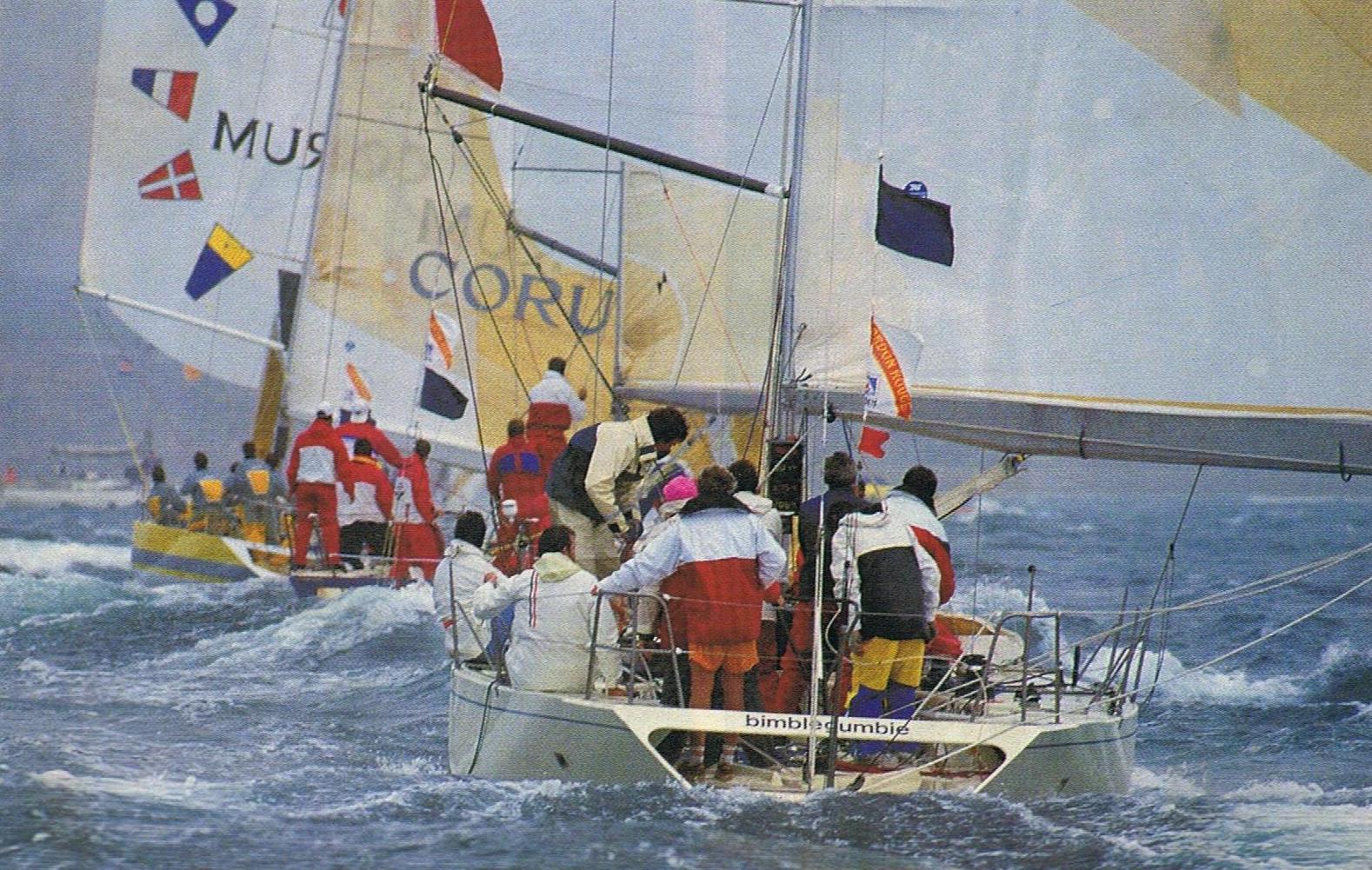
Juno IV as Australian entry in the 1991 Admiral's Cup Bimblegumbie (and photo below)
In 1991 Juno IV filled the Two-Tonner slot in the Australian team for that year's Admiral's Cup as Bimblegumbie, but finished seventh of the eight Two Tonners, although she collected more points than her team-mates Cyclone, the team's 50-footer, and Shardana II, the One Tonner. The Australian team finished last overall.
Juno IV was converted in the early 1990’s in private ownership to a cruiser/racer specification with easier deck gear to allow her to be easily sailed two-handed. In 2013 she was sold to another private owner who put her back into the racing circuit after 14 years and entered in the Round the Island 2014. Despite the lack of wind around the Needles, she was able to keep moving and won two trophies, the Field Barnacle (line honours) and the Renaissance Trophy.
Juno IV in more recent times (photo Challenge Yachting)
Juno IV was then re-established as a true racer. Further investment and improvements followed and she was entered in the Round the Island Race in 2015. Conditions were perfect for this classic racer and again the Juno IV team won the Field Barnacle trophy. The original aluminium mast was replaced with a carbon-fibre version in 2019, but it is understood that the boat is now being used purely as a cruising yacht and is based in Scotland.

Article updated May 2023

17 April 2022

Kenwood Cup 1988

The Maxis on the charge in reaching conditions off Hawaii - Sorcery leads Il Moro di Venezia, Ondine VII and Matador

This post features a selection of great photographs by Sharon Green (Ultimate Sailing) that capture some of the action during the 1988 Kenwood Cup held in Hawaii. A total of 45 yachts entered the regatta, which was the sixth biennial sailing of the Hawaii International Ocean Racing Series. Competitors came from Australia, Brazil, France, Italy, Japan, New Zealand, the United Kingdom and the United States. The series was a combination of the Maxi World Championship, the Champagne Mumm World Cup and the Kenwood Cup, all rolled into a single event. Given its status, the regatta featured the biggest fleet of Maxis ever assembled in the Pacific, and included Congere, Emeraude, Il Moro di Venezia, Kialoa, Matador, Ondine VII, Ragamuffin, SovereignWindward Passage II and Winterhawk (ex-Ceramco New Zealand). It was also the first series in which a team from the United Kingdom would compete in the Cup, consisting of the yachts Indulgence VI, Juno and Yeoman XXVII.

Action aboard Maxi yacht Ondine VII

The Olympic triangle races again proved to be the most exciting part of the series as the steady tradewinds in the 20-knot range assured excellent racing conditions. Unfortunately Kialoa was dismasted during practice and was unable to compete agains the stellar fleet assembled in Hawaii. The two new fractionally-rigged Maxis, Il Moro di Venezia and Windward Passage II were clearly faster than their older masthead rigged rivals. It was, however, the smaller yachts that lead the fleet on handicap as Irv Loube's One Tonner Bravura (US) sailed to three first places in the Olympic triangle races to win the Hawaii Silver Jubilee Trophy. The Australian One Tonner Sagacious V was hot on his heels with two second paces, but fell off the pace in the third triangle race.

Bravura leads her One Ton rivals around a wing mark during one of the Olympic triangle races

No records were set in the Molokai Race due to the prevalence of light winds resulting from a tropical disturbance south of Hawaii. The race started in moderate trade winds of 10-12 knots which would drop to five knots by the morning. Windward Passage II was leading the fleet by 15 minutes at the turning mark and although she then sailed into a hole just before the finish line, she managed to protect their line honours position by just two minutes from Sorcery. The smaller yachts were left becalmed off Molokai's North Shore and the overall winner on corrected time was Jubilation, from Santa Barbara, while Bravura faltered with an 11th place to fall behind Sagacious V by five points in the top individual yacht standings. 

A close start amongst the One Tonners, with (amongst others obscured) Once a Jolly Swagman leading Sagacious V, Seikaiha, Kaitaro IV, Ultimate Challenge, General Hospital, Bravura and Black Jack

The Around the State Race was also sailed in lighter than normal winds which again meant that no records would be set. Windward Passage II continued to show her impressive form as she lead the fleet around the course finishing over six hours ahead of the Australian Maxi Sovereign. Sagacious V relinquished her hold on the overall honours after retiring with rigging problems. Bravura put in an excellent performance by finishing second behind Chicago yacht Insatiable, and secured overall individual honours and the King Kamehameha Trophy.

Insatiable (fifth overall and first overall in Class D)

In the team competition for the Kenwood Cup, the Australia Red Team of Great News, Sagacious V and The Esanda Way, and the USA Red Team of Bravura, Champosa V and Insatiable established their early dominance for the coveted trophy. However it was the Australia Red Team that were finally able to narrowly win the Cup by just five points.

Sagacious V (ninth overall and second overall in Class E)

Matador (13th overall and second in Class A) to leeward of Ondine VII

Yeoman XXVII (29th overall and fourth in Class C) rounds a leeward mark

Jubilation (second yacht overall and first in Class C)

Champosa V (17th overall and third in Class C)

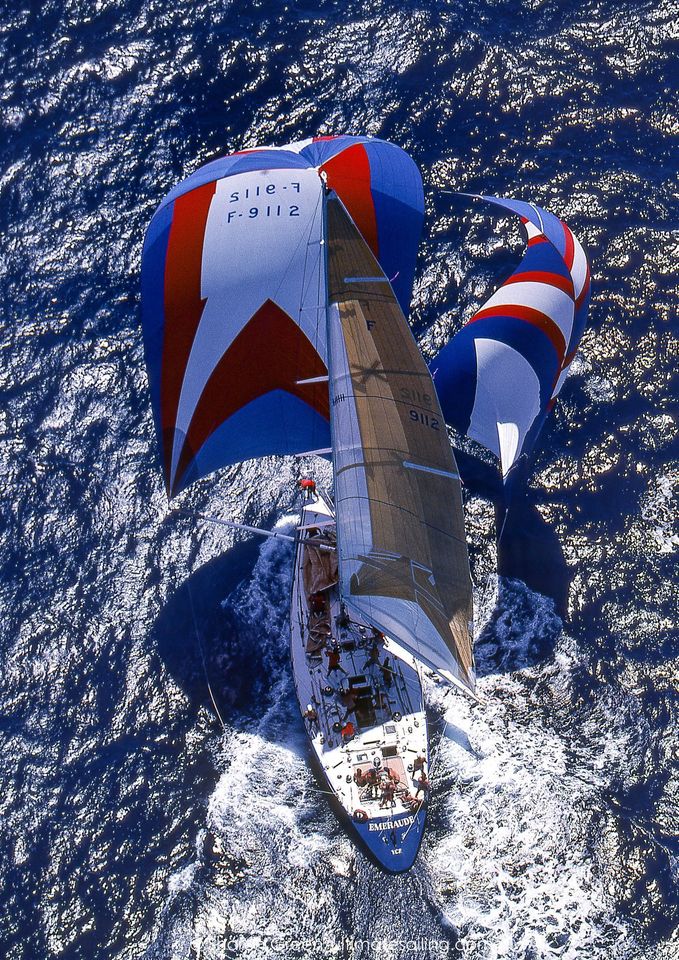
French 'mini' Maxi Emeraude (30th overall and eighth in Class A)

The Japanese Farr 43 Mimi (ex-Equity) (13th in Class E and 27th overall)

Sorcery (18th overall and fourth in Class A) to leeward of Matador

Japanese One Tonner Victoria (seventh in Class E and 14th overall)

A happy looking crew aboard Insatiable

Brazilian One Tonner Black Jack (ninth in Class E and 20th overall)

Ondine VII

More photos from this series can be seen here.


Article dated April 2022