New Zealand's Monique, a Farr 42-footer (rating just under the Two Ton limit at 31.9ft IOR) was the top individual yacht of the inaugural 1978 Clipper Cup (photo Phil Uhl)
Forty-one yachts, representing Australia, France (Tahiti), New Zealand, Japan, Taiwan and the United States, competed in the inaugural Clipper Cup regatta held in 5-12 August 1978. The series incorporated a 100-mile race around Oahu, three 30-mile offshore Olympic Triangle courses and the 775-mile Around the State race (the latter race had been held six times since 1972).
Kialoa IIIwith all extras set during one of the offshore races during the 1978 Clipper Cup (photo Phil Uhl)
Fortunately renowned marine photographer Phil Uhl was there to capture the action, and this article features a number of his photos from the series.
One Tonners Country Boy (left) and Magic Pudding (ex-B195) enjoy a close battle during the 1978 Clipper Cup - Magic Pudding went on to finish as third yacht overall in the individual standings, and Country Boy was 10th (photo Phil Uhl)
Leeward mark action, with New Zealand's Inca (1730) visible (photo Phil Uhl)
Adding prestige to the regatta were two of the world’s fastest Maxi yachts, Jim Kilroy’s 79-foot ketch Kialoa III and Huey Long’s 79-foot sloop Ondine. Ondine completed the Around Oahu Race in a record 13 hours and 18 minutes, edging out Kialoa by a scant six seconds, in one of the then closest boat-for-boat finishes in yacht racing history (although Ondine owed Kialoa time on handicap due to a 3.2ft difference in rating). The balance of the fleet completed the course during the night and the following morning. Taiwan’s small 30-foot Don Quixote (a Farr Half Tonner rating 21.6ft IOR), stole the show with an overall win on handicap (though team results were limited to yachts with a minimum rating of 27ft).
The Farr Half Tonner Don Quixote won the Around Oahu Race, and finished as 12th yacht overall
The New Zealand Farr-designed One Tonner Lovelace finished ninth overall and formed part of the third placed New Zealand 'B' team (photo Phil Uhl)
The next three Olympic course races held of Waikiki resulted in the finest exhibition of offshore racing ever seen in Hawaii. With blustery trade winds of 20-25 knots with a warm Hawaiian sun, competition amongst the fleet was outstanding. Particularly keen was the racing among the One Tonners, New Zealand’s Country Boy andLovelace, Hawaii’s Carrie Ann V and Australia’s Magic Pudding (ex-B195). Australia’s Ragamuffin (Syd Fischer), a Frers 47-footer and New Zealand’s Monique (Jim Dowell), a Farr Two Tonner, each dominated their respective Class A and Class B divisions by sweeping all three Olympic events.
Syd Fischer's Ragamuffin, second yacht overall and part of the winning Australian team (photo Phil Uhl)
Big Schott, a Peterson 41 Two Tonner (rating 32.1ft), finished seventh overall and helped the Australian 'A' Team to win the King Kamehameha Trophy
The Around the State Race presented the fleet with every sailing condition known to sailors. A light but steady breeze gave some hope that Phantom’s record set in 1977 would be bettered. On the 300-mile reach from Niihau to South Point on the Big Island, conditions varied from heavy winds to almost nothing as they approached the Point. After rounding South Point, the fleet immediately hit strong winds and began beating up the treacherous Ka’u Coast.
The Bruce King-designed 48-foot bilgeboarder Hawkeye (part of the US 'Blue' team) carried a high 42.3ft rating and struggled upwind but nevertheless finished 14th overall (photo Phil Uhl)
Ondine with spinnaker and blooper set (photo Phil Uhl)
Finally Ondine, after battling Kialoa for nearly five days, claimed line honours off Waikiki, with Kialoa finishing three hours later. Magic Pudding had showed great speed in the light air stages, allowing her to finish six hours ahead of the next One Tonner, Carrie Ann, and was the handicap winner.
Magic Pudding sails upwind past South Point on her way to winning the Round the State Race (photo Phil Uhl)
Monique took first place overall on handicap for the series, winning the Clipper Cup, with Ragamuffin second and Magic Pudding third. Australia’s ‘A’ Team of Ragamuffin, Big Schott and Magic Pudding won the King Kamehameha Trophy for the top team. The New Zealand ‘A’ Team (Monique, Country Boy and Gerontius) were second, and New Zealand ‘B’ (Inca, Lovelace and Anticipation) were third. In the battle of the Maxis, Kialoa edged out Ondine in the overall results, finishing 17th and 18th respectively.
Big Schott in fresh upwind conditions (photo Phil Uhl)
Inca, a 45-footer rating a low 32.7ft, off the North Shore of Molokai - she finished fifth overall (photo Phil Uhl)
Hawkeye seen here to the lee of Oahu during the Round the State Race (photo Phil Uhl)
Japan's Sunbird V, a S&S 54-footer (with a low 39.0ft rating) finished 24th overall(photo Phil Uhl)
Kialoa III charges her way through some white water (photo Phil Uhl)
Another view of Hawkeye on a reaching leg (photo Phil Uhl)
Gekko V from Japan (above and below), a Frers 41-footer, finished 19th overall (photos Phil Uhl)
Another photo of Australian yacht Big Schott (photo Phil Uhl)
Checkmate (left), which finished in seventh place overall, and Hawkeye in close proximity after a windward mark during the 1978 Clipper Cup (photo Phil Uhl)
Earlier articles about the International Offshore Rule ('IOR') have looked at some of the key components of measuring a yacht under the rule, and deriving a handicap with the aim of allowing different size yachts to compete against each other at any venue around the world (Part 1 is here). Level rating was the non-handicap form of racing under the IOR, where each boat was designed to the same handicap rating, or ‘Ton’ class.
Part of the big 43-boat fleet that contested the 1976 One Ton Cup in Marseille, France (photo Bateaux magazine)
Looking at the level rating classes first, the glamour fleet were the One Tonners, which had the ‘Coupe Internationale du Cercle de la Voile de Paris’, or the One Ton Cup, as their holy grail. The Cup was so named because it was presented in 1899 by the Cercle de la Voile de Paris ('CVP') for competition by boats with fixed keels, rated at one ton or less under the French tonnage rule of 1892. These small boats, approximately 5m on the waterline, raced in Cowes or on the Siene until 6-metre class yachts were used for the trophy following the advent of the IYRU International Rule. The impressive trophy was just under a metre high and was carved out of a 10kg block of solid silver by a Parisian goldsmith.
The One Ton Cup
The last One Ton Cup in 6-metres was held in 1962. In 1965 the CVP declared that it should be used for yachts racing boat for boat at a maximum specified RORC rating (22ft). The clubs at La Rochelle soon after gave the Half Ton Cup for boats with an 18ft rating, and the Quarter Ton Cup for boats with a 15ft rating. The additional international racing that occurred under this arrangement became a major influence on the whole process for a change towards an international rating rule. With the arrival of IOR, it was agreed to use the same level rating concept. Thus in 1971 the One Ton class was defined at 27.5ft IOR, Half Ton at 21.7ft, and Quarter Ton at 18ft. There was also a Two Ton class which was not well supported at a 33ft rating and was changed to 32ft in 1974 (and later to 34.5ft). In 1974 the US delegates to the ORC presented a Three-Quarter Ton Cup for racing at 24.5ft, and the Mini Ton class was introduced in 1978 for racing at 16.0ft. In 1983 the rating limit for One Tonners was raised to 30.5ft, after a drop in support for the One Ton Cup at the old limit, and giving the class a dual purpose as they would now meet the lower rating limit for the Admiral's Cup.
The popularity of the Half Ton Class was evident from this photograph of a start during the 1976 Half Ton Cup in Trieste (photo Bateaux magazine)
These limits were further adjusted to two decimal figures as measurement techniques became more precise (e.g., the One Ton limit became 30.54ft). The 50-Foot Class, followed a similar model using a limit of 40ft (increased slightly to 40.54ft in 1991), but used individual and variable ratings within this limit for some regattas, and no ‘Ton’ classification was applied to this fleet.
The 50-Footers enjoyed close racing on a level-rating basis for many years (photo Guy Gurney)
In the same vein, Maxi yachts were those that raced under the IOR's rating limit of 70.0ft (which was subsequently eased in the late 1980s), but given the sometimes large variance in actual ratings for these large yachts their racing was usually based on handicap results, although line honours remained a keen focus.
Part of the Maxi fleet competing in the 1988 Kenwood Cup in Hawaii, with Sorcery(70.82ft IOR)leading Il Moro di Venezia (70.05ft), Ondine VII (70.04ft)and Matador (69.99ft)
Associated with the Quarter, Half and One Ton Cups were race-specific trophies. For the One Ton Cup, these included the Trophee de la Societe Nautique de Marseilles, for the winner of the short offshore race, and the White Horse Trophy, for the winner of the long offshore race.
One challenge in changing Pendragon from her original configuration as a Three-Quarter Tonner to a One Tonner in 1979 was meeting the increased accommodation requirements for One Tonners stipulated by the ORC 'Green Book' regulations (photo Paul Mello)
Each level rating class was subject to specific ORC regulations that governed the world championships (the ‘Ton Cups’) for each of the level rating classes (the ‘Green Book’). This set out the rating limits for each class, the rules under which each championship would be raced (such as the length and type of courses to be raced) and the maximum number of entries for any given championship. The Green Book also specified certain design parameters not otherwise covered by the IOR rule itself, such as the minimum height and area of headroom, freshwater capacity, the minimum number of berths, and even the minimum thickness of squabs to be carried.
A closely packed fleet of One Tonners during the 1984 One Ton Cup, the first held under the new rating limit of 30.5ft
Level-rating yachts were also campaigned in mixed fleet regattas (where they might further optimise performance and fall in or out of the class limit), which necessitated the use of handicapping and the application of time correction factors.
Close racing between a group of One Tonners during the 1987 Admiral's Cup (photo Bateaux magazine)
A yacht’s IOR rating was a length measurement, expressed in feet. For a yacht designed with an eye to the rule, its rating might typically be around 8-10ft less than its LOA. In a handicapped race, the IOR rating was used to compute either a Time Correction Factor ('TCF') expressed as a decimal figure, and which for 'Time-on-Time' handicapping was computed against elapsed time to provide a corrected time; or as a Time-on-Distance allowance, expressed in seconds per nautical mile. Time-on-Time is similar to a general handicap or PHRF system. Time-on-Distance was used by multiplying the distance of the race by a time factor, and subtracting from the boat's actual time, to compute the boat's corrected time (the current IRC rule dispenses with the conversion between rating and handicap, by simply expressing a yacht’s rating by way of a TCF).
A crowded start line at the 1985 Admiral's Cup, with 57 yachts (representing 19 national teams) rating between 30 - 40ft IOR in a single fleet (photo Guy Gurney)
This was a further complication in the level of acceptance achieved by the IOR, at least in mixed-fleet racing. This is because no matter how accurate the measurement system, if the time correction formula was seen to unduly favour one size of yacht over another, the system would lose support.
Startline action during the 1978 Quarter Ton Cup in 1978, held in Japan (photo Guy Gurney)
Under IOR, and as with the former CCA and RORC, the USA continued to use Time-on-Distance while others used a single figure TCF, and this also resulted in different perceptions of the rule. A committee of ORC sat for several years attempting to reach a single compromise on time allowances, and duly dissolved itself without finding a solution. However, both approaches were based on the same principle, in that a higher rating gave a smaller time allowance, and vice versa.
The diminutive Farr-designed KevFlyer, rating just 20.0ft, racing in the 1980 Clipper Cup (photo Phil Uhl)
The generally adopted formula for the TCF adopted by the RORC for IOR racing was, at least initially, a relatively simple calculation: TCF = (R1/2 + 2.6) / 10. For example, a One Tonner, with a rating of 27.5ft, had a TCF of 0.774, while a Half Tonner, with a rating of 21.7ft, had a TCF of 0.716.
International mixed fleet racing under IOR, with Half Tonners (eg Swuzzlebubble, KZ3494) racing alongside the Maxi Kialoa III(background) during the 1977 Southern Cross Cup (photo Phil Uhl)
As with the IOR rule itself, the TCF formula underwent further evolution, with yacht clubs able to adjust the formula to suit their preferences. For example, in 1975 the RORC produced the following amendment: TCF = 0.2424(R)1/2/1 + 0.567(R)1/2. The only significance of this was to create a ‘hard point’ in the time correction factor graph at the place of a ‘base’ yacht of 29ft rating (TCF of 1.000). This formula withstood pressure for further change until the mid-1980s, where bigger yachts were given some easement following the dominance of One Tonners in the 1985 and 1987 editions of the Admiral’s Cup, but the swing of the pendulum lead to something of a rout by the fastest 50-footers in 1989. Such problems with finding the 'perfect' formula were, at least for the Admiral's Cup, subsequently avoided by changes to the regatta format from 1991 with boats racing in level rating divisions.
Changes to the RORC's TCF in 1989 saw the ascendancy of the 50-footers in that year's Admiral's Cup, with Jamarella taking individual honours overall, followed by Will (second) and Stockbrokers Container in fourth (photo Peter Ludlow)
The Farr-designed Shockwaveon her way to winning the 1992 Two Ton Cup (held in conjunction with the 1992 Kenwood Cup in Hawaii)
Part of the text used for this article is adapted from the book A Lighter Ton - The Champion NZ Yachts of the 1970s, 2012
Sorcery seen here during the 1984 Clipper Cup (photo Phil Uhl)
Sorcery was designed in the early 1980s by Gary Mull for US yachtsman Jake Wood. She was a long Maxi yacht for that time at 82ft 4in, where Maxis were typically around 80ft, and this was expected to provide higher speed potential off the wind. The initial design work for Sorcery involved analysing the existing Maxi designs, and Mull’s design comments at the time noted, based on that analysis, that the hull design was not only longer than her competitors but was also targeted to produce slightly better sail area/wetted surface and sail area/displacement ratios than those of the existing Maxi fleet.
Sail plan and hull profile drawings of Sorcery as published in NZ Yachting magazine
Sorcery was a conventional looking yacht, while featuring Mull’s trademarks of the era (as much as these could be differentiated from typical IOR yachts at that time) of a typically steeply angled stem married to a shallow forefoot, with a pronounced bustle around her after girth station. This lead to a long counter with an angled transom with a near vertical cut-off at the stern end. Sorcery was a big and heavy yacht, although her displacement of 79,000lbs was not extreme at this size range.
Sorcery under construction at Republic Yachts, circa 1983
Sorcery’s righting moment was moderately high, and partially derived from greater beam than the existing Maxi fleet (19ft 9in, as compared with Kialoa IV at 18.5ft, for example). Initially her ‘I’ measurement was to have been 98.5ft, but this was adjusted to 101ft through other changes to the design while remaining within the 70.0ft IOR Maxi rating limit. The keel was unremarkable in plan form and section, and weighed some 47,000lbs, with a draft of 12ft 6in. The elliptical planform rudder was unusual, but one that Mull claimed as the most efficient known in terms of lift/drag ratio where overall span is not limited. With a nod to a favourable measurement under the Engine Propellor Factor component of the IOR, her feathering propellor was some 43in in diameter, and exited the upper trailing edge of the keel, powered by a 200hp engine.
The deck arrangement for Sorcery (as viewed in 2009)
Some 13 deck designs were drawn by Mull, which were then reviewed by Wood before the final decision was made for the deck layout that was eventually adopted.
Launch day, 23 December 1983 at Marina del Rey
Wood had founded Republic Fastener Manufacturing Company in California which supplied fasteners to the aerospace industry and he established Republic Yachts where Sorcery was built, from aluminium plate on longitudinal frames supported by transverse web frames. She was launched in December 1983 before transiting the Panama Canal to compete in the 1984 SORC. She had a difficult start to the series but improved strongly in the final two races to finish in fifth place in the 10-boat Class A fleet (with race results of 4/DNF/10/5/2/1), and was 49th overall. Notably, Sorcery took overall fleet honours in the final race of the series, the Nassau Cup, just beating Brooke Ann, the Class B winner, by 10 seconds on corrected time.
Sorcery leads Windward Passage, Kialoa IV and Ondine during the 1984 SORC (photo Guy Gurney)
Sorcery seen here (above and below) in light airs during the 1984 SORC (photo Larry Moran)
Later that year Sorcery competed in the 1984 Clipper Cup. In the first race, Boomerang and Condor had some difficulties at the start of the Maxi division, allowing Nirvana and Sorcery to lead the fleet to the weather mark off Diamond Head. The new and impressive Frers-design Boomerang began to play catch-up, out-footing and out-pointing the other Maxis as she drove to windward. Nirvana had rounded the mark half a length ahead but Sorcery found her legs and slipped by on the first offwind leg as the wind shifted east 20 degrees and abated slightly. Before long the reaching leg became nearly a square run, and a long run at that. A 27.5 mile triangular course had been laid, but the wing mark came loose and drifted nearly 3 miles before a mark boat reached it and took its place. Sorcery led the way to the new mark while the fleet hoisted bloopers in her wake. Sorcery held the lead at the leeward pin, followed by Nirvana and Kialoa IV. Boomerang had caught three of her Maxi competitors by then and began to make more time on the final beat, before blowing out her no.4 genoa.
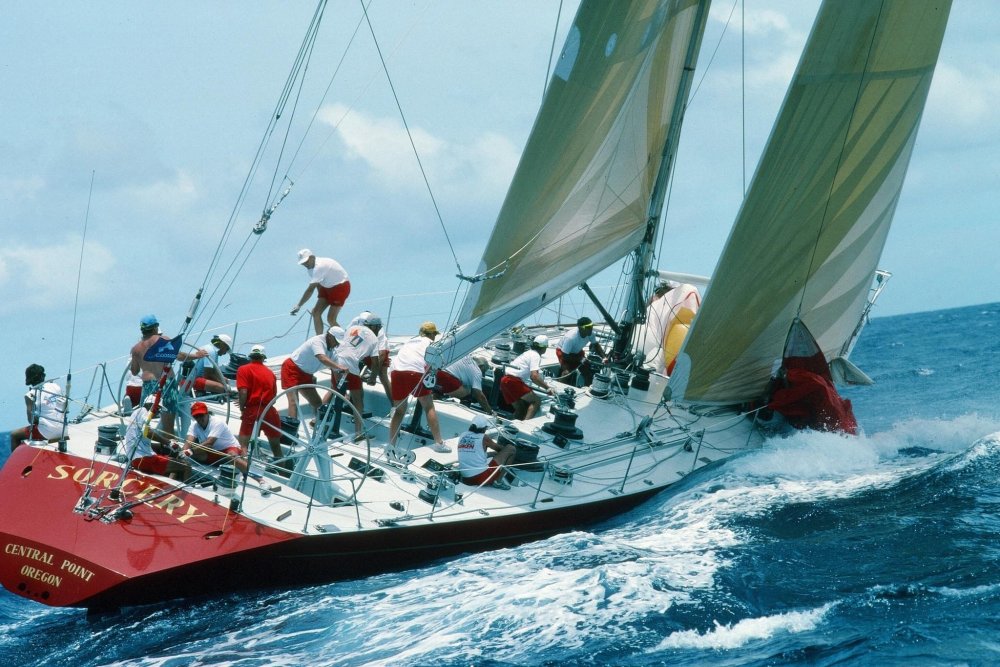
Sorcery during the 1984 Clipper Cup (photo Phil Uhl)
In the second race a more conservative start by Boomerang lead to a great boat-for-boat race with Sorcery. Sorcery lead at the weather mark, but was overhauled by Boomerang the next time around. It was expected by the Maxi crews that Boomerang’s design and configuration would be vulnerable dead downwind, and Sorcery seemed to confirm this by taking the lead at the final leeward mark. However, on the last upwind leg Boomerang sailed higher and faster and moved back into the lead, until her no.4 let go again. While she maintained the lead while changing sails she missed the finish line, sailing between the committee boat and the weather mark. Realising their mistake, the skipper of Boomerang turned the Maxi around and headed for the line, but Sorcery managed to cross ahead by 17 seconds. Unfortunately, during one of the downwind legs Sorcery’s spinnaker had brushed the spreaders of the Frers 40 Flasher and her resulting percentage penalty set her back three places, effectively handing Boomerang the race victory.
Sorcery, possibly during the 1984 Clipper Cup (photo Sorcery Sailing)
The next race, the 150-mile Kalua Koi Molokai Race, counted for double points. Sorcery found herself in a tight battle in the early stages with Boomerang, Condor and Kialoa IV, playing the shifts off Maunalua Bay, separating briefly and then coming back together as they tacked out of the depression on Oahu’s southern shore. By Koko Head and the start of the Molokai Channel, Boomerang had a lead that she would not relinquish. The return trip from Kalaupapa Peninsula was a tight reach until clear of Molokai, then a spinnaker run back to Diamond Head and the finish. Both Kialoa and Sorcery closed in on Boomerang, but Boomerang’s lead was too great and she held onto her lead comfortably. Kialoa and Sorcery crossed the line overlapped with Kialoa’s bow just ahead - the record shows that Sorcery edged out Kialoa on corrected time (although the reason for that is unclear as Kialoa's rating for the series was lower than Sorcery's). Notably the Maxis were able to save their time on the fleet and took the top placings.
Sorcery during the 1984 Clipper Cup (photo Sharon Green | Ultimate Sailing)
Light winds greeted the fleet for the fourth race, which was of some concern to the Sorcery crew who lamented their vulnerability in such conditions. In the words of crew boss Rex Banks (reported in Yacht Racing and Cruising magazine), “When the wind gets light we die a thousand deaths”. Boomerang proved her speed and romped home in first place, taking overall fleet honours, while Sorcery finished 13th.
For the triple-weighted Round the State Race, the fleet initially encountered light, fluky wind, but Sorcery moved into the fore as the leaders fetched Makapuu and the Maxis flew no.1 genoas and set jib tops, although Sorcery had destroyed her no.2 on a spreader prior to the start and had to live with a large gap in her inventory for the duration of the race. After some fast reaching, Ragamuffin (ex-Bumblebee IV) lead the fleet into a dead zone off Niihau, with Sorcery and Nirvana astern. These three were the first to slip free of the windless void in the late afternoon before starting the long reach down to South Point. Boomerang took the lead about 55 miles from South Point, moving a mile ahead of Kialoa IV and Sorcery, and went on to break Kialoa’s 1982 record for the race by over an hour. Condor saved her best finish for the most important race coming in third, followed by Sorcery, Nirvana and Ragamuffin.
Sorcery finished the series and in tenth place overall (3/16/2/13/21), just ahead of Nirvana but well behind Boomerang and Kialoa IV who finished first and second respectively. She finished in third place in Class A (1/4/2/4/4).
Sorcery seen here crossing behind Nirvana and ahead of Windward Passage during the 1984 Big Boat Series (photo Facebook)
Sorcery went on to compete in the 1984 Big Boat Series in San Francisco, posting a series of third places for third overall, with Boomerang taking out overall honours in the six-yacht Maxi fleet. These two yachts provided the high point for spectators in the second race, after Boomerang started early and had to play catch-up on the long first beat. Two legs later Boomerang was overlapped with Sorcery as they ran down the City waterfront and hardened up for a tight reach out into the Bay. They sailed the entire leg overlapped with their spinnakers on the verge of collapse and their mainsails flogging. They rounded the next mark with Sorcery still holding a marginal lead and squared away for the run. At the leeward pin, Sorcery changed their headsail down to a no.3 and found themselves underpowered - she lost her lead quickly to Boomerang and runner-up Kialoa IV.
Sorcery to leeward of Boomerang during a tight battle in the second race of the 1984 Big Boat Series (photo Sharon Green | Ultimate Sailing)
In February 1986 Sorcery competed in the 1,100 mile San Diego to Manzanillo (Mexico) race, where she set an elapsed-time record of 6 days and one hour, surpassing the old record set by the 67-foot yacht Merlin in 1978 by over an hour.
A bump being added to Sorcery's midships to enhance her IOR rating, in or about 1986
Later that year Sorcery took line honours in all five races in the 1986 Kenwood Cup (the new name for the Clipper Cup). This included winning the Molokai Race from Windward Passage by 12 minutes. This was followed by a nearly four-day match race with Passage in the 775-mile Round the State race. The two Maxis covered each other tack-for-tack throughout the race, cross-tacking 13 times alone during the 60-mile windward leg up the Big Island of Hawaii’s rugged Ka’u coastline. The race ended in a heated neck-and-neck downwind duel to the Diamond Head finish line with Sorcery finishing just under 11 minutes ahead of Passage.
Sorcery leads Il Moro di Venezia, Ondine VII and Matador during the 1988 Kenwood Cup (photo Phil Uhl)
A similarly timed photo to the one above by Sharon Green | Ultimate Sailing, with Ragamuffin also appearing in the background
Action on the bow of Sorcery during the 1986 Kenwood Cup (photo Guy Gurney)
Sorcery competed in the Kenwood Cup again in 1988, with the series incorporating the Maxi World Championship and featuring the biggest fleet of Maxis ever assembled in the Pacific, including Congere, Emeraude, Il Moro di Venezia, Kialoa V, Matador, Ondine VII, Ragamuffin, Sovereign, Windward Passage II and Winterhawk (ex-Ceramco New Zealand). By this stage the 70.0ft rating limit for the series had been eased, and most of the Maxis were optimised beyond this measurement, with Sorcery having an increased rating of 70.82ft, which also suggested she had undergone some modifications to increase speed. The new Frers-designed and fractionally-rigged Windward Passage II was the fastest Maxi in 1988, but Sorcery threatened her overall hegemony by almost taking line honours in Molokai Race after Passage fell into a hole just before the finish line. Overall, however, Sorcery finished down the overall standings.
Sorcery leads Matador in tight power reaching conditions during the 1988 Kenwood Cup (photo Sharon Green | Ultimate Sailing)
An aerial photograph from the 1988 Kenwood Cup, with Sorcery trailing close behind Ondine VII and Matador (photo Histoiredeshalfs website)
Sorcery rounds a leeward mark behind Matador during the 1988 Big Boat Series, which was won convincingly by Il Moro di Venezia (photo Sharon Green | Ultimate Sailing)
Sorcery also raced in the 1990 Kenwood Cup, finishing in second place in Class A, behind the new Drumbeat which generally had the legs of her older rival. There was one race when Wood and his crew gave Drumbeat a series fright, leading for all but the final leg. Seahorse magazine described it as a truly splendid race, where by a combination of fortune and inspired sailing the obviously slower Sorcery, using every wile and trick in the book, stayed just in front of the quicker boat almost all the way around. However two-thirds of the way up the final beat Sorcery tacked on Drumbeat's weather bow and the genoa leech caught on a spreader, causing it to tear and then split, and Sorcery's three-hour moment of glory had passed. The 1990 edition also featured the inaugural sailing of the 390-mile Kaula Race as the replacement for the 775-mile Round the State Race, but while a shorter distance, it involved a 141-mile beat in up to 30 knots for the return leg from Kaula to Oahu, and many seasoned sailors commented that it was one of the toughest races they had ever experienced. Drumbeat and Sorcery rounded Kaula just minutes apart, but on the return leg Sorcery suffered a number of gear failures including the loss of both main and genoa halyards, putting them more than 2 hours behind at the finish.
Sorcery prepares to set a spinnaker in the 1994 Sydney-Hobart Race (photo Facebook)
Sorcery headed to Australia in 1994 to race in that year's Sydney-Hobart, where she finished fourth across the line, just three hours behind line honours winner Tasmania (ex-New Zealand Endeavour), and 26th on corrected time (of 236 yachts). A video of that race can be seen here:
Sorcery raced in Antigua Race week in April/May 1996 and placed second overall in the Big Boat class and top of those boats more than ten years old. She then sailed across the Atlantic to Ireland, posting a best days’ run of 274 miles, and raced in the Round Ireland Race and Ford Cork Week – in the latter she won the first light airs race of the regatta, after withdrawing from the first race after one of her 26-strong crew was flipped overboard by a running spinnaker sheet, who was eventually recovered uninjured by a rescue boat.
Sorcery in 2009
In her last racing campaign under Woods’ ownership in the 2006 MEXORC she won all seven races against other more modern yachts such as Pendragon and Magnitude 80.
Interior view of Sorcery, circa 2012 (photo Facebook)
Jake Wood died in March 2007, and a subsequent obituary in Latitude 38 magazine in May 2007 noted that one aspect that had set him apart from the many owners that came and went through the ranks of various fleets was that he held onto boats that he enjoyed. So, long after the IOR Maxi fleets had gone, Woods still sailed Sorcery, racing her always with a huge crowd aboard in just about every Southern California, Mexican or Hawaiian event at one time or another. A life-long competitive sailor from England, John Walker, bought Sorcery and he relocated the yacht from Marina del Rey to Vallejo in November 2007. At some stage, possibly post-2007, Sorcery was fitted with a new bulbed keel. The IMUA Yacht Charter Company runs a Facebook page for Sorcery and where readers can stay up to date with her continued maintenance and sailing events.
Sorcery being relaunched in June 2021 following a refit at Svends Bay Marine (photo Facebook)
Other photographs and information on Sorcery can also be seen on the Histoiredeshalfs website here.
Sorcery as seen in Redwood City in October 2024 (photo Facebook)


.jpg)