Condor seen here in fresh reaching conditions during the 1984 Clipper Cup, leading Nirvana and Ragamuffin (photo Phil Uhl)
Condor was an 80-foot maxi yacht commissioned by Bob Bell, who’s first maxi was Condor of Bermuda, designed by John Sharp for the 1977 Whitbread Round the World Race. The experience with Condor of Bermuda resulted in firm ideas about the performance areas to aim for with a new yacht. Ron Holland’s design notes of the time advised that there had been a great deal of communication between Bell and the design team during the early stages of design development for his new maxi. The outcome was a longer boat, at 80.3ft LOA, with a generous 18.7ft beam and displacement of 75,865lbs, with similar parameters to Jim Kilroy’s slightly earlier Kialoa IV, also designed by Holland.
Condor profile and sail plan
To ensure light air speed, a larger sail plan than for Kialoa IV was chosen, putting the ‘I’ dimension at the magical 100-foot mark, the first modern yacht to achieve this height while also meeting the 70.0ft maximum rating under IOR. This mast was based on a Hood Yacht Systems extrusion fabricated by Proctor Masts, with a three-spreader inline rig geometry supported by Navtec rod rigging.
Condor during the 1981 Seahorse Maxi Series (photo Phil Uhl)
Hull form, keel design and construction all related to this increase in sail area which was expected to develop speed not only in light airs, but in the widest possible range of sailing conditions. The hull was constructed in Cornwall by Mid-Ocean Marine utilising Kevlar and carbon composites, with an aluminium space frame responsible for handling the enormous loads generated by the large sail plan. Condor was instantly recognisable with topsides of a deep plum colour and yellow trim, and yellow spinnakers.
Condor's deck plan and interior arrangement
The design for Condor also made no pretence of being anything other than a racing yacht. The interior layout prioritised the practical needs of sail stowage and handling, either side of the engine, freezer and gear stowage areas. This allowed the weight of sails to be located around the yacht’s centre of gravity rather than up for’ard as typical at the time for yachts of this size. Double hatches near the mast were arranged specially for minimising the effort to move maxi-sized sails to and from the deck. The engine itself was an 8-cyliner 8LXB Gardner diesel that turned a 42” diameter folding propeller.
The deck layout was chosen with full communication between designer, owner and the supplier, Lewmar. As with all other aspects of the yacht, the six-pedestal drive layout was oriented towards maximum efficiency during short-course racing.
Condor sails downwind with her bright yellow spinnaker and blooper set and leading Kialoa IV during the 1981 Seahorse Maxi Series (photo Phil Uhl)
Condor was instantly recognisable with topsides of a deep plum colour and yellow trim, and yellow spinnakers, and she was launched in mid-June 1981, in time for her first major racing event - the 1981 Seahorse Maxi Series held in Cowes. This series was contested by 11 yachts of 52.6 – 70.0ft IOR. Condor, skippered by Dennis Connor, and Kialoa IV were typically at the head of the fleet, with seldom more than several boat-lengths between them. Condor won the first race, but Kialoa IV turned the tables in the next two races, with the Frers-designed maxi Xargo also getting amongst the action with two second places. The fourth race was a 60-mile course around the Isle of Wight, which Condor was leading before she ran hard aground on Hamstead Ledge, promptly handing line honours to Kialoa IV and going on to finish in last place, and fourth overall in the series (on both line and handicap).
Condor during the 1982 SORC, with Nirvana to windward and Windward Passage and Kialoa IV behind (photo Phil Uhl)
Condor went on to finish second in Class A in that year’s Channel Race. She later raced in the Sardinia Cup where she was dismasted, with her lofty spar breaking just below the second spreader. From there she was transferred in January 1982 to Florida by freighter to collect a new four-spreader Hood mast, and to compete in the 1982 SORC. She finished seventh in Class A after failing to finish the first two races, before going on to finish with more promising results of 2/2/8/3 in the ten boat fleet.
Condor off the North Shore of Molokai during the 1982 Clipper Cup (photo Phil Uhl)
The next major event for Condor was the 1982 Pan Am Clipper Cup (with stablemate Condor of Bermuda also amongst the competitors), remembered for the fresh conditions associated with a nearby hurricane. Condor was skippered in this series by Dick Deaver and performed well, taking second in Class A behind Kialoa IV, with placings of 1/4/2/2/2. She was third yacht in the overall standings (1/35/8/4/2), edging out Bravura and Kialoa IV on countback (all three yachts finished on 746 points). She again placed second in September that year at the Big Boat Series in San Francisco (placings of 2/2/2/2/2). Her next major race was the 1982 Sydney-Hobart Race, where she narrowly beat Alan Bond’s Apollo for line honours, but was a lowly 95th on corrected time.
Condor during the 1983 SORC (photo Larry Moran)
Condor also competed in the 1983 SORC, but with somewhat lacklustre results, finishing in sixth place of 11 Class A yachts (placings of 6/2/5/5/7/9), a penalty contributing to her ninth place in the final race.
Condor seen here leading Kialoa IV during the 1983 SORC, and demonstrating an impressive amount of mast bend (photo Larry Moran)
Later that year, however, Condor showed her pedigree in the Fastnet Race, where she scored the coveted triple - taking line honours, in record time (beating the time previously set by Condor of Bermuda), and overall handicap victory.
Condor rounds a leeward markduring the South Pacific Maxi Championship off Sydney Heads (photo Phil Uhl)
Another of the more memorable races in Condor’s heyday occurred later that year, with an incredibly close duel with Marvin Green’s David Pedrick -designed Nirvana in the 1983 Sydney-Hobart Race. The two maxis had enjoyed close racing throughout the Burns Philip South Pacific Maxi championship preceding the Sydney-Hobart (alongside the Southern Cross Cup of that year), with two wins each but won by Nirvana after she prevailed in the double-points 180-miler. The close race during the 1983 Sydney-Hobart Race culminated with Condor grounding and left parked for five minutes on White Rock near the finish line in the Derwent River, while Nirvana slid on by to win by 2m 16s.
Condor gybes at a wing mark during the 1983 South Pacific Maxi Championship off Sydney Heads, ahead of Nirvana (photo Phil Uhl)
The facts of the incident were recorded in the subsequent protest decision, which was ruled in favour of Condor:
“Nirvana on starboard tack was being overtaken by Condor also on starboard tack. Condor was sailing faster than Nirvana and overtook her to windward and between her and the shore. At the time the overlap was established there was sufficient room for Condor to establish it in safety. The overlap was established at least five lengths prior to the position of the grounding. Both yachts had steerageway, but were moving slowly with Condor moving faster than Nirvana.
“Condor hailed for water while holding a course to clear the White Rock. Nirvana was sailing higher than Condor and holding a course closing the shore. Condor hailed again for room and Nirvana commenced to pull away. Condor struck the bottom and stopped. Condor did not have sufficient room to clear the shore and her stopping caused a minor contact between the yachts after the grounding...".
Nirvana was disqualified for failing to give Condor sufficient room. However, Condor’s request for a time allowance was rejected (as not meeting the requirements of Rule 69(a), (b) or (c)). While she secured line honours, she was only 73rd on corrected time (won that year by Challenge II).
Condor heads upwind to the first turning mark off Sydney Heads during the 1983 Sydney-Hobart Race (photo Phil Uhl)
Condor lowers her genoa after setting spinnaker and turning south during the 1983 Sydney-Hobart Race (photo Phil Uhl)
Condor was represented at the protest hearing by Ted Turner, who had been at the wheel, relying on his own evidence and the introduction of video film. Nirvana's case was presented by navigator Peter Bowker, who called in crewmen Geoff Prior and Steve Colgate (who'd been at the helm at the time) as witnesses. A dignified Green conceded that the protest committee's task had been a hard one and though he wasn't happy with the decision, he accepted it. Bell and Turner were also low-key, feeling that their rights had been vindicated but "sorry to see it end like this".
Footage from the 1983 finish can be seen in the Youtube video above.
Condor in fresh upwind conditions during the 1984 Clipper Cup, with Ragamuffin visible to windward (photo Phil Uhl)
After a good showing in the 1982 Clipper Cup, Condor was less impressive in the 1984 edition finishing fifth of the seven Class A yachts (7/4/5/6/3), and well behind Boomerang and Kialoa IV which were also the top two yachts of the regatta overall. Her regatta did not start well, after suffering a poor start in the first race having struggled to reef her mainsail properly. Her best race was the final Round the State, which counted for triple points, where she finished third.
Condor crosses behind Kialoa IV during the 1984 Clipper Cup (photo Phil Uhl)
Condor prepares to hoist a new spinnaker after the original sail splits in two during the 1984 Clipper Cup (photo Phil Uhl)
Condor sails upwind during the 1984 Clipper Cup (above and below), being skippered by New Zealander Murray Ross (photos by Phil Uhl)
At around this time Condor was fitted with a new keel with the weight lower and further aft. Her stern was also remodelled, where the flat sloping transom was altered to a more curved shape and shorter length and one that appeared to result in less drag.
Condor undergoing some radical keel surgery sometime during the mid-1980s (photo Facebook)
Condor featured on the front page of the Sunday Tribune on 18 August 1985, after the storm-affected Fastnet Race of that year.
Bell went on to race Condor in the Sydney Hobart from 1986 (finishing 12th) and the 1986 SORC (finishing last in Class A).
Condor seen her in Hobart after the 1994 Sydney-Hobart Race (photo Facebook)
Condor was purchased by Tony Paola in 1989 and after a refit she finished 78th on corrected time in that year’s Sydney-Hobart Race, but improved to 14th in the 1990 edition. She again raced in 1992, for the last time under IOR, where she finished 15th. After another refit in 1994 she won the Sydney-Southport Race, and under IMS finished 72nd in that year’s Sydney-Hobart.
In 1996 she was fifth yacht into Hobart, and was 18th on handicap. She later went on to race at Hamilton Island Race Week, 2009 – 2013, by then owned by David Molloy. She was the winner of Cruising Division 1 in 2010, and third in 2011 and 2017.
Condor with a more cruising oriented set-up, competing in the Hamilton Island Race Week in 2013 (photo Andre Francolini)
Condor’s home port is now Airlie Beach, on the Australian East Coast, where she is used as a charter yacht for overnight sailing adventures with several of her contemporaries for her present owners, ProSail.
Zamazaan is a 52-foot Farr design (Design #60), that was commissioned in 1977 by New Zealand architect Neville Price and conceived as a good all-round ocean-racing yacht with the emphasis on long passage races where a predominance of reaching and running conditions could be expected. She was also designed to be a fast yacht for its size for racing in Auckland Harbour and the Hauraki Gulf, where she would initially be based, using handicap systems other than IOR.
Zamazaan racing on the Hauraki Gulf during the 1979 Balokovic Cup (photo Maritime Museum)
The Farr design notes for Zamazaan comment that performance at that time for size and IOR handicap honours were conflicting parameters which required a compromise that was difficult to attain, and made more so by proposed changes in the IOR during the design process. These changes, which would penalise lighter displacement yachts for which Farr was renowned, went through three iterations during the construction of Zamazaan (in kauri wood), "requiring considerable use of the crystal ball".
The underwater shape and sharp-looking profile of Zamazaan visible before her launch in 1977
The more significant changes made during that time were a switch from the planned centreboard (or drop keel) in favour of a fixed keel, a slight increase in displacement, alterations to the aft sections, and a slight change in the forward depth area where the dimension was to be restricted. These tweaks in response to the dictates of the IOR were evident in her stern overhang that resulted in a waterline length of just 39'6" and displacement of 21,043lbs (which compares favourably to the IOR 50-footers of the late 1980s that displaced approximately 26,000lbs), but ensured a competitive rating of 41.7ft IOR.
A photo of Zamazaan during her preparation for the 1979 Transpac - showing an alteration to incorporate a boarding platform within her transom (photo Facebook)
Zamazaan featured a large fractional rig, while the keel was a high aspect ratio minimum thickness foil with computer-developed sections to produce required lift with as little drag as possible.
Zamazaan during the 1979 Laihana Sauza Cup in Hawaii, after the 1979 Transpac (photo Phil Uhl)
After some racing in the local New Zealand scene, Zamazaan was bought by US interests
A short documentary here follows a three-day yacht race in the Hauraki Gulf in autumn 1980, against a new Farr 54-footer Cotton Blossom, this being Zamazaan's first race under her new American skipper Warwick Tompkins, before being relocated to the US where she was owned by Bob Cole, but retained her NZ sail number (3883). She was delivered to the US by a crew of four, via Tahiti and then to Honolulu in time for the 1980 Clipper Cup where she finished first in Class A. She didn't feature in the results for the very windy 1982 series.
Zamazaan on a close reach during the 1980 Big Boat Series (photo Phil Uhl)
Zamazaan seen here from aboard Great Fun during the 1981 Big Boat Series (photo Phil Uhl)
Zamazaan during the 1982 Big Boat Series (photo Phil Uhl)
Skippered by Paul Cayard, she finished third in the City of San Francisco Trophy division of the 1981 Big Boat Series (with results of 2/4/4/3/6), behind Great Fun and Swiftsure. In the 1982 series (now under semi-charter to the Sausalito Yacht Club) she finished in sixth place (6/5/9/3/7) in the nine-boat division. Zamazaan then continued to compete in the IOR racing scene in San Francisco, and other races off the West Coast of USA.
Zamazaan suffers a broach during the 1982 Big Boat Series (photo Phil Uhl)
Zamazaan after the 1983 Transpac (photo Sailing Anarchy | Thisnametaken)
According to comments on Facebook, Zamazaan's luck faded in the late 1980s, after she was stranded on a reef in Hawaii. however, she was fixed up by a local sailor but was then confiscated by authorities.
Zamazaan seen here during a Friday night race off Waikiki after the 1987 Transpac (photo Phil Uhl)
Zamazaan (US-3883) seen here again in 1987 off Waikiki (photo Phil Uhl)
Zamazaan in another spot of trouble while racing in 2008 (photo Facebook)
Zamazaan seen here racing in the Pacific Cup in 2017 (photo Facebook)
Zamazaan has since benefited from numerous upgrades and renovations over the years. This has included a higher boom, so the crew doesn't have to hide in the 'foxholes' carved into the trimming stations. The current owner Greg Mullins has put a lot of effort into the boat over the past several years, with a new deck layout, floating leads, bowsprit, asymmetric spinnakers etc.
Zamazaan in her current livery, circa 2022 (photo Facebook)
Part of the deck layout on Zamazaan, as seen in 2022 (photo Facebook)
Some onboard footage can be seen here (while racing in 2020).
The second
edition of the Pan Am Clipper Cup attracted 64 yachts from Australia, Bermuda, Canada,
Japan, New Zealand, Hong Kong, the United States and the United Kingdom. Fortunately renowned marine photographer Phil Uhl was there to capture the action, and this article features a number of his photos from the series.
Winner of the 1980 Clipper Cup, Australian yacht Ragamuffin (photo Phil Uhl)
The fleet
included three Maxis, Siska (Australia) and Windward Passage (US) and the smaller Mistress Quickly (UK). Condor of Bermuda had also planned to compete, but struck a coral atoll north of Tahiti enroute to Hawaii.
The 73-foot Maxi, Windward Passage in her new configuration as a sloop, put in a dominant performance through the first four races of the series (photo Phil Uhl)
It was the Australian yacht Ragamuffin, a Peterson 45-footer owned by Syd Fischer (rating 35.2ft IOR), won the Clipper Gold Cup for the top individual yacht of the series, also winning on corrected time the final 775-mile Around the State Race, the Class B point score for the series and for the three inshore races. Ragamuffin was part of the Australia No.1 team, with Challenge and Sweet Caroline, that convincingly won the international teams prize, the King Kamehameha Trophy, with a runaway margin over the US Red team.Sweet Caroline, a Davidson Two-Tonner (31.9ft), also won the Class C point score for the series.
Ragamuffin rounds a mark during the 1980 Clipper Cup (photo Phil Uhl)
This result meant that Australia, in less than a year, had won the Admiral's Cup, the Southern Cross Cup and the Clipper Cup, and was their second successive victory in the Clipper Cup teams series, having won the inaugural event in 1978 (with Fischer's earlier yacht, the Frers-designed Ragamuffin, being part of that victorious team).
The US Red team was comprised of two Holland designs, Tomahawk and Shenandoah who performed consistently, but the 1976 Farr One Tonner, Carrie Ann V, turned in five average results.
The Australian 77-foot Maxi, Siska (67.2ft IOR)(photo Phil Uhl)
The first race, the Around Oahu Race, was a line honours battle between the Maxis with Siska setting a new record and beating Windward Passage by 3½ minutes and Mistress Quickly by 6 minutes, although the placings were reversed on corrected time.
The Bob Miller designed Maxi, Mistress Quickly (63.2ft IOR) sporting her unique and recognisable spinnaker (photo Phil Uhl)
Soon after a start in Class D, with yachts Sweet Caroline (3557), Brother Dominic (KZ-4264) and Unchu (J-2611) visible, amongst others (photo Phil Uhl)
The Olympic Triangle courses again provided a showcase for racing skills among the offshore yachts, although winds were unusually light. Windward Passage showed her style and versatility by winning the Maxi class in all three of these races, while New Zealand’s Anticipation (a Bob Miller 50-footer) and Australia's Gold Coast Express each did the same in Classes A and D.
The New Zealand Davidson 46-footer Shockwave (photo Phil Uhl)
The 775-mile
Around the State Race would prove to be a race for the navigators and
tacticians trying to avoid the windless holes in the lee of Kauai and the Big
Island. Windward Passage again took line honours finishing in four days, 11 hours
and 32 minutes, but this was not enough to set a new record. Mistress Quickly
was 11½ hours behind while Siska withdrew after she hit a coral head on the
windward side of Oahu shortly after the start.
Kiwi Klipper, a production Farr 38 (rating 35.5ft IOR), from the US (photo Phil Uhl)
Ragamuffin, Fischer's fourth boat of the same name, was a member of the Australian team in the 1979 Admiral's Cup and finished the series with results of 7/3/1/3/1, with her win of the quadruple points Round the State Race being enough to displace Windward Passage from the point score lead.
Windward Passage leads Siska and Mistress Quickly off Oahu (photo Phil Uhl)
US yacht Shenandoah (30.9ft IOR) leads Shockwave and Challenge during the Laihana Sauza Cup, a warm-up event before the Clipper Cup - Challenge would suffer a collision during this race but was repaired in time for the start of the series (photo Phil Uhl)
It was noted at the time that Fischer's new Ragamuffin had been the least successful member of the winning Australian team in the previous year’s Admiral’s Cup. It was considered a good boat, but not outstanding at that level of competition. She seemed to be inferior to another member of the Australian No.1 team, the S&S 46-footerChallenge(34.5ft), owned by Lou Abrahams. Challenge had been the outstanding boat of the 1979 Southern Cross Cup series, and beat Ragamuffinin three out of the five races in the Clipper Cup, including winning the Around Oahu Race. She would have made it four if the ball joint at the top of her forestay had not failed on the final beat of the third race. A quick bear-away saved the mast, and with halyards rigged as a jury forestay she managed to finish the race at 17th on corrected time, after earlier looking likely to be third.
The US yacht Saudade, a S&S design (35.1ft IOR) (photo Phil Uhl)
Shockwave trails closely behind another Davidson design Snow White II (NZ, 37.4ft IOR) (photo Phil Uhl)
Ragamuffin's other team-mate Sweet Caroline was sailed consistently well throughout the series and was one of several Davidson designs which performed strongly in the Hawaiian trade-wind conditions. Shockwave, a Davidson 46-footer (33.6ft IOR) owned by New Zealander Neville Crichton, gave Ragamuffin and Challenge strong competition in Class B and finished second overall in the Round the State Race to finish second in the Clipper Cup overall point score, just two points behind Ragamuffin.
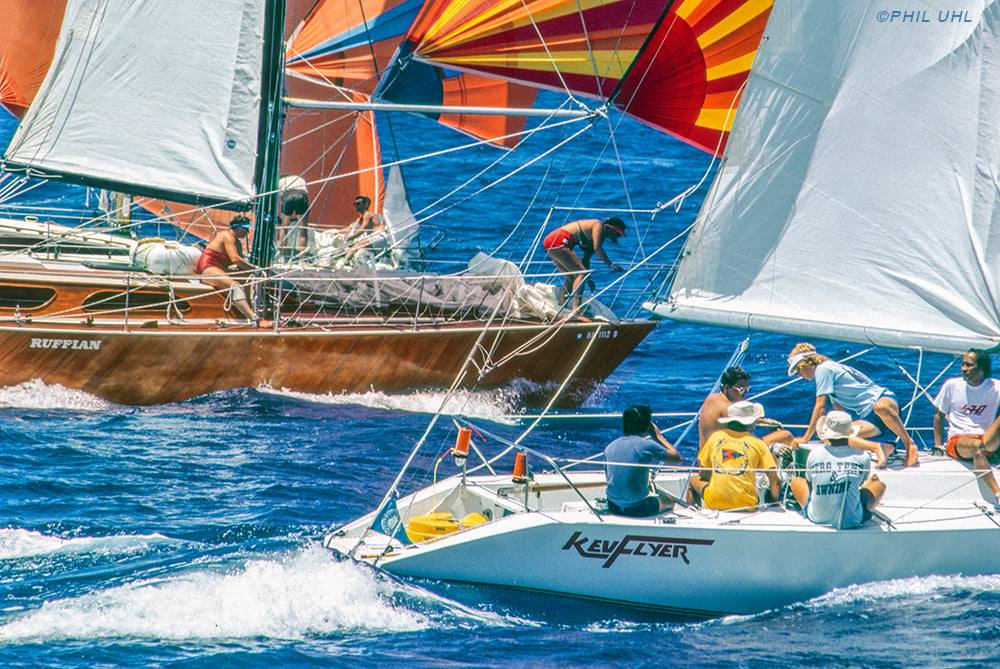
The smallest yacht in the series, the Farr-designed Kev Flyer (20.0ft IOR), seen here alongside the Wilson-designed Ruffian (30.7ft) (photo Phil Uhl)
Other yachts which topped Ragamuffin, Shockwave and Challenge at times included Anticipation, a Lexcen 50-footer that benefitted from an age allowance (39.2ft IOR) that had been the leading yacht after three races (and was third going into the final race), and the new Farr designed 52-footer Zamazaan (41.7ft) which won Class A overall (and finished sixth overall).
Shockwave leads ex-New Zealand yacht Inca (both trailing Gerontius) during the 1980 Clipper Cup (photo Phil Uhl)
Shenandoah with Unchu to leeward and New Zealand's Brother Dominic (another Davidson design) passing Koko Head (photo Phil Uhl)
The time-on-distance system used for calculating the handicap results appeared to favour the big yachts in the regatta. Apart from taking line honours in four of the races, Windward Passage (67.7ft IOR) also posted corrected time scores of 3/1/1/2, before falling to 13th in the Round the State finale and finishing third overall, behind Shockwave.
Gold Coast Express, an Australian One Tonner, the convincing winner of Class D (photos Phil Uhl)
The performance of Gold Coast Express, another Davidson design, was also notable as
she won every race in Class D on both line and corrected time. She was unique in that she had 60 owners, all members of the small Southport Yacht Club on the Gold Coast of Queensland. She was a development of Davidson's famous Half Ton champion Waverider, and rated only 27.1ft with the centreboard fixed. But despite outclassing her competition in Class D, she could not figure higher than 15th in the overall fleet in a series dominated by higher rating boats.
Foredeck action aboard Windward Passage (photo Phil Uhl)
Japanese yacht Unchu - this photo seems to be from the fourth race (third inshore) which she won, as she looks to be ahead of many larger yachts (photo Phil Uhl)
One exception to the big boat hegemony was the result of the the 40-foot Japanese yacht Unchu (30.3ft) which won the fourth race, the final Olympic triangle after picking a favourable windshift. Unchu was designed by Ichiro Yokoyama, who had designed Magician V, the winner of the 1978 Quarter Ton Cup held in Japan. This was the first win for a Japanese yacht in a major offshore series outside Japan.
Japanese yachtUnchu, winner of the final inshore race (photo Phil Uhl)
The increase from 1978 in the number of competing yachts in 1980 was considered a good sign that the regatta was popular with offshore sailors, and attracted another quality fleet in 1982.
The 45-foot S&S designInca(which sailed for NZ in 1978 but was US-owned by 1980) rounds a leeward mark followed byTimber Wolf(Farr, USA),Darth Vader(Tarrabochia, NZ)andUin na Mara III(Farr, USA)
The Farr Half Tonner Don Quixote (rating 22.7 ft), not much bigger than Kev Flyer,rounds a leeward mark (photo Phil Uhl)
Mile High, a 50-foot fractional Peterson design (rating 39.0ft) from Hong Kong, seen here off Koko Head - she went on to finish third in Class A (photo Phil Uhl)
Another Davidson design, Brother Dominic, seen here rounding a windward mark (NZ, 32.1ft IOR) (photo Phil Uhl)
The Britton Chance-designed Glory (US, 43.7ft IOR)leads Snow White II (photo Phil Uhl)
The Tarrabochia-designed Darth Vader (33.4ft IOR) from New Zealand at a gybe mark during one of the inshore races (photo Phil Uhl)
Another view of Siska on one of the downwind legs (photo Phil Uhl)
Australia's Impetuous (Holland 42) leads Canada's Kanata (photo Phil Uhl)
Ragamuffin completing a gybe while rounding a wing mark (photo Phil Uhl)
The Australian yacht Mary Muffin, a Frers 47-footer (photo Phil Uhl)
Mile High, a Peterson designed 50-footer sailing for Hong Kong (39.0ft IOR), finished third in Class A, behind Zamazaan and Anticipation (photo Phil Uhl)
An aerial view of Snow White II on a downwind run (photo Phil Uhl)
Snow White II seen here alongside Ruffian, with the Farr 36 Country Boy (29.0ft) and Gold Coast Express in the background, during a pre-regatta race (photo Phil Uhl)
Gold Coast Express during the Laihana Sauza Cup, showing her distinctive Davidson 'crease' in her aft sections (photo Phil Uhl)


.jpg)