Showing posts with label One Ton Cup 1979. Show all posts

22 January 2015

One Ton Cup 1975

The 1975 One Ton Cup was sailed off Newport, Rhode Island, under the sponsorship of Ida Lewis Yacht Club, in early September of that year, and contested by 20 yachts from eight countries.
Pied Piper - North American and World One Ton Champion 1975 (photo histoiredeshalfs)
The series was taken convincingly by Lowell North and Dick Jennings sailing a new Doug Peterson design, Pied Piper. The pair had sailed a near flawless series in the North American championship two weeks prior, which had also been attended by nine of the One Ton Cup fleet, and went on to post a 1/5/1/1/2 series in the Cup to beat second placed Peterson design Gumboots (Germany), the defending champion, by just under 8 points, with another US yacht America Jane III (Scott Kaufman design) third.


Gumboots - 1974 One Ton Cup winner (photo Robert Foley/Yacht Racing)
Although there were several other contenders, including the new Holland design Silver Apple (Ireland), the real battle lines were among the top three as the series wore on. There was almost always a first division and then the rest of the fleet - the difference was small but difficult to break, with ten yachts rounding a mark in the offshore races after 50 miles just three minutes apart. Racing was also a complete test for the fleet, with light to moderate airs predominating, but a real New England blow featuring in the final race to expose those less prepared.

Gumboots and America Jane III in light air conditions during the 1975 One Ton Cup
The 1974 One Ton Cup held in Tourquay had been won by Gumboots, a development of his previous breakthrough design Ganbare that had finished second in 1973. The success of Ganbare paved the way for One Ton design to settle on a smaller and lighter type of yacht (but still of relatively heavy displacement in today's terms), with reasonably pronounced forefoots, flat-ish garboards and narrow sterns. America Jane III was perhaps the most different of the new boats, as it was heavier, very broad aft and deeper, and seemed able to carry more sail as the breeze increased. It was evident at this stage that the future of S&S types such as Mach II, and the earlier America Jane II, were really in doubt, given their lack of speed in the series. Masthead rigs remained universal, with many sporting hydraulic backstays and forestays, as well as vangs and other items of gear.

The new Kaufman America Jane III (right) alongside the smaller S&S America Jane II (photo histoiredeshalfs)
Earlier in the summer, East Coast One Tonners had also competed in both the Block Island and Larchmont Race Weeks. This provided time for changes in sails, tuning, ballast arrangements and rating in the pursuit for improved performance. Later, and between the North American championships and the Cup, America Jane III, Silver Apple and another Peterson design Kindred Spirit (US) all put chainsaws to their keels to remove lead. America Jane III, which had removed about 460lbs of lead, and Kindred Spirit increased their sail area, and Silver Apple removed their solid propeller in favour of a folding one.
 
America Jane III in power reaching conditions (photo histoiredeshalfs)
America Jane III
became more tender and reduced her rating by about .35ft - she raised it back to the One Ton limit of 27.5ft by adding length to her spinnaker pole and girth to her spinnaker, and about 2 feet to her LP (genoa overlap). Before she made these changes she had performed so poorly in the North American championship that she was almost dropped from the invitation list for the Cup. Her subsequent results in the Cup series, at least after her disastrous first race where she placed 15th, proved that the changes were successful.


The US yacht Artemis, designed by Ron Holland, finished fifth overall (placings 5/6/5/9/9) (photo histoiredeshalfs)
Silver Apple also benefited from changes to her keel and ballast, but not by as much. Kindred Spirit ran out of time to add sail in response to her lightened keel, but did not suffer significantly as a result, even though she sailed with a sub-optimal rating of 27.4ft.
The first race was an Olympic course sailed in light to moderate airs, and the shift off the Point Judith shore determined the preferred side of the course. However, tactics played second fiddle to boat speed, and in this regard Pied Piper asserted herself early. The second race was a little windier and sailed on a windward-leeward track. There were no real surprises, other than Pied Piper finishing fifth and the race being won by Kindred Spirit, which after a second in the first race was leading the series at this stage. America Jane III bounced back from her poor result in the first race with a second placing.


US yacht Kindred Spirit challenged early but finished fourth overall (photo Robert Foley/Yacht Racing magazine)
The middle distance offshore event started in light airs and conditions remained shifty throughout. Fog closed in on the second day's dawn and rounding marks became a real test for the navigators. The fleet assumed their normal order, with Pied Piper winning, ahead of America Jane III and Gumboots.

Pied Piper (left) and America Jane III 'bloop' their way downwind (photo Robert Foley/Yacht Racing)
The third inshore race, race four, started in a dying breeze, which eventually gave out as the entire fleet reached the 'windward' mark with spinnakers up. A new breeze then arrived with force, building to 30 knots by the finish. America Jane III managed a second, behind Pied Piper, despite a port-starboard incident with Silver Apple - the force of the collision was such that Silver Apple's stem fitting was damaged beyond repair, and she was unable to start in the final race. America Jane III was holed, but she was able to be repaired.

Ted Turner's Vamp, chasing Mach II (middle) and Pied Piper (yellow, to the right) (photo histoiredeshalfs)
The final long offshore was held in strong winds, with seas up to 8 feet and 35 knot winds and fronts crossing the fleet on three occasions. Damage was relatively light, however, with Natael II (Italy) breaking a forestay fitting and Fortune Hunter (Australia) losing part of her rudder. America Jane III powered through for the win (for series places of 15/2/2/2/1), with Pied Piper second, and Gumboots finishing in her customary third place (with series placings of five thirds).

Pied Piper was the most consistent boat in the fleet, benefiting from excellent helmsmen and an experienced crew which included Tim Stern and Rod Davis, and she was quickly bought after the series by Ted Turner (who owned and sailed the Peterson designed Vamp to sixth place in the series). She featured a very effective rig, designed by Lowell North who worked closely with Stern on its development. Her genoas appeared to marry well with her forestay curve, and could bend her mast with great control. This allowed her to carry a mainsail with more shape for lighter air and reaching, while still permitting her to flatten the sail for stronger winds. The control over her mast bend was such that the crew rarely needed more than a flattening reef to depower the rig in heavier air. Turner planned to contest the SORC with Pied Piper the following year, but in the meantime took the boat to Australia for the 1975 Southern Cross Cup where she lined up for a close contest with the new Farr design Prospect of Ponsonby.  She later competed in the 1979 One Ton Cup, which was again raced in Rhode Island, but by which time she was well off the pace.

The crew of America Jane III sheet on after rounding a leeward mark (designer Kaufman grinding) (photo Robert Foley/Yacht Racing magazine)
The early threat posed by Kindred Spirit faded after the second race, and although leading the series at this stage she faded to fourth after posting 6/8/7 in the final three races. Ganbare (Italy) contested the series with a largely Italian crew. She was competitive in the light going but otherwise outclassed and finished 16th overall (from a 16/16/8/15/DNF series), which indicated the level of progress that the One Ton fleet had made in the previous two years.

The fleet start one of the races in light airs during the 1975 One Ton Cup

 Dockside photos of some of the 1975 One Ton Cup fleet can be seen here.

23 December 2013

One Ton Cup 1980

Filo da Torcere - 1980 One Ton Cup winner
With recent focus on the 'revisiting' of the One Ton Cup scheduled for 2015, it seemed timely to look back some 34 years to one of the original versions of the event, being the 1980 series held in Naples, Italy.  

Italy deployed no less than 26 yachts in the selection trials and was thus regarded as the strongest country in the One Ton Cup itself. Those boats which missed selection went on to sail for other countries, which lead to a big fleet of 27 yachts representing 12 nations.

One of the best boats, which didn't enter the trials, was Exelsior Yacht Club, skippered by Paul Elvstrom, went on to sail for his home country of Denmark. With his success in the 1978 series, Ron Holland was the best represented designer, and particular interest focused on Two new boats,Todahesa, skippered by John Kolius, and Sharkey, with Tim Stearn, Lowell North and Butch Dalrymple-Smith in her crew, and were possibly the fastest boats in the regatta. The earlier Holland design Indulgence was unsuccessful in Newport in 1979, but made the journey to the Mediterranean for the 1980 series. 

Filo da Torcere

Garibaldi finished seventh overall (note the carbon fibre staunchions)
Sharkey in good spinnaker reaching conditions, just ahead of Filo da Torcere
The top boats sported fractional rigs, and were generously canvassed in anticipation of the light airs expected in Naples, and exotic construction was becoming commonplace, with a high proportion of internal ballast - normal for the earlier centreboarders but also favoured by the keelers. At the extreme, Sharkey's keel was made of wood. 
Sharkey sets off on a light air reach
There were no new boats from Bruce Farr, Doug Peterson or German Frers, while Laurie Davidson's new boat Alerted was under-canvassed for the conditions.
Filo da Torcere rounds a leeward mark during the Italian One Ton Cup selection trials
The Italian yacht Cuordileone - finished strongly with two seconds in the final two races to finish fourth overall
Light winds prevailed throughout, and it was stop go racing in Naples Bay for the short offshore race, in which Indulgence was leading 20 miles from the finish only to be left behind when the wind died and filled in from the opposite direction. Her 24th place in that race eliminated her Cup hopes, notwithstanding the attention to detail applied by Harold Cudmore and Phil Crebbin, the two main members of her afterguard.
Nat - a US charter entry finished ninth overall
The Holland design Indulgence
Filo da Torcere
It was the Italian yacht Filo da Torcere, designed by Andrea Vallicelli, that proved to be the most consistent in the tricky conditions. Filo da Torcere was never one of the favourites, despite her good placings throughout the regatta (10/5/6/3/4). She was built early in 1980 of moulded ply, and was skippered by dinghy champion Stephano Roberti, with an Italian crew. They won the series thanks to good placings in each race, no matter what the conditions, except in the first inshore race when they chose the wrong side of the course on the first beat - even then her placing of tenth compared favourably with the worst results of her closest competition.
Indulgence on a light air reach
The striking paintjob of the Fontana/Maletto/Navone design Buonalena (above and below)
Scott Rohrer aboard the Fontana/Maletto/Navone-designed Buonalena, which sported a striking angled green colour scheme, finished in second place, with placings of 2/3/11/4/7. She had lead the series going into the final long offshore but finished out of the running in the high points race, and finished just ahead of Sharkey in third (4/18/1/11/3), and Courdileone. Todahesa finished fifth. Indulgence won the final race, giving her the White Horse Trophy (which was awarded to the winner of the long offshore race during the One Ton Cup events) for the second year in a row. Exelsior Yacht Club finished a disappointing eighth.
Filo da Torcere
Filo da Torcere sails upwind in light to medium conditions on her way to winning the 1980 One Ton Cup
Filo da Torcere as seen in 2013


3 February 2013

1979 One Ton Cup

My recent post on Pendragon features a number of photographs taken by US photographer Paul Mello who was active in the Newport area in the late 1970s and early 1980s. He has recently released more of his great black and white prints from the One Ton Cup held in September 1979. I have created a gallery from his photographs and I am grateful for his permission to use them here. 

Mello has noted these photographs on the Sailing Anarchy website as being from the North American One Ton series (held shortly before the One Ton Cup proper). Some of these shots feature various European yachts, however, and so could also be from the One Ton Cup itself, unless some of the European boats had decided to contest the North American series as a warm up regatta. 

Startline action, Indulgence leads away to leeward
Hot Flash, a Gary Mull design, built by Goetz Boats, looks good here during the North Americans
Pendragon to leeward of Indulgence
The tortured stern treatment of the defending champion, the Ron Holland design Tilsalg-Flensburg from Germany (finished 10th overall)
The classic Peterson pintail stern shape of the 1975 One Ton Cup winner Pied Piper (finished 12th overall)
 Tilsalg-Flensburg approaches the weather mark in the lead with Indulgence to the right and Pendragon to the left
The fleet heads off on one of the reaching legs, Pied Piper bringing up the rear
 The Farr design Downtown during the North Americans
US yacht the Bill Cook designed Celebration works up in Narragansett Bay in the prestart of the second race in the One Ton Cup that was waived off due to 40 knot plus winds and a forecast for more. Celebration finished sixth overall.

28 January 2013

Pendragon (Davidson 34)

Pendragon sailing during the 1978 Three-Quarter Ton Cup and sporting her experimental mylar headsail
Pendragon was another legendary Laurie Davidson IOR yacht, that made a name for herself by winning the Three-Quarter Ton cup in 1978, and then went on to win the One Ton Cup in 1979, a feat not achieved by any other yacht in level rating competition.

After the success of Waverider, and despite penalties being introduced to the IOR rule to slow the light displacement type of yacht, Davidson remained in demand. US dinghy sailor John MacLaurin wanted a flat hulled New Zealand-style centreboard yacht and asked Davidson for a Three-Quarter Tonner. The result was Pendragon, a development of and big sister to Waverider, and also built lightly in wood by Tim Gurr of Ocean Racing Yachts in Auckland. 
Pendragon being lifted for inspection ahead of the 1978 Three Quarter Ton Cup (photo courtesy of Doug Wardrop)

Builders plaque (photo Craig CRM)
Pendragon achieved the designers brief and the distinctive purple yacht put in a dominant performance in the 1978 North American One Ton championship held in San Diego, but lost the title to the Graham & Schlageter designed Chocolate Chips after a poor final race that counted for 150% points (with a final regatta result of 2/1/1/1/9). She went on however to win the 1978 Three-Quarter Ton Cup held in light airs in Victoria, British Columbia, and in so doing beat new designs from Britton Chance, Ron Holland and others in conditions in which the light yacht was not expected to excel. A notable addition to her sail wardrobe was an early and experimental mylar genoa, and because of the dark green colour of this early prototype, it was dubbed the "garbage bag."
Pendragon undergoing inspection (including by her famous designer, second on right) before the 1978 Three-Quarter Ton Cup (photo D Wardrop)
Pendragon sailing during the 1978 Three-Quarter Ton Cup (above and below) and sporting her experimental mylar headsail
The changes to the IOR in 1979 had a serious effect on Pendragon, with her rating moving up a full two feet (from 24.5ft to 26.5ft). It became apparent at a very early stage that Pendragon could not remain competitive in a Three-Quarter Ton configuration. Davidson resolved however that his champion yacht could still be competitive, by audaciously turning the formerly full-size 34ft Three-Quarter Tonner into a small One Tonner, a yacht that would normally be at least 36ft long. Davidson advised owner MacLaurin that the next One Ton Cup was to be held in Newport, Rhode Island, a venue noted for generally light winds, and so a small, light yacht with a large sail plan could be a potent combination.
The specific changes for Pendragon's rig to move her up to One Ton class

The alterations required to bring the yacht up to a One Ton rating (27.5ft) were, however, extensive. Further displacement was required to achieve the increased minimum centre of gravity factor, and for this Gurr travelled to the US to oversee the addition of 15mm of lead around the midships area, which was then glassed over and faired in. The sail plan was increased by approximately 20%, through the addition of a longer boom and a small bowsprit for larger headsails (see diagram above). A bigger centreboard was also fitted, although this proved to be slightly too thin in section. The yacht sailed with the centreboard pinned down to avoid the new moveable appendage factor penalty, and Pendragon was the only centreboard boat in Newport in 1979.

Other changes were also needed to meet the different regulations for the normally bigger One Tonners, with more headroom needed and accommodation for an extra crewmember. During the North American One Ton series, held a month before the Cup, Pendragon showed that she had the pace against the top boats, but was making too much leeway upwind and finished in fifth place, with results of 2/5/4/8 in the fifteen boat fleet (won by the Cook design Firewater). Additional width was added to the centreboard before the One Ton Cup series.
Pendragon during the 1979 One Ton Cup (photo Sail magazine)
Continuing changes to the IOR possibly accounted for the fact that only 12 yachts from four countries attended the 1979 One Ton Cup, although a non-European venue was probably also to blame. The regatta was also affected by the influence of nearby Hurricane David, with one race waved off in high winds, and another was scrubbed after the hurricane had caused one of the marks to come adrift causing some navigational issues for many boats. 
Pendragon during racing (above) and afterwards (below) - photos by Paul Mello
Pendragon proved to be fast in the light air of the first race, and throughout the series she proved to be untouchable downwind, while able to hold her own on the upwind legs. The result of the regatta remained close, however, with the Holland design Indulgence, which had proved to be very fast in the preceding North American championship, challenging strongly for the title by winning the final 245 mile ocean race and taking the coveted White Horse Trophy. Pendragon stayed close and finished a close second, which was enough to win the Cup (with a series result of 1/3/2), an unprecedented and un-repeated result for a yacht designed for a different, and lower, level rating class.
Pendragon's increased sail plan is clearly evident in this photograph taken during the 1979 One Ton Cup
Some great photographs from the 1979 One Ton Cup, and the preceding North American One Ton series, taken by photographer Paul Mello, and I am grateful for his permission to reproduce some of these here.
Pre-regatta preparation by crewmember Kimo Worthington on Pendragon's centreboard
Startline action in the 1979 North American One Ton series, Indulgence to weather of Pendragon

Pendragon rounds a windward mark during the 1979 One Ton Cup
Pendragon designer Laurie Davidson is interviewed after the One Ton Cup victory by David Phillips of the Providence Journal 
 Meanwhile the crew celebrate, skipper Rod Davis on the left, John MacLaurin holding the now-empty bottle. Other crew are Dave McCulley, Bryon Pratt, Curt Oetking, Kimo Worthington and Paul Murphy.
A delighted John MacLaurin (centre) receives the One Ton Cup, September 1979
Pendragon seen here racing off Marina Del Rey in 1981 (photo Phil Uhl)
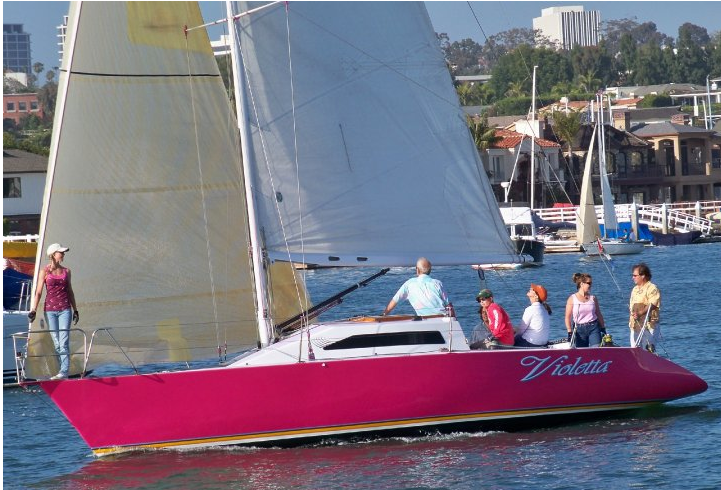
The yacht continues to sail and race in Newport on the US West Coast under her new name Violetta. Her original purple colour scheme has now given way to vivid pink, but she retains the distinctive bowsprit. 
Pendragon as she was seen in 2017 (photos Craig CRM)

Recent photographs of Violetta (Yachtworld)

Violetta (Facebook)


Article updated May 2025