9 February 2014

Feltex Roperunner (Farr 40)

Feltex Roperunner (photo Farr Yacht Design)
Feltex Roperunner was designed by Bruce Farr for a syndicate headed by Don Lidgard to contest the New Zealand trials for the 1981 Admiral's Cup. Design #82 was, as noted by Farr, conceived as an all-out Admiral's Cup yacht with no concession to any other style of racing or unnecessary creature comforts. The minimum Admiral's Cup rating of 30.0ft IOR was decided on not only for minimum capital outlay, ease of handling and a size of boat where optimum performance can be gained very easily in a light-ish displacement yacht, but also because over the years minimum rating appeared to have offered the best chance of producing the top all-round performance in typical conditions experienced in the Admiral's Cup (the top individual yacht in the previous regatta was another minimum-rater, the Peterson designed Eclipse).

Feltex Roperunner came up against a range of new boats for the hotly contested trials, but notwithstanding the world championship victories of Farr's yachts in 1977, new rule penalties against light displacement designs had seen something of a change in designer preference amongst New Zealand skippers by 1980. Feltex Roperunner was the only Farr design in the trials, and Ron Holland designs had come to the fore, represented by the minimum raters Swuzzlebubble III, Epiglass New Zealand and Spritzer, and the larger Monique. These yachts came up against the S&S 46 footers Marac and Ngaruru, and the Davidson 50-footer Outward Bound (designed for the Whitbread round the world race).
Feltex Roperunner was built at the Marten Marine yard in a hi-tech Kevlar and Klegecell layup
Feltex Roperunner on launching day at Half Moon Bay, Auckland (photo Murray Buckman)

The design and deck layout for Feltex Roperunner by Farr Design (the boat was finished with a straight stem profile rather than the slight concavity shown in this drawing)
Despite the changes to the IOR, Feltex Roperunner's hull form remained typically Farr with powerful stern sections (although more conservative than Farr's earlier efforts), moderate beam and a fine bow to handle a short chop to windward, and as light in displacement as the new displacement/length factor of the IOR Rule would allow, consistent with all-round performance objectives. Indeed, Feltex Roperunner was significantly lighter than the Holland designs (12,000lbs compared to 13-14,000lbs), but in broad terms appeared to have traded this for length, being about a foot shorter. The boat featured a large fractional rig, designed to enhance her light weather performance and to give more power out of crowded start-line situations.
Feltex Roperunner on launching day at Half Moon Bay, Auckland (photo Murray Buckman)
Feltex Roperunner (closest to camera) during the start of the 1981 Auckland Anniversary Regatta (photo Sea Spray magazine)
Feltex Roperunner sailing downwind in light airs during the 1981 Auckland Anniversary Day regatta (photo Sea Spray magazine)
Feltex Roperunner preparing for a race start off Auckland's Orakei Wharf (photo Doug Elder)
In response to some initial observations that the hull of Feltex Roperunner looked more distorted than that of the Holland boats, Farr commented at the time that “Our boats look bumpier because they’re wider aft, but really they are fairer than the competition. In fact, the boat is quite sweet at the aft end, the only unfairness being in the topsides where we have rounds and hollows adjacent to each other".
Feltex Roperunner on the wind and approaching a windward mark and displaying reasonably undistorted stern buttock lines (photo Farr Facebook page)
Feltex Roperunner (right) leads Swuzzlebubble III into Auckland Harbour on a tight reach during the 1981 Admiral's Cup trials. Spritzer can be seen to leeward, and Marac ahead
Feltex Roperunner's initial performance looked promising, and she, along with Swuzzlebubble III and Epiglass New Zealand, proved the most consistent in the observation trials. However, in the subsequent selection trials she faltered, and her series results of 3/4=/7/1=/5/4, for fourth overall, were not as consistent as the trio of Swuzzlebubble III, Epiglass New Zealand and Marac that clinched selection. At times Roperunner went like a champion, as in the short offshore race when she tied for first place with Swuzzlebubble III, but on other occasions she didn't seem to handle the chop as well as the finer-sterned Holland yachts. Her campaign was not helped when she hit the rocks off Rangitoto in the second harbour race while she was leading the group of minimum raters.
Feltex Roperunner is set up well to windward of Spritzer and Swuzzlebubble III in a harbour race start off Westhaven (above), but Swuzzlebubble III has soon slipped ahead (below)


Above and below - Feltex Roperunner sails past Motuhie Island during the 1981 Admiral's Cup trials (photo Maritime Museum)
Gibbs’ faith in Holland was well rewarded with Swuzzlebubble III finishing as the top individual boat in the Admiral’s Cup, although the team itself finished a disappointing fifth overall. 
The Roperunner in a fresh southerly off Evans Bay in Wellington, with Southern Raider (KZ-4666) and Red Herring II to weather (photo Rip magazine)
Feltex Roperunner went on to compete in the Southern Cross Cup trials, held in typically fresh conditions in Wellington in October 1981. She was by then owned by a syndicate headed by Geoff Thorpe and renamed The Roperunner. She was selected for the New Zealand team alongside the S&S 46-footer Ngaruru and a new Davidson yacht, the 38-foot Southern Raider. 
The Roperunner to windward of the Davidson-designed Szechwan during the 1981 Southern Cross Cup series (photo Seahorse)
The team appeared sound enough, but in the light breezes and sloppy seas off Sydney it was a failure. The team were further handicapped when Southern Raider was forced to retire from the Sydney-Hobart race following structural problems after heavy squalls on the first night. The Roperunner salvaged what she could, finishing 13th in the Cup fleet (following placings of 12/7/20 in the earlier races), but Ngaruru could do no better than 28th, of 30 boats.

The Roperunner during the 1981 Southern Cross Cup series
The Roperunner did not return to New Zealand, and went on to race in Australian offshore regattas for some years. She displayed some longevity and perhaps improvement following further tuning, and The Roperunner finished a creditable 15th overall in the 1983 Sydney to Hobart race (of 158 finishers), the year that the new generation Farr 40's like Pacific Sundance came to the fore to win the Southern Cross Cup for New Zealand. This effort was no doubt a significant factor that led to The Roperunner being crowned the Blue Water Champion by the Cruising Yacht Club of Australia for the 1983-84 season.
The crew of The Roperunner after the finish of the 1983 Sydney to Hobart race (photo Facebook)
The Roperunner was understood to be based at the Lake Macquarie Yacht Club in about 2016, she now (as of December 2023) sits somewhat forlornly on a mooring at Belmont Bay in New South Wales, with an unpainted extension to her cabin top (and much reduced cockpit) and the addition of a steering wheel.
The Roperunner as seen in December 2023 in Belmont Bay (photo Facebook) 

Update - May 2025: The Roperunner has been rescued (now based in Lake Macquarie) and is undergoing restoration.

The Roperunner being lifted from the water ahead of her restoration, May 2025 (photo Facebook)

The Roperunner has been reverted to her original name and now has her own Facebook page, so you can follow progress on her restoration here.


Article updated July 2026

5 February 2014

NZ One Ton Cup trials 1971


Wai Aniwa during the 1971 NZ trials
The 1969 edition of the One Ton Cup was the last to be held under the RORC rule. The victory by Rainbow II in the 1969 event meant that the RNZYS won the right to host the next contest in New Zealand. The change of hemispheres made the timing awkward, with the regatta to be held either in six months or eighteen months. With the IOR coming into effect in January 1970, and because the One Ton rating would move up to 27.5ft (from 22.0ft under RORC), it was decided that an 18 month gap between events was preferable. As a result, the first One Ton Cup under IOR would be contested in New Zealand in February 1971.

The introduction of the new IOR rule meant a rush to the design board to come up with new yachts for the regatta, both in New Zealand and in those countries intending to challenge for the trophy, including Germany, Italy, Sweden and Switzerland. The conversion from the RORC rule to IOR lead to a general reduction in ratings for a given design, making it necessary for existing boats to increase their rated sail area, or take up other measures that would bring up their ratings to the relevant class limit. That meant a busy summer for measurers, converting and optimising yachts designed to the RORC rule to measure as One Tonners under the new IOR.

Young Nick working up before the trials - she benefited from longer lead up time compared to her rivals (photo Sea Spray magazine)
The introduction of the IOR had at first steadied the situation arising from the type-forming and optimisation going on under the RORC rule. In the first couple of years designers were still adapting to this complicated rule, but boats were becoming more sophisticated. The changes also induced a trend towards bigger boats, leading designers to over-react in the same direction and resulting in a new ‘maxi’ breed of One Tonners, yachts approaching 40ft in length and up to 7,700kg displacement, typified in New Zealand by the Dick Carter design Wai Aniwa, and the S&S design Pathfinder. 

Escapade being launched from Steel Yachts and Launches yard on the Tamaki River, 6 August 1970 (photo NZ Yachting & Boating magazine)
The trend towards increased displacement at this time was initially not so much to increase or decrease its value, but to spread it out to the ends, particularly aft. This had the effect of increasing the prismatic coefficient in response to reductions in the area and depth of the immersed mid-section. This trend probably began through attempts to flatten off the boat at the inner depth point, thus achieving a greater depth value for a given displacement. Although bows became finer, displacement and buoyancy in the for’ard sections was redistributed to create notably deeper bow sections. 

Preparation for the trials included the need to complete the many measurements involved in obtaining an IOR certificate. Here triallist Concord (sistership to Rainbow II) is subjected to the inclining tests in the still waters of the Tamaki River required to measure her stability (photo Sea Spray magazine)
The growing size and displacement of the new boats indicated to some that the authorities had made a basic error in setting the One Ton rating at 27.5ft. Certainly in the New Zealand situation, the rule made many former One Tonners just a little too small and a lowering of the rating to 27ft or less would have allowed more boats to have been competitive. Rainbow II had been sold to a Bermudan yachtsman. But she was a relatively short yacht and would have been of doubtful value even if she had been available.

Other than increased size and length, other expensive developments which featured on the new boats included aluminium hulls and hydraulic boom vangs. Wai Aniwa (above), skippered by Chris Bouzaid, even utilised a pivoting keel, designed to provide greater lift to windward, and allow deeper sailing angles downwind (the photo to the right shows Wai Aniwa being lowered onto the central pivot shaft). She was built in aluminium and was finished only days before the trials. S&S designs were to the fore in this era, and two new boats were commissioned from the famous New York office, Young Nick, and an aluminium sistership Escapade. Other new yachts included the John Lidgard-designed Runaway, the C&C design Mustang and the Carter designed Outrage.These new boats joined eleven other One Tonners of varying sizes, shapes and pedigrees for the trials series.


Escapade during the 1971 trials (photo Sea Spray)
Young Nick was the early favourite, and lived up to expectations by winning the first thirty-mile trial race with some ease. But the second race, the medium distance ocean event, went against all predictions when it was won by the diminutive Moonlight, a modified Townson 32 class yacht sailed by the explorer Peter Mulgrew, by just 30 seconds from Wai Aniwa.

Moonlight leads Wai Aniwa downwind during the 1971 trials (photo Gary Baigent collection)
Young Nick followed up the disappointment of a disqualification in the second race by winning the third, by a massive five and a half minutes, and took out the next short race as well. 
The S&S design Young Nick powers upwind during the 1971 trials. Note the then-fashionable bendy boom (photo Sea Spray magazine).
After four races Moonlight, consistently in the running, was leading on points from Escapade and Wai Aniwa. But it was Wai Aniwa that revelled in the eased sheets work of the final long ocean race, which she won comfortably from Runaway and Escapade. Young Nick sneaked into fourth while Moonlight faded from contention with a disappointing seventh. Thus, and based strictly on the trials points results, the selection committee picked Wai Aniwa, Young Nick and Escapade for the New Zealand team to contest the 1971 One Ton Cup.

28 January 2014

Road Warrior (J/41 One Tonner)

Road Warrior - 1984 Newport-Bermuda Race
Road Warrior is one of about twenty J/41's that were built by J/Boats between 1984 and 1987, and were notable campaigners in the IOR scene in the US over that period. The J/41, designed by Rod Johnstone, was designed to rate as a One Tonner (30.5ft IOR), but first came to prominence in the 1984 SORC, when Dazzler finished third in Class E and third overall, while a fractional-rigged version Alethea finished fourth in class and fifth overall. The masthead design carried a bit more ballast than the fractional variation, while Alethea carried a larger headsail and smaller mainsail than other fractionally rigged boats of the size.


Dazzler had some interesting duels with Diva during the SORC, which was one of the first of the new breed of fractional lighter displacement yachts designed by Joubert/Nivelt. Dazzler was sailed by Bill Shore and Perry Harris, and breezed home in the heavily weighted Lauderdale race ahead of Diva, Allegiance (an Alan Andrews-designed One Tonner) and Alethea. Dazzler held onto her overall lead for two more races until Diva and Allegiance had a memorable first and second in the Miami-Nassau race, separated by just 3 seconds. 


The J/41's followed up their 1984 SORC success by taking the first three places in the  USYRU North American One Ton Championships, with Charlie Scott's Smiles winning, followed by Road Warrior, owned and skippered by America's Cup yachtsman John Kolius, with Dazzler taking third. Smiles went on to win that years' Onion Patch Trophy, while Road Warrior finished third.  
The Main Bear (left) during the 1985 SORC
Smiles went on to win the 1985 SORC overall - a large calm some 60 miles from the finish of the Miami-Nassau race benefited the smaller boats such as the One Tonners and gave Smiles a significant points edge over her larger competition. Indeed, the weather in the 1985 series was lighter than usual and this ideally suited the J/41, with its notable rocker, fine ends and low wetted surface. The win by Smiles was an impressive result for a production boat and caused some consternation for the many custom boat owners. Scott had even finished Smiles himself, although he went to some effort to centralise the deck equipment and the internal arrangement amidships to minimise weight in the ends.

Despite their initial success, the J/41's represented the end of the competitive masthead boats at the One Ton level, and after the 1985 season were considered something of an anachronism in the emerging trend towards fractional rigs in top level racing at the time. They were not widely regarded as the fastest boats on the track, but were marketed at the time as being easier to sail than their fractional competition. Consistency was emphasised, with higher average speeds across the wind range considered to compare favourably to the "moments of blinding speed interspersed with unbelievably slows" of their competition. 
Jack Knife (photo One Ton Class Facebook page)

The fine ends and slightly bow down trim of the J/41 in IOR mode (photo J Boats)
The J/41 performance assessment at the time commented that "fractional designs (including J/41s so rigged) have the edge when jib reaching and occasionally downwind under 5 kts TWS (when gybing angles are tighter downwind), but the J/41 is unbeatable upwind over 10 kts AWS or downwind over 12 kts TWS. The exceptions are in conditions over 25 kts AWS upwind where small rig Farr 40s excel or in some marginal surfing/wave conditions when close spinnaker reaching." 
One of the many J/41's, Merrimac (photo J Boats)
The J/41's were also noted for their structural integrity, when five survived the rough 1984 Bermuda Race, and two survived the SORC that year without failure. Construction nevertheless pushed the limits of the time, utilising vacuum bagged unidirectional  aircraft-grade Baltek Contourkote sandwich and 1/8th inch unidirectional carbon fibre skins for increased rigidity and impact resistance in critical areas. 

Road Warrior missed the 1984 SORC but raced in the 1985 event as The Main Bear, and was later renamed Lorimar. She is now owned by a Dutch yachtsman Jan Kuffel who bought the boat in 2008 in Long Island and she is now called Red Gull after her sponsor. Red Gull regularly lines up in IOR regattas hosted in the Netherlands against other older boats such as 45 South II, Canterbury, Container, Caiman, Jamarella, Lady Be, Morningstar, Marionette, Pinta and the like.

The happy crew of Red Gull, now sailing in Europe (photo Jan Kuffel)


10 January 2014

Infinity (Holland 47)

This post features a selection of photographs of the Ron Holland-designed 47-footer Infinity, taken by Phil Uhl and Larry Moran (and some others) during the 1981, 1983 and 1984 SORC. Infinity was commissioned and owned by US yachtsman John B Thomson Jr, and was in some ways a standard design approach for Holland, with a reasonably high freeboard, masthead rig, medium displacement and a flush deck, which was not dissimilar to many of her competitors during that era. She featured a straighter transom than Holland's previous designs which arguably gave the yacht a more elegant appearance than some of his earlier boats that had a pronounced curve in the transom profile. She had a rating of 35.9ft IOR for the 1981 SORC, which increased slightly to 36.2ft for the 1983 series.

Infinity finished 10th in Class B in the 1981 SORC (after placings of 6/7/10/11/14/13). She was fourth in Class B in 1983 (after placings of 6/7/1/5/1/3), behind a trio of Frers 51 yachts Carat, Bla Carat and Zero, and finished 33rd overall. In 1984 she came up against the likes of the Frers 50s Morning Star and Retaliation, and the Peterson design Artemis in Class B, and finished eighth, and was 42nd overall. 

A photo of Infinity in a nice upwind mode during the 1981 SORC (photo Guy Gurney | Facebook)

Infinity competing in the 1981 SORC (photo Phil Uhl)
Another photo from the 1981 SORC, with Infinity to leeward of Canadian yacht Amazing Grace (photo Phil Uhl)

Infinity powers upwind during the 1983 SORC (photo Larry Moran)


Infinity and Ichiban cross tacks during the 1984 SORC (photo Larry Moran)
Infinity at the Truman Annex after the Ft Lauderdale to Key West race in early 1982, with Aries alongside (left), and Locura and Rolling Time (right) (photographer unknown)


Infinity goes into a death roll (photographer unknown)

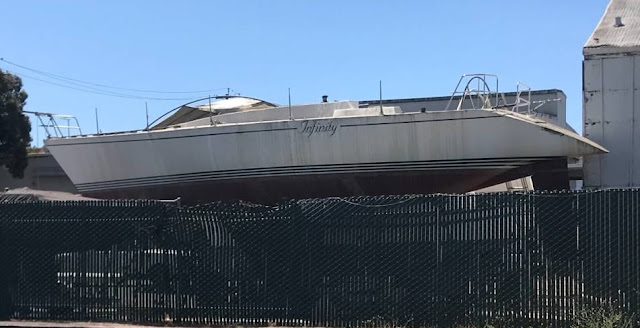
Infinity in somewhat dilapidated condition as of June 2021, as sighted in Richmond USA (photo Facebook)


Article updated March 2025

2 January 2014

Stress (Norlin One Tonner)

Following a recent article on the Peter Norlin designed One Tonner Agnes I have been contacted by the current owner of the last of Norlin's 'A-series' of yachts, the One Tonner Stress, which has prompted this post  regarding her origins and racing history based on some excellent insights and photographs from Markus Norlin and her current owner, Polish yachtsman Zbyszek Kania.

Stress was built with GRP over an Airex core by Sailing Progress for the 1977 season, commissioned by Goran Winberg and Borje Blumenthal. She was essentially a development of the Agnes lines, but with slightly less drawn out displacement in the bow and slightly larger. 

Stress achieved immediate success in her first season - the overall winner of the Round Gotland race (against 200-300 boats) and a host of other local regattas in Sweden and Finland. She was winner of her class in Cowes Week that year, performing strongly in the light winds that prevailed, and she then went on to finish second overall in the Channel Race. Her result in the light airs Fastnet Race was not as impressive, as stronger winds came in for the smaller yachts after Stress and other top boats had finished.
Stress during the 1978 One Ton Cup (photo courtesy Markus Norlin)
Stress had measured in at just 27.2ft IOR, just below the One Ton limit of 27.5ft, and so for the 1978 season, and the One Ton Cup of that year, her bow section was replaced with one with a finer entry, extending her waterline and increasing her rating by 0.3ft. 
The original lines drawing of Peter Norlin's Stress
Peter Norlin at the helm of Stress
At the 1978 One Ton Cup, held in Flensburg, Germany, Stress opened her campaign strongly, with a first place in the opening race, and followed this with a fourth in the second race. But after this she stood no chance against the lighter fractional rigged yachts as the breeze arrived. Stress finished the series in seventh place overall, but won the Bummerlunder Cup for the best yacht in the inshore races, and was the top scoring masthead rigged yacht. 

Startline action in the 1978 One Ton Cup - Stress leads off towards the pin end of the line - Danish yacht Heatwave is visible two boats back with second placegetter Bremen just to windward (photo courtesy Markus Norlin)
Stress in her preferred light air conditions during the 1978 One Ton Cup (photo courtesy Markus Norlin)

Stress (left) in close company during the 1978 One Ton Cup, with Heatwave (D2892) and Export Lion (KZ-3398) to leeward and ahead.
After that Stress was sold by her original owners to a Swedish doctor Stephan Brandstedt, who raced her in the 1979 Fastnet Race. In the severe conditions that prevailed the mast was lost and the crew sought shelter in Cork, Ireland. She was then sold in 1984 to Johan Listrup and she was renamed Sylvia 2 (after his wife and mother), and the yacht went on to scored further victories in the Round Gotland race in 1984 and 1986, and in other years, up to 1991, she dominated Class 3 in this famous Swedish race. 
Sylvia 2 during a long offshore race off Sweden during the 1980s
Her present elliptical rudder was built in 1985 by Listrup's son, Jens Listrup, and based on rudder drawings from the Norlin One Tonner Big Foot. The previous owner had already modified the original rudder but this was very heavy, while Jens utilised the original aluminium shaft and corrected the previous asymetric shape to a more efficient (and symmetrical) design, saving 100kg in the process.
The Listrup family also built these impressive 1:10 scale models of Stress
Sylvia 2 was sold to a Polish sailor Bruno Salcewicz in 1996. She is now raced by another Polish sailor, Kazimierz Kuba Jaworski, who had also won the monohull division in the 1980 OSTAR. Kania has renamed the yacht as Mist and she now sails on the Baltic Sea, and is looking in good condition after a recent refurbishment in Poland. 
Stress in her more recent configuration, seen here in Poland in 2013 (photo Zbyszek Kania)