17 April 2022

Kenwood Cup 1988

The Maxis on the charge in reaching conditions off Hawaii - Sorcery leads Il Moro di Venezia, Ondine VII and Matador

This post features a selection of great photographs by Sharon Green (Ultimate Sailing) that capture some of the action during the 1988 Kenwood Cup held in Hawaii. A total of 45 yachts entered the regatta, which was the sixth biennial sailing of the Hawaii International Ocean Racing Series. Competitors came from Australia, Brazil, France, Italy, Japan, New Zealand, the United Kingdom and the United States. The series was a combination of the Maxi World Championship, the Champagne Mumm World Cup and the Kenwood Cup, all rolled into a single event. Given its status, the regatta featured the biggest fleet of Maxis ever assembled in the Pacific, and included Congere, Emeraude, Il Moro di Venezia, Kialoa, Matador, Ondine VII, Ragamuffin, SovereignWindward Passage II and Winterhawk (ex-Ceramco New Zealand). It was also the first series in which a team from the United Kingdom would compete in the Cup, consisting of the yachts Indulgence VI, Juno and Yeoman XXVII.

Action aboard Maxi yacht Ondine VII

The Olympic triangle races again proved to be the most exciting part of the series as the steady tradewinds in the 20-knot range assured excellent racing conditions. Unfortunately Kialoa was dismasted during practice and was unable to compete agains the stellar fleet assembled in Hawaii. The two new fractionally-rigged Maxis, Il Moro di Venezia and Windward Passage II were clearly faster than their older masthead rigged rivals. It was, however, the smaller yachts that lead the fleet on handicap as Irv Loube's One Tonner Bravura (US) sailed to three first places in the Olympic triangle races to win the Hawaii Silver Jubilee Trophy. The Australian One Tonner Sagacious V was hot on his heels with two second paces, but fell off the pace in the third triangle race.

Bravura leads her One Ton rivals around a wing mark during one of the Olympic triangle races

No records were set in the Molokai Race due to the prevalence of light winds resulting from a tropical disturbance south of Hawaii. The race started in moderate trade winds of 10-12 knots which would drop to five knots by the morning. Windward Passage II was leading the fleet by 15 minutes at the turning mark and although she then sailed into a hole just before the finish line, she managed to protect their line honours position by just two minutes from Sorcery. The smaller yachts were left becalmed off Molokai's North Shore and the overall winner on corrected time was Jubilation, from Santa Barbara, while Bravura faltered with an 11th place to fall behind Sagacious V by five points in the top individual yacht standings. 

A close start amongst the One Tonners, with (amongst others obscured) Once a Jolly Swagman leading Sagacious V, Seikaiha, Kaitaro IV, Ultimate Challenge, General Hospital, Bravura and Black Jack

The Around the State Race was also sailed in lighter than normal winds which again meant that no records would be set. Windward Passage II continued to show her impressive form as she lead the fleet around the course finishing over six hours ahead of the Australian Maxi Sovereign. Sagacious V relinquished her hold on the overall honours after retiring with rigging problems. Bravura put in an excellent performance by finishing second behind Chicago yacht Insatiable, and secured overall individual honours and the King Kamehameha Trophy.

Insatiable (fifth overall and first overall in Class D)

In the team competition for the Kenwood Cup, the Australia Red Team of Great News, Sagacious V and The Esanda Way, and the USA Red Team of Bravura, Champosa V and Insatiable established their early dominance for the coveted trophy. However it was the Australia Red Team that were finally able to narrowly win the Cup by just five points.

Sagacious V (ninth overall and second overall in Class E)

Matador (13th overall and second in Class A) to leeward of Ondine VII

Yeoman XXVII (29th overall and fourth in Class C) rounds a leeward mark

Jubilation (second yacht overall and first in Class C)

Champosa V (17th overall and third in Class C)

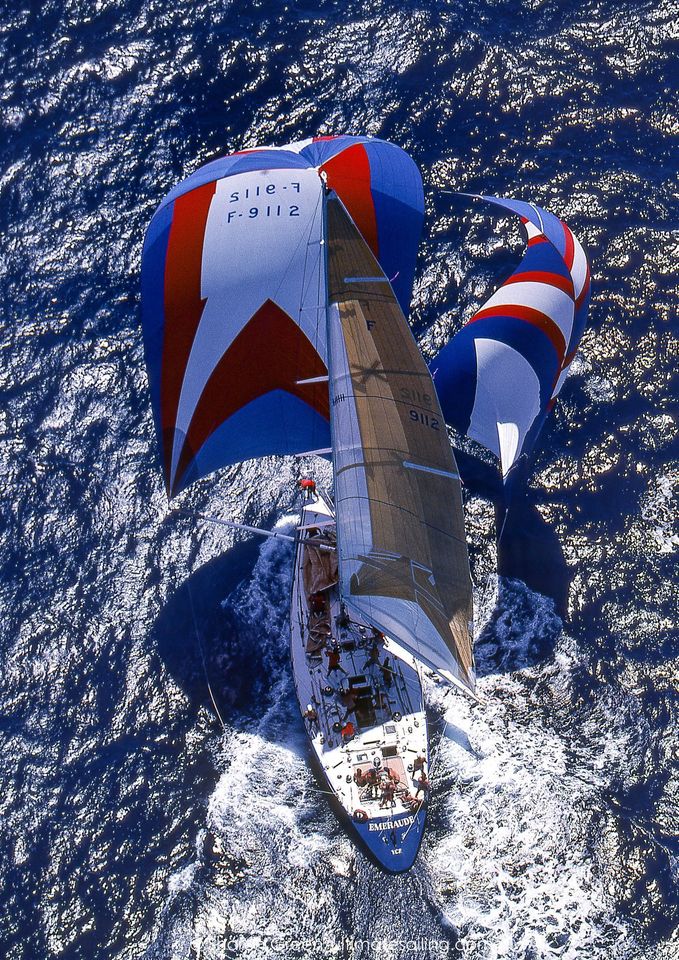
French 'mini' Maxi Emeraude (30th overall and eighth in Class A)

The Japanese Farr 43 Mimi (ex-Equity) (13th in Class E and 27th overall)

Sorcery (18th overall and fourth in Class A) to leeward of Matador

Japanese One Tonner Victoria (seventh in Class E and 14th overall)

A happy looking crew aboard Insatiable

Brazilian One Tonner Black Jack (ninth in Class E and 20th overall)

Ondine VII

More photos from this series can be seen here.


Article dated April 2022

12 February 2022

Lady Be (Frers 45)

Lady Be was the first of the production Beneteau 456, after Beneteau decided they needed a fast offshore yacht in their production range. She was designed by German Frers and, although supposedly a production yacht, the hull was constructed in Kevlar and carbon-fibre/foam sandwich with a stripped out interior. She was 13.8m (45.3ft) long, with a beam of 4.2m and displacement of 9,225kg, and carried a rating of 35.4ft.

Lady Be in hard reaching conditions (photo Facebook)
Eric Duchemin was recruited by Beneteau to campaign Lady Be for the French Admiral's Cup trials and just failed to gain a place. However, she came under the eye of Peter Blake, who was looking for a yacht to charter for the hastily prepared New Zealand Admiral's Cup team where she would join Neville Crichton's Frers 43 Shockwave. Crichton had initially planned his boat for a New Zealand team, but when no other boats came forth for selection, he campaigned Shockwave in the Australian trials. Despite her dominance of that series, however, Shockwave was not selected and Crichton found himself with a hot boat in need of team-mates. He managed to goad the New Zealand sailing fraternity into action, and Ian Gibbs joined the fray by chartering Swuzzlebubble IV, the former Epiglass New Zealand (Wee Willie Winkie), a Holland 40 and near sistership to his earlier Swuzzlebubble III which was top individual yacht in the 1981 Admiral's Cup.
Lady Be rounds a windward mark during the second race of the 1983 Admiral's Cup, just ahead of US yacht Locura

Blake thought that Lady Be could be made competitive for the Admiral's Cup, particularly if Duchemin stayed on, and chartered the French yacht. Following an unremarkable 16th place in the first race of the series (where Shockwave finished last after incurring a 23 place penalty), Blake proved his point in the second race when, in a reasonable breeze in the Solent, Shockwave and Lady Be had a great race together to finish third and fourth respectively. That was as good as it got however, as lighter winds in the two ocean races put the bigger boats like them out of the running. The Channel Race was a small boat benefit, and Lady Be finished in 41st place, with Shockwave not much better in 32nd. In better conditions in the fourth race, Lady Be finished 17th and then 16th in the Fastnet race finale, to finish as 19th yacht overall, with the New Zealand team taking sixth place.

Lady Be seen here during the 1983 Admiral's Cup, trying to outrun the smaller yacht Almagores (Peterson 43), which finished second on individual points and was part of the second placed Italian team (photo Phil Uhl)

Lady Be powers upwind under full main and no.3 genoa (photo Facebook)
Lady Be to windward to team-mate Shockwave at the start of the second race in the 1983 Admiral's Cup (photo Johnathan Eastland | Ajax)
Lady Be leads Scarlett O'Hara downwind during the second race of the 1983 Admiral's Cup (photo Alan Sefton | NZ Yachting)
The following sequence of photos are of Lady Be taken by Larry Moran on the long downwind leg of the St Petersburg to Ft Lauderdale race during the 1984 SORC. Lady Be was sailed by Francois Chalain and finished in 3rd place in Class C (and 14th overall) with division placings of 8/2/2/1/9/8.
Lady Be during the St Petersburg to Ft Lauderdale race during the 1984 SORC (photo Larry Moran)

Lady Be on her way to second place in the St Petersburg to Ft Lauderdale race (photo Larry Moran)
Lady Be with Bravura and Secret Love (overall winner of Class C) following (photo Larry Moran)
Lady Be with Bravura and Secret Love following, and Invictus out to the left (photo Larry Moran)

Lady Be with Bravura and Secret Love following (photo Larry Moran)

Another photo of Lady Be during the 1984 SORC, this time by Guy Gurney
It is understood that Lady Be was sold to Russell Hoyt in Newport, R.I. and renamed Destination where she was actively raced on the US east coast. In 2009 she took part in the ARC 2009 race under the ownership of Jurgen Dobbelaer and with her original name of Lady Be. Unfortunately she had to abandon the race due to leaks in the rudder post. She was transported to Muiden in the Netherlands in 2010 and is in service as a charter yacht for day trips on the IJsselmeer (as of 2016).

Article updated July 2024

5 February 2022

Anticipation (Lexcen 50)

Anticipation was a 50-foot Ben Lexcen design, commissioned by Don St Clair Brown who was widely regarded as the Father of New Zealand yachting. Don had sailed several Flying Dutchman and Dragon class yachts and a Tornado, before eventually building Anticipation (in aluminium) in 1975 where he left his greatest mark on New Zealand's ocean racing scene. Anticipation was of moderate displacement for the period and masthead rigged, and with her distinctive broad yellow stripe she was a feature of the New Zealand keelboat scene for many years, and Don campaigned her in most of the major Pacific ocean races including the Clipper Cup and Sydney-Hobart as well as local New Zealand regattas.
Anticipation in her early days

Anticipation racing during the 1975 Sydney-Hobart (photo Jenny Farrell | Maritime Museum)
Anticipation, with her original rating of about 40.3ft IOR was a strong performer in the New Zealand 'B' team in the first Clipper Cup in 1978, alongside Lovelace (Farr One Tonner) and Inca, an S&S 46 footer)
Anticipation during a local Auckland race in 1979 (photo Maritime Museum)
During the 1979 Southern Cross Cup trials

Anticipation at the start of the 1979 Auckland to Suva race (photo Maritime Museum)
With the benefit of an age allowance, she again sailed strongly in 1980, even though winds were lighter than ideal for her, with results of 5/2/5 in the first three races to initially lead such famous new yachts as Challenge, Ragamuffin and Shockwave.
Anticipation during the 1980 Clipper Cup (photo Phil Uhl | Facebook)
Anticipation with spinnaker and blooper in excellent trim (possibly during the 1980 Clipper Cup)
Although now seven years old, Anticipation finished in fifth place in the New Zealand trials for the 1982 Clipper Cup, now with a lower 38.5ft rating, and formed part of the New Zealand 'Red' team (alongside Bad Habits and Solara). The 'Red' team finished in sixth place (ahead of the smaller yachts making up the 'Green' team in 9th), where she finished 17th overall with placings of 20/21/18/27/18.
Anticipation - seen here during the 1982 Lahaina Sauza Cupfeatured on the cover of 'Sailing' magazine in March 1985 (photo Phil Uhl)

Anticipation on a tight reach during the Lahaina Sauza Cup ahead of the 1982 Clipper Cup (photo Phil Uhl)

Anticipation fully pressed on a tight reach during the 1982 Clipper Cup (photo Phil Uhl)
Powering along upwind during the 1982 Clipper Cup (photo John Malitte | Sea Spray)
Anticipation again made the running in 1984, further benefiting from the IOR age allowance with a rating of 37.9ft, and was part of the seventh-placed New Zealand 'B' team (with Black Sheep and Blast Furnace). She outperformed both of her team-mates to finish 18th overall.
Anticipation off Molokai during the 1984 Clipper Cup (photo Phil Uhl)
Charging along downwind, possibly during the 1984 Clipper Cup (photo Facebook)
While Don owned and continued to race Anticipation until his death in 2008 (at 94), he also commissioned Thunderbird, a Farr 43, in 1984 in which he sailed in the 1985 Southern Cross Cup and went on to win the 1986 Kenwood Cup (the former Clipper Cup) alongside Equity and Exador

Anticipation soon after the start of the 2006 Coastal Classic race (photo Richard Gladwell | Sail World)

Anticipation competing in an Australian regatta, date unknown
Anticipation is sadly now languishing as a houseboat of sorts in Mooloolaba, Australia (photo below from 2022, Facebook).


Article updated September 2025

12 November 2021

1981 New Zealand Admiral's Cup trials

This post features photographs taken from slides that form part of the Auckland's Maritime Museum's online collection. These photographs are from the 1981 New Zealand Admiral's Cup trials, that were contested by eight yachts over a course of observation races in March 1981 followed by a selection trials series proper. The trials were won by Swuzzlebubble III, a Holland-designed 40-footer, and she was joined in the New Zealand team by near sistership Epiglass New Zealand, renamed Wee Willie Winkie for the Admiral's Cup itself to avoid Rule 26 (sponsorship) complications, and Marac, a fractionally-rigged S&S 46-footer, later re-named Inca for the same reason. Other contenders in the series were Feltex Roperunner (a Farr designed 40 footer for Don Lidgard), Spritzer (a masthead Holland 40), Monique (a masthead Holland 42-footer), Ngaruru (S&S 46, sistership to Marac/Inca). Digby Taylor also used the series as a warm-up regatta for his Whitbread entry, the Davidson 50-footer Outward Bound. While Swuzzlebubble III went on to be the top individual yacht in the Admiral's Cup that year, Wee Willie Winkie and Inca could only manage 26th and 42nd respectively, and the New Zealand finished in sixth place overall.

Epiglass New Zealand to weather of Spritzer, soon after the start of one of the trial races in easterly conditions on the Auckland Harbour
Evan Julian's S&S 46-footer Marac (rating 34.5ft IOR) crosses Epiglass New Zealand and Feltex Roperunner (4499)
Ngaruru (4513) leads Monique (3325), Spritzer (4490) and Swuzzlebubble III (4466)

Epiglass New Zealand (30.6ft IOR) skippered by Stu Brentnall - note the hard turn in the sheer between the maximum beam point and the stern, as a way of maximising crew leverage between these two measurement points

Ian Gibbs' Swuzzlebubble III (30.2ft IOR) sails past Islington Bay towards the Motuihe Channel

Swuzzlebubble III sails into the Motuihe Channel in perfect easterly conditions

Marac sails back into Auckland Harbour
Feltex Roperunner, the lowest rating boat in the series (30.1ft IOR), runs downwind through the Motuihe Channel back into Auckland Harbour
Spritzer sailing past Motuihe Island - a similar design to Epiglass New Zealand and Swuzzlebubble III but masthead rigged (30.2ft IOR). She competed in the Admiral's Cup for Bermuda as Flirt of Paget.
Epiglass New Zealand sails downwind past Rangitoto Island with Sprizter to windward and Feltex Roperunner astern

Spritzer and Epiglass New Zealand head out into the Hauraki Gulf

Epiglass New Zealand sails past Gannet Rock 
Feltex Roperunner sails past Motuihe Island and out into the Hauraki Gulf in a fresh south-westerly