18 April 2013

Pacific Sundance (Farr One Tonner)

Pacific Sundance was one of an initial trio of new boats to Bruce Farr's Design #136, a 12.2m (40ft) development of Farr's fast 37 footers (Migizi and Freefall, Design 124) that had shown great speed at the SORC in 1983 and were the first of a new generation of Farr IOR designs. The design was finalised in April 1983 and was the first response to the change in the ORC rules that increased the IOR limit for the One Ton class from 27.5ft to 30.5ft. 

Design 136 was pitched to excel in the lumpy and windy Australian and New Zealand conditions, with less sail area and more length than boats intended for Northern Hemisphere racing, but it went on to do well everywhere. The boat was considered to be extremely stiff, with small straightforward trapezoidal keels. The design proved a phenomenal performer upwind, and in their day were fast reaching and OK running.  

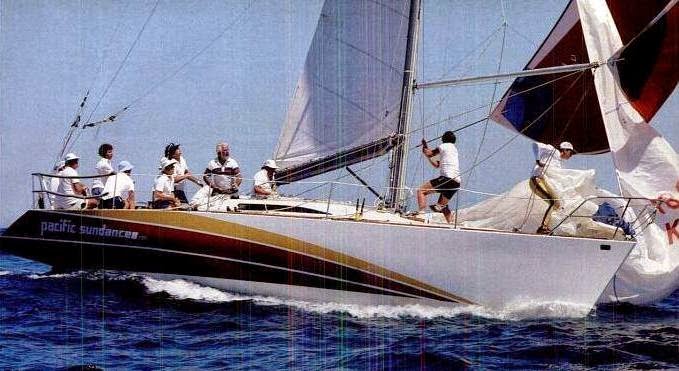
Pacific Sundance during the 1983 Southern Cross Cup trials (photo Diana Littler/Sea Spray)
Pacific Sundance was commissioned by Del Hogg for the New Zealand Southern Cross Cup trials held in late 1983, following Tom McCall's decision to press ahead with the first of the new design, Exador. These two yachts were joined by sistership Geronimo (Owen Chantaloup), and all three were built from the same mould at Cookson Boatbuilders, utilising a PVC core and some kevlar. It is understood that her original name, Pacific Sundancer, based on sponsorship from a skin-care company, ran foul of IYRU Rule 26 - the 'r' was covered up with tape to give the yacht her better-known name.
Pacific Sundance in close-quarters action in an upwind leg during the 1983 Southern Cross Cup (photo Phil Uhl | Uhl Studios)
Pacific Sundance leads team-mate Geronimo during the 1983 Southern Cross Cup (photo Diana Littler/Sea Spray)
Pacific Sundance during the 1983 Southern Cross Cup (photo Facebook)
As noted in an earlier post on Geronimo, the three yachts all benefited from the one-design nature of their tuning programme, and were able to edge out the only other real threat in the Hitachi-sponsored trials, from Neville Crichton's Frers 43 Shockwave. Pacific Sundance was the top performer, and Geronimo and Exador finished second equal, and thus the New Zealand team for the Southern Cross Cup in 1983 was comprised of three Farr One Tonners. 
Spinnaker hoist at a top mark during the 1983 Southern Cross Cup series (above and below)

Pacific Sundance heads off on a reaching leg, team-mate Geronimo behind and approaching the top mark
The 1983 team made up for disappointing New Zealand efforts in 1979 and 1981, with a devastating and all-conquering performance, taking wins in three out of five races. Pacific Sundance finished as first yacht overall in convincing fashion - skippered by Geoff Stagg and Peter Walker, Pacific Sundance posted a first, third and fourth among 27 yachts in the three inshore races. They also won the 180-miler, and the Sydney-Hobart race finale - in fact she nearly won the Sydney-Hobart overall, but ran out of wind just 40 miles from the finish.  
Geronimo and Exador finished the series in second and fourth place overall, cementing a solid win by the New Zealand team, by a massive 100 points over second-placed New South Wales. This was an even more dominant performance than 1977, and on a par with New Zealand's first win in 1971. 
Pacific Sundance sails on a flat run during the 1983 Southern Cross Cup series
The next year Pacific Sundance, Exador and Shockwave were selected for the New Zealand 'A' team to contest the 1984 Clipper Cup. This was a powerful line up, and the team lead the series from the first race. Pacific Sundance and Exador were going so fast in the final Round the State race that they were running first and second on corrected time and the Clipper Gold Cup looked to be New Zealand's. However, disaster struck when Exador was engulfed by a rogue wave off South Point (on Hawaii's Big Island) that tore out her rig. The loss of Exador from the running dropped the team to second overall (just 12 points behind the US White team of Camouflage, Checkmate and Tomahawk).
Pacific Sundance behind the Ross 44 Blast Furnace and ahead of Exador being unloaded in Hawaii for the 1984 Clipper Cup, with Shockwave just visible to the right (photo Phil Uhl | Uhl Studios)

Pacific Sundance during the 1984 Clipper Cup (photo John Mallitte/Sea Spray)
Pacific Sundance on a reaching leg during the 1984 Clipper Cup (photo NZ Yachting)
Pacific Sundance works her way upwind during the 1984 Clipper Cup
Pacific Sundance was sailed in San Francisco in the mid-1980s (as Sundance), including the 1986 Big Boat Series, and she raced in the 1988 One Ton Cup in San Francisco, where she was sailed by Chris Dickson and finished in a creditable eighth place, given her vintage by that time, and was one of seven Farr designs to finish in the top ten.
Sundance (as she was known for a while) during the 1986 San Francisco Big Boat Series
Pacific Sundance in a broach during the windy conditions of the 1988 One Ton Cup in San Francisco
Pacific Sundance now races actively in Auckland, and featured in the 2013 Three Kings offshore classic and competed in the 2015 One Ton Revisited regatta in Auckland.
Pacific Sundance during a RNZYS winter series race in May 2014 (photo Ginger Photography)
Pacific Sundance finishing the 25 November 2016 White Island Race (photo Suellen Hurling)

Pacific Sundance during a windy Squadron winter series race in 2018

Pacific Sundance gets a new coat of paint at Pier 21, Westhaven, Auckland (photo Facebook)

This piece of famous New Zealand yachting history is currently (as at March 2024) for sale.


Article updated August 2026

15 April 2013

Diva (Joubert/Nivelt One Tonner)

Diva was the standout new boat in the 1983 Admiral's Cup. The yacht, owned by Patrick Faure and Bernard Moureau, represented a continuation and extension of the French approach to Half Ton designs of the period, combining moderate rated length (33.77ft) with relatively low displacement (12,302lb) combined with a fractional rig with clean hull lines that ended in relatively undistorted stern sections. Diva was designed by the French pairing of Bernard Nivelt and Michel Joubert to rate as a One Tonner (30.5ft IOR), close to the minimum size allowed for the Admiral's Cup. She was designed to excel in light airs with a large sail plan, supported on a Franspar mast and flying North sails from the San Diego loft. 

Diva was constructed in Kevlar foam with carbon fibre longitudinal stringers - building commenced in February 1983 and she was hurriedly launched on 1 May for the French trials - she missed the first race but won all the others convincingly, sailed superbly by Yves Pajot and a crew of Half Ton sailors, along with designer Nivelt. 

Diva was joined for the French Admiral's Cup team by another Joubert/Nivelt design, Passion (32.0ft IOR), which had been built for the cancelled Two Ton Cup at Le Havre. A Frers 41 Ossian (32.4ft IOR), the ex-Mea Culpa, completed the French lineup. Diva started the series strongly, with a second and fifth in the first two races. Her series looked to have ended in disaster when she ran over a mooring off Ryde Sands, off Lee-on-Solent, early in the Channel Race, and the mooring cable became firmly lodged between the keel and rudder. The light airs that plagued the race benefited the minimum raters, however, and once the Diva crew had escaped from their entanglement the unsettled wind allowed Diva to work up to fifth place by the Nab Tower, although she slipped to eighth at the finish.
Diva leads some bigger yachts on her way to second place in the first race of the 1983 Admiral's Cup
The Diva crew work to extricate themselves from a mooring cable soon after the start of the Channel Race (and another view below, by Guy Gurney)

Stern view of the 1983 Admiral's Cup top scorer, Diva
A feature of the Fastnet race finale was the match race between the top placed Diva and the Castro design One Tonner Justine IV, skippered by Harold Cudmore for the Irish team. Justine IV led Diva most of the way to Fastnet Rock, but Diva slipped ahead to round minutes ahead. On the run home when the wind increased to 30 knots Justine IV lost track of Diva's navigation lights and Pajot's crew arrived home an hour ahead of the Irish. Cudmore successfully protested Diva for not showing their navigation lights, and a 5% penalty was awarded, but she was still the top boat of the series.  

Unfortunately Diva's stand out performance was not matched by her team-mates who were completely outclassed, while a crew dispute saw Passion not race the Fastnet, and France finished the series in a lowly 12th place (of 15 teams).

Diva during the 1984 SORC
Diva was bought by the German team manager Berend Bielken in August 1983. A month later the new crew broke the rig, and it wasn't until the end of the year that they could get in some good sailing days in the North Sea before shipping the boat to Florida to contest the 1984 SORC. 1984 was the year of the new One Tonners (sailing in Class E) and Diva came up against the likes of Alan Andrew's Allegiance, Ted Irwin's Razzle Dazzle and the J41 Dazzler
Diva holding off Razzle Dazzle during the 1984 SORC
Diva began a late run in the fourth race, coming through in the last three races with results of 1/2/2 in class, and 2/6/14 in fleet, to be the first European yacht to win the coveted Governor's Cup for top yacht overall. She finished second in class behind Allegiance, and was the first fractionally rigged yacht to win the SORC.
Diva - overall winner of the 1984 SORC, and second in Class E (photo Larry Moran)
Diva went on to race in the 1984 One Ton Cup sailed off the South Brittany coast in France, where she finished tenth overall with placings of 17/5/8/12/10.
Images of Diva from the 1984 One Ton Cup 

Diva - circa mid-1980s


12 April 2013

Prospect of Ponsonby (Farr 1104)

In 1975 Bruce Farr was able to turn his attention to a One Ton sized yacht (Design 51), following a commission from yachtsman Noel Angus, who had owned the 727 plug, Pinto. Angus was impressed with his Quarter Tonner and could see that a scaled up vesion would have advantages over the predominantly heavy designs of the day. Prospect of Ponsonby was built in Tauranga and launched in September 1975, just in time for the New Zealand Southern Cross Cup trials of that year. 

Compared with her competition, Prospect was of light displacement (8,500lbs), and featured a fractional rig (of 13/16 proportion) - an Australian Sheerline section with a backstay, no runners and swept back spreaders. 

The ballast ratio on Prospect was higher than Farr's earlier designs, while the hull shape was more extreme in depth and fineness forward, with a long and wide stern that was combined with a sloping transom and overhang. The design did feature some distortions in order to achieve a lower measured length, in addition to the hard turn of the sections at the critical beam and depth measurement points. As would become common on later boats (e.g. see previous post on the 1987 Caiman), the boat featured a pronounced extension of maximum beam aft along the sheerline in order to get the crew as far outboard as possible within the overall beam measurement.

Notwithstanding her cruising compromises with a relatively comfortable interior and large cabin, Prospect turned out to be a breakthrough design, taking five guns in five starts in the New Zealand Southern Cross Cup trials and finished well clear of the second placed S&S design Quicksilver and the Brin Wilson design Tempo.


Preparing for a start in the 1975 Southern Cross Cup trials (photo 1976 DB Yachting Annual)

The trials were contested by 19 boats, with only one DNF recorded in the whole of the five race regatta. The fleet was dominated by heavy displacement types (other than Farr’s Gerontius and her sistership Kailua and two Spencer designs), and Prospect was untouchable in this company. Prospect was able to foot it with the other One Tonners on the wind, including Bouzaid’s Peterson design Streaker. Once on the reaches, however, she scorched away from her rivals and was reaching faster than several higher rating boats. As Farr noted, “she reaches about as fast as a good Two Tonner”, boats that were typically 6ft longer.

The absolute dominance of the series by Prospect had not been seen since the peak of Rainbow II’s career, and was all the more remarkable when considered that it had been the most competitive offshore series held in New Zealand at that stage. 

Prospect of Ponsonby, seen here outside Sydney Heads during the third race of the 1975 Southern Cross Cup (photos Sea Spray magazine)

The Southern Cross Cup was contested by 11 teams and 33 yachts, which included US maxis Kialoa III and Windward Passage, and the top scoring yacht from the 1975 Admiral's Cup, the German Frers designed Noryema X. The series was hard fought, but the New Zealanders surprised everyone, including themselves, by topping the scoreboard with 545 points, 28 points clear of their closest rivals, the New South Wales team. The most intriguing aspect of the series was the showdown between Prospect and the reigning One Ton champion, Ted Turner's Peterson-designed Pied Piper, with the boats beating each other twice each - a loss of instrumentation saw Prospect sail too far offshore in the Sydney-Hobart race and finish the race in third place, but won top individual honours for the series overall. 
Prospect of Ponsonby during the 1975 Southern Cross Cup (photo 1976 DB Yachting Annual)

Prospect of Ponsonby appears briefly in the CYCA film of the 1975 Sydney-Hobart race (in quiet conditions at the finish from 21:45):

With the Dunhill Classic ocean racing series to be sailed in Auckland, and the One Ton Cup to be sailed in France in 1976, top skippers sought out the new Farr designed boats. Prospect was sold in Australia, and her continued performance led to the development of a production version of the yacht in both countries, known as the Farr 1104. From the Glass Yachts mould in New Zealand came a number of proven campaigners in the New Zealand offshore scene, including Chick Chack, Razzle Dazzle, Mardi Gras and Nell Gwyne. These boats were immediately successful, and spawned further development of the design, including The Number (later named 45 South II), Piccolo (Australia) and Sweet Okole, the latter going to win class C in the 1977 SORC, and later the 1981 Transpac. The design also found its way into Europe, with a couple of well-known English yachts performing with distinction in the English scene, including Karena and 1976 RORC Yacht of the Year, Solent Saracen, the latter owned and built by John MacCarthy, and followed his earlier champion Peterson Three-Quarter Tonner of the same name.

Piccolo, overall winner of the 1976 Sydney to Hobart race
Farr 1104s racing in Auckland in the early 1980s (photo Farr Yacht Design)
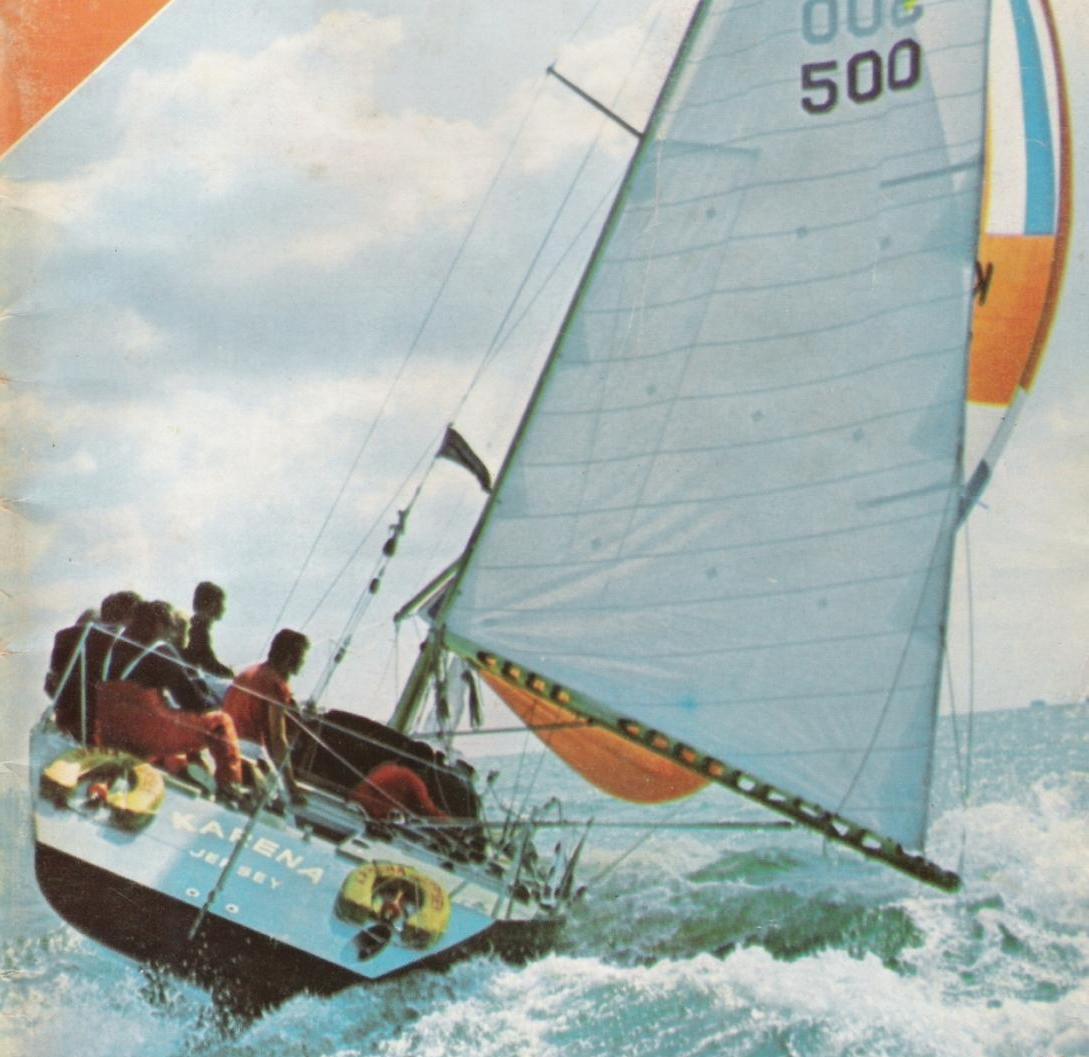
Karena, a cold-moulded One Tonner along Farr 1104 lines, and originally based in Jersey
45 South II and another derivative, Jiminy Cricket, would go on to contest the 1976 One Ton Cup for New Zealand (see post).

Wild Turkey, a 'racing' version of the Farr 1104 design, competed in the 1977 One Ton Cup in Auckland, and is seen here in the 1978 One Ton Championships in Middle Harbour (photo Phil Uhl)

Farr 1104 Revolution is still active in the Auckland racing scene

10 April 2013

Caiman (Judel/Vroljk 44)

Profile drawing of the second Caiman
The 1987 Dutch yacht Caiman probably falls into the 'not so famous' category.  This was owner Gerry Jeelof's second yacht, following the original (although confusingly named in retrospect) Caiman II, a Peterson 43. Caiman II was an evergreen campaigner that contested three Admiral's Cups - she was chartered to the Bermudan team in 1981, where she managed to run aground during the third inshore race, but was the top trialist for the Jeelof's home Netherlands team and again in 1985. While she was the top Dutch yacht in 1985, she was starting to show her age and it was time for a newer boat.

The new Caiman was the latest from the Judel/Vrolijk design office, at 44ft overall and featuring twin wheel steering, which was something of a contrast to developments on their German-built 43 footers Container and Pinta, which had adopted tiller steering.

Caiman powers along upwind
The design also included what had become a common feature in IOR yachts at this time, with a long extension of maximum beam aftwards before a hard turn to the stern, as a method to increase the righting moment of the crew while still minimising the after girth measurements. Caiman had a displacement of 17,400lbs and a rated sail area of 1,096sq ft, and sailed with a rating of 34.2ft.
Deck and interior arrangement plans, note the aftwards extension of maximum beam
Caiman viewed here at her berth during the 1987 Admiral's Cup (photo Ian Watson)
Although Caiman benefited from a reasonably experienced crew from earlier campaigns the yacht never quite featured - her first regatta was the 1986 Sardinia Cup where her best performance was a seventh in a windy first inshore race, but thereafter she didn't enjoy the prevailing light air conditions. Caiman was selected for the Dutch team for the 1987 Admiral's Cup. Her best result was a tenth in one of the inshore races, but she was otherwise outclassed and finished as 33rd yacht overall, with the Dutch team finishing in 11th place.


The cockpit layout on Caiman, twin wheels with mainsheet behind (photo Ian Watson)
Caiman can be seen here alongside her team-mate, the 50ft Pro-motion V at Queen Anne's Battery Marina after the 1987 Fastnet Race and conclusion of the Admiral's Cup (photo Shockwave40 blog)