17 June 2023

Clipper Cup 1980

The second edition of the Pan Am Clipper Cup attracted 64 yachts from Australia, Bermuda, Canada, Japan, New Zealand, Hong Kong, the United States and the United Kingdom. Fortunately renowned marine photographer Phil Uhl was there to capture the action, and this article features a number of his photos from the series. 

Winner of the 1980 Clipper Cup, Australian yacht Ragamuffin (photo Phil Uhl)

The fleet included three Maxis, Siska (Australia) and Windward Passage (US) and the smaller Mistress Quickly (UK). Condor of Bermuda had also planned to compete, but struck a coral atoll north of Tahiti enroute to Hawaii. 

The 73-foot Maxi, Windward Passage in her new configuration as a sloop, put in a dominant performance through the first four races of the series (photo Phil Uhl)
It was the Australian yacht Ragamuffin, a Peterson 45-footer owned by Syd Fischer (rating 35.2ft IOR), won the Clipper Gold Cup for the top individual yacht of the series, also winning on corrected time the final 775-mile Around the State Race, the Class B point score for the series and for the three inshore races. Ragamuffin was part of the Australia No.1 team, with Challenge and Sweet Caroline, that convincingly won the international teams prize, the King Kamehameha Trophy, with a runaway margin over the US Red team. Sweet Caroline, a Davidson Two-Tonner (31.9ft), also won the Class C point score for the series. 
Ragamuffin rounds a mark during the 1980 Clipper Cup (photo Phil Uhl)

This result meant that Australia, in less than a year, had won the Admiral's Cup, the Southern Cross Cup and the Clipper Cup, and was their second successive victory in the Clipper Cup teams series, having won the inaugural event in 1978 (with Fischer's earlier yacht, the Frers-designed Ragamuffin, being part of that victorious team). 

The US Red team was comprised of two Holland designs, Tomahawk and Shenandoah who performed consistently, but the 1976 Farr One Tonner, Carrie Ann V, turned in five average results.

The Australian 77-foot Maxi, Siska (67.2ft IOR) (photo Phil Uhl)
The first race, the Around Oahu Race, was a line honours battle between the Maxis with Siska setting a new record and beating Windward Passage by 3½ minutes and Mistress Quickly by 6 minutes, although the placings were reversed on corrected time.

The Bob Miller designed Maxi, Mistress Quickly (63.2ft IOR) sporting her unique and recognisable spinnaker (photo Phil Uhl)

Soon after a start in Class D, with yachts Sweet Caroline (3557), Brother Dominic (KZ-4264) and Unchu (J-2611) visible, amongst others (photo Phil Uhl)

The Olympic Triangle courses again provided a showcase for racing skills among the offshore yachts, although winds were unusually light. Windward Passage showed her style and versatility by winning the Maxi class in all three of these races, while New Zealand’s Anticipation (a Bob Miller 50-footer) and Australia's Gold Coast Express each did the same in Classes A and D.

The New Zealand Davidson 46-footer Shockwave (photo Phil Uhl)
The 775-mile Around the State Race would prove to be a race for the navigators and tacticians trying to avoid the windless holes in the lee of Kauai and the Big Island. Windward Passage again took line honours finishing in four days, 11 hours and 32 minutes, but this was not enough to set a new record. Mistress Quickly was 11½ hours behind while Siska withdrew after she hit a coral head on the windward side of Oahu shortly after the start. 

Kiwi Klipper, a production Farr 38 (rating 35.5ft IOR), from the US (photo Phil Uhl)
Ragamuffin, Fischer's fourth boat of the same name, was a member of the Australian team in the 1979 Admiral's Cup and finished the series with results of 7/3/1/3/1, with her win of the quadruple points Round the State Race being enough to displace Windward Passage from the point score lead. 
Windward Passage leads Siska and Mistress Quickly off Oahu (photo Phil Uhl)

US yacht Shenandoah (30.9ft IOR) leads Shockwave and Challenge during the Laihana Sauza Cup, a warm-up event before the Clipper Cup - Challenge would suffer a collision during this race but was repaired in time for the start of the series (photo Phil Uhl)
It was noted at the time that Fischer's new Ragamuffin had been the least successful member of the winning Australian team in the previous year’s Admiral’s Cup. It was considered a good boat, but not outstanding at that level of competition. She seemed to be inferior to another member of the Australian No.1 team, the S&S 46-footer Challenge (34.5ft), owned by Lou Abrahams. Challenge had been the outstanding boat of the 1979 Southern Cross Cup series, and beat Ragamuffin in three out of the five races in the Clipper Cup, including winning the Around Oahu Race. She would have made it four if the ball joint at the top of her forestay had not failed on the final beat of the third race. A quick bear-away saved the mast, and with halyards rigged as a jury forestay she managed to finish the race at 17th on corrected time, after earlier looking likely to be third.

The US yacht Saudade, a S&S design (35.1ft IOR) (photo Phil Uhl)

Shockwave trails closely behind another Davidson design Snow White II (NZ, 37.4ft IOR) (photo Phil Uhl)
Ragamuffin's other team-mate Sweet Caroline was sailed consistently well throughout the series and was one of several Davidson designs which performed strongly in the Hawaiian trade-wind conditions. Shockwave, a Davidson 46-footer (33.6ft IOR) owned by New Zealander Neville Crichton, gave Ragamuffin and Challenge strong competition in Class B and finished second overall in the Round the State Race to finish second in the Clipper Cup overall point score, just two points behind Ragamuffin

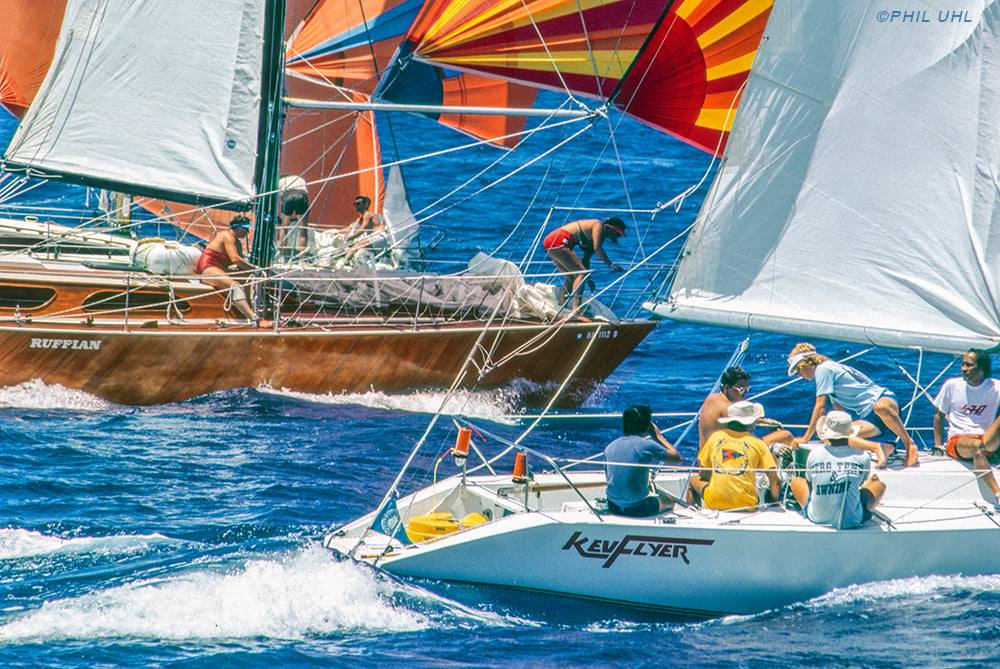
The smallest yacht in the series, the Farr-designed Kev Flyer (20.0ft IOR), seen here alongside the Wilson-designed Ruffian (30.7ft) (photo Phil Uhl)
Other yachts which topped RagamuffinShockwave and Challenge at times included Anticipation, a Lexcen 50-footer that benefitted from an age allowance (39.2ft IOR) that had been the leading yacht after three races (and was third going into the final race), and the new Farr designed 52-footer Zamazaan (41.7ft) which won Class A overall (and finished sixth overall).
Shockwave leads ex-New Zealand yacht Inca (both trailing Gerontius) during the 1980 Clipper Cup (photo Phil Uhl)

Shenandoah with Unchu to leeward and New Zealand's Brother Dominic (another Davidson design) passing Koko Head (photo Phil Uhl)
The time-on-distance system used for calculating the handicap results appeared to favour the big yachts in the regatta. Apart from taking line honours in four of the races, Windward Passage (67.7ft IOR) also posted corrected time scores of 3/1/1/2, before falling to 13th in the Round the State finale and finishing third overall, behind Shockwave

Gold Coast Express, an Australian One Tonner, the convincing winner of Class D (photos Phil Uhl)
The performance of Gold Coast Express, another Davidson design, was also notable as she won every race in Class D on both line and corrected time. She was unique in that she had 60 owners, all members of the small Southport Yacht Club on the Gold Coast of Queensland. She was a development of Davidson's famous Half Ton champion Waverider, and rated only 27.1ft with the centreboard fixed. But despite outclassing her competition in Class D, she could not figure higher than 15th in the overall fleet in a series dominated by higher rating boats. 
Foredeck action aboard Windward Passage (photo Phil Uhl)

Japanese yacht Unchu - this photo seems to be from the fourth race (third inshore) which she won, as she looks to be ahead of many larger yachts (photo Phil Uhl)  
One exception to the big boat hegemony was the result of the the 40-foot Japanese yacht Unchu (30.3ft) which won the fourth race, the final Olympic triangle after picking a favourable windshift. Unchu was designed by Ichiro Yokoyama, who had designed Magician V, the winner of the 1978 Quarter Ton Cup held in Japan. This was the first win for a Japanese yacht in a major offshore series outside Japan.

Japanese yacht Unchu, winner of the final inshore race (photo Phil Uhl)

The increase from 1978 in the number of competing yachts in 1980 was considered a good sign that the regatta was popular with offshore sailors, and attracted another quality fleet in 1982.

The 45-foot S&S design Inca (which sailed for NZ in 1978 but was US-owned by 1980) rounds a leeward mark followed by Timber Wolf (Farr, USA), Darth Vader (Tarrabochia, NZ) and Uin na Mara III (Farr, USA)

The Farr Half Tonner Don Quixote (rating 22.7 ft), not much bigger than Kev Flyer, rounds a leeward mark (photo Phil Uhl)

Mile High, a 50-foot fractional Peterson design (rating 39.0ft) from Hong Kong, seen here off Koko Head - she went on to finish third in Class A (photo Phil Uhl)

Another Davidson design, Brother Dominic, seen here rounding a windward mark (NZ, 32.1ft IOR) (photo Phil Uhl)

The Britton Chance-designed Glory (US, 43.7ft IOR) leads Snow White II (photo Phil Uhl)
The Tarrabochia-designed Darth Vader (33.4ft IOR) from New Zealand at a gybe mark during one of the inshore races (photo Phil Uhl)

Another view of Siska on one of the downwind legs (photo Phil Uhl)

Australia's Impetuous (Holland 42) leads Canada's Kanata (photo Phil Uhl)

Ragamuffin completing a gybe while rounding a wing mark (photo Phil Uhl)

The Australian yacht Mary Muffin, a Frers 47-footer (photo Phil Uhl)
Mile High, a Peterson designed 50-footer sailing for Hong Kong (39.0ft IOR), finished third in Class A, behind Zamazaan and Anticipation (photo Phil Uhl)
An aerial view of Snow White II on a downwind run (photo Phil Uhl)
Snow White II seen here alongside Ruffian, with the Farr 36 Country Boy (29.0ft) and Gold Coast Express in the background, during a pre-regatta race (photo Phil Uhl)

Gold Coast Express during the Laihana Sauza Cup, showing her distinctive Davidson 'crease' in her aft sections (photo Phil Uhl)


Article updated August 2026


27 May 2023

Windward Passage (Sydney 1977)


Windward Passage on a reaching leg during the 1977 Southern Cross Cup series (photo Guy Gurney)
Following on from my recent article about Windward Passage, renowned photographer Guy Gurney has published some great close-up images of this famous Maxi, while she was racing as part of the US team in the 1977 Southern Cross Cup series, and in her original ketch configuration. She had teamed up for this series with Phantom as one of the two 2-boat US teams (Kialoa III and Bravura forming the other team). 
Windward Passage on a reaching leg during the 1977 Southern Cross Cup series (photo Guy Gurney)

The series was notable for a major collision between Windward Passage and Kialoa III in the first race of the regatta, with Windward Passage hitting Kialoa III on her port quarter during a leeward mark rounding, resulting in a large hole in Kialoa III’s hull above the waterline and significant deck damage, caused by a combination of the bow and the sawing action of Windward Passage’s heavy wire bobstay. This also put Windward Passage at serious risk of losing her main mast as the bowsprit and headstay were no longer supported. Kialoa III protested Windward Passage (and won), but was unable to race again until the Sydney-Hobart finale. Windward Passage had to sit out the second race, and finished 20th in the third race.

Windward Passage on a reaching leg during the 1977 Southern Cross Cup series (photo Guy Gurney)

Above and below, Windward Passage shows her power under spinnaker and blooper as she slides past the photographer (photo Guy Gurney)


5 May 2023

Cascade (Milgram 38)

Cascade in her favoured reaching conditions
Cascade was radical cat-rigged ketch designed in 1972 by Professor Jerry Milgram (of the Massachusetts Institute of Technology), which challenged the current status quo of yacht design in terms of both the yacht itself and its rig, and is of some interest as a result. The 38-footer featured a stepped deck profile with high topsides for’ard with a sharply raked stem that together had a somewhat ungainly appearance, described at the time as “the ugliest ocean racer in sailing memory”, and despite fears at the time, she fortunately had no future influence on yacht design.

Cascade sported two stayed cat rigs, with masts of 50 and 52 feet height, with the for’ard mast positioned quite close to the bow with little room for headsail. The use of a dual cat rig set up was a canny way of side-stepping some of the complex sail area measurements applicable under the then Mark II version of the IOR. While she was able to present up to 800m2 of sail area by flying an assortment of staysails between the two masts, her rated sail area was just 325m2 (for comparison, the S&S yacht Lightnin’ had a rated sail area of 550m2 and rated 27.2ft). This was combined with other advantages in the Engine and Propellor Factor of the rule, along with rating contrivances around the bow and stern profiles and a displacement of some 17,000lbs and a 52% ballast ratio. The overall result was that Cascade rated a very low 22ft, little more than a Half Tonner.
The aesthetically challenging profile view of Cascade
Cascade nearly swept the New York Yacht Club cruise (a series of races) in the late summer of 1972, winning two races, finishing second twice, before losing one of her masts. Milgram then took her to the SORC regatta in January 1973. However, by that stage the Offshore Racing Council (ORC) of the then International Yacht Racing Union which administered the IOR had taken note of the radical newcomer. The ORC was empowered under Rule 101 of the IOR to “deal with any peculiarity of design and to give such rating as they consider equitable” where a boat was deemed to be exploiting a rules loophole. On the recommendation of its International Technical Committee (ITC), the ORC summarily raised Cascade’s rating by 10%, to 24.2ft. Milgram was able to have this reduced to 22.8ft in time for the 1973 SORC by shortening the rig and making a few other smaller adjustments.

Cascade in her original configuration
Milgram was reported at the time to say that while Cascade's rating should possibly be higher, the sail area was not as effective as a sloop’s big spinnaker or big-boy genoa which work better on a reach and run than Cascade’s staysails. He was somewhat bitter towards the ITC: “They cite the first sentence of [Rule 101] which allows the IYRU to invoke a penalty in exceptional cases so as to cover any radical departures, but I cite the last rule, 866E, which specifically prescribes how to rate cat-rigged ketches”. Rule 866E was:

"A cat‐rig may not carry a spinnaker unless accepting this as a basis for foretriangle measurement, in which classification and measurement would be as for a sloop or cutter. Conversely, a schooner, yawl or ketch which carries neither head, sails nor spinnaker may be rated without fore‐triangle measurement by following normal procedures outlined in the foregoing but using zero for, the fore‐triangle rated area".
Cascade seen here prior to a start in the 1975 SORC (photo Facebook)
At the start of the 1973 SORC it seemed the issue was something of a storm in a teacup. Cascade did not do very well in the opening St Petersburg-Venice Race and then, although finishing strongly in the St Petersburg-Fort Lauderdale Race, she missed a course marker and was penalised just over 3 hours. With four races to go, she lay 27th in a fleet of 125 boats. Conditions had been in Cascade’s favour, as she was very quick on a reach, but less impressive upwind or dead downwind. With reaching legs prevalent, Milgram could afford to take a very conservative approach to the starts, and then proceed to reel in his competitors.
Cascade seen here at the 1983 SORC (Yachting magazine)
In this fashion Cascade went on to win the Miami-Lucaya Race, and then the Lipton Cup off Miami. For the 176-mile Miami-Nassau Race, the SORC’s premier event, Cascade meandered off the startline last as usual, but as her staysail was hoisted and filled with a south-easterly on her beam she leapt ahead. Within 10 minutes she had Lightnin’ abeam in her own Class E and was fast catching up with Munequita which had started a full 15 minutes earlier in Class D and went on to cruise across the Gulf Stream and went on to take overall honours. But by then, Cascade’s crew knew there were not enough points available in the last race, the Nassau Cup, to overcome the Fort Lauderdale error.
Cascade competing in the 1983 SORC and now sporting a headsail, of sorts
The final epic contest in the Nassau Cup between Munequita, Lightnin’ and Robin for the top honours did not distract the ocean racing community for long from their preoccupation with Cascade, which had a poor showing in the final race to finish fifth overall. At its April 1973 meeting the ITC subsequently closed the measurement loophole exploited by Milgram on the basis of the newly issued Mark III version of the IOR. This version dropped the provisions of Rule 866E and Cascade’s rating shot up to 27.2ft.
Cascade during the 1983 SORC, note the backstay bumpkin, and the mizzen staysail being tacked to the weather rail - the tack of the mizzen also appears to be fixed to the bottom of the mast (photo Phil Uhl | Facebook)
Comments from a former Class E competitor in a ‘Scuttlebutt’ article about Milgrim (following his passing in December 2021) and Cascade is instructive, noting that upwind, Cascade was about as fast as a Half-Tonner, but when reaching, Cascade made good use of mizzen staysails and was about as fast as the One Tonners, which were about her same length overall but Cascade probably had an extra foot or so waterline length. As far as ‘design break-through’, the boat was considered a big step backwards. Although no genoas or spinnakers meant much less work for crew, her speed was considered poor to average for a 38-footer and the boat’s success was primarily due to its low rating. Others have described Cascade as a 38-footer that sailed like a 33-footer but rated like a 30-footer, and could not be described as a good boat. It is understood that Cascade also lost the US Half Ton championship around this time against a Scampi 30, due to damaged rigging in one race, and being beaten in light airs in another.
Cascade on an upwind leg during the 1983 SORC, with an unusually full shape to the lower part of the mizzen (photo Phil Uhl)
Ten years on, Cascade reappeared for the 1983 SORC, on charter to Russell Long, with changes that had reduced her rating to 24.0ft, the minimum allowed for the series. This was further reduced to 23.3ft through the age allowance factor used for the SORC regatta. Cascade's new set up included a headsail with a LP measurement of just 3.5ft, and it appeared to have a larger mizzen that necessitated the addition of a bumpkin to support the backstay. She remained able to sail much faster than her rating on reaching courses, but in the first and third races with their high proportion of windward work, she suffered badly. After a tenth place in Class F in the opening Boca Grande Race, she revelled in the heavy downwind conditions of the St Petersburg - Ft Lauderdale Race and won the race overall by nearly two hours on corrected time, from Locura. She went on to finish 16th (Lipton Cup) and 2nd (Ocean Triangle) but did not finish the Miami-Nassau Race and was unable to start the Nassau Cup finale, so finished up ninth in class and 55th overall.
Another view of Cascade sailing upwind during the 1983 SORC (photo Phil Uhl)
Later in 1983 the SORC administrators announced the removal of its specific age allowance and moved to limit the minimum rating for future entries to 24.5ft (Three-Quarter Ton size). This effectively disqualified Cascade from the series, although no doubt she could have been altered to reach this new rating limit.
Cascade being craned prior to relaunch as a cruiser (photo Facebook)
It is understood that Cascade later ended up at Even Keel in Yarmouth, Maine after being resurrected as a cruiser circa 1991. From there she was taken to the Caribbean and may have ended up in the Rio Dulce. 

6 April 2023

Clipper Cup 1978

New Zealand's Monique, a Farr 42-footer (rating just under the Two Ton limit at 31.9ft IOR) was the top individual yacht of the inaugural 1978 Clipper Cup (photo Phil Uhl)
Forty-one yachts, representing Australia, France (Tahiti), New Zealand, Japan, Taiwan and the United States, competed in the inaugural Clipper Cup regatta held in 5-12 August 1978. The series incorporated a 100-mile race around Oahu, three 30-mile offshore Olympic Triangle courses and the 775-mile Around the State race (the latter race had been held six times since 1972).

Kialoa III with all extras set during one of the offshore races during the 1978 Clipper Cup (photo Phil Uhl)
Fortunately renowned marine photographer Phil Uhl was there to capture the action, and this article features a number of his photos from the series.
One Tonners Country Boy (left) and Magic Pudding (ex-B195) enjoy a close battle during the 1978 Clipper Cup - Magic Pudding went on to finish as third yacht overall in the individual standings, and Country Boy was 10th (photo Phil Uhl)
Leeward mark action, with New Zealand's Inca (1730) visible (photo Phil Uhl)
Adding prestige to the regatta were two of the world’s fastest Maxi yachts, Jim Kilroy’s 79-foot ketch Kialoa III and Huey Long’s 79-foot sloop Ondine. Ondine completed the Around Oahu Race in a record 13 hours and 18 minutes, edging out Kialoa by a scant six seconds, in one of the then closest boat-for-boat finishes in yacht racing history (although Ondine owed Kialoa time on handicap due to a 3.2ft difference in rating). The balance of the fleet completed the course during the night and the following morning. Taiwan’s small 30-foot Don Quixote (a Farr Half Tonner rating 21.6ft IOR), stole the show with an overall win on handicap (though team results were limited to yachts with a minimum rating of 27ft).
The Farr Half Tonner Don Quixote won the Around Oahu Race, and finished as 12th yacht overall
The New Zealand Farr-designed One Tonner Lovelace finished ninth overall and formed part of the third placed New Zealand 'B' team (photo Phil Uhl)
The next three Olympic course races held of Waikiki resulted in the finest exhibition of offshore racing ever seen in Hawaii. With blustery trade winds of 20-25 knots with a warm Hawaiian sun, competition amongst the fleet was outstanding. Particularly keen was the racing among the One Tonners, New Zealand’s Country Boy and Lovelace, Hawaii’s Carrie Ann V and Australia’s Magic Pudding (ex-B195). Australia’s Ragamuffin (Syd Fischer), a Frers 47-footer and New Zealand’s Monique (Jim Dowell), a Farr Two Tonner, each dominated their respective Class A and Class B divisions by sweeping all three Olympic events.
Syd Fischer's Ragamuffin, second yacht overall and part of the winning Australian team (photo Phil Uhl)
Big Schott, a Peterson 41 Two Tonner (rating 32.1ft), finished seventh overall and helped the Australian 'A' Team to win the King Kamehameha Trophy 
The Around the State Race presented the fleet with every sailing condition known to sailors. A light but steady breeze gave some hope that Phantom’s record set in 1977 would be bettered. On the 300-mile reach from Niihau to South Point on the Big Island, conditions varied from heavy winds to almost nothing as they approached the Point. After rounding South Point, the fleet immediately hit strong winds and began beating up the treacherous Ka’u Coast. 
The Bruce King-designed 48-foot bilgeboarder Hawkeye (part of the US 'Blue' team) carried a high 42.3ft rating and struggled upwind but nevertheless finished 14th overall (photo Phil Uhl)
Ondine with spinnaker and blooper set (photo Phil Uhl)
Finally Ondine, after battling Kialoa for nearly five days, claimed line honours off Waikiki, with Kialoa finishing three hours later. Magic Pudding had showed great speed in the light air stages, allowing her to finish six hours ahead of the next One Tonner, Carrie Ann, and was the handicap winner.
Magic Pudding sails upwind past South Point on her way to winning the Round the State Race (photo Phil Uhl)
Monique took first place overall on handicap for the series, winning the Clipper Cup, with Ragamuffin second and Magic Pudding third. Australia’s ‘A’ Team of Ragamuffin, Big Schott and Magic Pudding won the King Kamehameha Trophy for the top team. The New Zealand ‘A’ Team (Monique, Country Boy and Gerontius) were second, and New Zealand ‘B’ (Inca, Lovelace and Anticipation) were third. In the battle of the Maxis, Kialoa edged out Ondine in the overall results, finishing 17th and 18th respectively.
Big Schott in fresh upwind conditions (photo Phil Uhl)

Inca, a 45-footer rating a low 32.7ft, off the North Shore of Molokai - she finished fifth overall (photo Phil Uhl)

Hawkeye seen here to the lee of Oahu during the Round the State Race (photo Phil Uhl)

Japan's Sunbird V, a S&S 54-footer (with a low 39.0ft rating) finished 24th overall (photo Phil Uhl)

Kialoa III charges her way through some white water (photo Phil Uhl)

Another view of Hawkeye on a reaching leg (photo Phil Uhl)

Gekko V from Japan (above and below), a Frers 41-footer, finished 19th overall (photos Phil Uhl)

Another photo of Australian yacht Big Schott (photo Phil Uhl) 
Checkmate (left), which finished in seventh place overall, and Hawkeye in close proximity after a windward mark during the 1978 Clipper Cup (photo Phil Uhl)


Article updated April 2026