26 November 2022

Juno V (Farr 50)

Juno V racing in the first 1991 50-Foot World Cup race at Key West (photo North Sails | Sailing World)
Juno V was English sailor Mike Peacock’s follow on yacht from his 1987 One Tonner Juno III, and 1989 Two Tonner Juno IV.  She was designed by Bruce Farr to compete in the highly competitive 50-foot circuit and the 1991 World Cup, and with a view towards filling the big-boat slot for Britain in the 1991 Admiral's Cup. Juno V was Farr design #224m, being a derivative of near sistership designs #224 Mandrake and Springbok. While her dimensions are not published, a comparison of design #224 to the earlier generation #203 Carat shows slightly less overall length (49.6ft) and more beam and a little more displacement. 
Juno V in Cowes
Juno V was built by Green Marine, all in carbon fibre with foam and honeycomb core in the hull and an all honeycomb core in the deck. Because she was built to race in the Admiral’s Cup, and would have to cope with the conditions that might be encountered in the Channel Race and Fastnet Race, she was built a little more heavily than the circuit-only Fifties, including carrying a stronger (and heavier) mast.
Juno V working up in early trials in Cowes (photo shockwave40 blog)
Juno V was sailed for the first time in the Solent in November 1990 (flying North working sails and Sobstad spinnakers) so that builder Bill Green could take care of any last-minute modifications before the boat was shipped to Miami for the World Cup Florida regattas in early 1991, including Key West, which featured a very competitive fleet of 15 boats.
Juno V in the thick of the action during the Key West regatta, 1991 (photo Yachting magazine)

Juno V on her way to winning Key West, January 1991 (photo Seahorse)
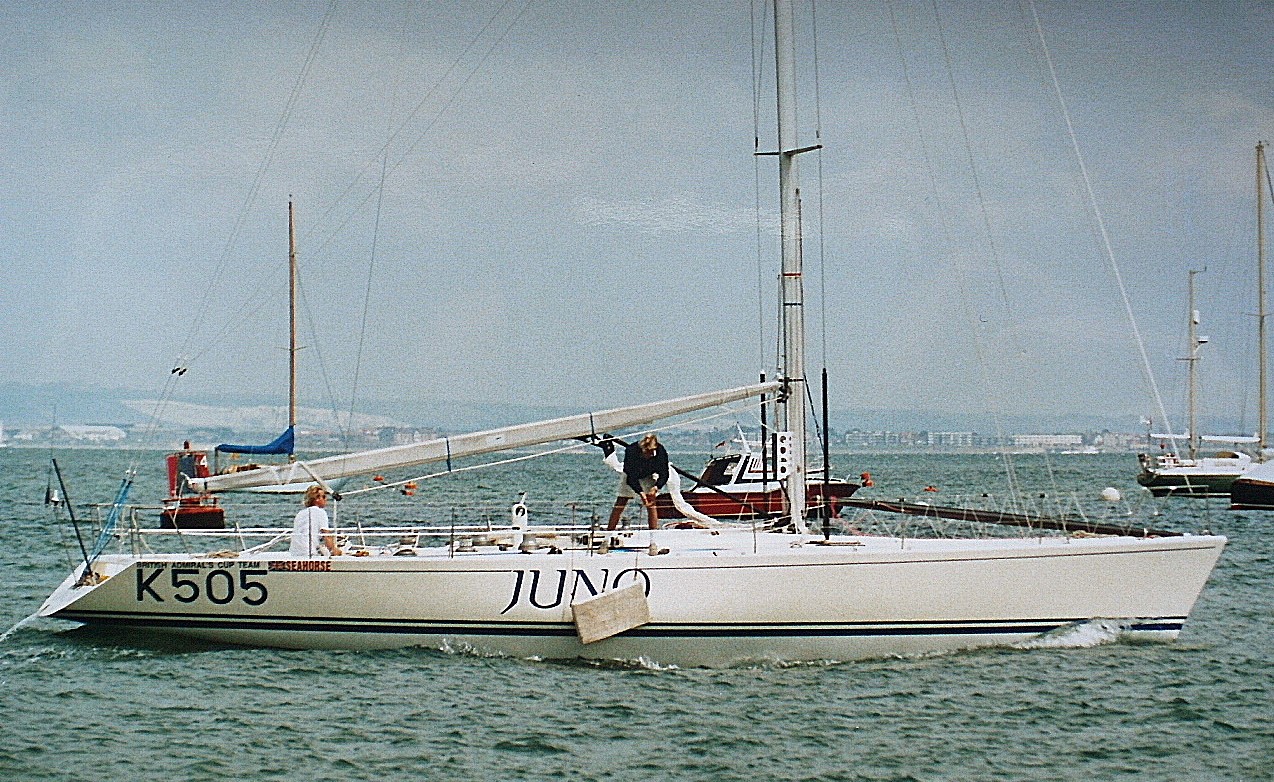
Juno V approaching Cowes Marina, possibly just prior to or during the 1991 Admiral's Cup (photo shockwave40 blog)
After a poor first race (10th) at Key West, Juno V put her mark on the series from Day 3, winning the first two races of the day. Although she finished the regatta with two ninths, the series was notable for the lack of dominance by any one boat, and she took out the event, just 2.25 points ahead of Heaven Can Wait and Champosa VII. She was lucky in the last race to just avoid a pile up at the first windward mark between Carat, Capricorno and Windquest, dipping just to leeward of the wreckage and then shoot the weather mark and continue racing. Juno V also benefited from improved reliability against the likes of Fujimo and Champosa VII who had encountered difficulties in the windier and warm-up races.
Juno V during the 1991 Admiral's Cup, above and below (photo shockwave40 blog)

For the 1991 Admiral’s Cup, Juno V was joined by the Farr Two Tonner Wings of Oracle and the Dubois One Tonner Port Pendennis. The Official History of the Admiral’s Cup notes that “Britain’s team served as an indication of how fast the pool of Admiral’s Cup boats was slipping away. Only Mike Peacock’s new Farr 50, Juno V, was the old style of yacht: owned by a private individual and sailed by pretty much a Corinthian amateur crew, headed in this instance by Mike McIntyre".
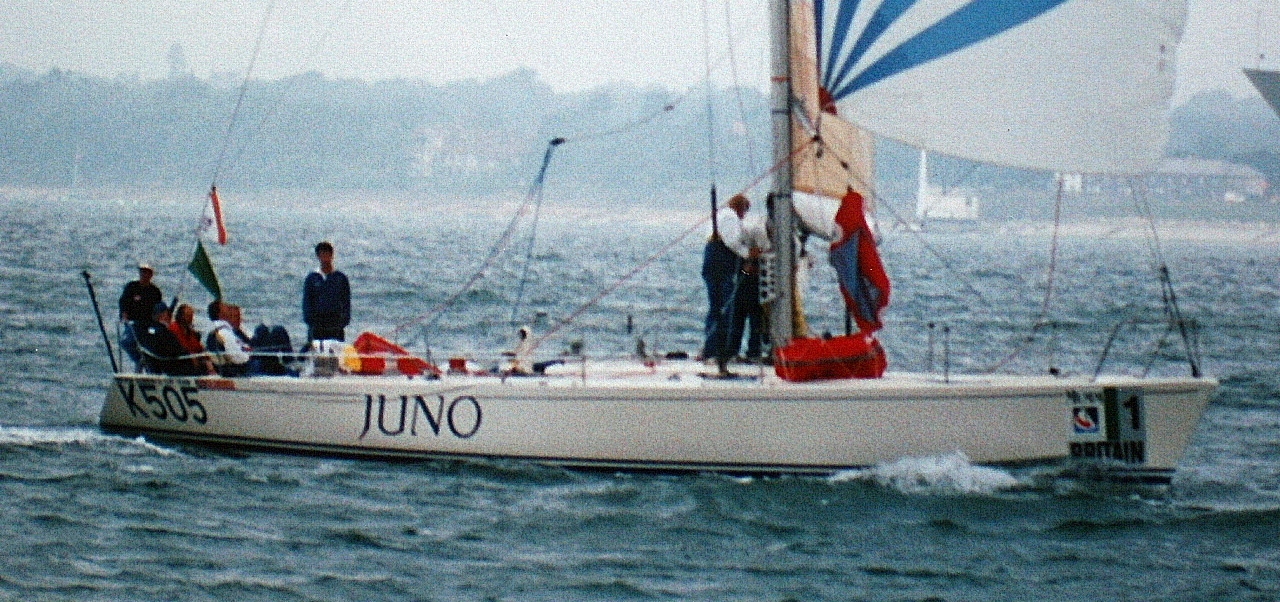
Juno V (right) ahead of Will during the 1991 Admiral's Cup
Unable to repeat her 50-Foot circuit form, Juno V finished fifth of the eight 50-Footers, with placings of 2/6/3/4/2/7, and while Port Pendinnis sailed strongly in the One Tonner division, Wings of Oracle was less impressive and the team finished fourth overall.
Juno V during the 1991 Admiral's Cup (photo Derek Stroud)
The 1991 World Cup concluded with a regatta in Miura, Japan, in early November 1991. Juno V didn’t make the podium in this series, but did enough to finish second in the overall World Cup standings, just 4.5 points behind Abracadabra.
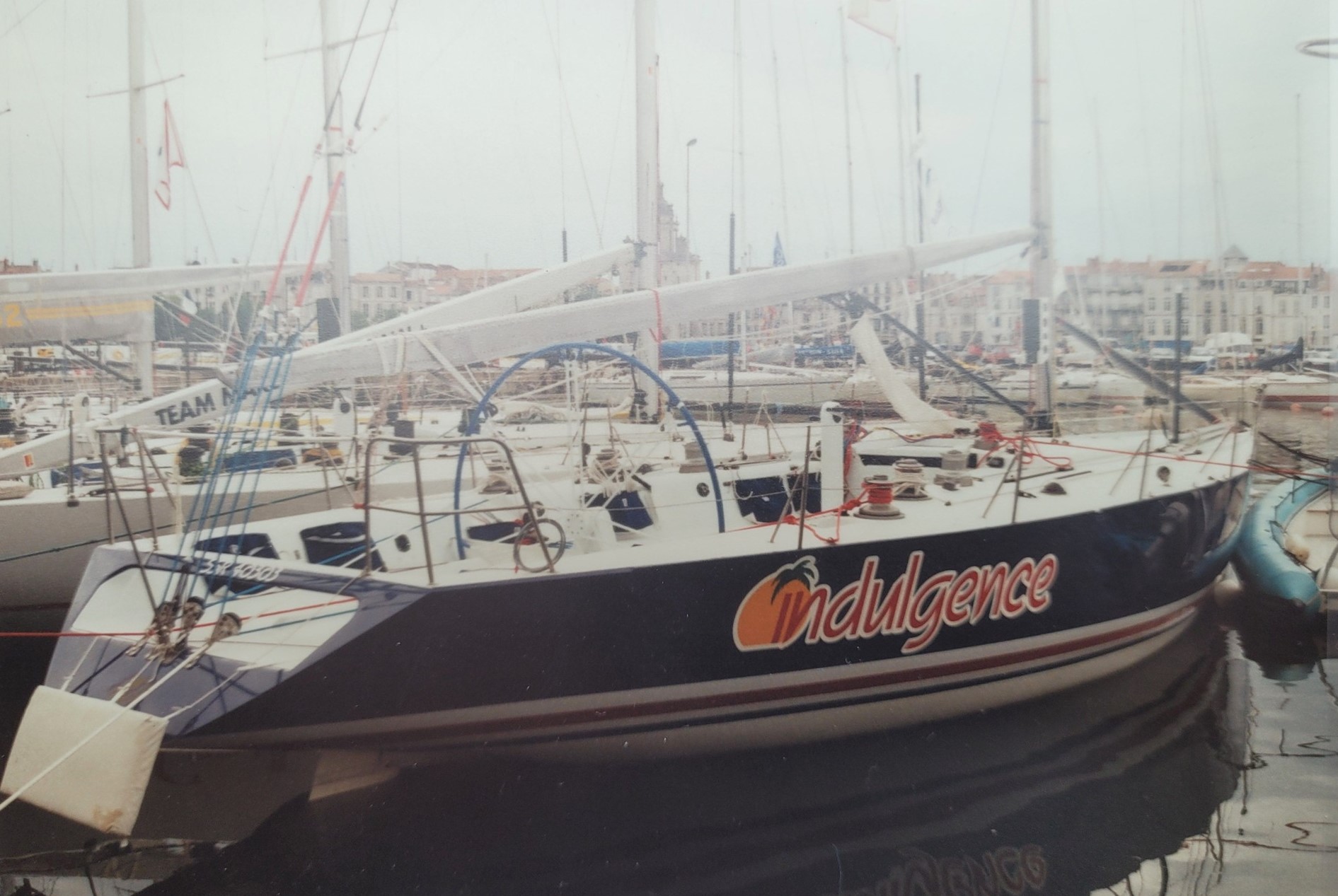
Indulgence (dark blue hull), ex-Juno V, during a Lymington Regatta ahead of the 1993 Admiral's Cup (photo Sharon Green | Ultimate Sailing)
Indulgence circa-1993 (photo Facebook)
Juno V was later bought by Graham Walker and became the latest (and eighth) Indulgence, and Walker then took it upon himself to line up two team-mates for the 1993 Admiral’s Cup – no small task as by this time IOR racing was all but dead save for a few pockets of interest: the One Ton circuit and 50-Foot World Cup. Walker’s ‘chef d’equipe’ Peter Morton secured GBE International (ex-Port Pendennis) and Provezza Source (ex-Unibank) from Turkey. The problem was, however, that the British took control of these two boats only days before the Admiral’s Cup started. Indulgence did not get into her stride until half way through the series, her original skipper Eddie Warden Owen being replaced by Chris Law, who had flown in from Australia just three days before the first race. Indeed she saved her best for the last race, leading the 50-Foot fleet home in the Fastnet, crossing the line just two lengths ahead of Syd Fischer’s Ragamuffin (Australia), with France’s Corum Saphir a further few lengths behind. But the perils of bringing together a last-minute team to race at Admiral's Cup level were clearly apparent, with the team finishing a lowly sixth overall.

The history of Indulgence through the 1992 and final 1993 year of the 50-Foot World Cup and the following years are not known, but she later became Manado, racing as a charter vessel in Sweden (photos above). She is now looking a bit worse for wear, at least below the waterline, and has recently been surveyed by Lars Klingstrom, of Flirt of Paget fame, and some of his photographs are shown below. 
The topsides still retain a high gloss finish (above and below) (photos Lars Klingstrom)

View aft, though the companionway towards the navigation station and aft pipe berths (photo Lars Klingstrom)

The navigation station above the engine, with the primary winch couplings close above (photo Lars Klingstrom)


7 October 2022

Fastnet Rock 1987

This gallery of photographs were taken during the 1987 Fastnet Race by Michael Mac Sweeney, most of which feature the iconic Fastnet Rock, the turning mark for the race which sits just off the southern coast of Ireland. The Fastnet Race formed part of the famous Admiral's Cup event, which was won by the New Zealand team in 1987, spearheaded by the top individual boat in the series Propaganda. 

Irish Independent/Full Pelt, winner of the Fastnet Race after sailing a fast rhumb-line course to the Rock (photo Michael Mac Sweeney)

Propaganda, finished in fourth place in the Fastnet (photo Michael Mac Sweeney)

The Andrieu-designed Two Tonner Indulgence, part of the second placed British team, finished in 25th place (photo Michael Mac Sweeney)

The 45-foot US yacht Insatiable designed by Nelson-Marek, finished 31st (photo Michael Mac Sweeney)

The Briand-designed Two-Tonner Mandrake-Krizia, sailing for Italy, finished 28th (photo Michael Mac Sweeney)

Turkish Delight, a Castro-designed Two Tonner, sailing for Ireland, finished 23rd (photo Michael Mac Sweeney)

Irish entrant Jameson Whiskey, a sistership to Full Pelt and also sailing for Ireland, seen here heading back upwind after rounding Fastnet Rock, finished 13th (photo Michael Mac Sweeney)

Australia's Swan Premium II (Farr One Tonner) finished 16th (photo Michael Mac Sweeney) 

I-Punkt, finished 33rd (photo Michael Mac Sweeney) 


30 September 2022

Maxi Worlds 1990

This post features another great selection of photographs by Sharon Green (Ultimate Sailing) of the action during the second stage of the 1990 Maxi Worlds, held in Maimi in late October 1990. The photos feature the increasingly dominant Matador 2 (launched in the previous spring and which would go on to win the 1990 Worlds overall following the third stage of the series in St Thomas), Longobarda, Passage (the ex-Windward Passage 2) and Vanitas (the ex-Il Moro di Venezia III).

Vanitas ahead of Longobarda, Matador 2 and Passage

Vanitas leads Longobarda, Matador 2 and Passage 

Matador 2 - the longest and heaviest Maxi in the fleet

Vanitas leads Passage (left) and Longobarda (right)

Longobarda, suffered from breakages on the first day of racing, including blowing out her mainsail clew

Passage

Matador 2

Longobarda

Vanitas

Matador 2 chases Longobarda and Vanitas around a gybe mark
Big boats, big gear and big crews - Vanitas seen here running ahead of Longobarda and Matador 2

Matador 2 on a downwind run with Longobarda just behind

Vanitas leads Passage on a reaching leg


24 June 2022

Juno IV (Castro 44)

Juno IV prior to the 1989 Admiral's Cup (photo Seahorse)
Juno IV is a 44-footer designed by Tony Castro for Mike Peacock to seek selection for the British team in the 1989 Admiral’s Cup. It was one of the earliest all-carbon race yachts, with the structural design developed by the Castro design team, and was built by Killian Bushe in England.
Juno IV sails upwind in light airs (Riggarna Rigging advertisement)
Peacock had commissioned the earlier One-Tonner Juno for the 1987 Admiral’s Cup, and as part of the second-placed British team and had finished 9th in the individual standings. He was drawn to a mid-size yacht for 1989 because it was a vacant slot for the British team, with Alan Gray’s 50-footer Jamarella looking likely to gain the big-boat position, and because Graham Walker already had a well-advanced plan to try to win the 1989 One Ton Cup, and the One Ton position on the team, with his new Indulgence. Changes to the Time Modification Factor (TMF) for 1989 would benefit bigger boats, but they would still need to perform well.
Juno IV - note curved genoa tracks (photo Facebook)
After a late launch, early racing indicated that Juno IV was too stiff, although this yielded good results in a breeze. This lead to a series of keel changes, reducing the boat’s stability and rating, but also affecting her speed. In the pre-Admiral’s Cup analysis, Seahorse magazine noted that Juno IV had trialed different sails from three lofts but was still performing below expectations.
A view of Juno IV's underwater shape, at Lymington Marina (photo Shockwave40 blog)
The selection of the British team proved to be controversial. The team selectors, headed by Harold Cudmore, decided to send boats to Kiel Week, the last part of the German and Dutch trials, to measure them against the opposition. Jamarella generally proved her case, but Hitchhiker II, the ex-Jamarella (One Ton) was making a claim for either of Juno IV or Indulgence’s berth. Despite a poor result in Kiel Week, where Juno IV finished last of the serious contenders for a team place and appeared off the pace against the German 34-raters, the selectors decided there was sufficient time to re-adjust all of Juno IV’s parameters to give her more speed. Indulgence was selected because of her results in Naples, but as only a single One Tonner was sought, the nod went against Hitchhiker II in preference to Juno IV.
Juno IV in light air downwind conditions 
Said Cudmore at the time, “the third boat was a difficult choice and the selectors were in a quandary, as the bigger boats were proving to be more success with the new TMFs. Within the mid-size category, Juno’s performance had been disappointing. Hitchhiker was a proven boat with a proven owner…Juno was in extreme rating mode, more similar to the Kiwi boats, which was wrong for Kiel and wrong for the Admiral’s Cup. Whether in correct rating mode she would be more competitive was unknown. Size was the deciding factor, and Juno was selected”.
Juno IV (photo Peter Ludlow)
With only a month left to tune the British boats, Castro planned a longer, lower boom for Juno IV to increase her sail area by 5 percent, which was combined with the removal of 200kg of internal ballast (to reduce stability and the CGF measurement of the IOR) and further bow-down trim to offset the consequent rating increase of sail area changes. This lead to a final rating of 35.17ft for the Admiral's Cup, while the team also settled on a North Sails wardrobe, with the boat skippered by Mike McIntyre, a 1988 Star class gold medallist.
Juno IV (photo Facebook)
Observers remained sceptical that Juno IV was the best choice and Seahorse opined before the series that “something special needs to happen if Juno is to find the speed of the German team, and unless she does, this boat will be the weak link in the British team”.
Juno IV seen here leaving Lymington Marina (photo Shockwave40 blog)
The results of the initial stages of the 1989 Admiral's Cup suggested these concerns were well placed, with Jamarella’s first and Indulgence’s third in the first race being let down somewhat by Juno IV’s lowly 26th, after she was boxed in at the start and was never able to properly recover.
Juno IV
Juno IV was 24th in the Channel Race, although fortunately this was enough when combined with Jamarella’s third and Indulgence’s seventh, for the British team to move into the series lead.
Juno IV in the midst of (possibly) Admiral's Cup trials action, with Jamarella (K-180) visible to windward (photo Bateaux magazine, Histoiredeshalfs website)
Juno IV during the 1989 Admiral's Cup (photo Auckland Maritime Museum)
The team then put in a dominant display in the third race, the second inshore, with Juno IV improving strongly to finish 11th. This was a good result considering the time lost on the last run, where she had tried to shake off Librah with a gybe set but managed to tangle the boom in a running backstay. The resulting broach led to a torn spinnaker which had to be replaced.
Juno IV sails downwind during the 1989 Admiral's Cup (although is sailing with an inshore mainsail without reefing patches) (photo Facebook)
The third inshore was less impressive, with Juno IV finishing 21st, although this was better than Indulgence’s uncharacteristic 27th. Jamarella’s third, however, kept the team in first position in the overall standings.
Juno IV powers along upwind (photo Bateaux magazine, Histoiredeshalfs website)
Juno IV went on to finish 11th in the fourth inshore and 12th in the Fastnet Race, to finish the series in 13th place overall, and this was enough to help Britain to overall Admiral's Cup victory after their second place in 1987 (Jamarella was the top individual yacht and Indulgence was 11th). 

Juno IV went on to race in the 1989 Southern Cross Cup as part of the British team, with owner Peacock leading the UK challenge for the Cup which they won. She then competed in the 1990 Sardinia Cup, finishing second (either individually or as part of the British team) and was winner of the 1990 Setimana Del Boque, also in Sardinia.
Juno IV arriving at Lymington Marina (photo Shockwave40 blog)
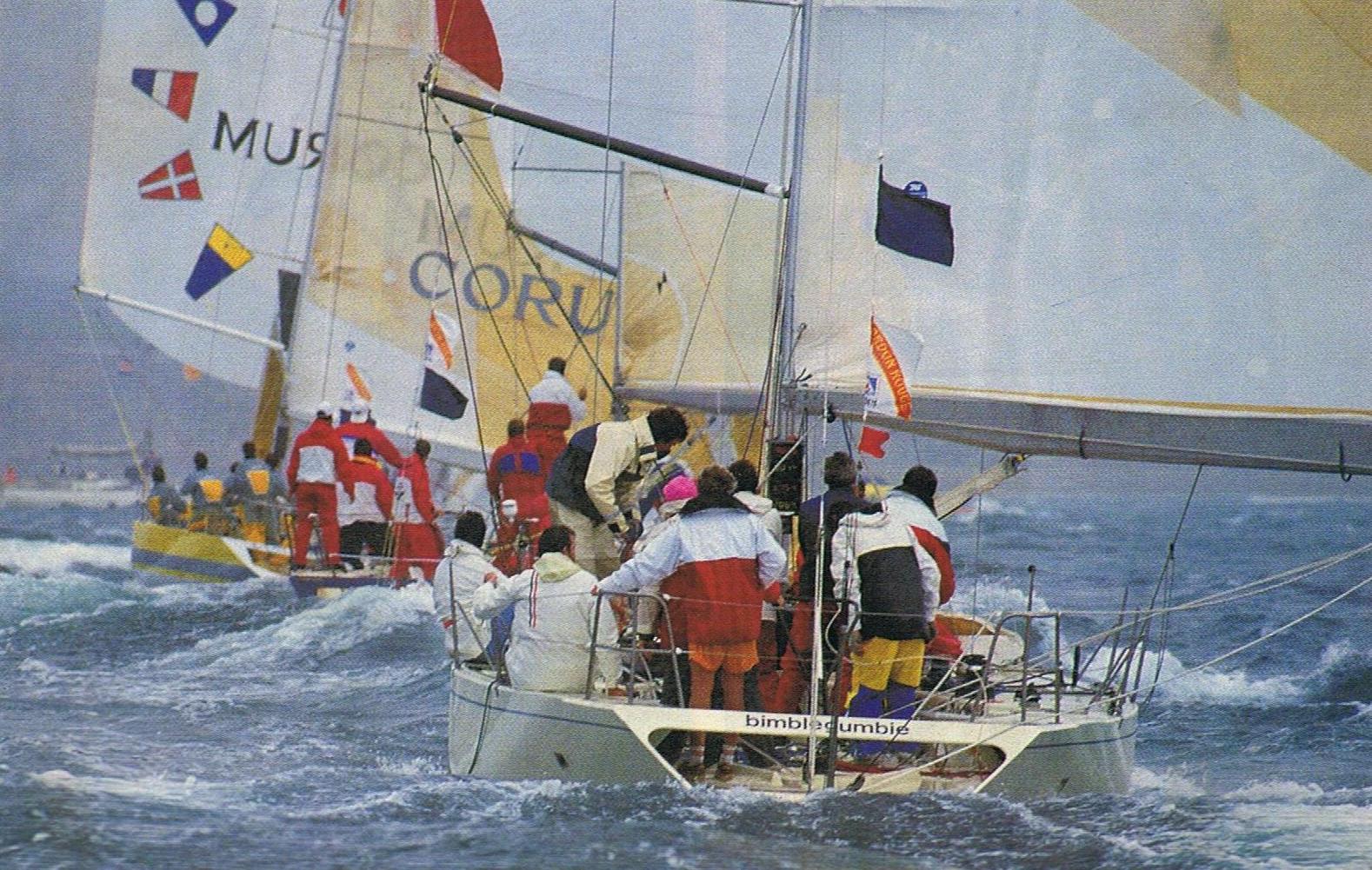
Juno IV as Australian entry in the 1991 Admiral's Cup Bimblegumbie (and photo below)
In 1991 Juno IV filled the Two-Tonner slot in the Australian team for that year's Admiral's Cup as Bimblegumbie, but finished seventh of the eight Two Tonners, although she collected more points than her team-mates Cyclone, the team's 50-footer, and Shardana II, the One Tonner. The Australian team finished last overall.
Juno IV was converted in the early 1990’s in private ownership to a cruiser/racer specification with easier deck gear to allow her to be easily sailed two-handed. In 2013 she was sold to another private owner who put her back into the racing circuit after 14 years and entered in the Round the Island 2014. Despite the lack of wind around the Needles, she was able to keep moving and won two trophies, the Field Barnacle (line honours) and the Renaissance Trophy.
Juno IV in more recent times (photo Challenge Yachting)
Juno IV was then re-established as a true racer. Further investment and improvements followed and she was entered in the Round the Island Race in 2015. Conditions were perfect for this classic racer and again the Juno IV team won the Field Barnacle trophy. The original aluminium mast was replaced with a carbon-fibre version in 2019, but it is understood that the boat is now being used purely as a cruising yacht and is based in Scotland.

Article updated May 2023