16 August 2025

Contents Page

With this blog now into its 13th year, it seemed like a good time to provide a more easily searchable list of the various articles that I have posted over that time, by categories.

REGATTA GALLERIES

Admiral’s Cup

Admiral's Cup 1987 (photo Guy Gurney)

Admiral’s Cup 1979 – Part 1

Admiral's Cup 1979 - Part 2

Admiral's Cup 1979 - Part 3

Admiral's Cup 1979 - The Italian Team

Fastnet Race 1979

1981 Australian Admiral's Cup Trials

1981 New Zealand Admiral's Cup trials

Admiral's Cup 1981 - Race 1

Admiral's Cup 1981 - Race 2

Admiral's Cup 1981

Admiral's Cup 1983

1985 Australian Admiral's Cup Trials

1985 Admiral's Cup

The Admiral's Cup - Through the Photographer's Lens

Admiral's Cup 1987

1987 Admiral's Cup

Fastnet Rock 1987

30th Anniversary of New Zealand's Admiral's Cup Win

Admiral's Cup 1989

1989 Fastnet Race start

Admiral's Cup 1991

Admiral's Cup 1991 (Part 2)

Admiral’s Cup 1993


Clipper Cup / Kenwood Cup

Clipper Cup 1982 (photo Phil Uhl)
Clipper Cup 1978

Clipper Cup 1980

1982 Clipper Cup

ClipperCup 1984  

Kenwood Cup 1986

Kenwood Cup 1986 – Part 2

KenwoodCup 1988

Kenwood Cup 1990


SORC

SORC 1985 (photo Sharon Green | Ultimate Sailing)
SORC 1981

SORC 1983

SORC 1983 documentary

Featured Photos - 1983 and 1984 SORC

Featured Photos - 1984 SORC

SORC 1985


Other Regattas

BigBoat Series 1978-84

Big Boat Series 1985-90

Onion Patch Series 1978

SouthernCross Cup 1983

Hamilton Island Race Week 1984


ONE TON CUP

The One Ton Cup

NZ One Ton Cup trials 1971

One Ton Cup 1971

One Ton Cup 1971 - Part 2

One Ton Cup 1972

One Ton Cup 1973

One Ton Cup 1975

One Ton Cup 1975 - Dockside photos

One Ton Cup 1977

1979 One Ton Cup

One Ton Cup 1980

One Ton Cup 1984

One Ton Cup 1986

One Ton Cup 1988

One Ton Cup 1989

One Ton Cup 1990

One Ton Cup 1990 - Part 2

The return of the One Ton Cup

One Ton Revisited 2015 - Race 1

One Ton Revisited 2015 - Race 2

One Ton Revisited 2015 - Race 3

One Ton Revisited 2015 - Race 4

One Ton Revisited 2015 - Race 5


HALF TON CUP

Half Ton Cup 1976

Half Ton Cup 1982

Half Ton Classics Cup 2015

Half Ton Classics Cup 2016

Half Ton Classics Cup 2017

Coutts Quarter Ton Cup 2017

Half Ton Classics Cup 2018

King One, Half Ton Cup 1981 (photo Guy Gurney)
Halfton Class Italia

Italian Half Ton Nationals 2013

Italian Half Ton Classics Cup 2014

Italian Half Ton Class - Asteria Cup 2015

Italian Half Ton Classics 2015

Italian Half Ton Cup 2019


QUARTER TON CUP


Quarter Ton Cup 1975

Quarter Ton Cup 1978

Quarter Ton Cup 1981

Quarter Ton Cup 1988

Quarter Ton Cup 1989

Dutch Quarter Ton Cup 2013

Quarter Ton Cup 2013

Half Ton Classics Cup 2013

2014 Quarter Ton Cup

2014 Half Ton Classics Cup

Quarter Tonners at the 2015 Vice Admiral's Cup

Coutts Quarter Ton Cup 2015

Quarter Tonners at the Vice-Admiral's Cup 2016

Coutts Quarter Ton Cup 2016

Regates Royales 2019


THE INTERNATIONAL OFFSHORE RULE


The International Offshore Rule - Part 1: Measuring Length

The International Offshore Rule - Part 2: Measuring Depth

The International Offshore Rule - Part 3: Measuring Sail Area

TheInternational Offshore Rule – Part 4: Level Rating and Handicapping

The end of the IOR

IOR to IRC conversions

Bloopers are back!


MAXIS

Kenwood Cup 1986 (photo Sharon Green | Ultimate Sailing)
Ceramco New Zealand (Farr 68)

Condor (Holland Maxi)


Flyer - finish of Whitbread Race 1977-78

Kialoa III (S&S Maxi)

Kialoa IV (Holland Maxi)

Longobarda (Farr Maxi)

Matador2

Midnight Sun (Peterson Maxi)

New Zealand Endeavour (Farr Maxi)

Sorcery (Mull Maxi)

Sovereign (Pedrick Maxi)

Steinlager 2

Windward Passage (Gurney Maxi)

Windward Passage (Sydney 1977)

Maxis at the Big Boat Series 1978

The IOR Maxis - 1980s

Maxi Worlds 1987

MaxiWorlds 1990


CUSTOM IOR YACHTS

Big Boat Series (photo Sharon Green | Ultimate Sailing)
Acadia (Peterson 43)

Anticipation (Lexcen 50)

Backlash (Everitt 43)

Big Shadow (Peterson 42)

Black Sheep (Lidgard 50)

Bondi Tram - Frers 41

Bullfrog (Peterson 55)

Caiman (Judel/Vroljk 44)

Cascade (Milgram 38)

Checkmate (Peterson 50)

Container (Judel/Vrolijk 42)

Corum Rubis and Corum Saphir

Dr Feelgood (Farr 40)

Eclipse (Peterson 39)

Evergreen and the Canada's Cup 1978

Feltex Roperunner (Farr 40)

Freefall and Migizi (Farr 37)

Flirt of Paget (Holland 40)

Flirt of Paget - sailing again

Hitchhiker (Frers 40)

Imp (Holland 40)

The Legend of Imp

Inca (S&S 46)

Infinity (Holland 47)

Intuition (Peterson 42)

Kiwi (Farr 43)

Kiwi (Farr 43) - for sale

Lady Be (Frers 45)

Librah (Farr 44)

Lobo and Sidewinder (Reichel/Pugh 43)

Locura (Soverel 43)

Locura - reborn

Outsider (Judel/Vrolijk 39)

Pendragon (Davidson 34)

Pinta (Judel/Vrolijk 43)

Razzle Dazzle (Irwin 42)

Red Rock IV (Frers 43)

Scarlett O'Hara (Peterson 43)

Settima Strega (Sciomachen 36)

Shockwave (Davidson 46)

Shockwave (Frers 43)

Southern Raider (Davidson 38)

Snake Oil (Farr 43)

Swuzzlebubble III (Holland 40)

Swuzzlebubble IV (Holland 41)

Swuzzlebubble VIII (Davidson One Tonner)

The New Zealand Farr 43s

The Shadow (Soverel 55)

Vanguard (Dubois 44)

Victory of Burnham (Dubois 44)

Wild Rose (Farr 43)

Zamazaan (Farr 52)


50-FOOTERS

50-Footers at Key West (photo Sharon Green | Ultimate Sailing)
The International 50-Foot Class - Part 1

The International 50-Foot Class - Part 2

The International 50-Foot Class - Part 3

The International 50-Foot Class - Part 4

Container (Judel/Vrolijk 50)

Jamarella (Farr 50)

Juno V (Farr 50)

Margaret Rintoul III - Frers 50

Retaliation (Frers 51)

Will (Farr 50)


TWO TONNERS

Police Car (photo Guy Gurney)
Love Machine 2 (1976 SORC)

Juno IV (Castro 44)

Police Car (Dubois 42) and Two Ton Cup 1979

Rubin XI (Judel/Vrolijk Two Tonner)

Shockwave (Farr Two Tonner)

Val Maubuee (Ribadeau-Dumas Two Tonner)

Wings of Oracle (Farr Two Tonner)


ONE TONNERS

Exador
Agnes (Norlin One Tonner)

Allegiance (Andrews One Tonner)

Aquila (Davidson One Tonner)

B195 (Peterson One Tonner)

Brava (Farr One Tonner)

Canterbury (Davidson 40)

CGI (Andrieu One Tonner)

Container (Judel/Vrolijk One Tonner)

Dazzler (J/41 One Tonner)

Diva (Joubert/Nivelt One Tonner)

Epic (Farr One Tonner)

Exador (Farr 40)

Export Lion (Farr One Tonner)

Fair Share (Farr One Tonner)

Full Pelt (Dubois One Tonner)

Ganbare (Peterson One Tonner)

Geronimo (Farr 40)

Heatwave (Jim Young One Tonner)

I-Punkt (Admiral's Cup 1985 and 1987)

Jade (Humphreys One Tonner)

Jamarella (Farr One Tonner) and Part 2

Jenny H (Farr One Tonner)

Jiminy Cricket and 45 South II (Farr One Tonners)

Jockey Club (Billoch One Tonner)

Juno (Humphreys One Tonner)

Legende (Peterson One Tonner)

Linda (Sciomachen One Tonner)

Lovelace (Farr One Tonner)

Mad Max (Davidson One Tonner)

Mr Jumpa (Farr One Tonner)

Pacific Sundance (Farr One Tonner)

Phoenix (Beneteau One Tonner)

Propaganda (Farr One Tonner)

Propaganda - found!

Prospect of Ponsonby (Farr 1104)

Rainbow II

Rainbow II - back in the water

Resolute Salmon (Chance One Tonner)

Road Warrior (J/41 One Tonner)

Rubin VIII & Saudade (Judel/Vrolijk One Tonners)

Smiles (J/41 One Tonner)

Spica (Japanese One Tonner)

Smackwater Jack (Whiting One Tonner)

Smir-Noff-Agen (Farr One Tonner)

Smir-Noff-Agen: Saved!

Smir-Noff-Agen - The Rebuild (Part 2)

Stress (Norlin One Tonner)

Swuzzlebubble V (Farr 39)

Terrorist (Bruce King One Tonner)

Terrorist - back in the water!

Terrorist - sailing again

The Red Lion (Farr 37)

The Red Lion (Farr One Tonner)

Vibes (Farr One Tonner)

45 South II (Farr One Tonner)


QUARTER TONNERS

Anchor Challenge (Farr Quarter Tonner)

Blackfun (Davidson Quarter Tonner)

Dive dive!

Downwind Fun

Fun (Davidson Quarter Tonner)

Hellaby (Davidson Quarter Tonner)

Kiwi 24 (Holland Quarter Tonner)

Magic Bus (Whiting Quarter Tonner)

Magic Bus - back in New Zealand!

Magic Bus - Relaunched!

Purple Haze (David Thomas Quarter Tonner)

The Loss of 'Espada' (GBR-50R)

Quarter Ton rebuild news

45 South and the Farr 727 (Farr Quarter Tonner)


HALF TONNERS

The revamped Swuzzlebubble, seen here in 2022
Candu II (Whiting Half Tonner)

Farr 920 (Half Tonner)

Free Lance (Briand Half Tonner)

Gunboat Rangiriri (Farr Half Tonner)

Howzat (Whiting Half Tonner)

Howzat - nearing completion

Howzat - launching day

Howzat - 2015 SSANZ Race 2

Newspaper Taxi (Whiting Half Tonner)

Screw Loose (Holland Half Tonner)

Silver Shamrock III (Holland Half Tonner)

Swuzzlebubble (Farr Half Tonner)

Swuzzlebubble - the transformation

Swuzzlebubble wins at the 2014 RORC IRC Nationals

Titus Canby (Farr Half Tonner)

Waverider (Davidson Half Tonner)

2269 (Farr Half Tonner)

2269 - Sailing Again


THREE-QUARTER TONNERS

Joe Louis, the Three-Quarter Ton champion in 1977
Lone (Farr Three-Quarter Tonner)

Joe Louis (Farr Three-Quarter Tonner)

Hustler 36 (Jones Three-Quarter Tonner)

Indulgence V (Andrieu Three-Quarter Tonner)


FEATURED WEBSITES

Featured Website - demi-coques.fr

Featured Blog - Chevalier Taglang

Featured Blog - shockwave40

See too: Histoiredeshalfs (for a complete list of IOR yachts) 


IN MEMORIAM

Ian Gibbs, Admiral's Cup champion dies at 87

Eight Bells - Doug Peterson

Laurie Davidson (1926 - 2021)


A LIGHTER TON – THE BOOK

A Lighter Ton - the book

A Lighter Ton - Reviews

A Lighter Ton - now an e-book


10 June 2025

The Shadow (Soverel 55)

The Shadow was a 55-foot Mark Soverel design, commissioned and owned by Richard Rogers, who was based in California and a newcomer to ocean racing. The Shadow was of the same era as Soverel’s smaller 43-foot design Locura and in general design terms she had some similar characteristics, featuring a broad stern and notable ‘S’-curve in her hull profile that minimised hull depth around the After Girth Station, to offset width in this area and reduce the likely after girth penalty measurement that she would have incurred. She also had a proportionally generous sail plan, set on a 15/16th fractional rig, and carried a reasonably high rating of 47.0ft. According to a Sports Illustrated article at the time, the yacht was named after a pulp magazine hero and 1930s-40s radio detective – she had a small tender named Margot Lane (The Shadow’s girlfriend), and the crew played tapes of The Shadow’s eerie laughter when coming in to dock.
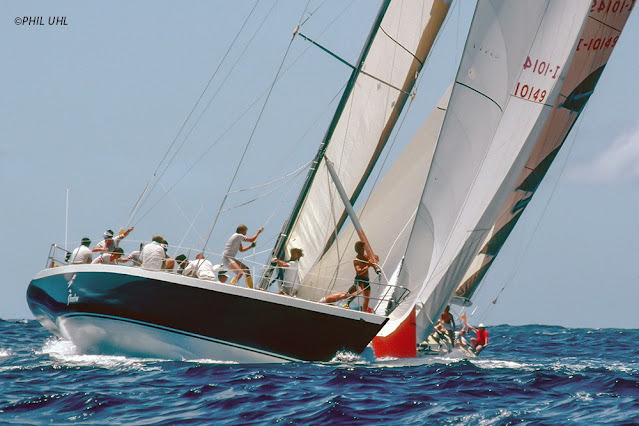
The Shadow rounding a mark during the 1984 Clipper Cup, with the Farr 58-footer Orlanda close behind (photo Phil Uhl)
The Shadow was launched in September 1983, just two weeks before the St Francis Yacht Club’s Big Boat Series of that year. She raced in the City of San Francisco Perpetual Class Trophy division, where she finished second to the Peterson 55 Bullfrog, with placings of 3/3/3/1/1.
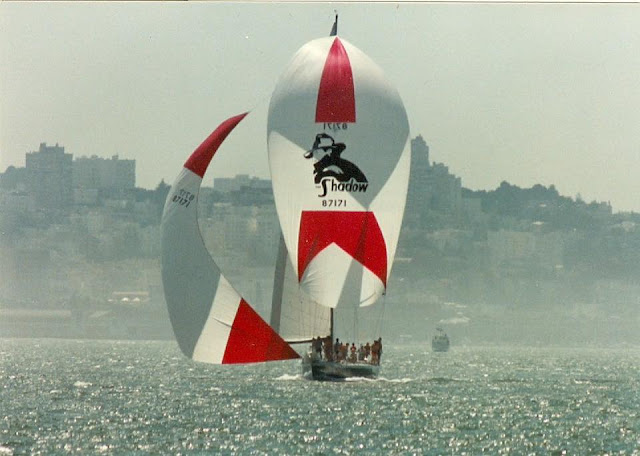
The Shadow, seen here during the 1983 Big Boat Series (photo John Hooker)
With that strong start she went on to race in the 1984 SORC, by now with a much more optimised rating of 45.8ft. Rogers had hoped that The Shadow would be able to compete in Class B in the SORC, but then Running Tide, a 12-year-old 60-footer with an age allowance that gave her a slightly lower rating than The Shadow's, also arrived. Running Tide's owner, Al Van Metre, asked to compete, as he had before, in Class A with the 70- and 80-foot Maxis. Race officials deferred to his wishes and so moved the similarly-rated The Shadow up, too.
The Shadow ghosts along in light airs (photographer unknown)
With her favorable time allowance relative to the Maxis and weather conditions that benefited smaller boats, The Shadow dominated the results in Class A, finishing first on corrected time in five of the six races and taking overall class honours. She was a less impressive in the overall fleet results, placing 26th, but the top placings were dominated that year by yachts in the smaller divisions, and in particular the crack One Tonners in Class E (such as the German yacht Diva, the top boat in the 1983 Admiral’s Cup).

"The maxis were intensely disappointed that we were in (Class) A", said Rogers in his interview with Sports Illustrated at the time, "and I agree with them. I think they should have their own class. I think it would've been more fair and more fun. It's hard to race a business against a boat like The Shadow".
The Shadow in or about 1984 (photographer unknown)
"The business" Rogers referred to is that of maxi management. Running a Maxi yacht, with a crew of more than 22, with an elaborate shore-support system, a tender, a sail program, and much much more, and moving them from regatta to regatta around the world (because that's where the maxis race, everywhere) is a demanding business. The most visible of the Maxi owners was Jim Kilroy, the owner and campaigner of not one but two dominating maxi yachts— Kialoa IV, which finished second to The Shadow in Class A, and his older Kialoa III which was being readied to compete at Antigua Race Week.

Kilroy, too, didn't think The Shadow should have raced in Class A, but his complaint, like Rogers', was with the race officials. "A 23-foot racing spread is a lot for one class", was all he would say publicly, but as spokesman for the Maxi owners, the men who spend the most on the sport, he had much to say behind closed doors to the SORC officials. Not unreasonably, the Maxi owners felt that if they go to the trouble of showing up for an event, lending it glamour, prestige and publicity it wouldn't otherwise have, they should be treated with greater consideration.
The wide and powerful stern sections of The Shadow are visible here in this image from the 1984 Clipper Cup 
It is likely that The Shadow would have done pretty well in Class B. Her wide stern sections, which Rogers calls 'Soverel training wheels' because they prevent the boat from heeling excessively, ran counter to the current thinking in new boats, most of which have moderately tapered sterns. "I wouldn't call Soverel a radical departure, but he's certainly different", says Rogers. Because she resists heeling, The Shadow was never reefed in the whole of the SORC series. Her greatest sail reduction was during the big winds of the St. Petersburg to Fort Lauderdale race, and that was to change down to a No. 3 jib. "If The Shadow had had a masthead rig, I would have had to shift down to the #2 genoa as the wind came up", Soverel explained. "But with a fractional rig like this one, you have the flexibility to power the mainsail up or down. With a fixed foretriangle area you have no flexibility. You've got to change your headsails”. The power inherent in The Shadow's length and overall stability resulted in the reported need for extensions to be welded to her winch handles to ensure enough runner tension could be applied to her lofty rig.
The Shadow sets off on a reaching leg during the 1984 Clipper Cup with Swiftsure to the right (photo Yachting magazine)
The Shadow then went on to compete in the 1984 Clipper Cup in Hawaii. At this regatta she raced in Class B, with a slightly increased rating of 46.2ft, alongside such yachts as the Frers 51 Tomahawk (ex-Margaret Rintoull III), the Peterson 55 Checkmate (ex-Bullfrog), the Farr 58 Orlanda and the Frers 50 Carat (ex-Retaliation). She ended up a surprise winner of this class, with results of 4/4/4/6/1. Although she had a very capable crew, she was out-performed by Checkmate and Tomahawk in the first four races.
The Shadow leads (just) Checkmate in power reaching conditions during the 1984 Clipper Cup (photo Charles P. LeMieux III | Yacht Racing & Cruising magazine)
Adequate righting moment in the typically breezy conditions had proved to be an essential ingredient for the top boats in the fleet, as witnessed by the performance of Checkmate and Tomahawk, which were two of the stiffest boats there. Soverel said later that The Shadow was ballasted to give a minimum Centre of Gravity Factor (0.968), to minimise her rating, which in hindsight proved to a mistake.
Breezy conditions during the 1984 Clipper Cup put a premium on crew-work, here the foredeck crew prepare for a gybe aboard The Shadow (Bruce C. Brown | Yacht Racing & Cruising magazine)
However, in the final race, the Round the State, points were heavily weighted (three times that of the Olympic tracks). During that race, Soverel noted that they started to feel disturbed wind as far as 200 miles out from the Big Island, possibly from other smaller islands up to windward. Later the wind really started to act strangely, “The Shadow would be doing a steady eight knots, just about on the wind, in a nice 20-22 knot trade wind, when suddenly, boom, we’d run into a light spot – maybe 8-10 knots of wind – that would last five or ten minutes, then we’d be back in the breeze. That happened a few times, then we hit a big hole and the breeze went from NNW into the south, so we tacked over onto the starboard tack layline. From here, maybe 60 miles out from the island, the air was light and fluky – sometimes we used a spinnaker – all the way to South Point. Once around the point it turned back into another nice race. The trades just collapse on the back sides of those islands. You get all kinds of different things – thermals, back-eddies and so on”.
The Shadow, seen here leading Checkmate and Jubilation during the 1984 Big Boat Series (photo Sharon Green | Ultimate Sailing)
While Soverel and his team managed to keep The Shadow to the fore in the tricky breezes, Checkmate’s long beat out to South Point knocked her out of the running, opening the door for The Shadow to earn class honours for the race and, by a single point over Tomahawk, for the series. She also finished fifth in the overall fleet standings (with placings of 11/10/14/8/7). The Shadow also formed part of the New York YC team, alongside Nirvana and Artemis, which beat the Royal Akarana YC team from New Zealand (Anticipation, Exador and Shockwave) in the club teams competition.
The Shadow (on port) in a close race with Orlanda during the 1984 Big Boat Series (photo L Gee | Facebook)
The Shadow then returned to San Franciso for the 1984 Big Boat Series, where Tomahawk managed to prevail for Class B honours, with The Shadow finishing second. She competed again in 1985, but did not feature in the top places.
The Shadow races alongside Checkmate during the 1985 Big Boat Series (photographer unknown)
Her racing career after that is not known, and she didn’t compete in the large Class B fleet that assembled for the 1985 SORC, and did not compete in the 1986 Clipper Cup. However, she has been sighted more recently in Greece, and is understood to be in good sailing condition.
The Shadow, as seen in Lefkas, Greece in 2023 (photo Bohumil Kafka | Facebook)
   

Article dated June 2025

26 April 2025

Admiral's Cup 1993

A stampede of 50-footers during the fourth race of the 1993 Admiral's Cup, with Champosa VII leading Pro-motion VII, Indulgence and Corum Saphir (photo Sharon Green | Ultimate Sailing)
Just as they did in similarly boisterous conditions in 1985, Germany outlasted their opponents to win the 1993 Champagne Mumm Admiral’s Cup for the fourth time. In a series that became a battle of attrition by the end of the Fastnet race, the Germans finished with all three boats – Container, Rubin XII and Pinta - intact, while the early front-runners, Australia and Italy, paid dearly for collisions and gear failure. Germany won by just a quarter of a point, an even narrower margin than the French in 1991. It was a fittingly close result for what was to be the swansong for the IOR in the Admiral's Cup.

Starline action during the 1993 Admiral's Cup, with Nippon to windward (mid-tack), Swing (JPN3553), Indulgence (GBR) and Jameson 3, with the bow of Mandrake to the right (photo Sharon Green | Ultimate Sailing)
The win nevertheless came as a surprise to the German team. Despite having the current One Ton champion Pinta, their team was not considered to be as strong as Australia or Italy.
Pro-motion VII powers along in fresh reaching conditions during the 1993 Admiral's Cup (photo Sharon Green | Ultimate Sailing)
As with the 1991 event, teams were made up of a 50-footer, Two Tonner and a One Tonner. However, the three-class level-rating scoring that had proved so successful in 1991 was dropped. Elapsed times had to be corrected not just into class order, but fleet order too. An age allowance factor was also introduced. However, only two scores from three boats were counted for each race (after it was feared that the series might fail and so two-boat teams were permitted for the first time). Only the Dutch team failed to field a three-boat team. It was therefore impossible to tell the results while racing was underway, and as a windy series, it favoured the larger yachts. This meant that some crews may have sailed well, but were rewarded with no points. A good 50-footer seemed essential for success, since their ability to obtain clear air early in any of the races guaranteed them a better chance than the boats which had to struggle through the disturbed air of one or two bigger classes – indeed, five of the seven races were won by the 50-footers and the other two went to Two Tonners. The One Tonners hardly got a look in, but Germany’s One Tonner, Pinta, that year's World One Ton champion, was essential to the team’s success even though she only recorded a score in two races.
Mandrake leads Jameson 3, with Champosa VII setting her spinnaker and followed by Corum Saphir and Container (photo Sharon Green | Ultimate Sailing)
Australia showed early form – Syd Fisher’s Ragamuffin (ex-Will) in the hands of Peter Gilmour, had looked the best 50-footer on the track. Gilmour constantly proved that, and only the combined attack of his opponents, and hitting a windward mark in the third race, stopped Ragamuffin from winning every race easily. The team’s One Tonner, Ninja, was a touch off the pace but this was made up for by John Calbert Jones’ Great News II (ex-Wings of Oracle), which became a force in the hands of Colin Beashel and it was only when her mast broke off at the deck early in the Fastnet, 20 miles north of the Scillies Islands, that the Australian challenge was lost.
Corum Saphir creates a bit of white water as she rounds a leeward mark (photo Sharon Green | Ultimate Sailing)
The German success was due to the efficiency of the team with back-up support that was ready for almost every eventuality, with New Zealand’s Peter Lester playing a key coaching role.
Jameson 2 rounds a gybe mark ahead of Rubin XII and Swing (photographer unknown)
France had probably had more practice than the rest of the team, but the combined talent never materialised into a winning force until the Fastnet, where once again, the French were the highest point scorers. But by then it was too late. Mistakes were common and Corum Saphir, the team's 50-footer (ex-Springbok), failed to score for her country in three of the inshore races when the big boats were dominant. Corum Rubis, the Two Tonner (ex-Bravura), recorded a solid score in every race and only Ragamuffin and Container were able to do as well. But Corum Diamant, the One Tonner (ex-Okyalos VI) failed to shine.
The aftermath of the Mandrake / Pro-motion VII collision in the fifth race (photo Sharon Green | Ultimate Sailing)
Italy lead into the final race, but were impacted by the loss of Mandrake, the 50-footer, in the fifth race after she had won two consecutive inshore races. Mandrake and the Dutch yacht Pro-motion VII crashed as they approached the windward mark for the second time. After losing her lead at the first mark Pro-motion was caught by other 50-footers, and then slightly over-stood the windward mark on the second time. She was slightly high on Indulgence’s weather hip as Mandrake came across on port. Skipper Francesco di Angelis dipped Indulgence’s stern but when the rudder stalled while attempting to dip Pro-motion and her bow entered the middle of Pro-motion’s hull, slicing to just below the waterline, at the same time breaking off the front four feet of the Italian yacht. For a time it seemed that both would sink, and it was a full minute before they could be prised apart. The crew of Pro-motion immediately put her on port tack to keep the gaping hole clear of the water and headed for Chichester Harbour with pumps going flat out. Mandrake’s crew, meanwhile, covered the hole in the bow with a storm jib, massed their weight and all sails in the stern and settled in for a long slow tow home to Cowes.
The extent of damage to Pro-motion is clearly visible from this photo by Gilles Martin-Raget (Facebook)
The video footage of this incident, including the lead-up and aftermath, can be seen in a Reuters film here, and in the video below (at 33 minutes).

Mandrake’s loss was crucial for the team which had looked so strong on paper. Larouge, the Two Tonner, had just won the Two Ton Cup and was top scorer in the class going into the Fastnet, but on the way back from Fastnet Rock, and 40 miles from Bishop Rock, her runner parted and their rig tumbled with 130 miles to go. The One Tonner, Brava Q8 (One Ton Cup winner in 1992) was seen as a potent performer, but she only produced a good score on one occasion. She was initially lucky in race 3 when after hooking the mooring of the outer distance mark, the race committee delayed the start, but later lost her mast not long after rounding the final leeward mark.

Japan finished fifth. Champosa VII, the team's 50-footer, showed flashes of brilliance but her overall score was not as hoped for. Swing was a regular scorer for her team, but Nippon, the One Tonner, was not as strong, and things were not helped when a crew-member went over the side during the Fastnet, and the yacht subsequently retired.

Britain was a lowly sixth. Indulgence (ex-Juno V) finishing as top yacht in the Fastnet, but other than a second in the opening race, she failed to score in the next four. Provezza Sauce, the Two Tonner, had good speed but this was often wasted. The young team aboard 
GBE International (ex-Port Pendennis), might have done better but lacked experience of mixed-fleet sailing in a small boat.
"Jameson on the rocks" (photo Sharon Green | Ultimate Sailing) 
The Irish team’s performance were impacted from the first race after the team’s One Tonner, Jameson 1 (ex-Fram XI), hit the rocks off Gurnard Ledge (to the west of Cowes) and lost her keel. Four other One Tonner’s hit as well but Jameson 1 was the only serious casualty. Down to two boats, there was further disappointment when Jameson 3 (ex-Heaven Can Wait) broke her boom at the mainsheet attachment during the Fastnet race. Jameson 2 (ex-Shockwave) was the team’s bright note, finishing as the top Two Tonner overall.

The 35th Fastnet race, the seventh race of the regatta, provided the 20 remaining boats left in the Cup with a proper test of the fleet. Good strong winds, on the wind all the way to the Fastnet Rock, and a fast run and reach back, found weaknesses and, as usual, was the final arbiter of the Cup. At the front of the fleet, it was a battle between Ragamuffin and Indulgence, with Corum Saphir coming into the equation on the way home. Corum Rubis led the Two Tonners at the Rock, 16-minutes ahead of Larouge. Pinta led the One Tonners, ahead of Brava Q8 by 11 minutes, and Ninja another seven minutes back.

Experience aboard Indulgence was a key factor at the Lizard, when in a foul tide navigator Peter Morton took the boat inshore into a countercurrent and this enabled Chris Law to steer her ahead of Gilmour and the Ragamuffin team. She then led Ragamuffin into Plymouth Sound by just 11 seconds, with Corum Saphir a further 12 seconds astern. 

However, Ragamuffin lost a place to Corum Saphir on corrected time, which was crucial for the overall results. After Larouge’s dismasting, the Cup result became a battle between Australia and Germany, and much depended on the One Tonners. Pinta was the difference, finishing seven minutes ahead of Brava Q8 and, more importantly, one place ahead of Jamieson 2 on corrected time. 

A subsequent protest against Jameson 2 by Prevezza Sauce under the Collision Regulations about an alleged luffing incident during the hours of darkness, which would have raised Ninja by one point and given the Cup to Australia, was dismissed by the International Jury and the final result, and Germany’s victory, was confirmed. 

It is noted that without the discard scoring system, Germany's points margin would have been even higher, so at least the 'right' country won under the 1993 system. Ragamuffin was the highest individual points scorer.

An excellent video of the close racing experienced during the series can be seen below.


This article (April 2025) is adapted from the accounts within Bob Fisher's article in 'Admiral's Cup Blow by Blow', September 1993 (as printed in Boating NZ magazine) and Timothy Jefferey in The Official History of the Champagne Mumm Admiral's Cup (1994). 

31 March 2025

Kenwood Cup 1988 - Part 2

This post follows an earlier article about the 1988 edition of the Kenwood Cup that featured photographs by Sharon Green. The following gallery focuses mainly on the Maxi fleet (who were holding their World Championship for that year) and includes photographs by Kaoru Soehata, Guy Gurney and Phil Uhl.

Ondine VII leads Windward Passage 2 (the winner of Class A) and Congere in tight reaching conditions during the 1988 Kenwood Cup (photo Guy Gurney)
Il Moro di Venezia leads Ondine VII and Matador (photo Kaoru Soehata)

An aerial shot of Congere in hard reaching conditions (photo Guy Gurney)

Sorcery leading Il Moro di Venezia, Ondine VII and Matador (photo Guy Gurney)

Ondine VII just after hoisting the spinnaker on a reaching leg - likely a sea-level shot taken at about the same time as the first photograph above (photo Guy Gurney)
A start of Class E, with General Hospital leading off the windward end with The Esanda Way (aka-Beyond Thunderdome) to leeward - Ultimate Challenge, Sagacious V and Bravura are visible further down the line (photo Phil Uhl)
Above and below - The leaders in the One Ton fleet near a gybe mark, with Bravura leading from Sagacious V, with Japan's Victoria and Brazil's Black Jack coming up from behind - Britain's Juno can also be seen to the left in the photo below (photos by Phil Uhl)

Another Class E start, with Sagacious V leading (photo Phil Uhl)

Ondine VII powers to windward (photo Guy Gurney)

An aerial view of French 'mini-Maxi' Emeraude (photo Kaoru Soehata)

Matador (right) and Il Moro di Venezia nearing a downwind mark (photo Guy Gurney)

Foredeck action aboard the 54-footer Jubilation at a leeward mark (photo Guy Gurney)

Ondine VII to weather of Sorcery (photo Guy Gurney)
The crew of Il Moro di Venezia prepare for a windward mark rounding (photo Guy Gurney)


Article updated January 2026